

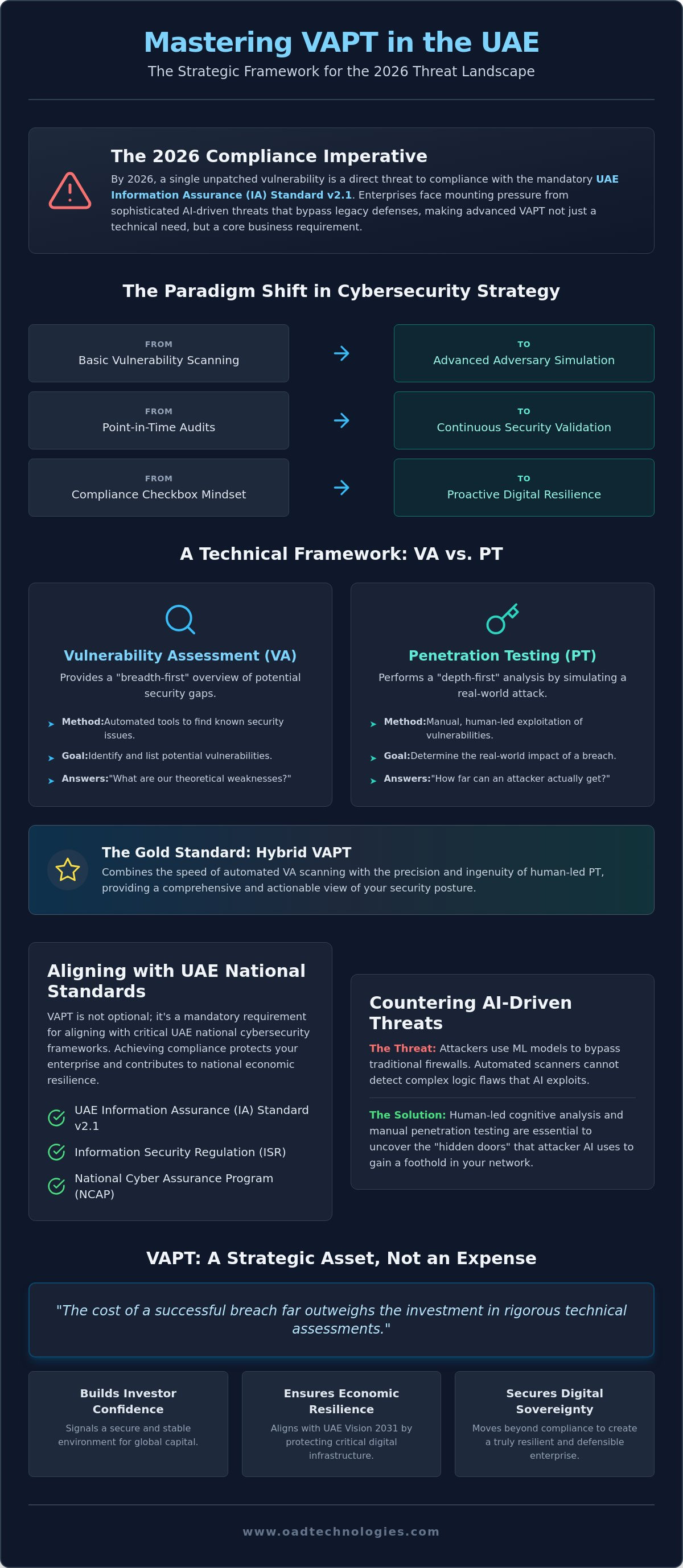
By the start of 2026, a single unpatched vulnerability is no longer just a technical oversight; it's a direct threat to your compliance with the UAE Information Assurance Standard v2.1. You likely feel the mounting pressure of evolving NESA requirements and the surge in AI-driven phishing attacks that bypass legacy defenses. It's difficult to find a partner who truly understands the national threat landscape while you're simultaneously trying to benchmark the cost of penetration testing in uae against actual business value. We know that your goal isn't just a checkbox audit, but a resilient architecture that protects your long-term viability.
This article provides the strategic framework you need to master Vulnerability Assessment and Penetration Testing (VAPT) to safeguard your enterprise. You'll learn how to achieve full alignment with ISR and NCAP standards while discovering zero-day vulnerabilities before attackers can exploit them. We'll preview actionable remediation roadmaps that bridge the gap between high-level innovation and practical, risk-reducing results for your UAE operations.
Key Takeaways
- Shift your focus from basic vulnerability scanning to advanced adversary simulation to effectively counter the sophisticated threat actors of 2026.
- Navigate the mandatory requirements of the UAE Information Assurance (IA) Standard v2.1 and ISR to ensure full regulatory compliance for your enterprise.
- Evaluate the cost of penetration testing in uae based on the technical depth and manual expertise required to uncover critical zero-day vulnerabilities.
- Adopt a proactive security posture by moving from point-in-time audits toward continuous security validation models that match your development lifecycle.
- Develop actionable remediation roadmaps that prioritize high-impact risks, ensuring your security investments translate into long-term digital resilience.
The Evolution of VAPT Services in the UAE’s 2026 Threat Landscape
The cybersecurity landscape in the UAE has undergone a fundamental transformation as we enter 2026. Traditional vulnerability scanning, once the benchmark for corporate safety, now falls short against sophisticated threat actors. Modern attackers utilize adversary simulation to mimic real-world breach attempts, moving beyond simple signature-based detection. Organizations are realizing that while the cost of penetration testing in uae is a factor in budget planning, the price of a successful breach far outweighs the investment in rigorous technical assessments. This shift requires a move toward strategic partnerships that prioritize deep technical insight over superficial automated reports.
The UAE's rapid digital evolution makes it a primary target for global cybercriminals. As the nation integrates cloud-native infrastructures and AI-driven services, the attack surface expands exponentially. Global threat actors view the region's high-value digital assets as prime targets for ransomware and sophisticated data exfiltration. VAPT is no longer just an IT requirement; it's a critical component of protecting the nation's critical information infrastructure and ensuring that corporate growth doesn't come at the expense of security.
The Rise of AI-Driven Threats in the UAE
In 2026, perimeter defenses are no longer static barriers. Attackers deploy machine learning models to identify subtle weaknesses in network traffic patterns, allowing them to bypass traditional firewalls and intrusion detection systems. Automated scanners often fail to detect complex logic flaws within customized enterprise applications because they lack the context of business operations. Human-led penetration testing fills this gap by thinking like an attacker to uncover vulnerabilities that software alone cannot see. It's about finding the "hidden doors" that AI-driven tools use to gain a foothold in your network.
Advanced VAPT engagements utilize human-led cognitive analysis to disrupt the automated patterns of AI-driven reconnaissance before they escalate into full-scale breaches; you can learn more about the psychological principles of deception used by experts like Thomas McElroy to better understand the human vulnerabilities often exploited in social engineering.
VAPT as a Pillar of National Economic Resilience
Technical security assessments do more than just protect data; they build the foundation of the UAE’s digital economy. High standards in cybersecurity directly influence investor confidence, signaling that the local market is a secure environment for global capital. By adopting standardized Security Testing Methodologies, businesses ensure their digital growth remains sustainable and resilient against external shocks. This level of precision is what separates a resilient enterprise from one that is merely compliant.
This strategic approach aligns perfectly with the goals of UAE Vision 2031. Moving beyond a compliance-only mindset is essential for long-term survival. A security-first partnership focuses on digital relevance rather than just checking boxes for the UAE Information Assurance Standard v2.1. When you prioritize deep-dive testing, you're investing in the digital sovereignty of your enterprise. Understanding the cost of penetration testing in uae involves recognizing it as a strategic asset that secures your place in the future economy.
Vulnerability Assessment vs. Penetration Testing: A Technical Framework
Understanding the distinction between a vulnerability assessment (VA) and a penetration test (PT) is the first step in building a resilient defense. A VA uses automated tools to identify known security gaps across a broad attack surface, providing a "breadth-first" overview. Conversely, a penetration test involves manual, human-led exploitation to determine how deep an attacker can penetrate. When calculating the cost of penetration testing in uae, enterprises must account for the specialized skill sets required for manual exploitation rather than just the license fees of scanning software. Following established PCI DSS Penetration Testing guidelines ensures that these tests provide meaningful data rather than just a list of potential patches.
A hybrid VAPT approach is the gold standard for UAE enterprises in 2026. It combines the speed of automated scanning with the precision of human ingenuity. This methodology ensures that you don't just see a list of vulnerabilities but understand the narrative of a potential breach. When evaluating the cost of penetration testing in uae, remember that price is dictated by the complexity of your cloud architecture, the number of API endpoints, and the depth of the testing methodology rather than simple headcount.
Black Box, White Box, and Grey Box Testing
Choosing the right methodology depends on your specific goals. Black Box testing provides the highest realism by simulating an outside attacker with no prior knowledge. White Box testing offers the best ROI for deep-dive secure source code reviews, giving testers full access to documentation and logic. Grey Box testing often serves as the most efficient middle ground, providing testers with limited credentials to simulate a malicious insider or a compromised user.
The VAPT Lifecycle: From Reconnaissance to Remediation
A sophisticated 2026 assessment follows a rigorous five-phase lifecycle: reconnaissance, vulnerability research, exploitation, post-exploitation, and reporting. The most critical stage isn't the hack itself, but the remediation and re-testing phase. This ensures that identified gaps are closed effectively. Integrating these findings into your governance risk and compliance (GRC) framework allows for long-term risk management. If you're ready to move beyond basic scans, our team can help you design customized security architectures that withstand modern pressure.
Regulatory Compliance: Aligning VAPT with UAE National Standards
Compliance in 2026 has evolved from a periodic checklist into a continuous mandate for digital sovereignty. The UAE Information Assurance (IA) Standard v2.1, issued by the UAE Cyber Security Council, serves as the primary framework for national cybersecurity policies. For organizations operating within the Emirates, aligning with these standards isn't just about avoiding fines; it's about verifying the technical integrity of the systems that power the nation's economy. When budgeting for security, the cost of penetration testing in uae is frequently viewed through the lens of regulatory risk mitigation, as non-compliance can lead to significant operational restrictions and loss of licenses.
Adhering to regulations like the Information Security Regulation (ISR) is mandatory for certain local government and semi-government entities, while federal entities must meet NESA requirements. These regulations demand rigorous technical audits to ensure that critical data remains protected against unauthorized access. Additionally, the UAE Personal Data Protection Law (PDPL) necessitates regular security testing to validate that personal data processing environments are resilient. By utilizing VAPT as a technical audit tool, firms can simultaneously satisfy ISO 27001 requirements and PCI DSS standards, creating a unified approach to global and local governance.
Meeting NESA and ISR Technical Requirements
Specific controls within the UAE National Cybersecurity Strategy require entities handling Critical Information Infrastructure (CII) to undergo regular penetration testing. These assessments must be documented with clear audit trails that demonstrate both the discovery of vulnerabilities and the subsequent remediation efforts. For CII operators, the frequency of testing has shifted toward a continuous model to maintain National Cyber Accreditation Programme (NCAP) status. This level of scrutiny ensures that the cost of penetration testing in uae delivers a clear return on investment by securing the nation's most vital digital assets.
Cross-Border Compliance and International Standards
Multi-national firms operating in the UAE face the unique challenge of balancing local mandates with international frameworks like CREST and OWASP. A sophisticated VAPT engagement ensures that your security posture remains consistent across different jurisdictions while respecting the specific modular controls of the UAE IA Standard v2.1. Validating your identity and access management (IAM) controls through these tests is essential for preventing unauthorized lateral movement within your network. This synergy between human insight and technical precision allows enterprises to maintain their digital relevance in a market where trust is the most valuable currency.
From Point-in-Time Testing to Continuous Security Validation
Relying on a single annual audit is a dangerous gamble in the 2026 threat environment. Static assessments only capture a snapshot of your security posture, which quickly becomes obsolete as new code is deployed and fresh exploits emerge. UAE enterprises are rapidly transitioning toward Penetration Testing as a Service (PTaaS) to maintain an agile defense. This model transforms the cost of penetration testing in uae from a one-off capital expenditure into a strategic operational investment that grows alongside your digital infrastructure. It's about ensuring that your defenses are as dynamic as the threats they face.
True resilience comes from integrating VAPT results into your broader security ecosystem. Findings from a penetration test shouldn't sit in a static PDF; they should be used to tune your managed detection and response (MDR) capabilities. By feeding exploitation data back into your SIEM and EDR platforms, you can fine-tune alert thresholds to detect real-world attack patterns more accurately. This synergy ensures that your monitoring tools aren't just looking for generic signatures but are specifically hardened against the vulnerabilities unique to your environment.
The "Shift-Left" Security Philosophy
Catching a vulnerability in production is significantly more expensive than identifying it during the design phase. Integrating VAPT into the DevOps lifecycle allows your team to address security flaws before they ever reach a live environment. This "Shift-Left" approach significantly reduces the long-term cost of penetration testing in uae by preventing the need for emergency patches and downtime. OAD Technologies facilitates "Shift-Left" through secure source code review, ensuring that security is woven into the very fabric of the application's architecture from day one.
VAPT and Cloud Security Posture Management (CSPM)
Multi-cloud and hybrid environments introduce unique configuration challenges that traditional testing often misses. It's essential to validate your cloud security posture management (CSPM) through targeted penetration testing. Automated tools might flag a misconfiguration, but a skilled tester determines if that flaw can actually lead to data exfiltration or lateral movement. This level of validation ensures that your cloud assets remain secure against the sophisticated techniques used by modern threat actors. If you want to move beyond point-in-time snapshots, you can partner with us for continuous security validation that protects your long-term digital relevance.
OAD Technologies: Precision-Engineered VAPT for the Modern Enterprise
OAD Technologies rejects the industry's tendency toward standardized, "one-size-fits-all" security audits. We view Vulnerability Assessment and Penetration Testing as a sophisticated exercise in system design rather than a simple checklist. By acting as a strategic partner, we ensure that your security posture isn't just a reaction to current threats but a proactive shaper of your digital future. While many providers focus on the surface-level cost of penetration testing in uae, we prioritize the long-term return on your security investment through high-quality craftsmanship and rigorous engineering standards.
Our methodology leverages human ingenuity to uncover complex logic flaws that automated scanners consistently miss. In a 2026 landscape where AI-driven attacks are the norm, relying solely on automated tools is a recipe for catastrophic failure. We build highly customized, risk-based VAPT scopes that reflect your specific enterprise architecture and business objectives. This approach ensures that every assessment provides deep technical authority while remaining grounded in practical business results.
A Synergistic Approach to Cybersecurity
We don't treat VAPT as an isolated event. Instead, we integrate our findings with other critical pillars of defense, such as data loss prevention (DLP), to create a comprehensive shield for your intellectual property. Our expert consultants provide actionable, business-centric remediation advice that bridges the gap between technical specialists and executive leadership. As the master designer of your national enterprise security architecture, we ensure that every vulnerability discovered leads to a stronger, more resilient system.
Next Steps: Securing Your Digital Future
Securing your enterprise begins with a preliminary consultation to define clear testing objectives and a precise scope. This ensures that the cost of penetration testing in uae remains aligned with your actual risk profile and regulatory needs. When you receive a deliverable from OAD Technologies, you get more than just a list of bugs. You receive a strategic roadmap that includes:
- Detailed technical breakdowns of exploitation paths and potential business impact.
- Prioritized remediation steps based on the modular taxonomy of UAE IA Standard v2.1.
- A multi-year security roadmap that synchronizes VAPT intelligence with your broader GRC goals.
We anchor our messaging with a promise of long-term viability. By choosing a partner that values precision over speed, you position your organization as a leader in the UAE's digital economy. Let's build a roadmap that guarantees your ongoing relevance in an ever-changing market.
Architecting Your National Digital Sovereignty
The cybersecurity landscape in the UAE demands a transition from traditional compliance-driven audits to a model of continuous resilience. We've explored how the synergy of human insight and technical precision is the only way to counter AI-augmented threats and satisfy the modular controls of the UAE Information Assurance Standard v2.1. While evaluating the cost of penetration testing in uae is a critical step for your 2026 budget, it's best viewed as a strategic investment in your organization's long-term digital sovereignty and investor confidence. Point-in-time snapshots are no longer enough to protect high-value assets in an environment of constant evolution.
As specialists in NESA and ISR compliance, OAD Technologies provides CREST-aligned methodologies that go beyond simple vulnerability identification. We act as your strategic partner, ensuring that every assessment strengthens your overall security architecture and supports your broader GRC goals. It's time to move beyond the limitations of standardized testing and embrace a roadmap of ongoing viability that protects your place in the nation's digital economy. Our proactive, solution-oriented mindset ensures your defenses remain as sophisticated as the systems they protect.
Secure your enterprise with a strategic VAPT assessment from OAD Technologies and build a resilient future today.
Frequently Asked Questions
What is the primary difference between a vulnerability assessment and a penetration test?
Vulnerability assessments use automated tools to identify a broad list of known security gaps across your network. Penetration testing is a manual, human-led process that attempts to exploit those gaps to see how far an attacker can go. When you analyze the cost of penetration testing in uae, you're paying for this specialized manual expertise that finds logic flaws automated scans miss.
How often should a UAE-based enterprise conduct VAPT to remain compliant with NESA?
Most organizations should perform VAPT at least annually or after significant infrastructure changes to meet basic UAE Information Assurance (IA) standards. However, entities handling Critical Information Infrastructure (CII) often require more frequent, sometimes quarterly, assessments to maintain National Cyber Accreditation Programme status. Moving toward a continuous testing model ensures your defenses stay ahead of the evolving 2026 threat landscape.
Can VAPT services be performed on cloud-native applications in the UAE?
Yes, specialized VAPT is essential for cloud-native applications to identify misconfigurations that automated tools might overlook. These assessments focus on API security, container vulnerabilities, and serverless architecture flaws. This type of testing ensures that your migration to multi-cloud environments doesn't introduce hidden entry points for attackers.
What are the typical deliverables of a professional VAPT service in the UAE?
You should expect a comprehensive report that includes an executive summary for leadership and a detailed technical breakdown for IT teams. A professional deliverable also provides a prioritized remediation roadmap and a re-testing phase to verify that all critical vulnerabilities were effectively closed. This documentation is vital for demonstrating compliance during national regulatory audits.
Is there a risk of system downtime during a penetration testing engagement?
Professional testers use controlled exploitation techniques to minimize the risk of service disruption. While any active testing carries a theoretical risk, experienced providers schedule high-impact tests during low-traffic windows to ensure business continuity. Clear communication between your team and the testers is the best way to safeguard operational stability.
How does VAPT help in complying with the UAE Personal Data Protection Law (PDPL)?
The PDPL mandates that organizations implement appropriate technical and organizational measures to protect personal data. VAPT acts as a technical audit that validates these measures are actually effective against real-world breach attempts. It provides the documented proof required by regulators that you've taken proactive steps to secure sensitive citizen information.
What qualifications should I look for in a VAPT service provider in the UAE?
Look for providers with internationally recognized certifications like CREST or OSCP. It's equally important that they demonstrate deep familiarity with local regulations like the UAE Information Assurance Standard v2.1 and ISR. A provider that understands the specific threat landscape of the Emirates can offer a more accurate assessment of your risk profile.
What is the difference between Black Box and White Box penetration testing?
Black Box testing simulates an outside attacker with no prior knowledge of your systems, providing a realistic view of external vulnerabilities. White Box testing provides the tester with full access to source code and network diagrams, allowing for a deep-dive analysis of internal logic. Both methodologies influence the cost of penetration testing in uae based on the time and technical depth required for the engagement.
Disclaimer
Content by OAD Technologies is for general informational purposes only and does not constitute professional or cybersecurity advice. No warranties are made regarding accuracy or completeness; reliance is at your own risk. OAD Technologies shall not be liable for any direct or indirect losses arising from use of this content.