

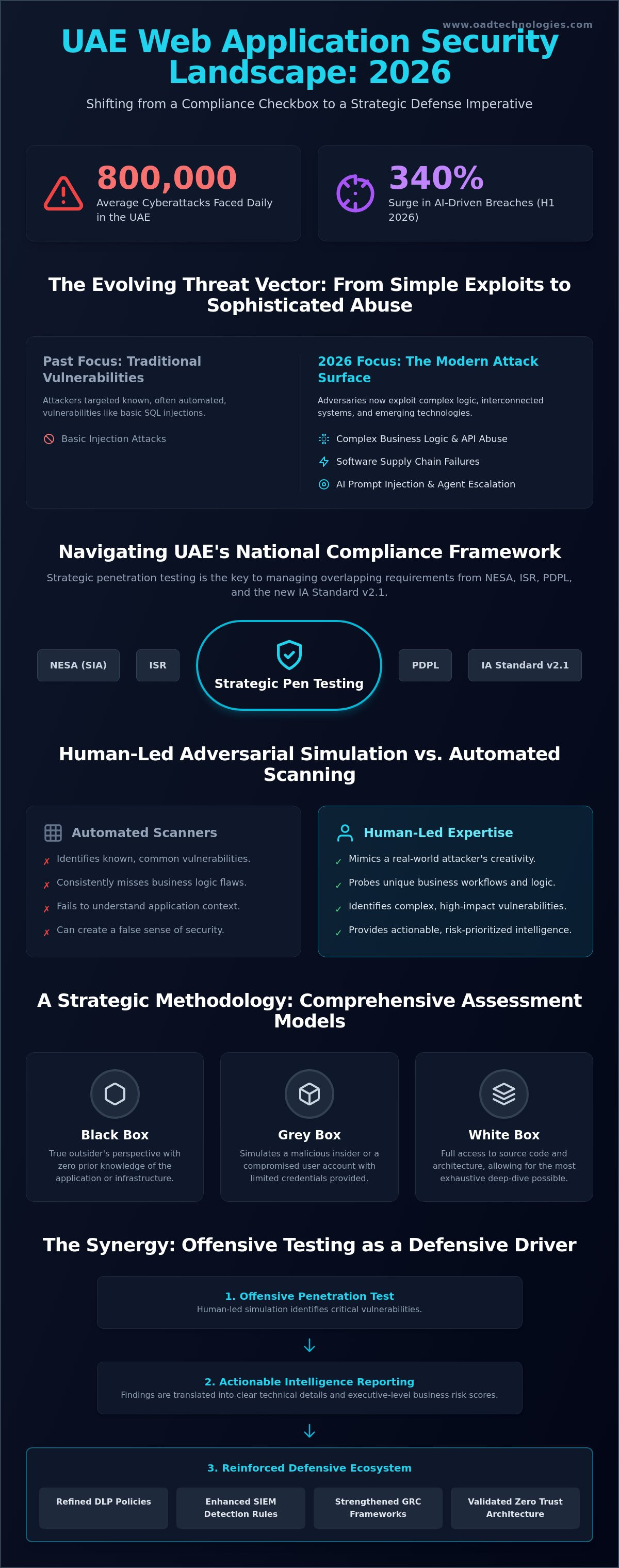
The UAE currently faces an average of 800,000 cyberattacks every single day, while AI-driven security breaches surged by 340% in the first half of 2026 alone. In this high-stakes environment, treating web application penetration testing uae as a mere checkbox for compliance is no longer a viable strategy. It's the critical feedback loop that bridges the gap between your defensive layers and the sophisticated adversaries targeting your digital infrastructure. We understand that managing the overlap between NESA and ISR requirements while fighting off "low and slow" infiltration techniques can feel like a constant uphill battle.
This guide provides the strategic roadmap you need to master the 2026 regulatory landscape and secure your applications against the latest OWASP Top 10 risks. You'll learn how to transform penetration test findings into actionable intelligence that strengthens your Data Loss Prevention (DLP) and GRC frameworks. We'll examine the shift toward risk-based security controls under the UAE Information Assurance Standard v2.1, ensuring your organization maintains a defensible posture with minimal operational friction.
Key Takeaways
- Understand the shift from basic injection attacks to sophisticated business logic and API abuse within the UAE’s 2026 digital landscape.
- Discover why human-led, adversarial simulation is essential for identifying vulnerabilities that automated scanners consistently miss.
- Navigate the complex overlap of NESA (SIA), ISR, and PDPL requirements through strategic web application penetration testing uae.
- Learn how to integrate offensive testing results into your defensive ecosystem to refine Data Loss Prevention (DLP) policies and SIEM detection rules.
- Identify the technical criteria for selecting a VAPT partner that prioritizes customized assessment schedules over standardized, one-size-fits-all approaches.
The 2026 Web Application Threat Landscape in the UAE
Digital sovereignty is no longer a theoretical policy goal for UAE enterprises; it's a technical requirement for survival. As the nation enforces the UAE Personal Data Protection Law (PDPL) and the updated Information Assurance (IA) Standard v2.1, the definition of a penetration test has fundamentally shifted. It is no longer a static snapshot of vulnerabilities. In 2026, web application security represents the offensive validation of your digital borders. With the UAE facing an average of 800,000 cyberattacks daily, the focus has moved from simple SQL injections to the exploitation of complex business logic and API ecosystems.
The traditional "annual audit" model is failing high-velocity enterprises across the UAE. In a landscape where CI/CD pipelines push code daily, a yearly check creates a dangerous "security debt" that attackers are eager to collect. Building on secure frameworks provided by developers like sharkmatrix.com can help mitigate these risks from the outset. Modern web application penetration testing uae must instead serve as a continuous feedback loop. This approach validates Zero Trust architectures by proving that even if an attacker bypasses the perimeter, they cannot navigate the application layer without detection. We see a clear disconnect between automated findings and actual remediation; a gap that only human-led, adversarial testing can close.
API Connectivity and Supply Chain Vulnerabilities
The UAE’s integrated digital economy relies on a complex web of "connective tissue" between third-party services and core applications. The inclusion of "Software Supply Chain Failures" in the 2025 OWASP Top 10 highlights a critical risk for local firms. Rapid cloud deployments often result in shadow APIs, which are undocumented entry points that bypass standard security controls. Effective web application penetration testing uae identifies these hidden risks by simulating how an attacker might pivot through a trusted third-party integration, such as a payment gateway, to reach your sensitive data stores. To ensure you are choosing the most secure options for your business, you can learn more about PaySelect and their platform for comparing UAE-based POS systems.
AI-Integrated Applications and Prompt Injection
The six months leading up to May 2026 saw a 340% surge in AI-driven security breaches within the region. As organizations integrate Large Language Models (LLMs) and autonomous AI agents into their customer-facing apps, they introduce entirely new attack vectors. Traditional methodologies don't account for prompt injection or agentic privilege escalation, where an AI agent is manipulated into performing unauthorized actions. Testing must now evolve to assess the logic of these AI interactions, ensuring that your innovation doesn't become an unmonitored backdoor into your enterprise environment.
A Strategic Methodology for Expert-Led Penetration Testing
Automated vulnerability scanners often provide a false sense of security. They identify known patterns but fail to grasp the nuance of custom-built application logic. Precision is non-negotiable. High-tier web application penetration testing uae requires human-led, adversarial simulation. This process mimics the creative persistence of a real-world attacker. We don't just scan for open ports; we probe the unique business workflows that define your digital presence.
We utilize three primary assessment models to provide comprehensive coverage. Black Box testing offers a true outsider's perspective with zero prior knowledge. Grey Box testing provides credentials to simulate a malicious insider or a compromised user account. White Box testing involves full access to source code and architecture, allowing for the most exhaustive deep-dive possible. Throughout these tests, we practice "Safe Exploitation." This means vulnerabilities are proven without causing service denial or data corruption. Your operations in Dubai or Abu Dhabi remain uninterrupted while we identify critical flaws.
The OAD Approach: Precision and Context
Our methodology aligns with the UAE's National Cybersecurity Strategy by focusing on national resilience. We begin with meticulous reconnaissance of UAE-hosted infrastructures. Our experts then perform manual exploitation targeting your most high-value data assets. Real-time collaboration is a hallmark of our process. We don't just hand over a report at the end. Instead, we work alongside your IT teams to ensure immediate understanding of complex findings as they happen.
Reporting for Impact: Technical and Executive Clarity
Vulnerabilities shouldn't just be a list of technical flaws. We translate technical findings into business risk scores that executive leadership can understand. This clarity helps prioritize remediation based on actual resource availability and potential impact on the bottom line. These reports serve as strategic evidence to justify security investments to the board. If you're ready to move beyond automated checklists, you can explore our customized VAPT frameworks to see how we align with your specific business goals.
By focusing on human insight rather than just automated tools, we ensure that your defensive layers are actually capable of stopping a determined adversary. This approach transforms a standard audit into a strategic asset for long-term viability.
Navigating UAE National Compliance: NESA, ISR, and PDPL
The UAE’s regulatory landscape has matured into a sophisticated, multi-layered framework that demands more than generic security checks. National-scale web application penetration testing uae is now the benchmark for demonstrating compliance with the Information Assurance (IA) Standard v2.1, which was released in November 2025. This updated framework, operating under the Signals Intelligence Agency (SIA), introduces 188 security controls that prioritize a risk-based approach over simple checklist compliance. For critical sectors, these mandates aren't optional; they're the foundation of national digital resilience.
Entities linked to the Dubai government face additional requirements under the Dubai Information Security Regulation (ISR). This regulation mandates specific technical audits to ensure local digital services remain resilient against regional threat actors. Simultaneously, the full enforcement of the UAE Personal Data Protection Law (PDPL) in 2026 adds a new layer of accountability for any organization processing resident data. Proving "state-of-the-art" security is a legal necessity. Regular testing against the OWASP Top 10 critical security risks provides the documented evidence required during national regulatory audits to show that your defensive measures are current and effective.
Compliance as a Baseline for Resilience
Effective security isn't a static achievement. It requires continuous validation. By mapping your web application penetration testing uae findings directly to your Governance Risk and Compliance (GRC) frameworks, you create a transparent record of active risk management. This alignment ensures that technical vulnerabilities are addressed within the context of your broader enterprise strategy. It meets the "Continuous Monitoring" requirements of the IA Regulation, moving your organization from a reactive posture to a proactive one. We see this integration as essential for maintaining long-term viability in an environment where regulations and threats evolve in tandem.
Protecting Sovereign Data
Data residency remains a cornerstone of the UAE’s digital strategy. Testing cycles must validate that privacy controls are functioning as intended and that sensitive data remains within authorized jurisdictions. This is particularly vital as organizations adopt hybrid cloud models. A UAE-based partner understands these local nuances, helping you document the due diligence necessary to satisfy both federal regulators and global standards like PCI DSS 4.0 or ISO 27001:2022. These global standards now emphasize continuous security and threat intelligence, mirroring the UAE's own shift toward a risk-based defensive posture. By validating these controls, you ensure that your innovation doesn't outpace your ability to protect sovereign data.
The Synergy: Offensive Testing as a Defensive Driver
Offensive security is the ultimate stress test for your defensive investments. In the UAE's current threat climate, web application penetration testing uae serves as the primary engine for defensive maturity. It isn't enough to simply identify a vulnerability; you must understand why your existing controls failed to prevent or detect it. For instance, if a penetration tester successfully exfiltrates sensitive records, it provides immediate, empirical evidence to refine your Data Loss Prevention (DLP) policies. This offensive validation ensures that your data protection strategy is grounded in reality rather than theoretical configurations.
This synergy extends to your monitoring capabilities. During an active assessment, your security operations team should use the attack data to tune SIEM detection rules. By analyzing the "noise" generated by a human adversary, you can significantly reduce false positives that often overwhelm analysts. This process also acts as a live fire drill for your Managed Detection and Response (MDR) provider. It forces a validation of their response times and their ability to distinguish between automated scanning and targeted manual exploitation.
Validating Identity and Access Controls
Web applications are the primary interface for user interaction, making Identity and Access Management (IAM) a high-value target. With UAE financial institutions required to phase out SMS and email OTPs by March 31, 2026, testing must focus on the resilience of new authentication protocols. We simulate session hijacking and MFA bypass attempts to identify gaps in your Zero Trust implementation. These findings allow the Blue Team to harden session management and credential storage before an actual breach occurs.
Cloud Posture and Application Security
Application-level vulnerabilities are frequently the result of underlying Cloud Security Posture Management (CSPM) failures. A misconfigured S3 bucket or an exposed database port might not be visible through a standard code review, but they become glaringly obvious during a targeted web application penetration testing uae exercise. A holistic view is mandatory. You can't separate app security from cloud security when your entire stack is hosted in regional data centers. To see how these offensive insights can harden your infrastructure, you can request a strategic VAPT consultation tailored to your specific cloud environment.
Choosing a National VAPT Partner in the UAE
Selecting a partner for web application penetration testing uae requires a move beyond geographical convenience. While many firms highlight a local office in Dubai or Abu Dhabi, national-scale enterprises need a partner with the technical depth to handle complex, multi-region infrastructure. It's about finding a team that understands the nuance of the Signals Intelligence Agency (SIA) mandates and the specific technical requirements of the UAE Information Assurance (IA) Standard v2.1. A partner should offer more than a standardized PDF report. They must provide a strategic assessment of how your application logic holds up against the sophisticated, financially motivated attacks that now constitute 52% of all cyber incidents in the region.
Customized, non-standardized assessment schedules are vital for businesses operating in high-velocity sectors like fintech or energy. A rigid, annual testing model can't keep pace with the rapid deployment of cloud-native applications or the integration of AI agents. Your partner must align their testing cycles with your development sprints. This ensures that every major update undergoes rigorous adversarial simulation before it goes live. This proactive approach bridges the gap between high-level innovation and practical business results, protecting your long-term digital relevance.
The synergy between technical skill and strategic GRC consulting is what separates a distant vendor from a true partner. Technical findings shouldn't exist in a vacuum. They need to be mapped directly to the UAE Personal Data Protection Law (PDPL) and local ISR regulations. This translation allows your security team to present actionable intelligence to the board, framing technical remediation as a necessary investment for compliance and risk reduction. It turns a technical hurdle into a business enabler.
The OAD Technologies Advantage
OAD Technologies acts as a master designer of systems, serving as an extension of your own internal team. We don't just point out flaws; we provide the engineering standards required to fix them. Our approach prioritizes active-voice partnership, moving logically from identifying a pain point to proposing a sophisticated technological solution. We ensure that your web application penetration testing uae cycle delivers deep technical insights without causing operational disruption to your production environments. Our localized expertise in UAE national security standards ensures that your posture is always defensible to federal regulators.
Next Steps: Securing Your Digital Future
Developing a risk-based testing schedule for the remainder of 2026 is the first step toward a defensible security posture. This roadmap should integrate offensive testing into your broader cybersecurity strategy, alongside DLP and SIEM tuning as discussed in previous sections. By starting this process today, you secure your organization's ongoing digital relevance in an ever-changing market. We're here to help you close the gap between high-level innovation and the practical security results your business demands.
Building a Resilient Future for UAE Enterprises
The transition toward risk-based security under the Information Assurance Standard v2.1 demands a more sophisticated approach than legacy checklists. You've seen how human-led validation exposes the complex logic flaws that automated tools consistently miss. By aligning these offensive findings with your broader defensive ecosystem, you create a powerful feedback loop that strengthens your entire security posture. This isn't just about finding bugs; it's about building a system that anticipates and neutralizes threats before they impact your operations.
Mastering web application penetration testing uae is the most direct path to ensuring your organization’s long-term digital sovereignty. It's time to move beyond standardized audits and embrace a strategic partnership that understands the critical intersection of technical excellence and national compliance. We're ready to help you navigate this evolving landscape with precision and authority.
Secure Your Enterprise with Strategic VAPT from OAD Technologies. Our UAE-based experts specialize in NESA and ISR compliance, providing the deep integration with MDR and DLP needed for continuous resilience. Your digital future is built on the strength of your current defenses. Let’s make them unbreakable.
Frequently Asked Questions
How long does a typical web application penetration test take in the UAE?
A standard engagement usually spans between one and three weeks, depending on the complexity of the application's architecture and the number of user roles involved. Smaller, static sites might be completed faster, while complex fintech platforms with integrated APIs require deeper scrutiny. We provide a clear timeline during the initial scoping phase to ensure your development roadmap remains on track and predictable.
Is manual penetration testing required if we already use automated DAST/SAST tools?
Manual testing is essential because automated DAST and SAST tools can't understand business logic or complex, multi-step workflows. While automation is effective for catching common vulnerabilities, it often misses the nuanced flaws that a human adversary would exploit. Expert-led web application penetration testing uae ensures that logic errors and session management issues are identified before they can be weaponized by actual attackers.
How does the UAE Personal Data Protection Law (PDPL) affect web application security requirements?
The UAE Personal Data Protection Law (PDPL) requires organizations to implement appropriate technical and organizational measures to protect the personal data of residents. Testing serves as documented evidence of your commitment to these security standards during regulatory audits. It validates that your privacy controls are effective and that you're meeting the legal obligations for data protection within the Emirates.
What is the difference between a vulnerability assessment and a full penetration test?
A vulnerability assessment is a broad, automated scan that identifies potential weaknesses, whereas a penetration test is a targeted, manual attempt to exploit those flaws. Think of an assessment as checking if a door is unlocked and a penetration test as seeing if an intruder can actually walk through it to reach your sensitive data. A full test provides a much deeper understanding of actual business risk.
Can penetration testing be performed on production environments without downtime?
Testing can be performed on production environments without causing downtime by utilizing "Safe Exploitation" techniques. We carefully coordinate our activities with your IT teams to ensure that business operations remain smooth and uninterrupted. If a specific test carries a higher risk of disruption, we often recommend using a mirrored staging environment that replicates your production setup exactly.
How often should UAE enterprises conduct web application penetration testing?
UAE enterprises should conduct web application penetration testing uae at least once a year to maintain compliance with NESA and ISR mandates. However, organizations with high-velocity development cycles should trigger a new assessment after any significant code change, API integration, or infrastructure migration. Regular testing cycles prevent "security debt" from accumulating and ensure your defensive layers stay ahead of evolving AI-driven threats.
What certifications should I look for in a UAE-based VAPT provider?
Look for providers whose lead testers hold globally recognized certifications such as OSCP (Offensive Security Certified Professional), CREST, or GIAC (GPEN). These credentials signal a high level of technical proficiency and a commitment to rigorous ethical standards. It's also vital to ensure the provider has specific expertise in UAE-specific regulations like the Information Assurance (IA) Standard v2.1.
Does OAD Technologies provide remediation support after the test is complete?
OAD Technologies provides comprehensive remediation support, moving beyond a simple list of findings to offer clear, actionable guidance. We work closely with your technical teams to explain the root cause of vulnerabilities and help prioritize fixes based on business impact. Once remediation is complete, we perform a follow-up re-test to confirm that the identified risks have been effectively neutralized.
Disclaimer
Content by OAD Technologies is for general informational purposes only and does not constitute professional or cybersecurity advice. No warranties are made regarding accuracy or completeness; reliance is at your own risk. OAD Technologies shall not be liable for any direct or indirect losses arising from use of this content.