

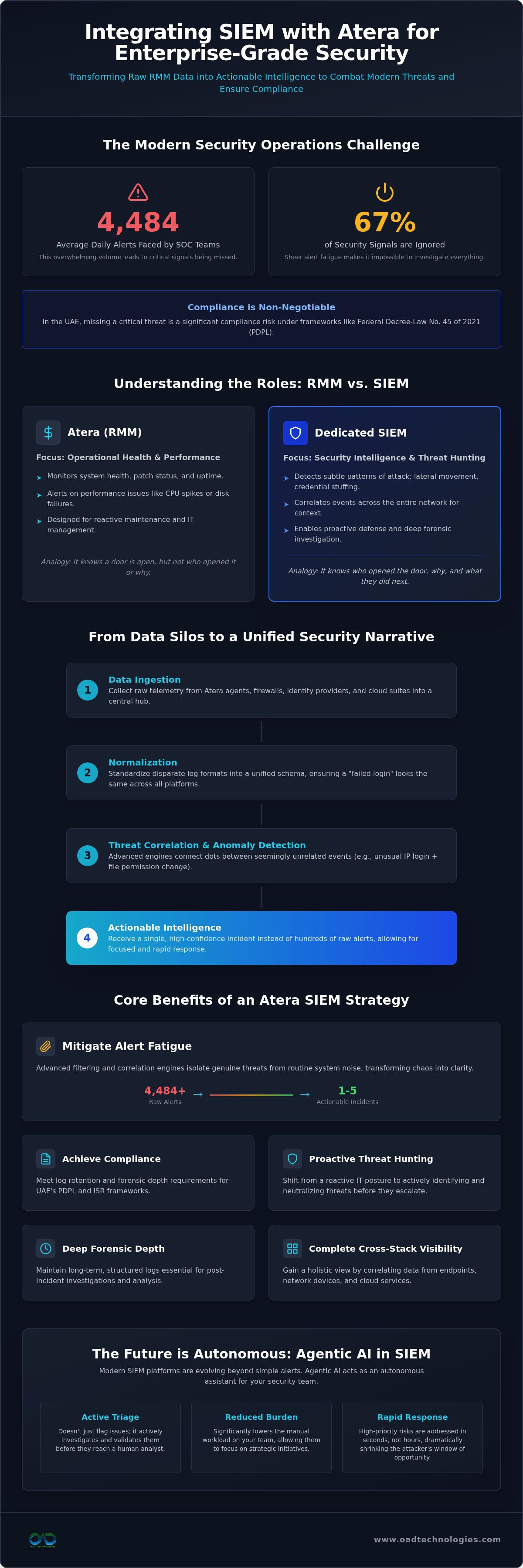
Did you know that SOC teams now face an average of 4,484 daily alerts, yet nearly 67% of those signals are ignored due to sheer alert fatigue? In the UAE enterprise landscape, where data integrity is a legal mandate under Federal Decree-Law No. 45 of 2021, missing a single critical threat isn't just an operational oversight; it's a significant compliance risk. You likely value Atera for its streamlined RMM capabilities, but you've probably found that standard logging falls short of the deep telemetry required for sophisticated threat hunting.
This guide demonstrates how to bridge that gap by implementing a high-performance atera siem strategy. By integrating dedicated security monitoring with your existing environment, you can transform raw infrastructure data into actionable intelligence. We'll explore how to filter out the noise, ensure your operations align with national cybersecurity frameworks like the PDPL, and achieve real-time visibility across every managed endpoint. You'll discover a roadmap to evolve from reactive IT management to a proactive, enterprise-grade security posture that protects your digital assets and your long-term reputation.
Key Takeaways
- Learn how to distinguish between RMM operational tasks and SIEM security intelligence to build a more resilient, multi-tenant environment.
- Discover the technical steps to transform raw endpoint data into structured telemetry by implementing a dedicated atera siem integration.
- Understand the specific log retention and forensic depth requirements necessary to align your IT operations with the UAE’s PDPL and ISR frameworks.
- Find out how to mitigate the "alert fatigue" crisis by applying advanced filtering that isolates genuine threats from routine system background noise.
- Explore how partnering with a managed security provider shifts your focus from managing software tools to achieving guaranteed security outcomes.
Understanding the Role of SIEM within the Atera Ecosystem
Atera provides a robust foundation for IT operations, but managing a fleet of devices is fundamentally different from defending one. While RMM tools excel at keeping systems online and performing optimally, they aren't designed to decode the subtle patterns of a targeted cyberattack. This is where Security Information and Event Management (SIEM) becomes essential. It transforms simple event logging into a proactive intelligence layer. For UAE enterprises, an atera siem strategy isn't just about adding a tool; it's about evolving from reactive maintenance to strategic digital resilience.
RMM vs. SIEM: More Than Just Alerts
RMM focuses on system health, patch status, and uptime. If a CPU spikes or a disk fails, Atera tells you immediately. However, security anomalies often mimic normal behavior. A SIEM looks for lateral movement, credential stuffing, or unauthorized data exfiltration that RMM alerts might miss. Relying on RMM for security often creates blind spots because it lacks the context of why an event happened, only that it occurred. It's the difference between knowing a door is open and knowing who opened it and why.
The Core Components of a Modern SIEM Integration
A modern integration captures event data across diverse architectures, including cloud environments and identity providers. It uses real-time correlation engines to connect dots between seemingly unrelated events. For instance, a login from an unusual IP followed by a sudden change in file permissions triggers an immediate response. Long-term log retention is also vital. In the UAE, maintaining these records is often a requirement for forensic investigations and meeting national compliance standards like the PDPL. This centralized approach ensures that multi-tenant environments remain secure without increasing the manual workload on your technicians.
The industry is currently shifting toward 'Agentic AI' within SIEM platforms. This technology doesn't just flag issues; it actively triages them. It acts like an autonomous assistant that can validate threats before they reach your desk. This reduces the burden on your team and ensures that high-priority risks are addressed in seconds rather than hours. By integrating this level of intelligence into your environment, you move beyond basic monitoring. You gain a proactive partner that understands the nuances of your specific network architecture and the evolving threat landscape in the region.
The Technical Synergy: How SIEM Complements RMM Monitoring
Atera agents are remarkably efficient at harvesting telemetry from endpoints. However, this data often exists in silos, separated from your network logs and cloud activity. An effective atera siem integration acts as a central nervous system, pulling these disparate threads into a single, structured security narrative. By transforming raw RMM data into normalized telemetry, you gain the ability to see beyond individual device health and start identifying sophisticated attack chains.
The primary advantage lies in visibility. While Atera monitors the local machine, a SIEM provides the necessary context from your firewalls, identity providers, and cloud suites. This cross-stack visibility is critical for modern defense. Without it, a technician might see a service restart in Atera as a routine glitch, while the SIEM identifies it as a persistence mechanism following a suspicious login. Adhering to the NIST Guide to Computer Security Log Management ensures that this data isn't just collected, but managed with the integrity required for enterprise security.
Data Ingestion and Normalization
Effective security monitoring starts with high-fidelity data collection. This involves pulling logs from Atera agents alongside third-party stacks like Bitdefender or ESET from the Atera Marketplace. The challenge isn't just gathering data; it's standardizing it. Disparate formats must be normalized into a unified schema so your correlation engine can analyze them effectively. This process ensures that a "failed login" on a Windows server looks the same as one on a cloud application, allowing for seamless cross-platform analysis and faster data integrity during the ingestion process.
Threat Correlation and Anomaly Detection
Once data is normalized, advanced correlation engines begin to filter the noise. Instead of receiving hundreds of individual alerts, your team sees a single, high-confidence incident. This deduplication is essential to combat alert fatigue. By utilizing User and Entity Behavior Analytics (UEBA), the system establishes a baseline for normal activity across your environment. UEBA serves as a critical defense layer by identifying subtle deviations in user behavior that signal stolen credentials or compromised accounts. This intelligence allows for a more proactive managed detection and response strategy, ensuring that your security posture evolves alongside the threats you face.
This technical synergy directly accelerates Incident Response (IR) workflows. When a threat is detected, the SIEM provides a complete timeline of the event, from the initial entry point to the affected endpoints identified by Atera. This level of detail eliminates the guesswork often associated with manual triaging. In the fast-paced UAE business environment, reducing the time between detection and remediation is the most effective way to minimize the potential impact of a breach.
Native Logging vs. Dedicated SIEM: Identifying the Security Gap
Atera provides essential visibility into system events, but relying solely on its native logging leaves a significant void in your defense strategy. The primary challenge isn't a lack of data; it's the inability to process it effectively. According to Vectra AI (July 2026), SOC teams receive an average of 4,484 daily alerts, yet a staggering 67% of these are ignored due to alert fatigue. For a UAE enterprise, this isn't just a productivity issue. It's a high-stakes gamble where one missed signal could lead to a catastrophic breach. A dedicated atera siem strategy solves this by moving beyond simple event capture to intelligent correlation.
Manual alert triaging is no longer a viable option for growing firms. Research from July 2026 indicates that manual triaging can cost organizations in some markets billions annually in lost efficiency. While Atera's AI Copilot helps automate routine IT tasks, it isn't a substitute for the specialized security logic required to stop an advanced persistent threat. A SIEM provides the "Single Pane of Glass" that CISOs need to see the entire attack surface, ensuring that security intelligence isn't buried under a mountain of routine maintenance logs.
The Risks of Under-Monitoring
Attackers don't target single machines; they target the gaps between your management tools. In siloed environments, an intruder can move laterally while each individual tool reports a "normal" status. This delayed detection is incredibly costly. By the time a human technician identifies a threat within standard RMM logs, the recovery costs have often already spiraled. A SIEM bridges these silos, connecting endpoint data with network and identity telemetry to catch attackers before they can exfiltrate sensitive data.
Comparison: RMM Logging vs. Enterprise SIEM
The difference between these two approaches comes down to three pillars: retention, correlation, and compliance. Standard RMM logs are often ephemeral, designed for troubleshooting rather than long-term forensic analysis. In contrast, an enterprise SIEM provides the deep historical data required by the UAE's Personal Data Protection Law (PDPL). While Atera helps you manage digital assets, it doesn't satisfy the rigorous Information Security Regulation (ISR) requirements for log integrity and cross-platform correlation.
Scalability is the final piece of the puzzle. As your digital footprint expands across cloud and hybrid infrastructures, the volume of telemetry grows exponentially. A native logging system will eventually buckle under the weight of this data, leading to dropped packets and visibility gaps. An enterprise-grade SIEM is built to ingest and analyze millions of events per second without latency. This ensures that as your business grows, your security posture remains uncompromised and fully aligned with national standards.
Implementing an atera siem strategy in the United Arab Emirates requires more than just technical connectivity; it demands strict alignment with national legal frameworks. The UAE Personal Data Protection Law (PDPL) mandates that organizations maintain clear records of data processing and provide rapid breach notifications. While Atera monitors the heartbeat of your infrastructure, it doesn't inherently provide the immutable audit trails required for rigorous regulatory scrutiny. Integrating a dedicated SIEM allows you to map technical events directly to your Governance, Risk, and Compliance (GRC) objectives, ensuring that every administrative action is logged, timestamped, and stored according to national standards.
Compliance-Driven Log Management
The UAE's Information Security Regulation (ISR) sets high benchmarks for log retention, particularly for entities within critical infrastructure and finance. These regulations often require logs to be stored for years, a requirement that standard RMM tools simply aren't built to handle. By automating your compliance reporting through a SIEM, you reduce the friction of manual audits and eliminate the risk of human error. Data residency is another critical factor. We ensure that sensitive logs remain within UAE borders, satisfying sovereignty requirements while maintaining end-to-end encryption for data both in transit and at rest.
Securing Multi-Cloud and Hybrid Environments
Most Atera users operate in hybrid environments, managing local endpoints alongside cloud-native workloads. This complexity increases the attack surface, making it vital to extend SIEM visibility to your Cloud Security Posture Management (CSPM) tools. Monitoring identity across Atera agents and Azure or AWS environments allows you to spot credential misuse before it escalates into a full-scale breach. In 2026, the synergy between SIEM and CSPM ensures that configuration drifts are not just detected but are immediately correlated with real-time threat telemetry to prevent exploitation.
This strategic approach transforms security from a cost center into a business enabler. By aligning your technology stack with national regulations, you protect your organization from both cyber threats and legal liabilities. If you're ready to modernize your defense, OAD Technologies can design a customized SIEM integration that meets the unique demands of the UAE market.
Elevating Atera Environments with OAD Technologies’ Managed SIEM
Deploying a SIEM is only the first step toward enterprise resilience. The real value lies in the operational intelligence that follows. While a standardized atera siem setup provides the logs, OAD Technologies provides the master designers who interpret them. We shift the focus from simply owning a security tool to achieving a specific security outcome. This transition is vital for UAE enterprises that need more than just automated alerts; they need a strategic partner to navigate a complex regional threat landscape where generic rulesets often fail to catch targeted attacks. Our approach ensures that your security stack isn't just a collection of software, but a cohesive defense mechanism.
The Managed SIEM Advantage
Building an in-house 24 X 7 Security Operations Center (SOC) is a massive financial undertaking that many firms find unsustainable. By choosing a managed approach, you eliminate the overhead of recruiting and retaining elite analysts. Our team provides continuous tuning of correlation rules, which is essential for reducing the 67% alert fatigue rate mentioned earlier. We don't just pass alerts to your technicians. We provide fully triaged incidents backed by human threat hunters who understand the difference between a routine administrative task in Atera and a genuine security breach. This level of precision is integrated directly with our Managed Detection and Response (MDR) services to provide round-the-clock protection across all endpoints.
Building a Resilient Security Roadmap
A truly resilient environment requires a layered defense. We work with you to integrate Identity and Access Management (IAM) with your SIEM to create a robust zero-trust framework. This ensures that every login monitored by your Atera agents is verified against behavioral baselines in real time. Our goal is to future-proof your security through a strategic partnership that evolves as your business grows. We don't offer off-the-shelf software; we build customized systems tailored to your specific operational needs and UAE compliance requirements. This proactive mindset allows us to act as an extension of your own team rather than a distant vendor.
If you're ready to move beyond basic monitoring and secure your digital future, consult with OAD Technologies for a customized SIEM strategy today. We provide the engineering standards and visionary leadership needed to keep your organization ahead of emerging threats. By bridging the gap between high-level innovation and practical business results, we ensure your infrastructure remains a secure platform for growth.
Modernizing Your Enterprise Defense Strategy
Transitioning from basic IT management to a sophisticated security posture is a necessity for UAE enterprises navigating 2026's threat landscape. You've seen how a dedicated atera siem strategy transforms raw telemetry into actionable intelligence, bridging the visibility gap that standard RMM tools leave behind. By centralizing logs and applying advanced correlation, you ensure your operations align with critical national standards like the PDPL and ISR. This isn't just about software; it's about shifting toward a resilient, outcome-based security model that protects your reputation and your data.
OAD Technologies acts as your strategic partner, providing the human expertise needed to manage complex digital challenges. We offer expert UAE GRC alignment and 24 X 7 Managed Detection and Response to ensure your environment remains secure around the clock. Our customized enterprise security integrations are designed to fit your specific operational needs, moving beyond off-the-shelf solutions to provide long-term viability. Secure your enterprise with OAD Technologies' Managed SIEM and take the first step toward a more proactive, visionary defense. Your digital evolution deserves a partner committed to your ongoing success.
Frequently Asked Questions
Does Atera have a built-in SIEM tool?
Atera does not include a native, built-in SIEM platform. It functions as a Remote Monitoring and Management (RMM) solution designed for IT operations and asset management. To achieve enterprise-grade security intelligence, users must integrate a dedicated atera siem strategy by connecting external security telemetry tools. This allows you to bridge the gap between basic system health monitoring and the advanced threat correlation required for modern cybersecurity within the UAE enterprise landscape.
What is the difference between RMM alerts and SIEM logs?
RMM alerts focus on infrastructure health, such as CPU spikes, disk failures, or missing patches. In contrast, SIEM logs provide deep security context by correlating events across your entire network. While an RMM tells you a service stopped, a SIEM identifies if that stoppage was part of a coordinated attack chain. This distinction is critical for UAE firms that need to move beyond operational uptime toward proactive threat detection and forensic readiness.
How does SIEM help with UAE PDPL compliance?
The UAE Personal Data Protection Law (PDPL) requires organizations to maintain documented records of data processing and provide rapid breach notifications. A SIEM automates this by creating immutable audit trails and real-time monitoring of sensitive data access. By implementing a structured atera siem integration, you ensure that all administrative actions are logged and stored according to national standards, significantly reducing the friction and risk associated with regulatory audits and legal liabilities.
Can I integrate third-party SIEM tools like Microsoft Sentinel with Atera?
Yes, you can integrate enterprise-grade SIEM tools like Microsoft Sentinel or Splunk with your Atera environment. This is typically achieved through API integrations or by deploying log collectors that ingest telemetry from Atera agents. This setup allows you to consolidate endpoint data with your cloud and network security stacks. OAD Technologies specializes in these customized integrations, ensuring that your disparate security tools function as a single, unified defense system tailored for the UAE market.
What are the benefits of a Managed SIEM over a self-hosted one?
Managed SIEM provides access to elite security analysts and 24 X 7 monitoring without the massive overhead of building an in-house SOC. Self-hosting often leads to alert fatigue, as internal teams struggle to tune correlation rules effectively. A managed approach ensures continuous rule refinement and human-led threat hunting. This shift from tool ownership to outcome-based security allows your team to focus on strategic growth while experts handle the complexities of real-time incident response.
How much log data should a UAE business retain for security audits?
Retention requirements vary by industry, but UAE national frameworks like the Information Security Regulation (ISR) often mandate periods ranging from six months to several years for critical infrastructure. Financial institutions may face even stricter standards. A dedicated SIEM handles this volume efficiently, ensuring data integrity and residency within national borders. This long-term storage is vital for forensic investigations, allowing you to reconstruct events months after an initial compromise occurred during an audit.
Does SIEM protect against ransomware in an Atera environment?
While a SIEM isn't a preventative shield like an antivirus, it is essential for detecting the early stages of a ransomware attack. It identifies suspicious lateral movement, credential misuse, and unusual file encryption patterns that RMM tools might miss. By correlating these signals in real time, a SIEM allows your security team to isolate infected endpoints before the encryption payload is fully deployed, significantly minimizing the potential impact on your business operations and data integrity.
What is the role of AI in modern SIEM integrations for 2026?
In 2026, AI has evolved into Agentic AI that autonomously triages high volumes of telemetry to isolate genuine threats. This technology reduces the noise that causes 67% of alerts to be ignored by human teams. In a modern atera siem setup, AI models establish behavioral baselines for every user and device. This allows the system to spot subtle deviations instantly, ensuring that your defense posture remains proactive rather than just reactive to known attack signatures.
Disclaimer
Content by OAD Technologies is for general informational purposes only and does not constitute professional or cybersecurity advice. No warranties are made regarding accuracy or completeness; reliance is at your own risk. OAD Technologies shall not be liable for any direct or indirect losses arising from use of this content.