

In 2026, ransomware was present in 48% of all recorded breaches, signaling a shift toward more aggressive, human-operated tactics that bypass traditional defenses. You've likely felt the frustration of managing fragmented security silos while knowing that legacy antivirus can't stop fileless attacks or the "EDR killer" tools now common in the wild. It's a high-stakes environment where the fear of data exfiltration often outweighs the threat of encryption itself.
We're here to change that narrative by showing you how edr ransomware protection disrupts the attack lifecycle at its most vulnerable points. This strategic guide explores the mechanics of endpoint detection and response, helping you move from reactive patching to a resilient infrastructure that survives initial breaches. You'll learn how to justify these investments to leadership by aligning technology with UAE-specific frameworks like the National Encryption Policy and the updated NCAP standards. We'll preview how a unified approach, combining EDR with Managed Detection and Response (MDR), creates the long-term digital relevance your enterprise requires to thrive in an increasingly complex threat landscape.
Key Takeaways
- Identify the critical shift from signature-based detection to behavioral analysis to counter modern "Living off the Land" attack vectors.
- Explore how edr ransomware protection records every system process to disrupt the ransomware lifecycle before data exfiltration occurs.
- Master the mechanics of thwarting lateral movement, ensuring that an initial breach does not lead to a catastrophic enterprise-wide event.
- Align your security deployment with UAE-specific GRC standards to bridge the gap between technical defense and strategic business compliance.
- Understand the necessity of integrating EDR into a broader Managed Detection and Response (MDR) framework for 24 X 7 operational resilience.
The Evolution of Ransomware and the Failure of Legacy Defenses
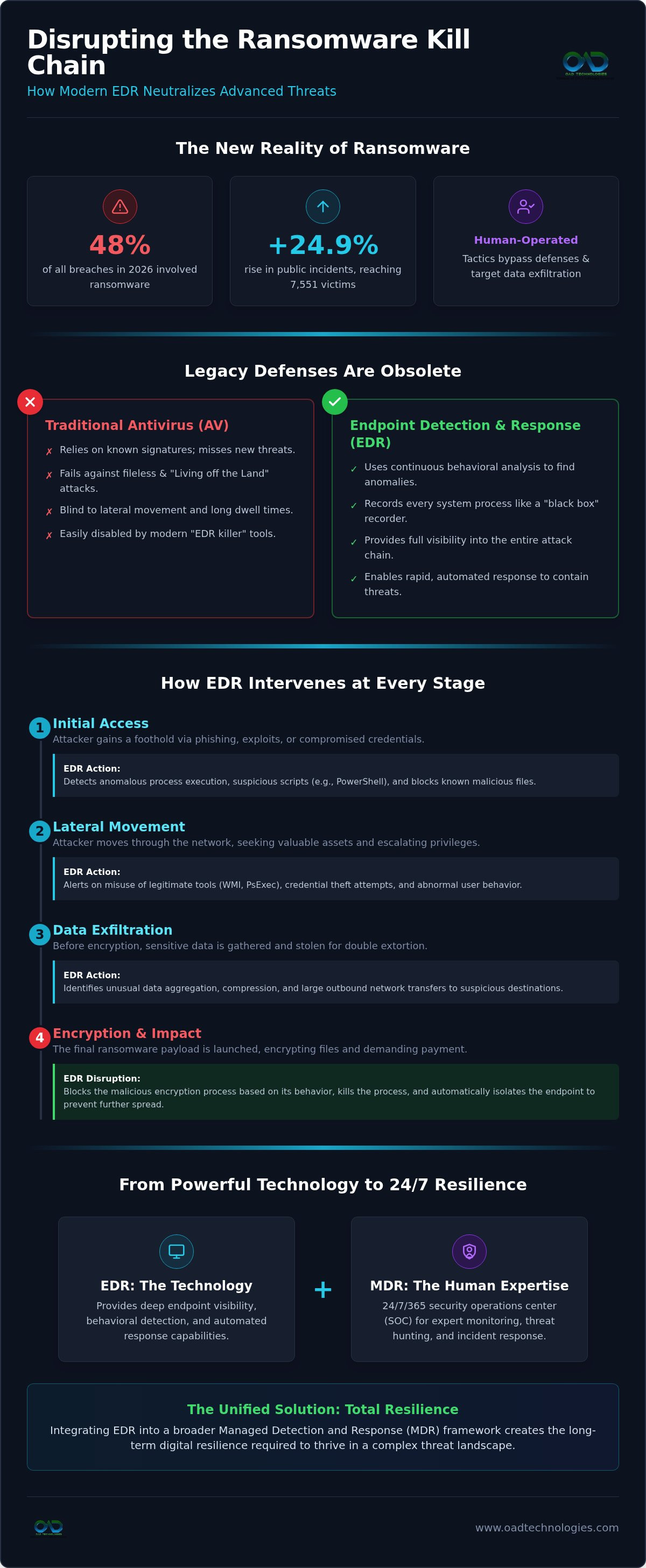
Ransomware has transitioned from simple, automated encryption to a sophisticated, multi-stage extortion economy. In 2026, the threat landscape is dominated by human-operated campaigns that prioritize data exfiltration over simple system lockouts. Between April 2025 and March 2026, publicly disclosed ransomware incidents rose by 24.9%, reaching 7,551 victims globally. This surge is fueled by a refined Ransomware-as-a-Service (RaaS) model where affiliates often claim 70% to 80% of the total payout. These actors don't rely on generic malware; they use polymorphic code that changes its signature with every execution, making traditional defenses ineffective.
Why Traditional Antivirus (AV) Falls Short
Legacy antivirus solutions rely on static file analysis to identify threats. They compare files against a library of known signatures to determine what is "bad." This approach fails in a world of fileless attacks. Attackers now frequently utilize "Living off the Land" (LotL) tactics, leveraging legitimate administrative tools like PowerShell or Windows Management Instrumentation (WMI) to carry out their objectives. Because these tools are trusted by the operating system, traditional AV remains silent while the attacker moves through your environment.
The "dwell time" problem further complicates this. When perimeter defenses are bypassed using compromised identities, legacy systems lack the visibility to track lateral movement. They don't see the reconnaissance or the slow staging of data. Without the continuous monitoring provided by edr ransomware protection, an intruder can remain inside a network for weeks, mapping out critical assets before the first file is ever encrypted.
Modern Ransomware as a Strategic Operation
Modern attacks are no longer "set and forget" scripts. They're strategic operations led by human adversaries who customize their approach based on the specific vulnerabilities of the target. These operators often deploy "EDR killer" tools designed specifically to disable basic security software before launching the final payload. This shift requires a move away from simple prevention toward a comprehensive response capability. Endpoint detection and response (EDR) acts as more than just a tool; it's a continuous monitoring capability that provides the visibility needed to stop an active intrusion.
EDR functions as the 'black box' flight recorder for your network endpoints, capturing every process execution, registry change, and network connection. By recording this telemetry, security teams can reconstruct the entire attack chain. In the context of UAE's Federal Decree-Law No. 34 of 2021, which criminalizes unauthorized system access, having this level of forensic detail is essential for both legal compliance and operational recovery. Effective edr ransomware protection ensures that even if an attacker gains initial entry, their lifecycle is disrupted before they can achieve their ultimate goal of extortion.
How EDR Mechanics Neutralize Advanced Threats
Modern defense requires more than a perimeter wall. It demands a deep, granular understanding of every action occurring within the operating system. Effective edr ransomware protection relies on continuous data collection, recording every process execution, network connection, and file modification in real time. This telemetry provides the raw material for sophisticated detection, allowing security teams to reconstruct events that would otherwise remain invisible to legacy tools.
Visibility: The Foundation of Endpoint Defense
Visibility starts at the kernel level. By monitoring at this deep layer, EDR can detect evasion techniques that attempt to blind security agents. This depth is vital for mapping endpoint activity to the MITRE ATT&CK framework, which categorizes the specific tactics and techniques used by adversaries. When you understand the "how" of an attack, you can respond with precision.
This approach aligns with strategic recommendations found in CISA's #StopRansomware Guide, which emphasizes the need for robust logging and endpoint visibility. Without this telemetry, incident response becomes a guessing game. EDR removes the guesswork by providing a verified audit trail of every attacker move. If you're looking to strengthen your posture, exploring a customized security integration can bridge the gap between raw data and actionable intelligence.
Behavioral Analysis vs. Signature Matching
The core innovation of EDR lies in its shift from Indicators of Compromise (IOCs) to Indicators of Attack (IOAs). While an IOC tells you that a known bad file exists, an IOA focuses on the intent of an action. For example, EDR doesn't just look for a virus; it looks for suspicious PowerShell executions or unauthorized credential dumping attempts. These behaviors often signal a breach before any malware is even deployed.
Artificial intelligence and machine learning play a critical role here by modeling baseline behavior for every user and device. When an endpoint suddenly begins scanning internal ports or modifying sensitive registry keys, the system flags the anomaly. This intelligent correlation reduces alert fatigue, ensuring that SOC teams focus on high-fidelity threats rather than background noise. Automated response actions then take over, isolating compromised hosts from the network before the infection can spread. This rapid containment is a hallmark of high-tier edr ransomware protection, turning a potential catastrophe into a manageable incident.
EDR vs. The Ransomware Lifecycle: A Step-by-Step Defense
Modern ransomware isn't a singular event; it's a multi-stage operation that often begins weeks before the final encryption payload triggers. To defend effectively, your security posture must address each link in the adversary's kill chain. Robust edr ransomware protection provides the granular control needed to disrupt these phases, moving beyond simple blocklists to identify the subtle signals of an active intrusion.
Disrupting the Kill Chain Early
The first phase of any attack involves gaining a foothold. This often occurs through a malicious macro, a drive-by download, or an exploited vulnerability. EDR identifies these initial access attempts by monitoring for unusual parent-child process relationships, such as a word processor launching a command-line interface. Once the foothold is established, the attacker must communicate with a Command and Control (C2) server to receive instructions. EDR blocks these unauthorized egress attempts by correlating process activity with known malicious IP ranges and domain patterns.
If an attacker evades the initial block, they'll immediately begin internal reconnaissance to find high-value targets. EDR identifies lateral movement by monitoring abnormal RDP or SSH usage, flagging instances where administrative tools are used to jump between workstations. By catching these movements early, you prevent a single compromised endpoint from turning into a total network takeover. This visibility allows your team to isolate the affected segment before the adversary can map out your sensitive data repositories.
Defeating the Extortion Phase
In 2026, the real threat isn't just encryption; it's the theft of intellectual property and sensitive client data. To truly secure digital assets, Data Loss Prevention (DLP) and EDR must work in tandem to monitor both the process behavior and the data itself. EDR detects the "staging" phase, where attackers gather files into compressed archives before uploading them to cloud storage. By monitoring for large-scale data movements and unauthorized cloud uploads, the system triggers alerts that stop exfiltration in its tracks.
Even if an attacker reaches the final stage, modern edr ransomware protection acts as a fail-safe. It identifies the specific cryptographic patterns associated with ransomware encryption. When the system detects a process rapidly modifying file headers or deleting shadow copies, it kills the process in real-time. This automated intervention buys critical time for your Security Operations Center (SOC) to intervene, ensuring that an attempted extortion remains an unsuccessful attempt rather than a catastrophic breach. This layered defense ensures that even the most advanced, human-operated campaigns find no room to operate within your infrastructure.
Strategic Implementation: Integrating EDR into the UAE Enterprise
Deploying a tool is simple. Integrating a capability is a strategic endeavor. For UAE enterprises, edr ransomware protection isn't a standalone purchase but a foundational layer of a broader resilience architecture. This process begins by aligning deployment with Governance, Risk, and Compliance (GRC) standards, ensuring that technical controls serve business objectives. By integrating EDR telemetry with a centralized SIEM, organizations create a unified security narrative, allowing for cross-stack correlation that identifies complex, multi-vector threats.
Success requires moving beyond "out-of-the-box" configurations. Every organization has a unique risk profile. Customizing EDR policies allows for aggressive blocking on critical servers while maintaining operational flexibility on developer workstations. This precision prevents security from becoming a bottleneck to innovation.
The Synergy of EDR and MDR
Technology alone is not a silver bullet. While EDR provides the data, Managed Detection and Response (MDR) provides the expertise to interpret it. Most UAE enterprises benefit from this synergy because it bridges the gap between automated alerts and human-led threat hunting. Professional remediation guidance is far more valuable than a simple "block" action. It allows teams to understand the root cause of an intrusion, ensuring that once a threat is removed, it doesn't return through the same vulnerability.
Regulatory Alignment and Data Sovereignty
Operating within the UAE requires strict adherence to national data protection frameworks. In 2026, the UAE National Encryption Policy and the updated National Cyber Accreditation Programme (NCAP) set clear benchmarks for how data must be handled. EDR telemetry storage must comply with these laws, ensuring that forensic data remains within sovereign boundaries when required.
Using EDR reporting helps organizations satisfy audit requirements by demonstrating "reasonable security" measures. It provides the documented evidence needed to prove compliance with Federal Decree-Law No. 34 of 2021. A resilient incident response plan centers on this data, turning raw logs into a strategic asset for long-term viability. To ensure your infrastructure meets these rigorous standards, consider a specialized cybersecurity assessment to identify and close existing gaps.
OAD Technologies: Designing Your Ransomware Resilience
OAD Technologies bridges the gap between high-level innovation and practical business results by acting as a master designer of your security ecosystem. We recognize that edr ransomware protection is only as effective as the architecture supporting it. Our methodology moves beyond simple software deployment, focusing on a deep, customized integration that empowers your people and safeguards your most critical digital assets. By blending technical authority with a visionary mindset, we ensure your infrastructure isn't just keeping pace but is actively shaped for future challenges.
Beyond Standardized Approaches
We reject standardized, "out-of-the-box" security models that fail to account for the nuances of your specific environment. Every enterprise operates with unique workflows and risk tolerances, making generic configurations a liability. OAD Technologies prioritizes a tailored architecture that reflects your operational reality. To ensure your defenses hold under real-world pressure, we utilize Vulnerability Assessment and Penetration Testing (VAPT) to rigorously validate your EDR’s effectiveness. This proactive testing identifies blind spots and ensures your behavioral heuristics are tuned to catch the most subtle indicators of attack.
Our collaborative partnership model means we function as a dedicated extension of your internal team. We don't just hand over a dashboard; we provide the strategic insight needed to navigate a complex threat landscape. By combining rigorous engineering standards with a solution-oriented mindset, we ensure that your technology serves your business goals without compromise. This synergy between human expertise and advanced technology is what transforms a tool into a comprehensive defense capability.
Securing the Future of Your Digital Assets
Cybersecurity is not a static destination; it's a continuous evolution. OAD Technologies anchors its mission in a promise of long-term viability, positioning ourselves as guardians of your ongoing digital relevance in an ever-changing market. As ransomware groups refine their AI-powered attacks and defense evasion tools, our proactive threat design keeps you ahead of the curve. We focus on creating a resilient infrastructure that survives initial breaches and prevents catastrophic data exfiltration.
Securing your infrastructure begins with a clear roadmap rather than a quick fix. A strategic security assessment allows us to map your current posture against the 2026 landscape and the UAE’s evolving regulatory requirements. This grounded approach ensures that your investment in security delivers measurable performance and supports strategic expansion. Partner with OAD Technologies to secure your enterprise endpoints today.
Securing Your Enterprise Legacy in the 2026 Threat Landscape
The transition from automated malware to human-operated extortion demands a shift from static defense to active resilience. You've seen how legacy tools fail to detect "Living off the Land" tactics and how the right edr ransomware protection disrupts the attack lifecycle before encryption begins. By moving beyond standardized software and embracing a tailored architecture, your organization can survive initial breaches while maintaining strict compliance with UAE regulatory standards. This alignment ensures that your technical controls satisfy both security needs and legal mandates.
Success in this environment requires the synergy of advanced telemetry and human expertise. As a specialized system integrator and MSSP, OAD Technologies provides the expert-led 24 X 7 SOC capabilities needed to turn raw data into strategic defense. We don't just offer tools; we design systems that ensure your long-term digital viability. It's about creating an infrastructure that doesn't just react to threats but anticipates them through proactive design.
Secure your enterprise with OAD Technologies' Managed EDR solutions.
Building a resilient future starts with a single, proactive step toward comprehensive visibility and expert-led response.
Frequently Asked Questions
Is EDR enough to stop all ransomware attacks?
No single tool can guarantee 100% prevention, but EDR is the most effective layer for disrupting the modern kill chain. While it identifies sophisticated behavioral anomalies, it works best when integrated into a broader Managed Detection and Response (MDR) framework. This defense-in-depth approach ensures that even if one layer is bypassed, secondary controls and human threat hunters can intervene before the adversary achieves their ultimate goal of data encryption or exfiltration.
How does EDR differ from traditional antivirus software?
Traditional antivirus relies on static signatures to identify known threats, making it blind to new, polymorphic malware. In contrast, edr ransomware protection focuses on behavioral telemetry, recording every process and connection on an endpoint. By analyzing intent rather than just file identity, EDR identifies "Living off the Land" attacks that use legitimate system tools. This continuous monitoring provides a level of visibility that legacy signature-based systems simply cannot match.
Can EDR help with compliance for UAE data protection laws?
EDR provides the forensic evidence and continuous monitoring required to meet rigorous UAE standards like the National Cyber Accreditation Programme (NCAP). It helps organizations demonstrate "reasonable security" measures as mandated by Federal Decree-Law No. 34 of 2021. By maintaining detailed logs of all system activity, enterprises can satisfy audit requirements and prove they've taken proactive steps to protect national data assets against unauthorized access and malicious misuse during an investigation.
What happens if a ransomware attack succeeds despite having EDR?
If a breach occurs, EDR functions as a "black box" flight recorder, allowing your security team to reconstruct the attack timeline with precision. This data is vital for identifying exactly which files were accessed and isolating the compromised segment to prevent further spread. By providing high-fidelity telemetry, EDR accelerates the remediation process, helping you restore operations and meet reporting obligations under UAE data protection laws while minimizing the total impact of the incident.
How much does EDR ransomware protection cost for an enterprise?
The investment for edr ransomware protection typically depends on the total number of endpoints and the depth of the management layer required. Enterprises must choose between self-managed licenses or a fully integrated Managed Detection and Response (MDR) service. While licensing costs are standardized across the industry, the true value lies in the customized integration and the 24 X 7 expert oversight that ensures the technology is properly tuned to your specific organizational risk profile.
Does EDR require a 24 X 7 Security Operations Center (SOC) to be effective?
EDR is most effective when paired with a 24 X 7 Security Operations Center (SOC) because advanced threats don't follow a standard workday. Automated alerts require human validation and rapid response to prevent lateral movement. Without round-the-clock monitoring, a high-fidelity alert generated at midnight might not be addressed until the following morning, giving attackers hours to stage data. The synergy between EDR technology and professional SOC analysts is what creates true enterprise resilience.
Can EDR detect 'fileless' ransomware attacks?
Yes, EDR is specifically designed to detect fileless attacks that bypass traditional file-scanning methods. It monitors for suspicious behaviors within system memory and identifies the misuse of legitimate administrative tools like PowerShell or WMI. By focusing on "Indicators of Attack" rather than static file signatures, EDR can spot an adversary executing code directly in memory. This capability is essential for stopping modern ransomware campaigns that prioritize stealth and evasion over traditional malware delivery.
Disclaimer
Content by OAD Technologies is for general informational purposes only and does not constitute professional or cybersecurity advice. No warranties are made regarding accuracy or completeness; reliance is at your own risk. OAD Technologies shall not be liable for any direct or indirect losses arising from use of this content.