
What if the traditional security audits your business relies on are already obsolete against the AI-driven exploits of 2026? As the UAE shifts from voluntary best practices to mandatory resilience, the pressure to maintain a clean bill of health for NESA and ISR audits has never been higher. You likely feel the weight of these evolving mandates, especially with the March 2026 deadline to phase out SMS OTPs and the requirement for digital impersonation risk assessments. It's a high-stakes environment where the search for expert penetration testing services often yields generic checklists instead of the strategic partnership your infrastructure demands.
We recognise that you require a roadmap that ensures compliance without disrupting your core operations. This article demonstrates how high-precision Vulnerability Assessment and Penetration Testing (VAPT) acts as a sophisticated diagnostic tool to safeguard your enterprise against zero-day threats. We'll examine the 2026 framework for resilience, covering everything from National Cyber Accreditation Programme (NCAP) enforcement to actionable remediation strategies. By the end, you'll understand how to transform technical findings into long-term business stability and regulatory certainty.
Key Takeaways
- Understand why the 2026 UAE threat landscape necessitates a shift from passive defence to a proactive, security-by-design approach to protect the national digital economy.
- Learn how elite penetration testing companies in dubai combine automated precision with human insight to map critical assets without risking business continuity.
- Clarify the strategic differences between vulnerability assessments and penetration testing to ensure your organisation selects the appropriate depth for its unique risk profile.
- Discover how high-precision VAPT facilitates seamless alignment with national regulatory frameworks like NESA and ISR while ensuring compliance with the UAE Personal Data Protection Law.
- Transition from static security reporting to a continuous resilience lifecycle by integrating VAPT findings with your Managed Detection and Response (MDR) strategy.
UAE Cybersecurity: Why VAPT is Essential in 2026
The UAE digital economy is no longer just an emerging market; it's a global hub of high-value targets. By 2026, the reliance on paperless government services and integrated financial ecosystems has made security by design a necessity rather than a luxury. Relying on security by obscurity, the hope that your systems are too small or niche to be noticed, is a failing strategy. Adversaries now use automated reconnaissance to find any crack in your armour. A rigorous penetration test is the only way to validate that your architectural defences hold up under real-world pressure.
Automated vulnerability scans, while useful for basic hygiene, are insufficient against modern adversary tactics. These tools often miss logic flaws or complex exploit chains that a human attacker would easily spot. In a region where the UAE Cybersecurity Council has previously identified the nation as a top target for cyberattacks, checking a box for compliance isn't enough. You need a deep, technical understanding of how an intruder might navigate your specific environment.
Evolving Threats Targeting National Infrastructure
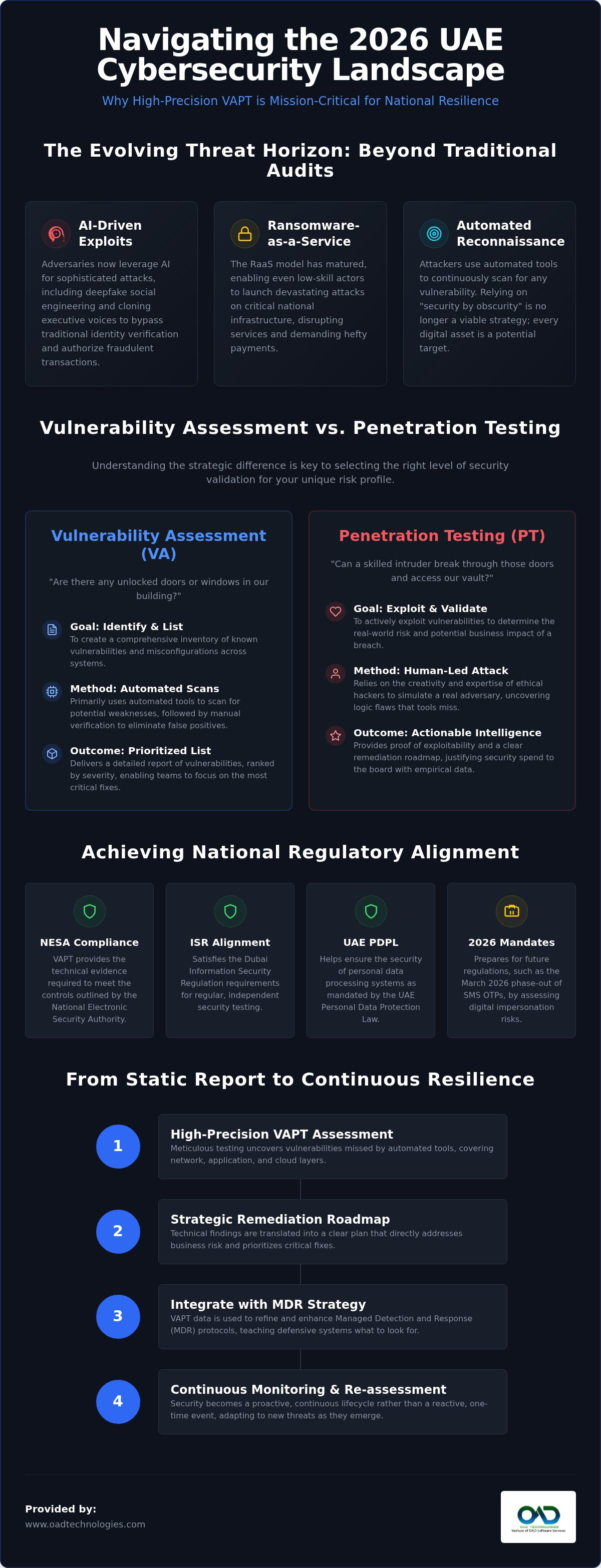
Ransomware-as-a-service (RaaS) has matured, allowing even low-skill actors to launch devastating attacks on critical infrastructure. In the UAE, we're seeing a surge in deepfake-enabled social engineering where AI clones the voices or faces of executives to bypass traditional identity checks. This isn't science fiction; it's the current reality for many local organisations. The 2026 threat surface for a UAE enterprise is a hyper-connected, AI-augmented ecosystem where every digital touchpoint serves as a potential gateway for state-sponsored or financially motivated adversaries.
The Strategic Value of Technical Assessments
CISOs often struggle to justify security spend to the board. High-precision VAPT provides the empirical data needed to demonstrate cybersecurity ROI. Instead of asking for budget based on vague fears, you can present a clear remediation roadmap that directly addresses business risk. Partnering with elite penetration testing companies in dubai allows you to protect your brand reputation before a breach occurs.
Beyond compliance with ISR or NESA, these assessments provide the technical foundation for more advanced services. For instance, VAPT data is vital for refining managed detection and response (MDR) protocols, ensuring your defensive systems know exactly what to look for. When evaluating penetration testing companies in dubai, the focus should be on strategic alignment. A vendor might give you a list of vulnerabilities, but a partner provides the human insight to explain which ones actually threaten your revenue stream.
The Anatomy of High-Precision VAPT: Methodology and Technical Rigour
High-precision VAPT is a meticulous engineering process, not a simple automated scan. At OAD Technologies, we reject the standardised scan-and-dump approach used by many generic vendors. Our methodology integrates advanced automated precision with deep human expertise to uncover vulnerabilities that software alone consistently misses. This rigorous framework aligns with international standards, such as the NIST Technical Guide to Information Security Testing, ensuring every assessment is grounded in proven technical logic.
The process begins with pre-assessment scoping. We work as a strategic partner to identify your most critical digital assets, ensuring the test covers high-risk areas without disrupting your daily operations. This phase is vital for setting clear boundaries and objectives, allowing us to simulate realistic attack vectors while maintaining system stability. If you're currently evaluating penetration testing companies in dubai, look for this level of initial strategic alignment.
Phase 1: Vulnerability Assessment (VA)
The first technical phase involves comprehensive scanning across your network, application, and cloud layers. We don't just rely on tool outputs; our engineers manually verify every finding to eliminate false positives. This saves your internal teams from chasing ghosts. We then categorise risks based on actual business impact and exploitability, rather than just using generic severity scores. This ensures your remediation efforts focus on the vulnerabilities that pose the greatest threat to your UAE operations.
Phase 2: Penetration Testing (PT)
Once we've mapped the vulnerabilities, we enter the exploitation phase. Here, our team simulates real-world attacks using advanced Red Teaming techniques. We don't just find a hole; we demonstrate what an adversary could actually do. This includes testing for Identity and Access Management (IAM) bypasses and evaluating how well your existing Endpoint Detection and Response (EDR) solutions perform under pressure. This phase provides the empirical evidence needed to understand your true defensive posture. It's this level of depth that separates elite penetration testing companies in dubai from those offering superficial checks.
The engagement concludes with a post-assessment remediation roadmap. We provide a prioritised, actionable plan for your technical teams to follow. Instead of a static report, you receive a strategic document designed to close security gaps and improve your long-term resilience against zero-day exploits. We empower your people with the knowledge to defend your systems more effectively.
Vulnerability Assessment vs. Penetration Testing: Defining the Strategic Difference
Many organisations conflate these two terms, but they represent distinct phases of a mature security lifecycle. Understanding this difference is critical when evaluating penetration testing companies in dubai. A Vulnerability Assessment (VA) provides a wide-angle lens, while a Penetration Test (PT) is a surgical strike. Together, they form the VAPT framework that UAE enterprises need to survive the 2026 threat environment.
VA and PT shouldn't be viewed as competing choices. Instead, they work in tandem to create a holistic security posture. A VA finds the doors that have been left unlocked; a PT determines if a determined intruder can actually kick them down. Matching the assessment type to your specific business goals ensures that you aren't just spending budget on security, but investing in resilience.
Vulnerability Assessment: The Broad Diagnostic
A Vulnerability Assessment focuses on identifying known security gaps across your entire infrastructure. It's a broad diagnostic tool that maps out every potential entry point, from unpatched servers to misconfigured cloud buckets. This process is largely automated, allowing for the technical rigour required to scan thousands of assets simultaneously. In high-risk environments, this should be a continuous or monthly practice to keep pace with the rapid release of new exploits.
The primary outcome of a VA is a comprehensive list of vulnerabilities. Each is typically ranked by severity, providing your IT team with a prioritised checklist for patching. While it lacks the human-led nuance of a full penetration test, it's the essential first step in hardening your perimeter. It provides the breadth necessary to ensure no obvious gap is left unaddressed.
Penetration Testing: The Targeted Deep-Dive
Penetration Testing moves beyond the list of flaws to test the actual resilience of your defences. It involves a skilled human adversary attempting to bypass your security controls, such as Identity and Access Management (IAM) or Endpoint Detection and Response (EDR) systems. This is a targeted deep-dive designed to reveal the real-world impact of a successful breach.
When you engage penetration testing companies in dubai for this service, you're looking for proof of concept. Can an attacker exfiltrate sensitive data? Can they achieve domain admin privileges? This type of testing is usually conducted annually or following significant system changes. The results provide a narrative of how an attack unfolds, which is invaluable for training your internal response teams. By simulating these sophisticated tactics, you move from theoretical risk to validated defence.
- VA Focus: Breadth and identification of known flaws across the entire estate.
- PT Focus: Depth and simulation of human-led exploits against specific targets.
- VA Frequency: Continuous or monthly for maintaining basic hygiene.
- PT Frequency: Annual strategic validation or after major infrastructure shifts.
Achieving National Regulatory Alignment: VAPT as a Compliance Catalyst
Compliance in the UAE has evolved from a recommendation to a rigid requirement. In 2026, the complexity of the regulatory landscape demands more than just a surface-level scan. High-precision VAPT serves as a compliance catalyst, providing the technical evidence required to satisfy national auditors. By identifying and remediating vulnerabilities before an audit begins, you transform your security posture into a documented record of diligence. Partnering with elite penetration testing companies in dubai ensures that your technical assessments align with the strategic goals of your Governance, Risk, and Compliance (GRC) framework.
This technical rigour acts as a bridge between high-level policy and practical implementation. When you present a VAPT report to a regulator, you aren't just showing a list of patches. You're demonstrating a proactive commitment to national security standards. This level of transparency is essential for maintaining operational licenses in highly regulated sectors like finance and energy.
NESA and ISR Compliance in the UAE
The National Electronic Security Authority (NESA) and the Information Security Regulation (ISR) form the bedrock of UAE cybersecurity standards. For organisations handling critical national infrastructure, compliance is mandatory. VAPT directly addresses the Technical Security Assessment controls within these frameworks. It's not enough to simply have a firewall; you must prove it works against simulated threats.
As we move through 2026, the enforcement of the UAE Information Assurance (IA) Standards has become stricter. Organisations handling critical infrastructure now require National Cyber Accreditation Programme (NCAP) accreditation. Detailed VAPT reports provide the necessary transparency for these rigorous evaluations. By documenting your remediation efforts, you show regulators that your organisation isn't just identifying risks but actively closing them.
PDPL and Data Sovereignty
The UAE Personal Data Protection Law (PDPL) carries significant weight in 2026. Data breaches involving personal information can lead to fines of up to AED 3 million for serious violations. VAPT helps secure sensitive data by identifying potential leak paths that could bypass your primary defences. This technical insight is vital for refining your data loss prevention strategies, ensuring that policy rules are grounded in technical reality.
Security testing also ensures your cloud posture aligns with national data residency rules. As many UAE enterprises migrate to local cloud nodes, VAPT validates that data remains within sovereign boundaries. It checks for misconfigurations that might inadvertently expose sensitive information to external jurisdictions. This level of technical rigour is why many CISOs prioritise established penetration testing companies in dubai for their regulatory needs. If your organisation is preparing for a 2026 regulatory audit, you can consult our GRC specialists to align your technical testing with national mandates.
Beyond the Report: Integrating VAPT into a Continuous Resilience Lifecycle
A static PDF report shouldn't be the final destination of your security engagement. In the high-velocity UAE business environment, treating a technical assessment as a one-off event leaves your infrastructure brittle against the next wave of AI-driven exploits. The most effective penetration testing companies in dubai act as strategic architects, providing the data necessary to build a continuous resilience lifecycle. This approach ensures that your organisation doesn't just survive an audit but actively shapes its own digital safety through rigorous engineering standards.
This data acts as a vital feedback loop for your existing security stack. For example, the results of a human-led exploit can be used to fine-tune your managed detection and response protocols. If our testers managed to move laterally without triggering an alert, your MDR team gains the specific intelligence needed to improve their monitoring logic. There is also a powerful synergy between VAPT and identity and access management. By simulating credential theft and privilege escalation, we help you validate that your IAM controls are robust enough to withstand real-world pressure. This synergy empowers your security specialists to move from a defensive mindset to a proactive, solution-oriented posture.
Remediation and Validation
Identifying a flaw is only the first step. True resilience requires rigorous re-testing to confirm that patches are fully effective and haven't introduced secondary issues. We've often observed that a quick fix can inadvertently break other security dependencies. To avoid this, it's essential to bridge the communication gap between security auditors and IT operations teams. Integrating VAPT findings directly into your corporate risk register ensures that every vulnerability is tracked with the same level of accountability as a financial risk. This steady and deliberate pace of improvement mirrors a well-managed development lifecycle, moving security from the server room to the boardroom.
VAPT as a Managed Security Pillar
The UAE's digital landscape in 2026 demands a shift from reactive, intermittent testing toward Continuous Threat Exposure Management (CTEM). This model ensures your defences are constantly validated against the specific adversary tactics seen in the region. OAD Technologies provides a unified view of risk across your entire enterprise, acting as a collaborative extension of your internal team. This partnership focuses on long-term success rather than quick fixes. If your organisation requires a partner that values high-quality craftsmanship and technical authority, consult with OAD Technologies for a tailored VAPT strategy that anchors your ongoing digital relevance. As one of the leading penetration testing companies in dubai, we focus on the synergy between human insight and technological capacity to protect your strategic expansion.
Securing Your Digital Future in the 2026 UAE Landscape
The transition toward a fully paperless, AI-integrated national economy has fundamentally altered the risk profile for every UAE enterprise. High-precision VAPT is no longer a discretionary technical exercise; it's the foundation of regulatory certainty and strategic resilience. Navigating the complexities of NESA, ISR, and the PDPL requires a partner that looks beyond the immediate scan to provide a long-term roadmap for security evolution. While many penetration testing companies in dubai provide automated checklists, true protection comes from a deep, human-led understanding of how modern adversaries exploit regional infrastructures.
OAD Technologies acts as your UAE-based strategic security partner, offering the technical authority needed to bridge the gap between innovation and operational safety. Our expertise in national compliance frameworks ensures your organisation meets every mandate while our lifecycle support integrates findings directly into your broader defence strategy. It's time to move from reactive patching to a proactive culture of continuous improvement. Secure your enterprise with OAD Technologies high-precision VAPT services and ensure your digital assets remain resilient against the threats of tomorrow. Your journey toward a fortified digital future starts with a single, precise assessment.
Frequently Asked Questions
What is the difference between a vulnerability assessment and a penetration test?
A vulnerability assessment is a broad, automated diagnostic that identifies known security gaps across your entire infrastructure. In contrast, a penetration test is a deep, human-led simulation of a real-world attack designed to exploit those gaps. While the assessment provides a comprehensive list of potential entry points, the test proves the actual impact an intruder could have on your operations. Most penetration testing companies in dubai recommend using both to achieve a holistic security posture.
How often should my organisation in the UAE conduct VAPT?
You should conduct a full penetration test at least once a year or following any major system architecture changes. However, vulnerability assessments are most effective when performed monthly or continuously to keep pace with the rapid evolution of 2026 cyber threats. For organisations subject to NESA or ISR mandates, your specific compliance level may dictate more frequent testing cycles to ensure you maintain national regulatory alignment and operational resilience.
Are VAPT services mandatory for compliance with the UAE PDPL?
The UAE Personal Data Protection Law (PDPL) requires organisations to implement technical measures that ensure a level of security appropriate to the risk. VAPT is a vital component of this requirement as it validates the effectiveness of your data protection controls. Regular testing demonstrates due diligence to regulators, helping you avoid the significant penalties associated with data breaches. It's a proactive way to prove that your technical defences are robust enough to safeguard sensitive personal information.
Will a penetration test cause downtime for our business operations?
A professionally managed assessment won't cause downtime if it follows a rigorous, non-disruptive methodology. We prioritise a pre-assessment scoping phase to establish clear boundaries and identify critical assets that require sensitive handling. By coordinating closely with your IT teams and using controlled exploitation techniques, we provide deep technical insights without impacting your system availability. This ensures you receive a clean bill of health for audits without interrupting your daily business workflows.
How long does a typical enterprise VAPT engagement take to complete?
A typical engagement generally spans between two and six weeks, depending on the complexity of your digital estate. This timeline accounts for initial reconnaissance, the active exploitation phase, and the detailed analysis required to produce a prioritised roadmap. We don't believe in rushed, standardised scans. Instead, we follow a steady and deliberate pace to ensure every finding is manually verified, providing the precision and high-quality craftsmanship your enterprise security framework demands.
What kind of report will we receive after the VAPT process?
You'll receive a comprehensive strategic document that includes an executive summary for leadership and a granular technical breakdown for your security specialists. The report prioritises vulnerabilities based on their actual business impact rather than generic severity scores. Crucially, it provides an actionable remediation roadmap and documented evidence of testing. This report is essential for passing national audits and serves as a foundational record of your organisation’s commitment to cybersecurity excellence.
Can VAPT help in reducing our cybersecurity insurance premiums in the UAE?
Yes, regular security testing is often a key factor in reducing cybersecurity insurance premiums. Insurers in the UAE market look for empirical evidence that an organisation is proactively managing its risk profile. By engaging reputable penetration testing companies in dubai to validate your defences, you demonstrate a lower probability of a successful breach. This proactive stance makes your organisation a more attractive prospect for insurers, often resulting in more favourable terms and lower annual costs.
Does OAD Technologies offer remediation services after the test?
OAD Technologies provides a prioritised remediation roadmap and strategic guidance to help your internal teams close identified gaps. We also offer validation re-testing to ensure that your patches are effective and haven't introduced new vulnerabilities. Our approach focuses on long-term success, integrating VAPT findings with your broader security operations, such as Managed Detection and Response (MDR). We act as a collaborative extension of your team, ensuring your resilience lifecycle remains continuous and effective.
Disclaimer
Content by OAD Technologies is for general informational purposes only and does not constitute professional or cybersecurity advice. No warranties are made regarding accuracy or completeness; reliance is at your own risk. OAD Technologies shall not be liable for any direct or indirect losses arising from use of this content.