
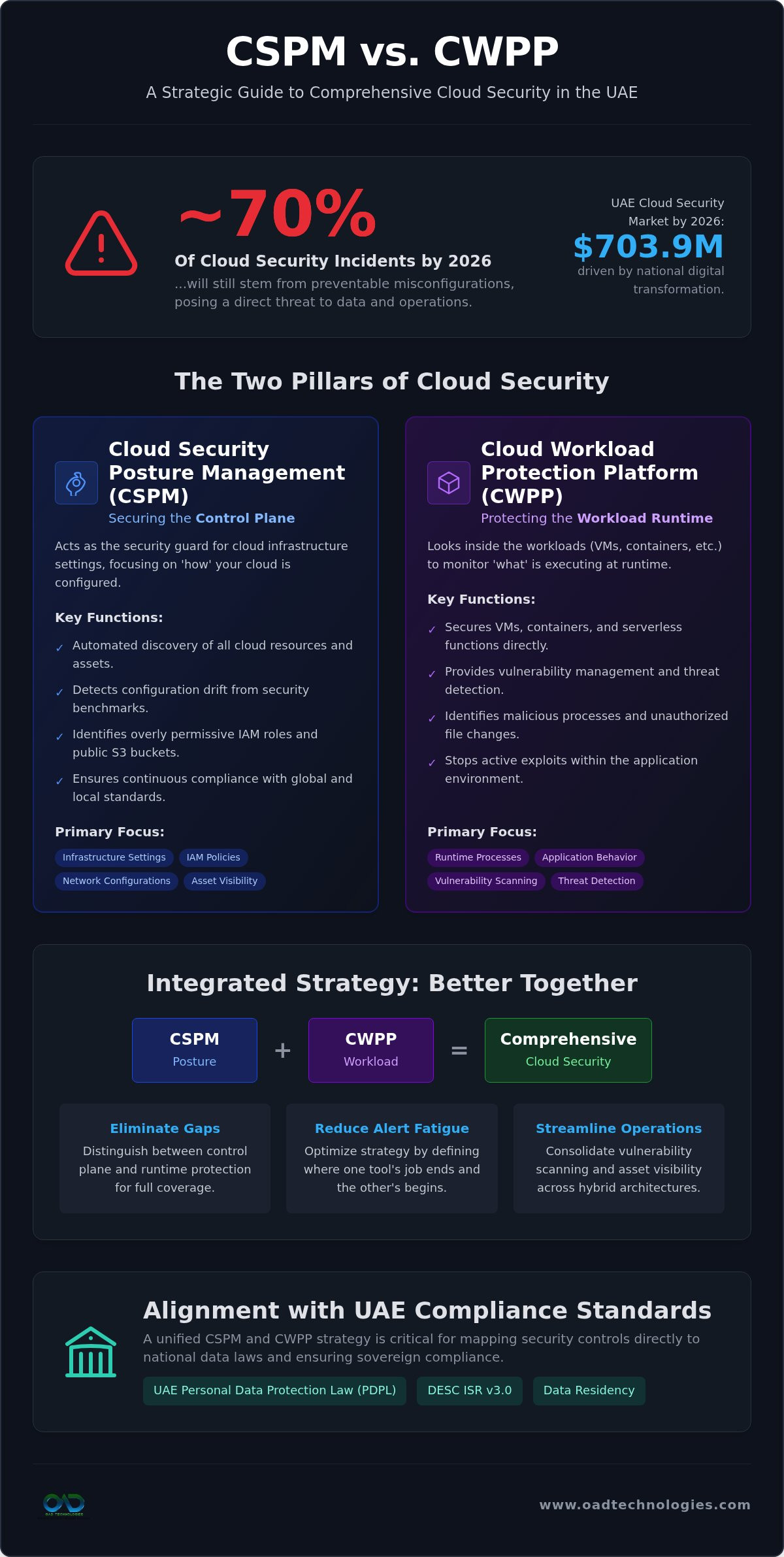
Nearly 70% of cloud security incidents in 2026 still stem from preventable misconfigurations. For enterprises across the Emirates, this isn't just a statistic; it's a direct threat to operational continuity and data integrity. Many local firms struggle with budget bloat and alert fatigue, often because they haven't yet optimised their CSPM solutions to work in harmony with their broader security stack. You've likely noticed that having more tools doesn't always result in better visibility, especially when your team is drowning in redundant notifications.
We understand the difficulty of mapping complex technical controls to the UAE Personal Data Protection Law or the DESC ISR v3.0 standards. This article masters the critical differences between Cloud Security Posture Management and Cloud Workload Protection Platforms. You'll learn to eliminate functional overlap and build a resilient, compliant infrastructure. We provide a clear roadmap for an integrated strategy that aligns perfectly with UAE national data laws and the latest IA Standards. By the end, you'll know how to transform your cloud security from a reactive cost centre into a proactive, strategic engine for long-term digital relevance.
Key Takeaways
- Distinguish between control plane configuration and workload runtime protection to eliminate critical security gaps in complex multi-cloud environments.
- Optimise your strategy for cspm solutions dubai by identifying where posture management ends and workload protection begins to reduce redundant alerts.
- Map your cloud security controls directly to the UAE Personal Data Protection Law (PDPL) to ensure data residency and sovereign compliance.
- Streamline your security operations by consolidating vulnerability scanning and asset visibility across hybrid cloud architectures.
- Discover how to integrate these specialised tools into a broader Managed Detection and Response framework for more effective threat hunting and incident resolution.
Navigating the Cloud Security Landscape in 2026
The traditional security perimeter has effectively vanished. By 2026, the UAE cloud security market has surged to a valuation of $703.9 million, driven by a national push toward digital transformation and multi-cloud adoption. Enterprise environments are no longer contained within a single data centre; they're distributed across various providers and hybrid setups. This evolution makes legacy "castle-and-moat" strategies obsolete. In this environment, your security is only as strong as your weakest configuration.
Success requires a deep understanding of the shared responsibility model. Your cloud provider ensures the security of the cloud, but you're solely responsible for security in the cloud. This includes managing identities, encrypting data, and ensuring correct configurations. Neglecting this distinction leads to "cloud ignorance," where simple misconfigurations account for nearly 70% of security incidents. For those evaluating cspm solutions dubai, the priority must be closing this accountability gap before an accidental exposure becomes a headline.
The Shift to Cloud-Native Architectures
Microservices and containers have replaced monolithic applications, bringing unprecedented agility to UAE businesses. However, this shift creates friction between DevOps speed and security governance. In a containerised world, assets are ephemeral. They spin up and down in seconds, making it nearly impossible for manual audits to keep pace. Visibility is now the primary challenge for modern cloud architects. Without a real-time view of your infrastructure, you're essentially flying blind, unable to verify if your latest deployment adheres to corporate policy.
Why Legacy Security Tools Fail in the Cloud
Traditional Endpoint Detection and Response (EDR) and network firewalls weren't designed for the cloud's dynamic nature. A standard firewall can't inspect the internal traffic flowing between microservices, nor can legacy EDR handle the scale of thousands of short-lived workloads. This is why modern cloud computing security requires a more sophisticated approach. You need tools that understand the control plane and the execution layer simultaneously. Standard tools lack the context to distinguish between a legitimate administrative change and a malicious exploit in progress.
The cost of getting this wrong is steep. Beyond the technical debt, there's the risk of non-compliance with the UAE Personal Data Protection Law (PDPL). Implementing robust cspm solutions dubai allows your team to move fast without breaking your security posture or risking heavy regulatory penalties. It's about building a foundation that supports innovation while maintaining the rigorous engineering standards your stakeholders expect.
Defining CSPM and CWPP: Core Functions and Objectives
Understanding the distinction between these two pillars is vital for any organisation scaling its digital footprint. While they often appear together in security discussions, they operate at different layers of the technology stack. One focuses on the "how" of your setup, while the other monitors the "what" of your execution. This layered approach aligns with the CISA cloud security guidance, which emphasises the need for both configuration integrity and runtime resilience.
Cloud Security Posture Management (CSPM) Explained
CSPM tools focus on the cloud control plane. They provide automated discovery of resources across diverse environments like AWS, Azure, and Google Cloud, ensuring that no "shadow" instances exist outside your governance. Their primary role is to detect configuration drift, such as an accidentally public S3 bucket or an overly permissive Identity and Access Management (IAM) role. When businesses invest in cspm solutions dubai, they gain a continuous feedback loop that checks their infrastructure against global best practices and local mandates. Cloud Security Posture Management serves as the security guard of the cloud infrastructure settings.
Cloud Workload Protection Platforms (CWPP) Explained
Where CSPM looks at the environment, CWPP looks inside the workloads themselves. This technology secures virtual machines, containers, and serverless functions at the runtime level. It provides vulnerability management and threat detection within the application environment, identifying malicious processes or unauthorised file changes as they happen. If you're running complex microservices, this visibility is indispensable for stopping active exploits. Cloud Workload Protection Platforms act as the bodyguard for the applications themselves.
The Strategic Synergy
The core objective of CSPM is reducing the attack surface by hardening the environment. In contrast, CWPP focuses on stopping active threats that have already bypassed initial defences. Both technologies provide critical telemetry that supports managed detection and response (MDR) efforts. By integrating these signals, your security operations centre can distinguish between a misconfiguration alert and a genuine breach attempt. This holistic view ensures that your team isn't just chasing ghosts but is actively defending against sophisticated adversaries. If you're unsure where your current gaps lie, a strategic cloud security review can help clarify your roadmap.
CSPM vs CWPP: A Comparative Analysis of Scope and Control
Selecting the right cspm solutions dubai requires a clear understanding of where your infrastructure management ends and your workload protection begins. In 2026, the complexity of hybrid environments means that focusing on just one domain leaves a gaping hole in your security fabric. While CSPM ensures your environment is built on a secure foundation, CWPP ensures that the operations running within that environment remain uncompromised. One manages the skeleton. The other manages the muscle.
Control Plane vs. Data Plane Protection
The primary distinction lies in the target of protection. CSPM focuses on the control plane, interacting directly with the APIs and management consoles of your cloud providers. It checks if your storage is encrypted or if your network security groups are too broad. Conversely, CWPP operates within the data plane. It targets the operating system and application layers of the workload itself, whether those are virtual machines, containers, or serverless functions.
These two domains work in tandem to prevent lateral movement during a breach. If an attacker bypasses a misconfigured firewall, which is a CSPM failure, the CWPP layer should detect the anomalous process execution as the intruder attempts to move between containers. Without this dual-layered visibility, a single oversight in your configuration can lead to a full-scale breach of your sensitive data. This synergy is what builds a truly resilient infrastructure.
Prevention vs. Active Protection
Think of CSPM as a proactive measure designed to prevent the "open door" scenario. It continuously audits your posture to ensure that every entrance is locked and every window is barred. However, if an intruder manages to pick the lock, they're inside. This is where CWPP takes over as the active protection measure. It functions like an intelligent motion sensor inside the room, identifying the intruder's presence and attempting to neutralise the threat in real time.
Asset visibility and vulnerability scanning represent the critical overlap between these tools. Both need to know what assets exist and which ones are vulnerable. In a mature security stack, the integration of identity and access management (IAM) is the glue that binds these together. IAM controls who can change the posture and who can access the workload, creating a unified security logic.
To manage the high volume of alerts generated by both systems, many UAE enterprises utilise a SIEM platform. By aggregating logs from both sources, security teams gain a unified view that distinguishes between a simple configuration drift and a coordinated attack. For organisations managing large-scale deployments, choosing cspm solutions dubai that offer seamless integration with existing monitoring tools is no longer optional. It's a strategic necessity for maintaining digital relevance in an ever-changing market.
Strategic Implementation: Alignment with UAE Compliance Standards
Compliance in the Emirates has transitioned from a set of voluntary best practices to a rigorous, enforceable framework. With the stricter enforcement of the UAE Information Assurance (IA) Standards in 2026, organisations handling Critical Information Infrastructure must now obtain National Cyber Accreditation Programme (NCAP) accreditation. This regulatory shift makes cspm solutions dubai a foundational requirement rather than a luxury. These tools don't just secure your data; they provide the verifiable evidence required for national audits.
The UAE Personal Data Protection Law (PDPL), or Federal Decree-Law No. 45 of 2021, mandates strict controls over how personal data is stored and transferred. CSPM allows you to enforce data residency policies automatically, ensuring that sensitive information remains within national borders as required by the Central Bank of the UAE (CBUAE) and other sector-specific regulators. By integrating these technical controls with your broader governance risk and compliance (GRC) strategy, you bridge the gap between high-level legal requirements and daily cloud operations.
Meeting UAE Regulatory Standards
Proving compliance requires more than just a secure setup; it requires continuous validation. CSPM serves this need by providing real-time visibility into your posture, mapping configuration settings directly to DESC ISR v3.0 requirements. While CSPM handles the environment's "state," CWPP satisfies the technical controls for sensitive data processing at the runtime level. OAD Technologies specialises in aligning these tools with national security frameworks, ensuring that your cloud architecture is both resilient and legally sound. We help you automate the reporting process, turning what used to be a months-long audit cycle into a streamlined, always-on verification engine.
The Evolution toward CNAPP
By 2026, the industry has largely moved toward Cloud-Native Application Protection Platforms (CNAPP). This evolution represents the strategic merger of CSPM and CWPP into a single, unified layer. Instead of managing disparate agents and consoles, CNAPP offers a holistic view of the entire application lifecycle. This unified approach combines agentless scanning for broad visibility with agent-based protection for deep, runtime security. It eliminates the silos between posture management and workload protection, allowing your team to focus on innovation rather than tool maintenance. If you're ready to modernize your approach, you can consult with our cloud security architects to design a tailored roadmap for your enterprise.
Adopting a unified platform reduces the risk of human error, which remains a primary cause of cloud incidents. When your posture management and workload protection speak the same language, you gain a clearer understanding of your actual risk profile. This synergy is particularly vital for financial institutions facing the CBUAE's 2026 deadlines for advanced authentication and impersonation risk assessments. A unified strategy ensures that every layer of your cloud stack contributes to a single, defensible security posture.
Securing Your Cloud Future with OAD Technologies
Software alone is rarely enough to secure a multi-cloud environment against sophisticated adversaries. While many global providers offer purely product-led approaches, OAD Technologies positions itself as a strategic partner that integrates technical tools into a unified security operations centre (SOC). We understand that the true value of cspm solutions dubai lies in how they're managed, monitored, and acted upon by experts who understand the local threat landscape. A tool without a strategy is just an additional source of noise in an already complex environment.
The OAD Approach to Cloud Resilience
Our methodology focuses on the synergy between human insight and technological capacity. We don't just deploy a platform; we provide a roadmap for long-term digital viability. This involves moving beyond basic configuration checks to deep technical security assessments, including specialised VAPT and comprehensive GRC consulting. By acting as a master designer of systems, we ensure that your security architecture is tailored to your specific operational needs. We reject standardised approaches in favour of precision and high-quality craftsmanship. This commitment ensures your organisation isn't just keeping pace with technology but actively shaping its future application.
We act as an extension of your own team. Our proactive, solution-oriented mindset is backed by rigorous engineering standards that prioritise business results over quick fixes. Whether you're a government entity or a private enterprise, our national focus ensures that your cloud strategy remains grounded in the reality of UAE regulations. We bridge the gap between high-level innovation and practical, defensible security outcomes.
Integrated Security Operations
OAD excels at breaking down technical silos. We integrate cloud security posture management directly into our Managed Detection and Response (MDR) framework. This allows for intelligent correlation between posture drifts and active workload threats, significantly reducing alert fatigue. When combined with data loss prevention (DLP) and Identity and Access Management (IAM), you achieve a level of asset protection that is both broad and deep. Our experts triage every notification, ensuring your team only focuses on the risks that truly matter.
The first step toward a more resilient cloud is a comprehensive gap analysis. We help you identify where your current cspm solutions dubai might be leaving you exposed or where tool overlap is causing unnecessary budget bloat. Our team provides the steady, deliberate guidance needed to manage the full development lifecycle of your security stack. Secure your digital relevance today by requesting a consultation for a customised cloud security architecture that protects your ongoing growth in an ever-changing market.
Building a Resilient Cloud Architecture for the UAE’s Digital Future
Navigating the complexities of a multi-cloud environment requires a shift from fragmented tools to a unified security logic. We've explored how the synergy between posture management and workload protection creates a defensible stack, balancing environmental hardening with runtime vigilance. For organisations operating under the UAE PDPL or DESC ISR v3.0, this dual approach is the only way to ensure data residency and sovereign compliance are maintained automatically. It's about moving beyond reactive fire-fighting toward a proactive, integrated security operations centre.
Choosing the right cspm solutions dubai involves more than just a software purchase; it requires a partnership focused on long-term digital relevance. As a UAE-based strategic cybersecurity partner, OAD Technologies specialises in aligning integrated MDR and GRC service delivery with national standards like NESA and the latest IA Standards. We provide the expert-led guidance needed to transform your cloud security from a cost centre into a strategic engine for growth. Secure your cloud infrastructure with OAD Technologies’ expert CSPM and CWPP solutions. Contact our team today. Your path to a secure, compliant cloud is a roadmap we're ready to design with you.
Frequently Asked Questions
What is the primary difference between CSPM and CWPP?
CSPM manages the security of your cloud infrastructure's configuration, while CWPP focuses on protecting the applications and data running within those workloads. Think of CSPM as the architect ensuring the building's blueprint is secure and CWPP as the security guard monitoring the activity inside the rooms. While CSPM prevents misconfigurations, CWPP detects and mitigates active threats at the runtime level, ensuring comprehensive coverage across your entire cloud stack.
Do I need both CSPM and CWPP for my cloud environment?
Yes, most modern enterprises require both to achieve a complete security posture. Relying solely on CSPM leaves you vulnerable to runtime exploits, while using only CWPP ignores the underlying configuration risks that allow attackers in. By integrating cspm solutions dubai with workload protection, you create a layered defence that addresses both the setup and the execution phases of your cloud operations, significantly reducing your overall risk profile and improving resilience.
How does CSPM help with UAE PDPL compliance?
CSPM facilitates compliance by providing automated visibility into where your data resides and how it's protected. It allows you to enforce residency policies that keep personal data within the UAE, a core requirement of Federal Decree-Law No. 45 of 2021. These tools continuously audit your environment against PDPL mandates, generating the necessary documentation for regulatory checks and ensuring that your cloud governance aligns perfectly with national data protection standards.
Can CWPP replace my existing endpoint security (EDR)?
CWPP doesn't replace EDR; instead, it extends protection to cloud-native environments like containers and serverless functions where traditional EDR often struggles. While EDR is excellent for persistent endpoints and virtual machines, CWPP is designed for the ephemeral, short-lived nature of modern cloud workloads. Using them together ensures that your security operations centre has full visibility across both your traditional infrastructure and your dynamic cloud-native applications, creating a more cohesive threat detection strategy.
What is CNAPP and how does it relate to CSPM and CWPP?
Cloud-Native Application Protection Platforms (CNAPP) represent the strategic consolidation of CSPM, CWPP, and other security functions into a single, unified platform. This evolution eliminates silos by providing a holistic view of the entire application lifecycle, from development to production. For UAE businesses, adopting a CNAPP approach simplifies management and improves threat detection by correlating posture risks with runtime alerts. This leads to more efficient incident response and reduced operational overhead in complex, multi-cloud architectures.
Which tool is more important for preventing data breaches in the cloud?
Neither tool is objectively more important because they address different stages of a potential breach. CSPM is vital for preventing the initial entry caused by misconfigurations, which remain a primary cause of cloud incidents globally. CWPP is equally critical for stopping an attacker who has already gained access to a workload. A strategic approach treats them as equal components of a unified security operations centre, ensuring that no stage of the attack lifecycle is left unmonitored or unprotected.
How often should CSPM scans be conducted for UAE enterprises?
Scans should be continuous rather than periodic. In a dynamic cloud environment where assets spin up and down in seconds, traditional weekly or monthly audits are insufficient. Real-time monitoring allows your team to detect configuration drift as soon as it occurs, ensuring that your cspm solutions dubai provide an accurate, up-to-the-minute view of your compliance status. This persistent vigilance is necessary to meet the rigorous engineering standards expected by UAE national regulators and auditors today.
Does CSPM work across different cloud providers like AWS and Azure?
Yes, enterprise-grade posture management tools are designed to provide a single pane of glass across multi-cloud environments, including AWS, Azure, and Google Cloud. This cross-platform visibility is essential for UAE firms that utilise diverse providers to maintain data sovereignty and avoid vendor lock-in. A unified dashboard allows your security team to apply consistent policies and compliance checks across your entire digital footprint, regardless of which cloud provider hosts the specific workload.
Disclaimer
Content by OAD Technologies is for general informational purposes only and does not constitute professional or cybersecurity advice. No warranties are made regarding accuracy or completeness; reliance is at your own risk. OAD Technologies shall not be liable for any direct or indirect losses arising from use of this content.