By 2026, the traditional security operations center will no longer be measured by how many alerts it processes, but by how effectively it anticipates the breaches that haven't happened yet. Many organizations across the UAE find themselves trapped in a cycle of alert fatigue, where the sheer volume of false positives obscures genuine threats. You've likely felt the strain of trying to recruit and keep specialized cybersecurity talent in a hyper-competitive market while worrying that a sophisticated attack might still slip past your existing defenses. Selecting a strategic mdr provider dubai has become less about outsourcing a task and more about architectural design for digital survival.
We understand that your goal isn't just to check a compliance box, but to build a fortress that empowers your internal team. This guide will show you how to evaluate a partner that bridges the gap between high-level technical innovation and the practical business resilience required to thrive. You'll discover how to achieve a drastic reduction in your Mean Time to Contain while supporting alignment with national standards like ISR and PDPL. We'll explore the evolution of response strategies and the necessity of a human-led approach that transforms cybersecurity from a cost center into a strategic asset for the long term.
Key Takeaways
- Understand the shift from reactive security to proactive, response-centric models that address the limitations of traditional EDR against multi-vector attacks.
- Define MDR as a strategic extension of your security team, pairing advanced telemetry with 24 X 7 human threat hunting and expert investigation.
- Learn how the integration of SIEM and EDR provides the foundational visibility and granular containment necessary for a resilient security architecture.
- Evaluate a potential mdr provider dubai based on their ability to maintain data residency and support alignment with UAE national standards like ISR and PDPL.
- Discover the value of a customized partnership that prioritizes human-tech synergy over standardized, one-size-fits-all security approaches.
The Evolution of Managed Detection and Response in the UAE
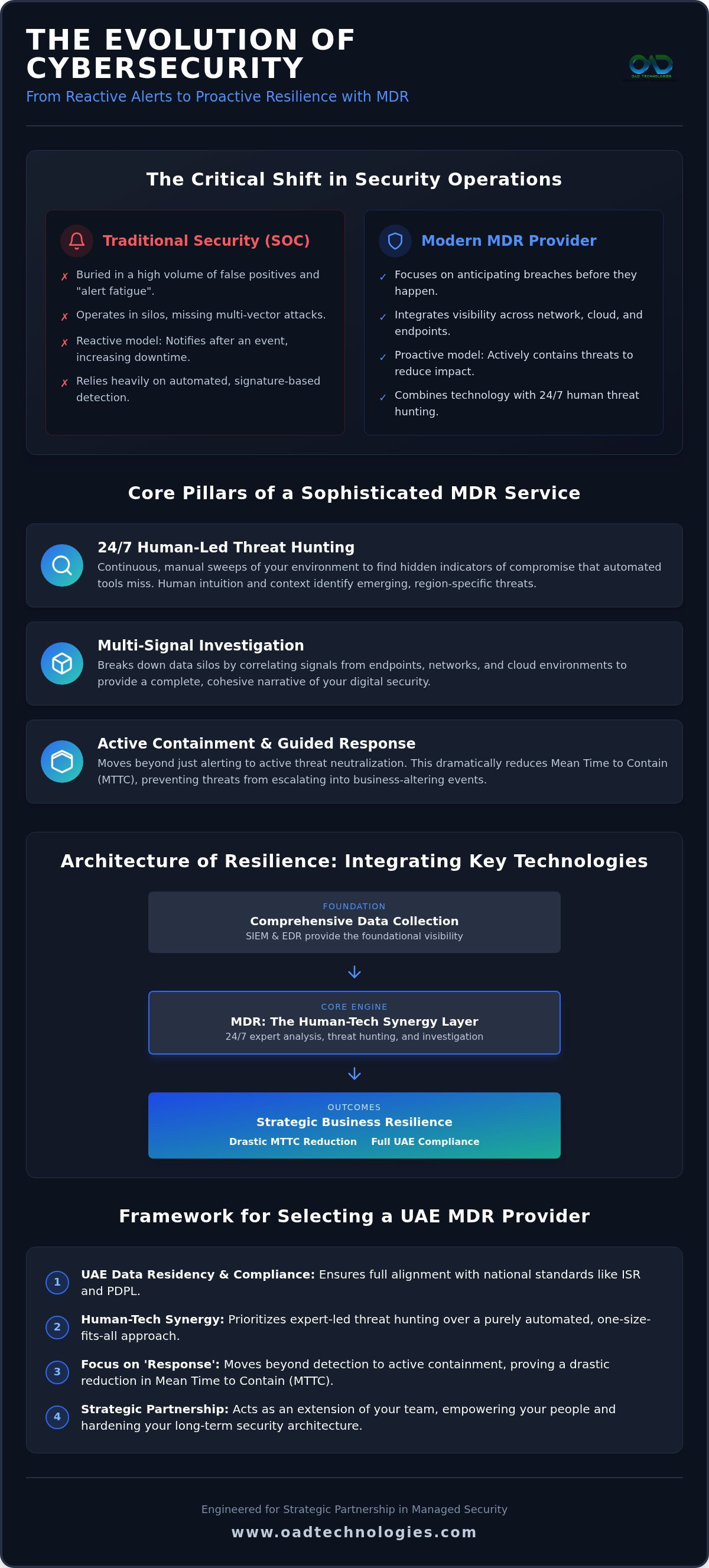
The cybersecurity landscape in the UAE has reached a critical inflection point. As national digital transformation initiatives accelerate, the complexity of the threat environment has outpaced the capabilities of traditional security operations centers. Many organizations find themselves buried under a mountain of data, struggling with the "alert fatigue" cycle that defines legacy models. In this context, the role of a specialized mdr provider dubai has evolved from a simple outsourcing option into a necessary architectural partnership. We're seeing a decisive shift away from reactive monitoring toward proactive, response-centric models that prioritize immediate containment over mere notification. This evolution is driven by the need for integrated visibility that spans network, identity, and cloud environments simultaneously.
Why Traditional Defense is No Longer Sufficient
Traditional Endpoint Detection and Response (EDR) solutions are powerful, but they often operate in silos. Modern, multi-vector attacks frequently bypass these automated tools by using "living-off-the-land" techniques. These methods involve using legitimate system tools to carry out malicious activities, making them nearly invisible to standard signature-based detection. Without deep human context and cross-signal visibility, automated systems can't distinguish between a routine administrative task and a sophisticated breach in progress. The cost of this delayed recognition is high; every minute an attacker remains undetected within your network increases the risk of catastrophic data loss and operational downtime. Relying solely on automation in 2026 is no longer a viable strategy for enterprise resilience.
The Strategic Importance of 'Response' in MDR
The "R" in MDR represents the most significant evolution in managed security. While traditional providers might simply pass an alert to your internal team, a sophisticated mdr provider dubai focuses on active containment. This means moving beyond "what happened" to "what we are doing about it right now." By integrating response directly into the detection cycle, businesses can achieve a dramatic reduction in their Mean Time to Contain (MTTC). This proactive stance ensures that threats are neutralized before they can escalate into business-altering events. It's about engineering long-term resilience, where the synergy between advanced infrastructure protection and human expertise safeguards your digital assets. This approach doesn't just replace your processes; it empowers your people to focus on strategic growth rather than constant fire-fighting.
Defining the Core Pillars of a Sophisticated MDR Service
Sophisticated Managed Detection and Response is a strategic extension of an enterprise's security team, combining advanced telemetry with human expertise to neutralize threats before they impact the bottom line. It's built on a triad of 24 X 7 threat hunting, deep investigation, and guided remediation. While many vendors focus on the technology, a true mdr provider dubai acts as a master designer of your security architecture, ensuring that every signal is accounted for across your network, endpoints, and cloud environments. This multi-signal visibility is vital. It breaks down the silos that attackers exploit, providing a cohesive narrative of your digital estate. For UAE boards and regulators, this creates the "Human Accountability Layer" necessary to prove that security isn't just an automated process, but a managed business risk.
24 X 7 Threat Hunting vs. Automated Detection
Automated tools are excellent at catching known patterns, but they often struggle with the subtle nuances of a bespoke attack. Proactive threat hunting involves continuous, manual sweeps of your environment to find hidden indicators of compromise that software might miss. Human analysts bring intuition and context to the table. They can spot an unusual login pattern that technically satisfies security rules but suggests a compromised identity. This original research allows a team to harden your defenses against emerging threats specific to the Gulf region. It's the difference between waiting for an alarm to go off and actively searching for the person trying to disable the alarm system.
Multi-Signal Investigation and Remediation
When data is siloed, your security narrative is incomplete. Sophisticated MDR integrates logs from your identity management, cloud posture, and network traffic to provide a 360 degree view of every incident. This allows for neutralization within minutes. Instead of just sending a report, your partner should bridge the gap between technical discovery and strategic response. They guide your team through the remediation process, ensuring the root cause is addressed to prevent recurrence. Choosing the right mdr provider dubai means finding a partner that understands the synergy between human insight and technological capacity. If you're looking to enhance your current posture, you can explore customized MDR integration that aligns with your specific operational needs. This level of detail ensures that your security investment translates directly into long-term business viability and regulatory confidence.
The MDR Lifecycle: Detect, Investigate, Respond
Effective MDR follows a three-stage lifecycle. Detection uses behavioral analytics to spot deviations from a baseline of normal activity, such as a user suddenly opening sensitive databases from an unrecognized location in the middle of the night. Investigation follows: analysts reconstruct the attack path to understand the full scope of the compromise before they act, so that containment deals with the whole incident rather than a single symptom.
Response is the final and most important stage. Some actions can be automated, such as isolating an infected workstation, while complex activity like lateral movement across the network calls for human-led intervention. Agreeing in advance which actions the provider may take on its own, and which need your approval, keeps the response fast without putting critical systems at risk.
Architecture of Resilience: Integrating SIEM, EDR, and MDR
True resilience isn't found in a single tool, but in the intelligent orchestration of multiple security layers. A premier mdr provider dubai acts as the master designer of this architecture, ensuring that your security stack functions as a unified whole rather than a collection of disconnected silos. Within this framework, SIEM provides the foundational visibility by aggregating logs from across your entire environment. While SIEM offers the broad view, Endpoint Detection and Response (EDR) delivers granular telemetry from individual devices, allowing for precise threat containment. MDR then orchestrates these signals, applying human intelligence to the data to neutralize complex attacks that automated systems might miss. The synergy between managed response and Data Loss Prevention (DLP) is particularly potent; it ensures that when a threat is detected, your most sensitive data assets are immediately shielded from exfiltration.
SIEM vs. EDR vs. MDR: Choosing the Right Layer
Understanding the specific role of each layer is essential for building a cost-effective and high-performance security posture. While you might be tempted to manage these tools in-house, the complexity of modern multi-vector attacks often makes a managed approach more reliable. Use the following comparison to evaluate your current coverage:
| Security Layer | Primary Scope | Response Capability | Typical Use Case |
|---|---|---|---|
| SIEM | Log Management | Passive Alerting | National Compliance (ISR/PDPL) |
| EDR | Endpoint Activity | Automated Blocking | Malware and Virus Containment |
| MDR | Full Infrastructure | Human-Led Response | Strategic Business Resilience |
Building a Unified Security Fabric
For an mdr provider dubai to be truly effective, they must integrate every signal into a single detection loop. This includes Identity and Access Management (IAM) data to spot credential theft and Cloud Security Posture Management (CSPM) telemetry to identify misconfigurations in real-time. By applying zero-trust principles through managed response, we ensure that every access request is verified and every anomaly is investigated. This unified fabric doesn't just identify threats; it creates a proactive defense that evolves alongside your business. It transforms security from a reactive burden into a stable foundation for digital expansion across the UAE.
Automation vs. Human Analysts
Security orchestration, automation and response (SOAR) playbooks give MDR its speed, but automation without oversight carries its own risk. If a playbook shuts down a critical production server because of a false positive, the disruption can outweigh the threat it was meant to stop. A mature provider uses automated actions for clear-cut, high-confidence detections and analyst review for anything ambiguous, so that each response is precise rather than blunt.
Selection Framework: Choosing an MDR Provider for National Compliance
Selecting a strategic partner requires a framework that balances technical prowess with strict adherence to UAE digital sovereignty. Your choice of an mdr provider dubai must prioritize data residency and sovereignty requirements to ensure sensitive national information stays within authorized borders. For many UAE enterprises this is driven by regulatory and contractual obligations, so confirm which requirements apply to your organization. By aligning your security operations with established Governance, Risk, and Compliance (GRC) frameworks, you transform security from a reactive cost into a documented, auditable process that satisfies both internal boards and external regulators. A partner's ability to map technical telemetry to specific regulatory controls is what separates a mere vendor from a master designer of systems.
Regulatory Alignment: DESC, PDPL, and ISR
Navigating standards like the Dubai Electronic Security Center (DESC) and the Personal Data Protection Law (PDPL) requires deep local market expertise. A sophisticated partner uses continuous monitoring to provide the evidentiary data needed for Information Security Regulation (ISR) audits. This proactive alignment means your response strategy doesn't just stop threats, but also keeps a reliable record of what happened. We recommend leveraging specialized GRC consulting to bridge the gap between your technical security posture and your long-term regulatory resilience. This approach means every incident response action is documented, which supports the evidence you provide in audits.
Operational Criteria for the Modern Enterprise
Beyond compliance, you must evaluate a provider based on their ability to deliver practical results. Mean Time to Contain (MTTC) serves as the primary KPI for any resilient organization. A partner should demonstrate a clear path to reducing this metric through 24 X 7 localized support and hands-on remediation. They should also possess the capability to support technical assessments like VAPT, ensuring that your detection capabilities are regularly validated against real-world attack scenarios. Look for vendor-agnostic capabilities that allow for seamless integration with your existing infrastructure, avoiding the trap of proprietary lock-in. A truly collaborative partner acts as an extension of your team, providing the human insight necessary to interpret complex data signals.
MDR vs. MSSP vs. In-House SOC
Most organizations weigh three operating models. A traditional managed security service provider (MSSP) typically monitors infrastructure, manages devices and forwards alerts, leaving investigation and response to your internal team. An in-house security operations center (SOC) gives you full control, but staffing it around the clock means recruiting and retaining several specialists to cover shifts, leave and training, on top of the cost of the tooling. MDR sits between the two: the provider hunts for threats, investigates them and takes agreed containment actions, while your team keeps strategic control through shared dashboards and playbooks.
Due Diligence Questions to Ask an MDR Provider
Technical datasheets show what a provider's tools can do; due diligence shows how its team works under pressure. Ask these questions before you sign:
- What is your response methodology? Ask for examples of the containment actions the provider takes, such as isolating a host or ending a malicious process, and agree clear rules of engagement so that a response never causes avoidable downtime.
- What level of response do you offer? Services range from basic notification, where your team investigates every alert, through guided remediation, where analysts tell your team what to do, to direct response, where the provider acts within agreed limits and follows up with a root-cause analysis.
- Which service levels will you commit to? Look for service level objectives and real-time reporting on time to detect and time to contain, presented in a way your leadership can read as business risk.
- How do analysts and automation work together? Ask how ambiguous "grey zone" alerts are handled, what experience and certifications the analysts watching your environment hold, and whether you will have a named contact who understands your business.
- Where is our data stored and processed? Confirm where telemetry and logs are kept, who can access them and how long they are retained, and check this against the obligations that apply to your organization.
If you're ready to align your security architecture with UAE national standards, consult with our GRC experts to design a compliant and resilient roadmap for your enterprise.
OAD Technologies: Engineering Strategic Partnership in Managed Security
OAD Technologies operates on a fundamental rejection of standardized, "black box" security models. We believe that every enterprise architecture is unique, requiring a bespoke integration strategy rather than a one-size-fits-all product. As a specialized mdr provider dubai, our role is to act as a collaborative extension of your own team. We don't just replace your processes; we empower your people by providing the high-level telemetry and human insight needed to make informed strategic decisions. This partnership model ensures that your organization remains resilient against the sophisticated threats of 2026 while maintaining clear accountability to your board and regulators. By acting as a master designer of systems, we bridge the gap between high-level innovation and the practical results your business demands.
The OAD Approach to MDR
Our methodology centers on a multi-signal detection loop that integrates SIEM, EDR, and IAM into a holistic defense fabric. By synthesizing data from these diverse sources, we create a comprehensive narrative of your digital estate. This visibility allows our analysts to perform proactive threat hunting and strategic containment with surgical precision. We focus on neutralizing threats at the source, significantly reducing the Mean Time to Contain (MTTC) while ensuring that your business operations continue without interruption. This isn't just about faster detection. It's about engineering a system where technology and human intelligence work in perfect synergy. We prioritize:
- Customized security roadmaps tailored to your specific business risks and operational challenges.
- Deep integration across network, identity, and cloud layers for total infrastructure protection.
- Human-led response that provides vital context beyond what automated alerts can offer.
- Continuous refinement of detection logic based on original threat research.
Securing Your Digital Future
Moving from tactical security to visionary resilience requires a partner who acts as a guardian of your digital assets. OAD Technologies positions your organization for long-term relevance in the UAE market by aligning your security posture with national standards and future technological shifts. We help you navigate the transition from reactive fire-fighting to a state of proactive readiness. This evolution is essential for maintaining a competitive edge in an increasingly complex digital landscape. Choosing the right mdr provider dubai is a commitment to the long-term viability of your enterprise.
Initiating a strategic assessment of your current posture is the first step toward this transformation. We work with you to identify hidden vulnerabilities and design a roadmap that integrates seamlessly with your existing infrastructure. By securing your digital future today, you ensure that your enterprise is prepared for the challenges of tomorrow. This proactive stance protects your reputation, your data, and your bottom line.
Engineering Tomorrow’s Cyber Resilience Today
The shift toward a proactive, response-centric security model is no longer optional for UAE enterprises aiming for long-term viability. By integrating multi-signal telemetry from SIEM, EDR, and DLP, organizations can bridge the gap between technical detection and strategic containment. Selecting a specialized mdr provider dubai helps keep your architecture aligned with national standards like ISR and PDPL while empowering your internal team with human-led insights. This architectural approach transforms security from a reactive cost into a stable foundation for digital expansion.
OAD Technologies acts as a master designer of these systems, focusing on the synergy between advanced infrastructure protection and human accountability. We don't just provide tools; we build a strategic partnership that safeguards your digital assets against the sophisticated threats of 2026. It's time to move beyond tactical fire-fighting and embrace a visionary approach to enterprise security that prioritizes long-term resilience over quick fixes. We're committed to helping you navigate this evolution with precision and expertise.
Explore OAD's Managed Detection and Response Solutions to start your journey toward a more resilient future. We look forward to helping you shape a secure and compliant digital landscape.
Frequently Asked Questions
What is the difference between a SOC and an MDR provider?
A traditional SOC primarily focuses on monitoring and alerting, whereas a sophisticated mdr provider dubai delivers active threat containment. While a SOC might notify your team of an anomaly, an MDR service uses human expertise to investigate and neutralize the threat in real-time. This shift from passive observation to active response is critical for reducing your Mean Time to Contain (MTTC) and ensuring business continuity during complex cyber incidents.
How does an MDR provider in the UAE support PDPL compliance?
An MDR provider cannot make an organization compliant on its own, but it can support its obligations under the Personal Data Protection Law (PDPL). Agree where telemetry and logs are stored and processed, and who can access them, so that these arrangements match your organization's obligations. By mapping technical detections to specific GRC controls, the provider can supply the evidence needed for audits and regulatory reviews. This turns security monitoring into a documented process that supports both regulatory requirements and internal governance.
Can an MDR provider actually stop an active ransomware attack?
Yes, an MDR service can neutralize ransomware before it encrypts your critical data. By integrating with Endpoint Detection and Response (EDR) tools, analysts can remotely isolate compromised hosts and terminate malicious processes within minutes. This rapid response prevents the lateral movement necessary for a large-scale attack. We focus on active containment strategies that protect your digital assets even when traditional signature-based defenses fail to recognize a new threat variant.
Does MDR replace our existing security team or tools?
MDR doesn't replace your internal team; it acts as a strategic extension that handles the overwhelming volume of false-positive alerts. This allows your specialists to focus on high-level security architecture and business-critical projects. We integrate with your existing security stack, such as SIEM and IAM, to enhance their value rather than rendering them obsolete. Our goal is to empower your people through advanced technology and 24 X 7 human-led oversight.
What signals should a modern MDR provider monitor?
A modern security posture requires multi-signal visibility across your entire infrastructure. We monitor telemetry from endpoints, network traffic, identity management systems, and cloud environments to create a unified detection loop. This comprehensive approach ensures that attackers have nowhere to hide, even if they use "living-off-the-land" techniques. By synthesizing logs from disparate sources, we provide a cohesive narrative of every incident, allowing for more precise and effective remediation.
How does MDR integrate with Data Loss Prevention (DLP)?
Integrating MDR with Data Loss Prevention (DLP) creates a powerful synergy for protecting sensitive information. While MDR focuses on detecting and responding to the intrusion, DLP acts as a final barrier to prevent the unauthorized exfiltration of corporate data. This dual-layered approach ensures that even if a perimeter is breached, your most valuable digital assets remain shielded. We design these systems to work in tandem, providing a resilient defense against both external actors and internal risks.
What is the typical onboarding time for an MDR service?
Onboarding follows a structured development lifecycle to ensure seamless integration with your environment. You can expect initial visibility and basic monitoring to be active within a few days of deployment. Full architectural optimization, including the fine-tuning of custom detection rules and GRC alignment, typically takes several weeks. This deliberate pace ensures that your mdr provider dubai understands your unique operational context before assuming full responsibility for your 24 X 7 defense.
Why is localized threat intelligence important for UAE businesses?
Localized threat intelligence is vital because attackers often tailor their methods to specific regions or industries within the UAE. Understanding the local threat landscape allows us to anticipate campaigns targeting Gulf-based financial or government entities before they reach your network. This regional context also ensures that your response strategies remain aligned with local regulatory shifts, such as DESC or ISR standards. We prioritize regional awareness to provide a more relevant and proactive defense.
Is MDR suitable for small and medium-sized enterprises (SMEs)?
Yes. MDR gives smaller organizations access to round-the-clock monitoring and specialist analysts without having to build and staff an in-house SOC. It lets an SME maintain a mature security posture while its internal IT team stays focused on day-to-day operations.
Does MDR include remediation or only alerts?
It depends on the service level you agree. Modern MDR services go beyond alerts and take direct containment actions, such as ending malicious processes, isolating compromised endpoints or disabling compromised accounts, within rules of engagement agreed in advance. Clarify during selection which actions the provider takes on its own and which it hands back to your team.
What happens in the first 24 hours after an MDR team detects a critical threat?
The first priority is containment: analysts isolate affected systems to stop the attacker moving across the network. They then investigate how the attacker got in and what was affected, and begin remediation with your team. A root-cause report with recommendations to prevent a repeat usually follows. The timings for each step should be set out in your service level agreement.
Can we keep our existing EDR tools when moving to MDR?
Often, yes. Many providers support a "bring your own license" model and integrate with the EDR platform you already run, which avoids a costly rip-and-replace. Confirm during evaluation that the provider supports your specific tools and can respond through them.
Which metrics show whether an MDR service is working?
Track mean time to detect (MTTD), mean time to respond or contain (MTTR/MTTC), the false-positive rate and the quality of the root-cause analysis after each incident. For return on investment, compare the cost of the service with the total cost of running an equivalent 24 X 7 in-house SOC, and with the time your own team gets back.
Is our data stored in the UAE when using MDR?
That depends on the provider and how the service is designed, so ask directly. Confirm where security telemetry and logs are stored and processed, who can access them and how long they are retained, and check these arrangements against the regulatory and contractual obligations that apply to your organization.
Disclaimer
Content by OAD Technologies is for general informational purposes only and does not constitute professional or cybersecurity advice. No warranties are made regarding accuracy or completeness; reliance is at your own risk. OAD Technologies shall not be liable for any direct or indirect losses arising from use of this content.