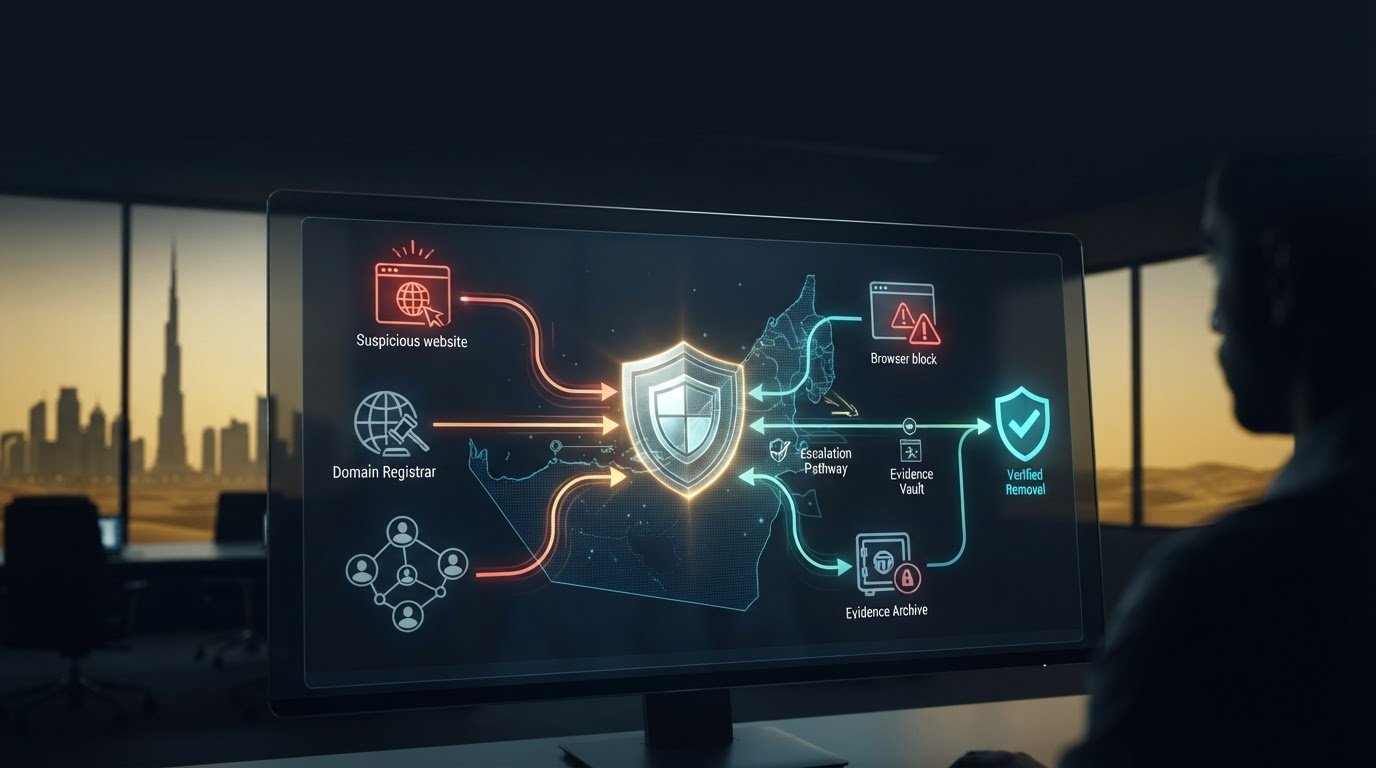
Organizations with a tested cyber incident response plan reduce the cost of a data breach by an average of $2.66 million compared to those left scrambling in the dark. You likely already know that a static document sitting on a shared drive won't stop a sophisticated 2026-era ransomware attack. The challenge lies in the sheer complexity of coordinating a multi-departmental response while the clock is ticking. It's a high-stakes environment where breach latency isn't just a technical metric; it's a direct hit to your bottom line and organizational reputation.
This guide helps you master the architecture of a modern cyber incident response plan that integrates Managed Detection and Response (MDR) with robust Data Loss Prevention (DLP). We'll show you how to align your technical actions with strict GRC requirements to ensure full compliance with UAE PDPL and ISR standards. By bridging the gap between human insight and automated systems, you'll build a scalable framework designed to reduce your mean time to respond (MTTR) and secure your organization's long-term digital resilience.
Key Takeaways
- Learn why a modern cyber incident response plan must transition from a static document to a living operational framework capable of countering 2026-era automated threats.
- Discover how real-time telemetry from SIEM and EDR solutions enables automated detection to trigger response protocols before human intervention is required.
- Understand how to leverage DLP as a secondary firewall to protect sensitive assets while ensuring your response aligns with UAE PDPL and ISR regulatory timelines.
- Master the six-phase execution model to effectively identify, contain, and eradicate sophisticated zero-day exploits and ransomware.
- Explore the synergy between human insight and MDR technology to build a customized security architecture that prioritizes long-term resilience.
Defining the 2026 Cyber Incident Response Plan
A cyber incident response plan is a living operational framework designed to detect, analyze, and mitigate cyberattacks before they escalate into catastrophic failures. In 2026, these plans must account for a new breed of AI-driven automated threats and zero-day exploits that move at machine speed, far outpacing manual intervention. This plan acts as the critical bridge between technical defense and business continuity, ensuring the organization remains viable under pressure. The ultimate objective is to minimize the Mean Time to Respond (MTTR) and reduce operational downtime to the absolute minimum.
Beyond the Document: Operational Readiness
Static PDF files stored on a local drive are a liability, not an asset. During a high-velocity ransomware attack, you can't afford to waste minutes searching for a document on a compromised network. High-performing teams understand that computer security incident management is about muscle memory and immediate access. The enterprise security mindset has shifted from asking "if" a breach will occur to preparing for "when" it happens. Your cyber incident response plan must be accessible even during total network outages, requiring offline, encrypted copies of playbooks and clearly defined communication channels that don't rely on internal infrastructure.
Operational readiness also involves the human element. It's not enough to have a list of steps; your Computer Security Incident Response Team (CSIRT) needs to practice these protocols until they become second nature. This proactive stance ensures that when an automated threat bypasses initial defenses, the response is calculated rather than chaotic.
The Financial Impact of Response Latency
The cost of a data breach is no longer just a line item; it's a direct threat to shareholder value and brand equity. In 2026, organizations with a tested and optimized cyber incident response plan save an average of $2.66 million per incident compared to those without one. Rapid containment is the only way to protect your reputation and maintain trust in a competitive market. Every minute of latency allows an attacker to exfiltrate more data or deepen their persistence within your systems.
Pre-incident preparation serves as the foundation of this speed. Utilizing Vulnerability Assessment and Penetration Testing (VAPT) allows you to identify and remediate the gaps in your architecture before an adversary exploits them. By simulating real-world threats, you refine your response speed and ensure that when a real event occurs, your team acts with surgical precision. This synergy between offensive testing and defensive planning creates a resilient posture that guards your digital assets during recovery.
The Technical Engine: Detection and Analysis
Detection is no longer a passive activity. A modern cyber incident response plan functions as an automated engine, fueled by continuous telemetry from every layer of the infrastructure. In 2026, waiting for a human to review an initial alert is a strategic failure. Automated detection systems now trigger the containment phase of the response plan instantly, neutralizing threats before they can move laterally. This proactive approach relies on a unified visibility strategy that spans cloud environments, endpoints, and network traffic. Without this 360-degree view, blind spots become breeding grounds for zero-day exploits.
Effective analysis requires:
- Real-time telemetry across all enterprise layers.
- Automated triage of low-level security events.
- Contextual enrichment of high-priority alerts.
Following the NIST Computer Security Incident Handling Guide, the detection and analysis phase requires high-fidelity data to differentiate between routine noise and genuine incidents. This involves more than just collecting logs; it requires the correlation of disparate data points to reveal the story behind the activity. Integrating this level of precision into your cyber incident response plan prevents teams from becoming overwhelmed by false positives. Effective analysis transforms raw data into actionable intelligence, allowing for a surgical response that stops breaches before they become material.
Synergizing SIEM and EDR for Real-Time Visibility
Visibility requires the integration of specialized tools. While SIEM aggregates logs to identify patterns of lateral movement, EDR provides device-level control. EDR can isolate a compromised endpoint immediately, stopping ransomware in its tracks. The SIEM then provides the context needed to understand the attack's scope. In multi-cloud architectures, this centralized visibility is essential for maintaining a consistent security posture.
The Role of Managed Detection and Response (MDR)
Technology provides the speed, but human insight provides the strategy. MDR acts as the active component of your 2026 response plan. It provides the specialized expertise required to triage complex, multi-stage attacks. 24 X 7 monitoring is now a prerequisite for regulatory compliance in the UAE. Expert analysts prevent alert fatigue by validating threats in real-time, allowing your team to focus on high-level recovery. It's about empowering people through technology.
Enterprises that prioritize customized security integration often find they can reduce MTTR by significant margins through better tool synergy and expert oversight.
Data-Centric Response and UAE Compliance
Attackers in 2026 don't just want to disrupt your operations; they want your data. Because data is the primary target of modern adversaries, a cyber incident response plan must shift from a perimeter-first approach to a data-centric model. If an adversary gains entry, the priority shifts from blocking the door to securing the vault. Integrating data protection directly into your response protocols ensures that even if systems are compromised, the actual value of the enterprise remains shielded. Data protection and incident response are two sides of the same coin; one secures the digital perimeter while the other guards the crown jewels during an active crisis.
Integrating Data Loss Prevention (DLP) into Response
During the containment phase of an incident, Data Loss Prevention (DLP) acts as a secondary firewall. While your technical teams work to isolate infected endpoints, DLP policies monitor and block the unauthorized movement of sensitive files across the network. This real-time visibility prevents exfiltration, turning a potentially catastrophic breach into a manageable security event. It provides the "active" defense needed when traditional network controls are bypassed.
DLP also serves as a critical forensic tool for your team. It allows you to verify the exact scope of a data breach by tracking which files were accessed, modified, or moved. This level of precision is vital for accurate reporting and recovery. Instead of guessing the extent of the damage, you provide stakeholders with documented evidence of what was protected and what was exposed, which significantly reduces the cost of post-incident investigations.
Navigating UAE PDPL and ISR Requirements
Compliance in the UAE market requires more than technical expertise; it demands a deep understanding of local legal frameworks. Your cyber incident response plan must include specific playbooks designed for the UAE Personal Data Protection Law (PDPL). These playbooks outline the exact steps for notifying the UAE Data Office and affected individuals within the mandated 2026 timelines. Failure to align your response with these windows can result in severe financial penalties and legal exposure.
Aligning technical logs with Information Assurance Regulation (ISR) standards is equally important for national enterprises. ISR requires rigorous reporting and evidence of control effectiveness throughout the incident lifecycle. By utilizing Governance, Risk, and Compliance (GRC) expertise, you bridge the gap between low-level technical logs and high-level regulatory requirements. This strategic alignment ensures your response survives national audits and maintains your organization's standing in the regional market, positioning security as a business enabler rather than a hurdle.
Executing the 6 Phases of Incident Response
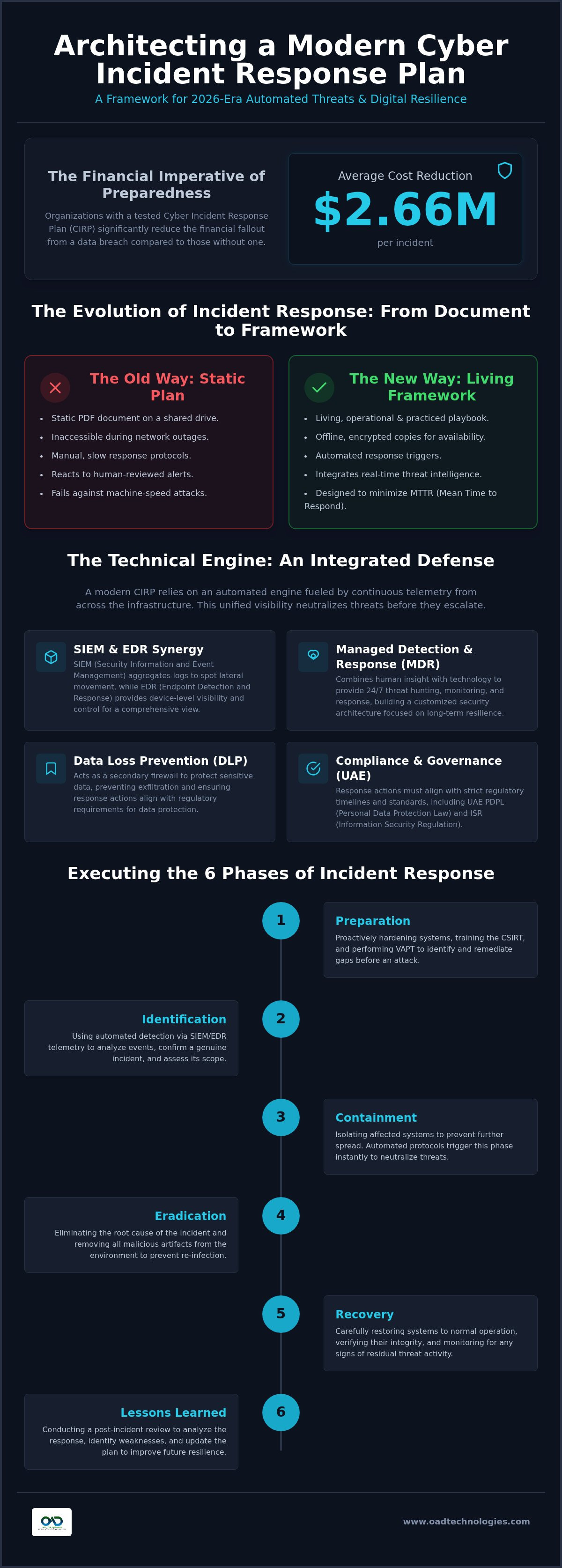
A rigorous 6-phase lifecycle ensures that your cyber incident response plan remains effective against the high-velocity threats of 2026. While legacy 4-phase models might suffice for smaller environments, national enterprises require more granular control to manage complex lateral movement. This structured process moves the organization from a state of chaos to one of restored stability, ensuring every action is documented and every vulnerability is closed. It's about building a repeatable engine for resilience.
- Preparation: Hardening the digital environment and conducting regular CSIRT drills to build team muscle memory.
- Identification: Utilizing real-time telemetry to differentiate routine security events from true, material incidents.
- Containment: Deploying immediate isolation strategies to stop the spread of malicious code across network segments.
- Eradication: Removing all traces of the adversary, sweeping for compromised credentials, and patching the initial entry vector.
- Recovery: Restoring systems from clean backups in a phased approach while monitoring for signs of re-infection.
- Lessons Learned: Analyzing forensic data to update playbooks and improve the long-term security posture.
Containment and Eradication Strategies
Tactical isolation is the cornerstone of effective containment. By segmenting network layers, you prevent ransomware from traversing the enterprise. In modern hybrid environments, this requires a synergy between local endpoint controls and cloud-native security. Utilizing Cloud Security Posture Management (CSPM) is essential for securing workloads post-breach, as it identifies misconfigurations that might allow an attacker to regain persistence. Analysts must prioritize forensic imaging before any system wipe and restore; without this data, you won't understand the full scope of the compromise or the adversary's intent.
Post-Incident Activity and GRC Alignment
Post-incident activity isn't just an administrative hurdle; it's a strategic opportunity to harden your defenses. A deep root cause analysis allows your team to update DLP and SIEM policies, ensuring the same attack vector can't be exploited twice. This data must flow directly into your risk register, ensuring your cyber incident response plan remains a living document within the broader Governance, Risk, and Compliance (GRC) framework. Communicating with stakeholders and regulators is much more efficient when using pre-approved templates that meet UAE PDPL standards. This alignment ensures that your technical response translates into legal and operational compliance, protecting the organization's reputation and shareholder value.
OAD Technologies acts as a strategic partner to help you design and test these complex playbooks. If you need to validate your current readiness, you can request a customized incident response audit to ensure your framework is fully 2026-ready.
Building Your Resilience with OAD Technologies
Standardized security protocols often fail because they don't account for the unique architectural nuances of a national enterprise. At OAD Technologies, we reject the "one-size-fits-all" approach in favor of highly individualized security designs. We act as master designers, crafting a cyber incident response plan that is deeply integrated into your specific operational reality. Our promise is simple: we provide the long-term viability and digital relevance you need to thrive in a volatile threat landscape. By acting as a strategic partner rather than a distant vendor, we ensure your defense is as agile as the adversaries you face.
Our methodology focuses on the critical synergy between human insight and technological capacity. While automated tools provide the necessary speed, it's the specialized expertise of our team that provides the strategic direction during a crisis. We don't just hand over a document; we build a resilient ecosystem that empowers your people and protects your most valuable digital assets.
Customized Response Architectures
A truly effective cyber incident response plan must be a seamless extension of your existing technology stack. We specialize in integrating your current infrastructure with our Managed Detection and Response (MDR) services to create a unified defensive front. This isn't about replacing what you have; it's about optimizing your SIEM and EDR telemetry to ensure no signal is missed. Our team develops bespoke playbooks that reflect your organization's specific data risks and recovery priorities.
We also bridge the communication gap that often exists between executive leadership and technical specialists. During an incident, clear reporting is vital for business continuity. We provide the structured, logical frameworks that allow technical teams to act with precision while giving leadership the high-level visibility needed to make informed strategic decisions. This alignment ensures that every department moves in unison when the clock is ticking.
A Proactive Partnership for 2026
Resilience isn't a destination; it's a continuous state of evolution. We help you move beyond reactive firefighting to a posture of proactive resilience. Through ongoing Vulnerability Assessment and Penetration Testing (VAPT), we identify and remediate weaknesses before they can be exploited. This offensive testing, combined with our strategic Governance, Risk, and Compliance (GRC) consulting, ensures your framework remains compliant with the latest UAE standards and national audits.
We position OAD Technologies as a transparent extension of your internal security team. Our collaborative mindset means we're constantly refining your defenses based on the latest forensic data and emerging 2026 threat intelligence. This proactive commitment to your success ensures that your enterprise isn't just keeping pace with technology but actively shaping its own secure future. We are the guardians of your digital relevance, providing the engineering excellence required for enduring stability.
Secure Your Digital Future with Operational Excellence
The shift from a static document to a living, automated cyber incident response plan defines the enterprise security landscape of 2026. By synchronizing real-time telemetry from SIEM and EDR with the strategic oversight of Managed Detection and Response, your organization moves from reactive firefighting to proactive resilience. Protecting your data during the containment phase requires specialized DLP integration, ensuring that even under pressure, your core assets remain secure and your operations stay aligned with UAE PDPL and ISR standards.
Building this level of sophistication requires more than just software; it demands a partnership with a UAE-based technical authority that deeply understands the national regulatory environment. As specialists in advanced MDR and DLP integration, we bridge the gap between technical defense and strategic GRC requirements to ensure your long-term digital viability. Secure your enterprise resilience with a customized response strategy from OAD Technologies. We're ready to help you design a future-proof architecture that empowers your team and protects your organization's digital legacy in an ever-changing market.
Frequently Asked Questions
What are the essential components of a cyber incident response plan in 2026?
Essential components of a cyber incident response plan in 2026 include automated detection playbooks, real-time telemetry, and regulatory reporting templates. A modern plan must include technical containment steps for AI-driven threats and clear communication protocols. It's an operational framework that bridges technical defense with business continuity. Inclusion of Managed Detection and Response (MDR) ensures expert human oversight during critical phases. This structure guarantees that technical actions lead directly to operational recovery.
How does a response plan differ for cloud vs. on-premise incidents?
Cloud response focuses on shared responsibility models and identity-based perimeters, while on-premise response emphasizes network segmentation and physical infrastructure. In the cloud, you rely on APIs and Cloud Security Posture Management (CSPM) to isolate workloads. On-premise incidents often require manual hardware isolation and forensic imaging. Your response strategy must account for these different visibility layers to ensure no blind spots remain during an active breach of your hybrid environment.
Who should be included in an enterprise Incident Response Team (CSIRT)?
A robust CSIRT includes technical leads, legal counsel, GRC specialists, and executive leadership. Technical members handle identification and containment, while legal and GRC teams manage compliance with UAE PDPL and ISR standards. Communications professionals are also vital for managing brand reputation. This multi-disciplinary approach ensures that the technical response aligns with broader business objectives and regulatory obligations, preventing silos and ensuring accountability throughout the entire lifecycle of an incident.
How often should we test our incident response plan through tabletop exercises?
Enterprises should conduct tabletop exercises at least twice a year to maintain operational readiness. High-risk sectors or those undergoing rapid digital transformation often benefit from quarterly drills. These exercises test the muscle memory of the CSIRT and identify gaps in the existing cyber incident response plan. Regular testing ensures that playbooks remain relevant against evolving 2026 threats and that all stakeholders understand their specific roles during a high-velocity attack.
What are the mandatory reporting requirements for cyber incidents in the UAE?
Mandatory reporting in the UAE is governed primarily by the Personal Data Protection Law (PDPL) and Information Assurance Regulation (ISR). Organizations must notify the UAE Data Office of material personal data breaches within the specific timelines established for 2026. National entities must also adhere to ISR standards, which require detailed documentation of control effectiveness. Your plan should include pre-approved templates to ensure reporting is accurate, timely, and compliant with rigorous national audits.
Can Managed Detection and Response (MDR) replace a formal response plan?
Managed Detection and Response cannot replace a formal plan; it acts as the active engine that executes the plan's technical phases. While MDR provides 24 X 7 monitoring and expert triage, the response plan defines the broader business context, legal obligations, and communication strategies. A formal plan provides the strategic roadmap that the MDR team follows. Without this framework, even the most advanced technical response will lack the coordination needed for organizational resilience.
How does Data Loss Prevention (DLP) assist in the recovery phase of an incident?
Data Loss Prevention (DLP) assists in the recovery phase by acting as a guardian for restored digital assets. It monitors the environment for signs of re-infection or unauthorized data movement as systems come back online. By verifying that sensitive data remains within authorized boundaries, DLP provides the forensic evidence needed to confirm successful eradication. This ensures that the recovery process doesn't inadvertently trigger a second wave of exfiltration during the restoration of critical services.
What is the role of SIEM and EDR in automating the response process?
SIEM and EDR are the primary tools for automating the detection and containment phases. SIEM aggregates logs to identify patterns of lateral movement, while EDR provides the capability to isolate compromised endpoints instantly without human intervention. This synergy reduces the mean time to respond (MTTR) by neutralizing threats at machine speed. In 2026, these automated triggers are essential for stopping high-velocity ransomware before it can encrypt or exfiltrate critical enterprise data.
Disclaimer
Content by OAD Technologies is for general informational purposes only and does not constitute professional or cybersecurity advice. No warranties are made regarding accuracy or completeness; reliance is at your own risk. OAD Technologies shall not be liable for any direct or indirect losses arising from use of this content.