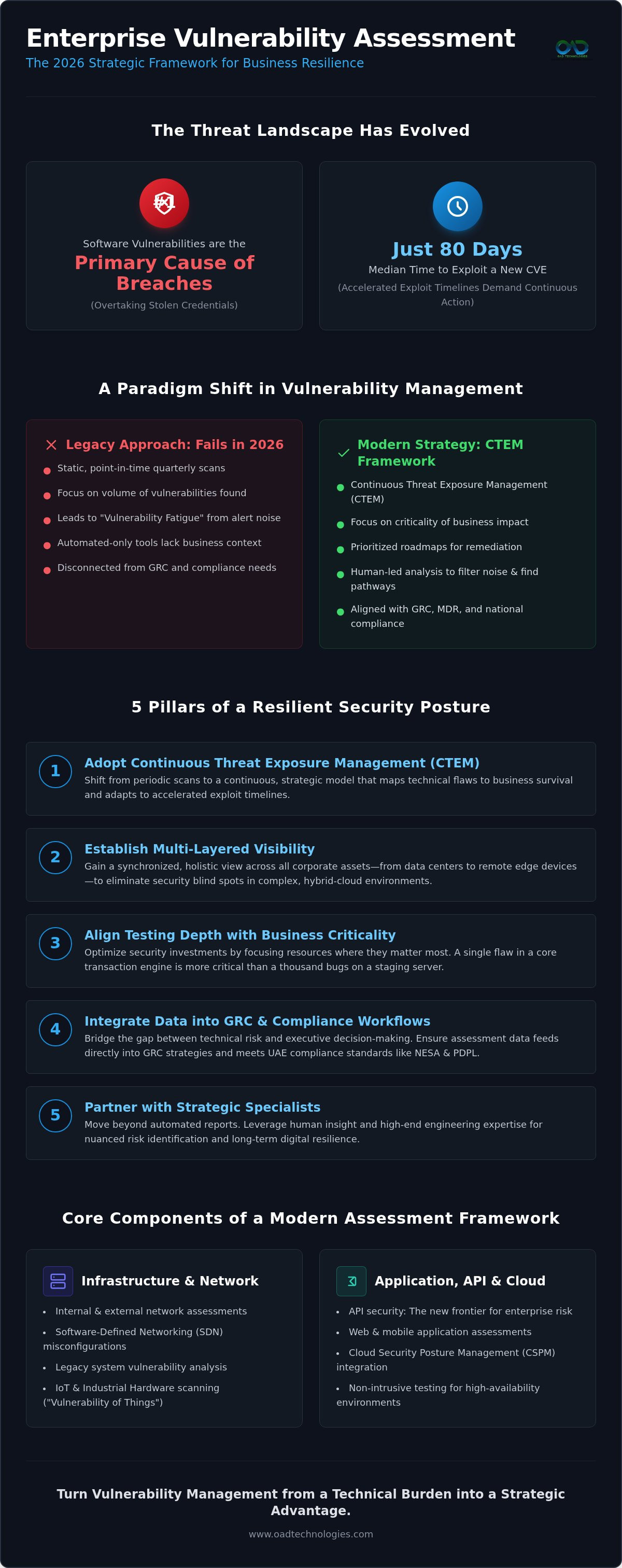
In 2026, software vulnerabilities have officially overtaken stolen credentials as the primary catalyst for data breaches, accounting for 31% of all security incidents according to the Verizon Data Breach Investigations Report. You’ve likely felt the mounting pressure of this shift. As the median time to exploit a new CVE has plummeted to just 80 days, your security team is probably drowning in a sea of "critical" alerts. Utilizing sophisticated enterprise vulnerability assessment services is no longer just about finding bugs; it's about filtering through the noise to protect your most critical assets while meeting strict UAE national compliance standards like NESA and PDPL.
This guide moves beyond the noise to show you how to transform a chaotic list of flaws into a prioritized roadmap for business resilience. You'll learn how to bridge the gap between technical risk and strategic decision-making. We'll explore a framework that aligns your remediation efforts with GRC and MDR strategies, ensuring your cybersecurity posture is both compliant and operationally sound in an increasingly volatile digital environment. By the end, you'll have the clarity needed to turn vulnerability management from a technical burden into a strategic advantage.
Key Takeaways
- Shift from static, point-in-time scans to a continuous threat exposure management (CTEM) model to counter 2026’s accelerated exploit timelines.
- Establish multi-layered visibility across all corporate assets to eliminate security blind spots in complex, hybrid-cloud environments.
- Optimize your investment in enterprise vulnerability assessment services by aligning the depth of testing with the specific business criticality of each asset.
- Bridge the gap between technical flaws and executive risk by integrating assessment data into GRC workflows and UAE national compliance frameworks like PDPL.
- Move beyond automated reports by partnering with strategic specialists who provide the human insight necessary for long-term digital resilience.
The Evolution of Enterprise Vulnerability Assessment Services in 2026
Vulnerability assessment has moved past the era of static, quarterly PDF reports. In 2026, enterprise vulnerability assessment services function as a continuous strategic layer rather than a periodic technical check. This evolution reflects a total pivot from legacy scanning toward Continuous Threat Exposure Management (CTEM). We're no longer just identifying technical flaws; we're mapping them to business survival. Organizations now recognize that a vulnerability's existence is less important than its potential to disrupt a specific revenue stream or a critical digital service.
This shift is particularly vital within the UAE's rapidly expanding digital economy. As businesses integrate more deeply with national infrastructure, the goal of assessment has moved from "volume of vulnerabilities" to "criticality of business impact." It's about precision. A single flaw in a core transaction engine is worth more attention than a thousand low-level bugs on an isolated staging server. This strategic lens ensures that security resources are deployed where they actually protect the bottom line.
Beyond the Scan: Why Legacy Approaches Fail in 2026
Automation is a baseline, not a strategy. Modern enterprise architectures, which now span massive IoT networks and decentralized edge computing, have rendered traditional scanners insufficient. Automated-only tools lack the context to understand how interconnected systems behave during a real attack. These legacy methods often trigger "vulnerability fatigue," burying security teams under an avalanche of alerts that lack prioritization. Gaining a deeper understanding of enterprise vulnerabilities requires human intelligence to filter the noise and identify the pathways that truly matter. In 2026, the complexity of the attack surface demands a more nuanced, individualized approach to risk identification.
The Strategic Alignment of Assessment and National Resilience
Within the UAE, vulnerability management is now intrinsically linked to national resilience. As the nation's digital footprint grows, protecting corporate infrastructure isn't just a private duty; it's a pillar of national security. Robust enterprise vulnerability assessment services ensure that organizations remain in lockstep with the UAE Personal Data Protection Law (PDPL) and NESA standards. This creates a "sovereign security" model where local expertise and high-end engineering safeguard the nation's digital future. By aligning corporate security with these national goals, businesses don't just stay compliant; they become active participants in the UAE's vision for a secure, technologically advanced society.
Core Components of a Modern Enterprise Assessment Framework
A resilient framework for 2026 isn't a single tool. It's a synchronized architecture of visibility. Modern enterprise vulnerability assessment services must provide a multi-layered view of the entire digital estate, from the data center to the remote edge. This requires a shift toward non-intrusive testing methodologies. In high-availability environments, testing shouldn't threaten operational uptime. Instead, it should utilize passive discovery and intelligent human-led analysis to validate what automated scanners might misinterpret as false positives. It's about precision.
Infrastructure and Network Vulnerability Identification
Internal and external network assessments remain foundational. However, the focus has shifted. We now look for misconfigurations in software-defined networking (SDN) and vulnerabilities within legacy systems that remain vital to core operations. The "vulnerability of things" represents a massive portion of the modern attack surface. Securing the IoT landscape requires specialized scanning that understands the unique protocols of industrial hardware. These devices often lack traditional security agents, making them prime targets for lateral movement.
Application, API, and Cloud Posture Assessment
APIs are the new frontier for enterprise risk. They act as the connective tissue for digital services but often lack the rigorous oversight applied to web front-ends. A modern framework must integrate cloud security posture management (CSPM) to ensure that cloud-native environments don't leak data through simple configuration errors. This includes deep-dive scanning for containers and microservices where vulnerabilities can hide in ephemeral layers. It's not enough to scan the code; you have to scan the environment it lives in.
Supply Chain and Third-Party Risk Evaluation
The integrity of your enterprise is only as strong as your weakest partner. In 2026, the Software Bill of Materials (SBOM) has become a mandatory component of a thorough assessment. We must evaluate how third-party vulnerabilities ripple through your environment. This is especially true when working with national service providers. Validating the security posture of these entities ensures that your supply chain doesn't become a backdoor for sophisticated actors. By building these pillars, organizations can transition from reactive patching to proactive resilience. If you're ready to refine your strategy, exploring a customized VAPT engagement can provide the deep-dive insights your leadership requires.
Vulnerability Assessment vs. VAPT: Aligning Depth with Risk
In 2026, the distinction between a vulnerability assessment and a penetration test isn't just technical; it's strategic. While legacy security models often treated these as interchangeable, modern enterprise vulnerability assessment services define them by their intent and depth. A vulnerability assessment (VA) acts as a comprehensive map of your environment, identifying and ranking flaws across the entire digital estate. In contrast, a penetration test is an active, human-led attempt to exploit those flaws to confirm their severity. The most resilient organizations don't choose one over the other. Instead, they integrate both into a cohesive VAPT strategy that aligns testing depth with the specific criticality of the asset.
Choosing the right depth requires a tiered approach. Tier 1 assets, such as core databases or public-facing portals, demand annual or bi-annual penetration testing. Tier 2 and 3 assets, which support internal operations, are better served by continuous, automated enterprise vulnerability assessment services. This tiered model ensures that your security budget is spent where it has the highest impact on business resilience. It prevents the common pitfall of over-investing in low-risk areas while leaving critical gateways under-tested.
Vulnerability Assessment (VA) for Broad Visibility
Vulnerability Assessment serves as the enterprise early warning system. It provides the broad visibility required to maintain a baseline security posture across thousands of assets. Because VA is highly automated and non-disruptive, it remains a cost-effective method for continuous monitoring. In the UAE, where frequent compliance reporting for NESA and PDPL is mandatory, VA provides the necessary data to demonstrate ongoing due diligence without the high overhead of a manual engagement. It ensures that no corner of the network remains unmapped, providing a steady stream of data for risk management teams.
Penetration Testing for Deep Validation
When an asset is critical to national infrastructure or holds sensitive sovereign data, broad visibility isn't enough. Penetration testing provides deep validation by simulating a targeted "hunt" for exploitable paths. This is where human ingenuity identifies complex chains of vulnerabilities that automated tools miss. Advanced Red Teaming exercises go further, testing the maturity of your incident response teams and validating the effectiveness of your EDR and SIEM controls. By attempting to bypass these defenses, pentesting confirms whether your security investments actually work when faced with a sophisticated adversary. This targeted approach ensures that your high-value targets are hardened against real-world exploitation.
Integrating Assessment Data into GRC and MDR Workflows
Raw technical data is often a liability until it's processed into actionable intelligence. In 2026, sophisticated enterprise vulnerability assessment services no longer deliver static reports that gather dust on a CISO's desk. Instead, they provide the real-time telemetry required to fuel a modern Governance, Risk, and Compliance (GRC) framework. This shift moves the needle from simple reporting to orchestrated remediation. By mapping technical flaws directly to business risks, organizations can automate the prioritization of patches based on actual impact rather than arbitrary severity scores. It's about turning a list of bugs into a strategic roadmap for resilience.
Meeting UAE Regulatory Standards (NESA and PDPL)
Technical assessments serve as the primary "evidence of due diligence" required under the UAE Personal Data Protection Law (PDPL). It's impossible to claim data protection without a verified understanding of the pathways that could lead to a breach. For entities governed by NESA, regular vulnerability assessments are a non-negotiable component of Information Assurance Standards (IAS) compliance. These assessments identify potential leak paths for sensitive sovereign data, allowing GRC teams to document risk mitigation strategies that satisfy national auditors. We don't just find bugs; we provide the evidentiary trail required to maintain national digital integrity.
The Synergy Between VA and Real-Time Detection
Integration with Managed Detection and Response (MDR) creates a "context-aware" security posture. When your detection team knows exactly which assets are vulnerable, they can prioritize alerts coming from those high-risk areas. For instance, an exploit attempt against a known-vulnerable server triggers a much higher response priority than the same attempt against a hardened system. By feeding assessment findings into SIEM platforms, organizations create a feedback loop where vulnerability data informs real-time correlation rules. This synergy allows for more aggressive monitoring of known weak points, ensuring that your defense is always strongest where your walls are thinnest. If you're looking to unify your technical findings with a broader business strategy, explore our integrated GRC and MDR solutions.
Selecting a Strategic Partner for National Enterprise Security
Choosing a provider for enterprise vulnerability assessment services isn't a procurement exercise; it's a strategic investment in your organization's long-term digital viability. In 2026, the market is saturated with "tool-flippers" who deliver automated reports without context. A true strategic partner acts as an extension of your internal security team, empowering your people rather than just replacing your processes with a software license. They bridge the gap between identifying a technical flaw and understanding its potential impact on your specific business operations. This level of partnership requires a shift from transactional scanning to a collaborative, engineering-backed relationship that prioritizes your unique architectural needs.
Evaluating Technical Maturity and Sovereign Expertise
A partner's value is defined by the human intelligence behind their tools. You need specialists who understand the specific threat actors targeting the national region and the tactics they use. Evaluate the depth of human expertise involved; anyone can run a scan, but few can interpret how a chain of minor flaws might lead to a catastrophic breach. Your partner must demonstrate alignment with international standards like ISO 27001 while mastering local UAE regulations. This sovereign expertise ensures that your assessments aren't just technically accurate but also legally and strategically sound within the national context. It's about finding a master designer of systems who understands your ambition and the regulatory landscape you operate within.
Implementing a Long-Term Remediation Roadmap
A static PDF report is a snapshot of yesterday's problems. A strategic partner provides an actionable remediation roadmap that prioritizes fixes based on business risk. This guidance should be clear enough for IT operations to execute immediately, moving beyond generic advice to provide specific, individualized solutions. High-quality enterprise vulnerability assessment services must include post-assessment support and rigorous re-testing to verify that vulnerabilities are truly closed. This fosters a culture of continuous improvement. Instead of treating compliance as a "one-and-done" checkbox, your partner helps you maintain a proactive stance that evolves as new threats emerge. This ongoing commitment is what separates a distant third-party vendor from a guardian of your ongoing digital relevance.
Building a Resilient Digital Future for the UAE
The transition from legacy scanning to continuous threat exposure management marks a fundamental shift in how we protect our national digital infrastructure. By adopting modern enterprise vulnerability assessment services, your organization moves beyond reactive patching toward a proactive defense model that aligns technical findings with business criticality. We've explored how integrating these insights into GRC and MDR workflows ensures compliance with UAE national standards like PDPL and NESA while sharpening the precision of your real-time detection capabilities. It's about precision and long-term viability.
Success in 2026 requires more than just automated tools; it demands a partnership rooted in engineering excellence and sovereign expertise. OAD Technologies offers deep UAE national GRC and VAPT expertise, providing strategic integration with your MDR and SIEM platforms to build a unified security posture. Our expert-led remediation roadmaps transform complex data into clear, actionable steps for your team. It's time to stop chasing alerts and start mastering your exposure. Secure your digital perimeter with OAD Technologies’ enterprise vulnerability assessment services and lead your organization toward lasting digital resilience. You have the tools and the framework; now it's time to execute with confidence.
Frequently Asked Questions
What is the difference between vulnerability assessment and penetration testing?
A vulnerability assessment identifies and catalogs known security flaws across your environment, while penetration testing involves active attempts to exploit those flaws. While VA provides the broad visibility needed for a baseline posture, pentesting confirms the actual exploitability of specific targets. In 2026, enterprises use both to balance cost-effective continuous monitoring with high-stakes validation of their most critical digital assets.
How often should a large enterprise conduct a vulnerability assessment in 2026?
For large enterprises, the 2026 standard has shifted toward continuous monitoring rather than periodic checks. While standards like PCI DSS v4.0.1 mandate scans at least every three months, high-risk assets require real-time exposure management. This approach allows security teams to respond to new CVEs within the current 80-day exploit window. Maintaining a steady cadence ensures your enterprise vulnerability assessment services remain aligned with the rapidly evolving threat landscape.
Can vulnerability assessment services help with UAE PDPL compliance?
Vulnerability assessment services are foundational for meeting UAE Personal Data Protection Law (PDPL) requirements. These assessments identify potential data leak paths and technical weaknesses that could lead to unauthorized access. By documenting these findings and the subsequent remediation steps, your organization provides the "evidence of due diligence" required by national auditors. This technical verification is a core component of a broader GRC strategy focused on national data sovereignty.
What is the benefit of a managed vulnerability assessment service over in-house tools?
Managed services provide a sophisticated blend of high-end tools and human expertise that is difficult to maintain in-house. While internal teams often face "vulnerability fatigue" from automated alerts, a managed partner provides objective analysis and a prioritized remediation roadmap. This partnership model allows your internal staff to focus on strategic growth while experts handle the complex engineering required to validate findings and ensure long-term digital resilience.
How does vulnerability assessment integrate with Managed Detection and Response (MDR)?
Integration with Managed Detection and Response (MDR) creates context-aware security. When your MDR team has access to current vulnerability data, they can prioritize alerts coming from known-vulnerable systems over those from hardened assets. This synergy allows for more aggressive monitoring of specific weak points. It transforms your detection strategy from a generic net into a targeted defense system that understands exactly where your perimeter is thinnest.
What are the most common enterprise vulnerabilities found in the UAE market?
In the UAE market, we frequently observe misconfigured cloud storage, insecure API endpoints, and unpatched legacy systems in industrial environments. The explosion of IoT has also introduced the "vulnerability of things," where non-standard protocols often lack basic security controls. Addressing these requires a non-standardized approach that looks beyond common web flaws to secure the intricate hardware and software architectures supporting the nation's digital economy.
Does vulnerability scanning disrupt production environments?
Modern vulnerability assessment services utilize non-intrusive, passive discovery methods to ensure zero disruption to production environments. By employing intelligent scanning techniques that respect bandwidth limits and system resources, we identify flaws without threatening operational uptime. This is critical for high-availability sectors where even a few minutes of downtime can result in significant financial loss. Strategic partners prioritize these non-disruptive methodologies to safeguard your business continuity.
What is the role of human analysis in a vulnerability assessment service?
Human analysis is the bridge between a raw technical report and a strategic business result. While automated tools are excellent at finding known signatures, only human experts can identify complex exploit chains that span multiple systems. These specialists filter out false positives and provide the actionable remediation roadmaps that IT operations need to execute. This human-led approach ensures that your security investments are focused on risks with the highest potential business impact.
Disclaimer
Content by OAD Technologies is for general informational purposes only and does not constitute professional or cybersecurity advice. No warranties are made regarding accuracy or completeness; reliance is at your own risk. OAD Technologies shall not be liable for any direct or indirect losses arising from use of this content.