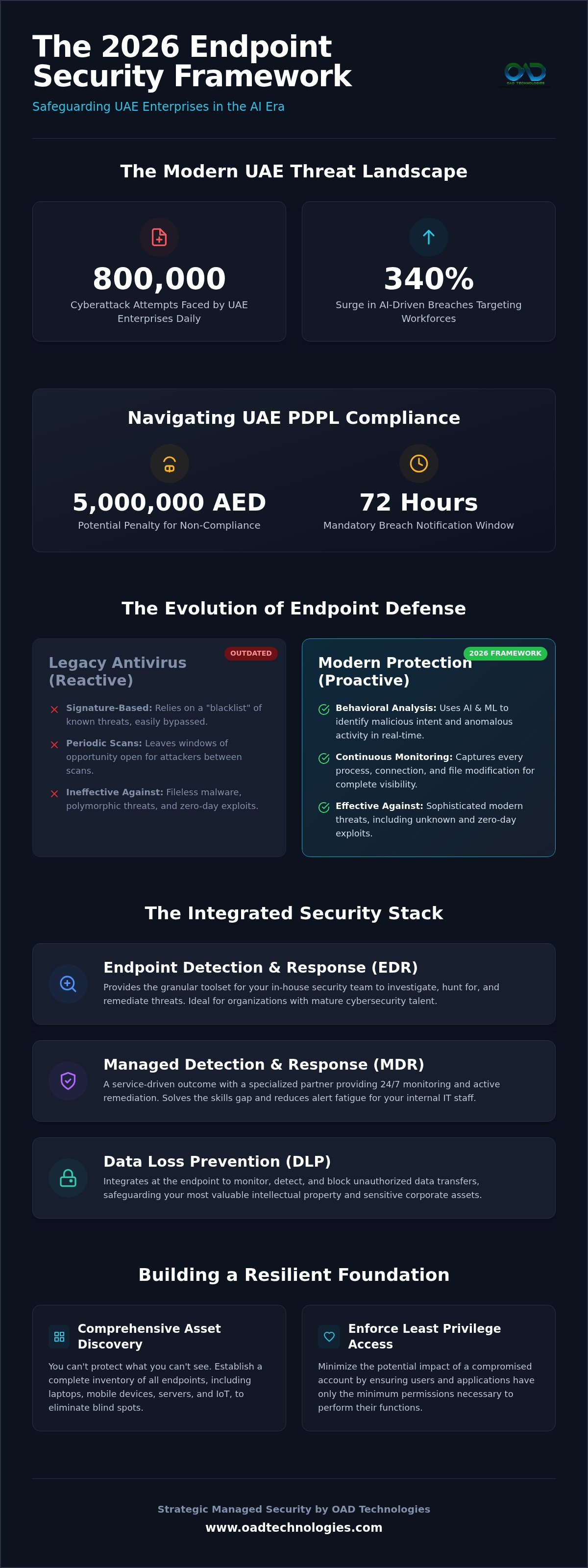
Did you know that UAE enterprises now face up to 800,000 cyberattack attempts every single day? With AI-driven breaches surging by 340%, the traditional perimeter has vanished, leaving your distributed workforce as the primary target. It's a high-stakes environment where the pressure to maintain robust endpoint security for business isn't just about IT uptime; it's about survival under the UAE Personal Data Protection Law (PDPL). You're likely managing the friction of hybrid work while worrying about the mandatory 72-hour breach notification window and potential 5,000,000 AED penalties.
We understand that you need more than a software patch. You require a strategic partnership that bridges the gap between high-level innovation and practical business results. This article provides the 2026 framework to help you master the complexities of modern protection, safeguarding your corporate assets while ensuring national regulatory compliance. We'll examine how a structured approach to visibility and incident response reduces risk. By the end, you'll have a clear roadmap for achieving a compliant digital environment that delivers a measurable ROI on your cybersecurity investment.
Key Takeaways
- Shift your defense strategy from reactive legacy antivirus to proactive behavioral analysis to combat sophisticated 2026 threats.
- Learn how to integrate EDR, MDR, and DLP into a unified framework for endpoint security for business that ensures both visibility and data protection.
- Navigate the complexities of the UAE Personal Data Protection Law (PDPL) by using endpoint telemetry to satisfy strict GRC auditing requirements.
- Establish a resilient foundation through comprehensive asset discovery and the enforcement of least privilege access across your national network.
- Discover how strategic managed security partnerships transform complex technical challenges into clear operational performance and long-term viability.
The Evolution of Endpoint Security: Beyond Legacy Antivirus
In the modern enterprise architecture, the endpoint has moved from being a simple workstation to the primary frontline of defense. To understand What is Endpoint Security? in a 2026 context, we must view it as the critical telemetry source for the entire organization. It's no longer just about laptops. The modern endpoint includes cloud-connected instances, mobile devices, and a vast array of IoT sensors that now populate the national industrial landscape. For UAE businesses, the stakes are exceptionally high. With daily attack attempts reaching up to 800,000, a single breach isn't just a technical failure. It's a financial catastrophe that can trigger administrative penalties of up to 5,000,000 AED under the PDPL.
Why Traditional Antivirus is No Longer Enough
Legacy antivirus systems relied on signatures, essentially a "blacklist" of known threats. This approach fails against the sophisticated techniques seen in 2026. Fileless malware, which executes entirely in memory without leaving a footprint on the disk, renders signature-based scanning obsolete. Polymorphic threats also pose a challenge; they constantly change their code to evade detection. Modern endpoint security for business requires continuous monitoring of system processes rather than periodic, scheduled scans. This shift from detecting the known to analyzing the unknown is the foundation of a resilient posture. Zero-day exploits, which target vulnerabilities before a patch exists, can only be stopped by observing how they interact with the operating system in real-time.
The Role of AI and Machine Learning in Threat Detection
Artificial intelligence has transformed threat detection from a reactive task to a predictive science. By leveraging machine learning models trained on global threat intelligence, systems can now identify anomalous behavior as it happens. This is vital for reducing false positives, which often overwhelm security teams and lead to alert fatigue in large enterprise environments. When the system understands what normal looks like for a specific user or device, it can flag deviations instantly. This strategic use of technology empowers people to focus on high-level strategy rather than chasing ghosts. Behavioral Heuristics represents the core of 2026 security by using algorithmic patterns to identify malicious intent regardless of the specific file or code structure used.
The Modern Endpoint Security Stack: EDR, MDR, and DLP Integration
Building on the transition from legacy antivirus, modern endpoint security for business relies on a multi-layered stack designed for visibility and rapid response. It's no longer sufficient to simply block known malware. You need to capture the entire lifecycle of an event. This involves creating a unified telemetry stream that feeds directly into your SIEM platform. This integration ensures that every file modification, network connection, and process execution is logged and analyzed within a broader corporate context. While AI handles the initial triage, an effective defense still requires a human-in-the-loop. Expert analysts provide the critical nuance needed to distinguish between a legitimate administrative script and a malicious lateral movement attempt.
EDR vs. MDR: Choosing the Right Level of Support
Selecting the appropriate level of support depends heavily on your internal resource maturity. Endpoint Detection and Response (EDR) provides the granular toolset your team needs to investigate and remediate threats. However, managing an in-house EDR platform requires high-tier cybersecurity talent, a resource that is increasingly difficult to secure. Most UAE enterprises find that Managed Detection and Response (MDR) offers a more sustainable path. MDR is a service-driven outcome where a specialized partner handles 24 X 7 monitoring and active remediation. This approach solves the skills gap, allowing your internal IT staff to focus on strategic growth while we manage the relentless volume of daily cyber threats.
Integrating DLP for Comprehensive Data Governance
Your intellectual property is your most valuable asset, which makes Data Loss Prevention (DLP) a vital component of the modern stack. By integrating DLP at the endpoint level, you can prevent unauthorized data exfiltration before it leaves the device. There is a powerful synergy between threat detection and data classification. For example, if an EDR tool flags a suspicious process, the DLP layer can automatically restrict that process from accessing sensitive financial records or customer data. This level of control is essential for safeguarding information on remote or unmanaged endpoints where traditional network perimeters are non-existent. Protecting your corporate reputation requires this proactive, data-centric mindset. If you're ready to enhance your visibility, exploring our MDR solutions is a logical next step for securing your digital perimeter.
Aligning Endpoint Protection with National Compliance and GRC
The regulatory landscape for UAE enterprises has reached a point of full maturity in 2026. National compliance isn't a secondary concern; it's the framework within which all technical decisions must be made. The UAE Personal Data Protection Law (PDPL) imposes strict requirements on how sensitive information is handled on every device. With administrative penalties reaching up to 5,000,000 AED, the cost of a visibility gap is simply too high. Implementing robust endpoint security for business ensures that your organization maintains the forensic readiness required for the mandatory 72-hour breach notification window. Without detailed telemetry from the edge, identifying the scope of a data leak within three days is nearly impossible.
To validate these defenses, many organizations integrate Vulnerability Assessment and Penetration Testing (VAPT). This proactive testing ensures that your endpoint configurations aren't just theoretically sound but are practically resistant to modern attack vectors. It provides the empirical evidence needed to prove that your security controls are functioning as intended.
Meeting UAE PDPL Requirements through Endpoint Visibility
Encryption and granular access controls on individual devices are no longer optional. They are direct responses to data privacy mandates. To satisfy the UAE Data Office, you must demonstrate that personal data is protected both at rest and in transit across your national network. This requires comprehensive log retention and immutable audit trails that prove who accessed what data and when. Utilizing automated compliance reporting reduces administrative overhead by translating technical logs into the documentation required by regulators.
Endpoint Security as a Pillar of GRC Strategy
A mature Governance Risk and Compliance (GRC) strategy views the endpoint as a primary risk vector. By mapping endpoint controls to national security frameworks, you create a defensible posture that scales with your organization. This risk-based management approach prioritizes security investments where they are most needed. Effective endpoint security for business within this context is central to Identity and Access Management (IAM), which secures the entry points to your endpoints. By ensuring that only verified users can access specific device functions, you close the gap between technical security and organizational policy. This alignment ensures that your cybersecurity investment supports long-term business viability rather than just acting as a temporary fix.
Building a Resilient Endpoint Strategy: Implementation Best Practices
Deploying endpoint security for business isn't a one-time event; it's a continuous lifecycle of discovery, enforcement, and optimization. To move beyond simple installation, UAE enterprises must adopt a structured roadmap that ensures technical tools translate into measurable resilience. This process begins with comprehensive asset discovery across your entire national network. You can't protect what you can't see, and in a landscape of 800,000 daily attack attempts, shadowed devices are your greatest vulnerability. Once visibility is established, your focus must shift to enforcing "Least Privilege" access policies. By restricting administrative rights and ensuring users only have access to the resources they need, you significantly reduce the potential blast radius of any credential compromise.
The third step involves implementing continuous monitoring paired with automated response playbooks. Given the mandatory 72-hour breach notification window under the PDPL, manual triage is no longer viable. Automation allows your systems to isolate infected hosts or kill malicious processes in milliseconds. This must be supported by a regular patching and vulnerability management cycle to close entry points before they can be exploited. Finally, integrate all endpoint telemetry into a centralized SIEM or SOC. This holistic visibility ensures that isolated events are recognized as parts of a larger, coordinated attack pattern.
Overcoming Common Implementation Challenges
One of the most frequent hurdles is the perceived trade-off between performance and security. Modern light-weight agents solve this by offloading heavy analysis to the cloud, ensuring user productivity remains high while maintaining deep visibility. Managing security for Bring Your Own Device (BYOD) and remote workforces adds another layer of complexity. You must ensure that security policies follow the user, regardless of the network they use. This requires seamless integration with your existing cloud infrastructure. Utilizing CSPM helps maintain a consistent security posture across hybrid environments, preventing misconfigurations that often lead to data exposure.
Training and Culture: The Human Element of Endpoint Security
Technology alone cannot secure an enterprise. With phishing incidents in the UAE increasing by 32% in the first quarter of 2026, employee awareness is your final line of defense. Establishing clear incident reporting protocols empowers your staff to act as active participants in your security posture rather than passive targets. Security teams must partner with business units to ensure that security measures are seen as enablers of safe growth rather than obstacles. If you're looking to build a more resilient digital foundation, our team can help you design a customized endpoint strategy tailored to your specific operational needs.
Strategic Managed Security: The OAD Technologies Approach
OAD Technologies operates as a specialized systems integrator and Managed Security Service Provider (MSSP), specifically engineered for the unique demands of the UAE market. We don't just provide tools; we design resilient architectures that bridge the gap between high-level innovation and practical business results. In an environment where AI-driven breaches have surged by 340%, your approach to endpoint security for business must be both technically advanced and strategically grounded. We act as an extension of your internal team, bringing the precision and accountability of a master designer to your digital ecosystem.
Our localized technical security assessments go beyond generic checklists. We understand the nuances of national regulatory alignment, providing GRC consulting that ensures your posture meets the strict standards of the UAE Data Office. This local expertise is vital for navigating the mandatory 72-hour breach notification windows and protecting against the financial risks of non-compliance. By grounding complex technical strategies in reality, we ensure that your security investment drives operational performance and strategic expansion.
Customized Integration for National Resilience
We reject standardized, one-size-fits-all approaches in favor of precise, high-quality craftsmanship. Every security architecture we build is a customized integration designed for long-term viability in an ever-changing market. We believe in the synergy between human insight and technological capacity; our tools empower your people, allowing them to lead with confidence while our systems manage the relentless telemetry of modern threats. This proactive, solution-oriented mindset ensures that your enterprise isn't just keeping pace with technology but actively shaping its future application.
Next Steps: Securing Your Enterprise Endpoints
Achieving a secure, visible, and compliant environment requires a partner who values long-term success over quick fixes. If your current framework lacks the visibility needed to satisfy PDPL requirements or the speed to counter modern ransomware, it's time for a strategic re-evaluation. We invite you to evaluate your current security posture with our team of specialists. Let's discuss how we can transform your endpoint security for business into a fundamental source of enterprise-wide data governance and resilience. Contact us today for a strategic consultation to secure your corporate assets for 2026 and beyond.
Future-Proofing Your National Enterprise Resilience
The transition from legacy antivirus to a sophisticated, telemetry-driven architecture is no longer optional for organizations operating within the UAE. This framework demonstrates that mastering endpoint security for business in 2026 requires a seamless integration of MDR, EDR, and DLP. This unified approach doesn't just block threats; it provides the forensic depth needed to satisfy strict PDPL mandates and the mandatory 72-hour breach notification window. By prioritizing asset visibility and least-privilege policies, you transform security from a reactive cost center into a strategic pillar of your GRC framework.
OAD Technologies stands ready to act as your strategic partner, offering specialized UAE-based MSSP services backed by deep GRC expertise and SIEM-validated operations. We bridge the gap between high-level innovation and practical results through technical assessments and comprehensive managed detection. It's time to move beyond standardized fixes and adopt a roadmap designed for long-term viability. Secure your enterprise with OAD Technologies’ strategic endpoint solutions today. Your journey toward a more resilient, compliant, and visible digital environment starts with a single proactive step.
Frequently Asked Questions
What is the difference between EDR and standard business antivirus?
Standard antivirus relies on "blacklists" of known signatures, while EDR focuses on continuous monitoring and behavioral analysis. EDR records every process execution and network connection to detect "living off the land" attacks that use legitimate tools for malicious purposes. While antivirus might block a known file, EDR identifies suspicious patterns in real-time. This provides the deep telemetry required for modern endpoint security for business, allowing teams to investigate the root cause of an incident.
Is EDR enough to protect my business from ransomware in 2026?
EDR is a critical tool, but it's rarely sufficient as a standalone solution against 2026's AI-driven ransomware. Sophisticated attackers often use automation to bypass automated toolsets. For comprehensive protection, you need a multi-layered strategy that includes Managed Detection and Response (MDR) for human-led threat hunting and Data Loss Prevention (DLP) to secure intellectual property. Resilience also requires regular offline backups and a "post-breach" mindset to ensure rapid recovery if an initial infection occurs.
How does endpoint security help with UAE PDPL compliance?
Endpoint security provides the essential visibility and audit trails needed to satisfy the UAE Personal Data Protection Law (PDPL). By maintaining detailed logs of data access and movement on every device, you can demonstrate compliance during regulatory audits. These tools enable the mandatory 72-hour breach notification required by the UAE Data Office. Without granular endpoint telemetry, your organization would struggle to identify the scope of a data leak within the legally required timeframe.
What are the benefits of outsourcing endpoint security to an MDR provider?
Outsourcing to a Managed Detection and Response (MDR) provider like OAD Technologies solves the critical cybersecurity skills gap. You gain access to a 24 X 7 Security Operations Center (SOC) without the massive overhead of hiring and training in-house specialists. This ensures that alerts are triaged instantly by human experts who can distinguish between false positives and genuine threats. This strategic partnership reduces response times and provides a higher ROI than managing complex endpoint security for business internally.
Does endpoint security software slow down employee computers?
Modern endpoint agents are designed to be lightweight and cloud-native, significantly reducing the performance impact on user devices. Unlike legacy antivirus that performs resource-heavy disk scans, modern tools offload the most intensive analysis to the cloud. This ensures that security operates silently in the background without interrupting employee workflows. For UAE enterprises, this balance between high-level protection and practical operational performance is vital for maintaining productivity across a distributed or hybrid workforce.
Can endpoint security protect remote workers using personal devices?
Modern frameworks extend protection to personal devices through specialized agents and containerization. By integrating Identity and Access Management (IAM) and Cloud Security Posture Management (CSPM), you can enforce strict security policies regardless of the device's ownership. This ensures that corporate data remains encrypted and isolated from personal applications. This approach allows your remote workforce to remain flexible while ensuring that every endpoint accessing your national network meets your organization's rigorous security standards.
How often should we conduct vulnerability assessments on our endpoints?
Vulnerability Assessment and Penetration Testing (VAPT) should be a continuous process rather than a yearly event. In the current threat landscape, new exploits emerge daily, making periodic scans insufficient. You should conduct assessments at least quarterly or whenever significant changes occur in your network architecture. This proactive approach ensures that your endpoint defenses are constantly validated against the latest attack vectors, maintaining a resilient posture that aligns with national security best practices.
What role does Identity and Access Management (IAM) play in endpoint security?
IAM acts as the gatekeeper for your endpoints, ensuring that only verified users can access sensitive corporate resources. By enforcing Multi-Factor Authentication (MFA) and "Least Privilege" policies, you mitigate the risk of credential-based attacks. When IAM is integrated with endpoint telemetry, your system can automatically revoke access if a device shows signs of compromise. This synergy creates a robust defense-in-depth strategy where identity verification and device health monitoring work together to secure the enterprise.
Disclaimer
Content by OAD Technologies is for general informational purposes only and does not constitute professional or cybersecurity advice. No warranties are made regarding accuracy or completeness; reliance is at your own risk. OAD Technologies shall not be liable for any direct or indirect losses arising from use of this content.