
As UAE enterprises adopt hybrid and multi-cloud environments, data moves across endpoints, networks, SaaS applications and cloud platforms. That complexity can make older data loss prevention controls difficult to manage, particularly when false positives interrupt legitimate work. A modern DLP programme should therefore balance protection, visibility and operational usability.
We believe security and agility should never be mutually exclusive. This guide empowers you to master the evolution of data loss prevention by building a strategic framework that secures your most valuable digital assets. You'll learn how to move from a restrictive mindset to one of true data resilience. We'll preview a roadmap for automated discovery and classification, provide tactics to reduce insider risk, and explain how DLP can support compliance readiness under applicable UAE data-protection and sector requirements.
Key Takeaways
- Shift your strategy from static "block-all" methods to a resilient framework that prioritises data visibility across hybrid and multi-cloud ecosystems.
- Master the integration of context-rich Identity and Access Management (IAM) to ensure your data loss prevention protocols adapt to user behaviour in real-time.
- Reduce the operational burden of false positives by leveraging behavioural analytics to distinguish between routine workflows and genuine insider threats.
- Implement a sustainable deployment roadmap that begins with rigorous Vulnerability Assessment and Penetration Testing (VAPT) to identify critical gaps before enforcement.
- Align DLP controls with applicable UAE Personal Data Protection Law (PDPL) requirements and the organisation’s wider privacy, security and governance processes.
What is Data Loss Prevention (DLP)? Defining Data Resilience in 2026
In 2026, the definition of What is Data Loss Prevention (DLP)? has moved beyond simple perimeter defence. It's no longer just a set of tools designed to block unauthorised transfers. Instead, modern data loss prevention acts as the cornerstone of enterprise data resilience. This strategic framework ensures your organisation's most sensitive information remains available, integral, and private, regardless of where it travels in a borderless digital ecosystem. We view it as a vital system designed to maintain business continuity even when security boundaries shift.
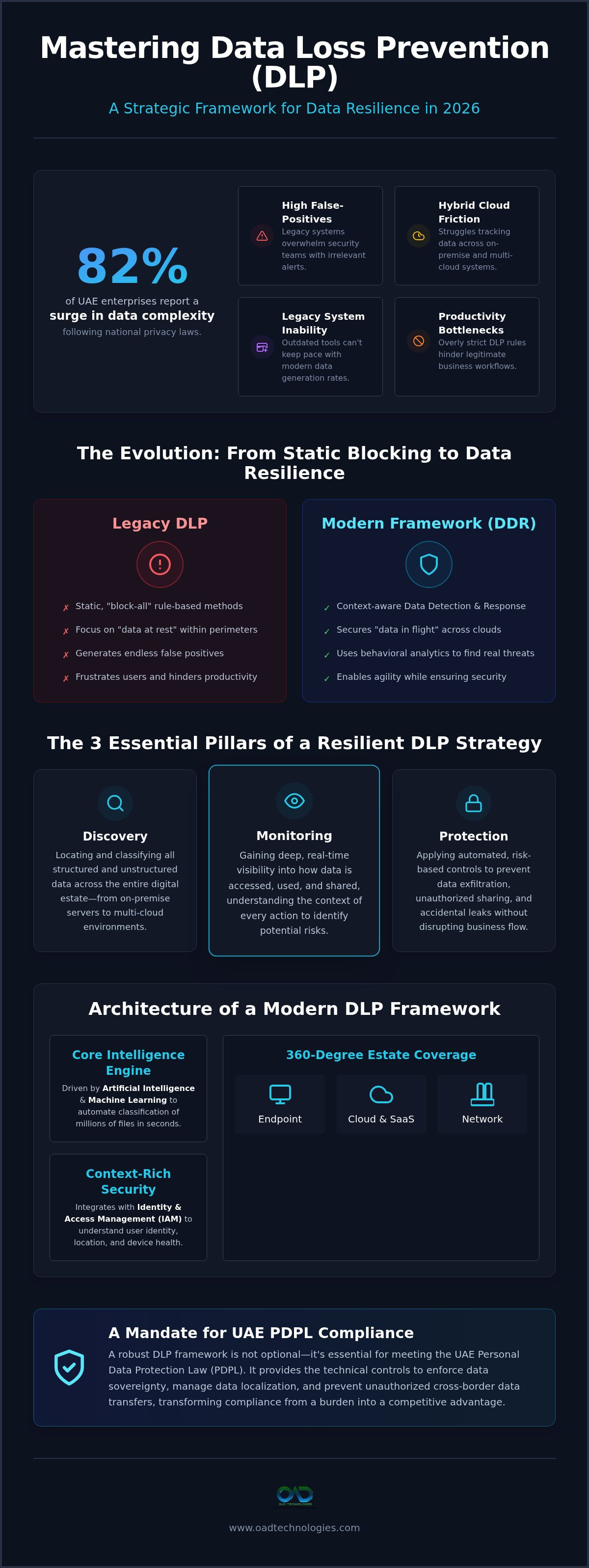
We see a decisive shift from focusing on "data at rest" to securing "data in flight" across complex cloud environments. As UAE enterprises adopt multi-cloud architectures, data constantly moves between local servers, SaaS applications, and remote endpoints. This mobility demands a strategy that understands context, not just file types. To achieve this, we anchor our approach in three essential pillars:
- Discovery: Locating and classifying structured and unstructured data across the entire digital estate.
- Monitoring: Gaining deep visibility into how data is accessed and shared in real-time.
- Protection: Applying automated, risk-based controls to prevent exfiltration or accidental leaks.
For organisations operating in the Middle East, these pillars aren't just technical requirements. They're fundamental to national security. Protecting intellectual property and citizen data strengthens the local digital economy, making robust data strategies a boardroom priority.
The Evolution from Legacy DLP to Data Detection and Response (DDR)
Legacy systems often rely on static, rule-based blocking that triggers endless false positives. These outdated methods frustrate users and overwhelm security teams. Modern frameworks have evolved into Data Detection and Response (DDR). This approach prioritises context-aware detection, allowing for a nuanced understanding of data lineage and intent. DDR provides real-time visibility into how information moves and changes, enabling teams to intercept threats without halting legitimate business processes. Data Detection and Response is the proactive evolution of traditional DLP.
How DLP Can Support UAE PDPL Readiness
The UAE Personal Data Protection Law (PDPL) governs the processing of personal data and includes requirements for cross-border transfers. It does not create a universal requirement for every relevant dataset to remain inside the UAE. DLP can support privacy and security controls by identifying sensitive data, monitoring agreed channels and applying policies to authorised and unauthorised movement. Applicability, lawful transfer conditions and evidence should be assessed with qualified advisers and within the organisation’s wider governance programme.
The Architecture of a Modern DLP Framework
Building a resilient architecture requires more than just installing software. It demands a coordinated symphony of sensors and intelligence. In 2026, a Modern DLP Framework must span across multi-cloud and on-premises environments without creating silos. We integrate data loss prevention with Identity and Access Management (IAM) to provide context-rich security. This ensures that a user’s identity, location, and device health inform every decision regarding data movement. By combining who is accessing the data with what the data actually is, we create a more intelligent defence layer.
Artificial intelligence and machine learning can assist with classification across large datasets. Their usefulness depends on data quality, configuration, coverage and review processes. Sensors at endpoints, across networks and within cloud environments can provide complementary visibility, subject to the systems and channels included in the agreed scope. If you're looking to design a bespoke architecture for your organisation, OAD Technologies can help you build a system tailored to your specific operational needs.
Automated Discovery and Classification
Manual tagging is obsolete. It's too slow for the era of Big Data and far too prone to human error. AI-driven fingerprinting and Exact Data Matching (EDM) allow us to identify sensitive data even when it's modified, renamed, or embedded in different formats. By automating this discovery process, we create more precise and less intrusive policies. This reduces friction for your employees while maintaining a high security bar. You can't protect what you haven't identified; automation makes that identification continuous and reliable.
Enforcement Across the Digital Perimeter
Enforcement happens where the data lives and travels. Endpoint DLP protects laptops and mobile devices, which is critical for your remote workforce. Network DLP monitors email and web traffic for unauthorised transfers in real-time. In the cloud, Cloud Security Posture Management (CSPM) can complement DLP by identifying relevant configuration risks while DLP addresses sensitive-data movement. A major focus for 2026 is "Shadow AI" protection. We monitor and control the flow of proprietary data into generative AI tools. This can help reduce the risk of proprietary information being submitted to unapproved generative AI services.
Solving the False Positive Crisis: A Human-Centric Approach
False positives are the silent killer of security efficacy. When a data loss prevention system flags every legitimate file transfer as a breach, it doesn't just annoy users; it creates "alert fatigue" that causes security teams to miss real threats. We approach this challenge by prioritising the synergy between human insight and technological capacity. Rather than relying on rigid rules, we design systems that understand the nuance of your specific business operations. This ensures that security remains a partner to productivity, not a barrier.
A key part of our Strategic DLP Roadmap involves shifting from a "Block" mentality to an "Educate" model. When a user attempts a risky action, the system can provide real-time coaching via pop-up notifications. This empowers employees to make better choices while reducing the burden on IT support. It's about building a culture of data resilience where every staff member understands their role in the security lifecycle. We believe that an informed workforce is your strongest line of defence.
User and Entity Behavior Analytics (UEBA)
Accuracy improves significantly when you monitor "intent" rather than just "content." UEBA allows the system to establish a baseline of normal behaviour for every user and device. By identifying anomalies, such as a developer accessing unfamiliar financial records, UEBA can surface activity for investigation that static rules may not highlight clearly. Behavioural signals can be integrated into a Managed Detection and Response (MDR) workflow so higher-risk findings can be prioritised for analyst review within the agreed service scope.
Streamlining the Incident Response Lifecycle
Efficiency in the SOC depends on automated triage. By correlating data loss prevention alerts with other telemetry, we can automatically discard low-risk noise. We advocate for deep SIEM integration to manage data alerts from a single, centralised pane of glass. This visibility allows for faster response times and more accurate investigations. Ultimately, the goal is low-friction security. You need a system that protects your digital assets without stopping the legitimate work that drives your organisation forward. We act as your strategic partner to ensure this balance is maintained over the long term.
Building a Strategic DLP Roadmap: From Assessment to Enforcement
Implementing a sustainable data loss prevention program requires a shift from reactive firefighting to proactive architecture. We advocate for an "Assess First" mentality. This begins with an assessment of sensitive data, business processes, existing controls and relevant data flows. Vulnerability Assessment and Penetration Testing (VAPT) may contribute evidence about technical weaknesses where it is relevant to the agreed scope, but it does not replace data discovery or process review. However, technology is only half the equation. Policy definition must involve business stakeholders from finance, legal, and HR to ensure that security measures don't stifle essential workflows. We recommend a "crawl, walk, run" approach to avoid operational paralysis and ensure long-term viability.
A strategic roadmap ensures that every technical control serves a specific business objective. By aligning your data loss prevention efforts with your wider corporate goals, you transform security from a cost centre into a business enabler. If you are ready to secure your digital future, OAD Technologies provides the strategic partnership needed to design and deploy these complex systems.
Step 1 & 2: Assessment and Data Mapping
The first phase focuses on identifying the organisation’s most sensitive and business-critical data. Loss or misuse of this information could create material operational, financial, legal or reputational harm. A GRC-aligned review can help map applicable obligations and internal policies to relevant data and processes. Visibility is an important foundation for effective data protection, while legal interpretation and compliance decisions remain with qualified advisers and accountable organisational owners.
Step 3, 4 & 5: Policy, Pilot, and Production
Once we map the data, we move to writing "Business-Aware" policies. These rules distinguish between high-risk exfiltration and routine data sharing. We always start with a "Monitor Only" phase. This period allows us to calibrate the system and verify accuracy without blocking legitimate business activities. It's during this phase that we eliminate the noise that typically plagues legacy systems. As the system demonstrates acceptable performance, coverage can be expanded across agreed cloud environments, endpoints and workforce scenarios. This phased progression is designed to improve consistency and reduce unnecessary disruption while preserving review, exception handling and rollback options.
Elevating Data Protection with OAD Technologies
At OAD Technologies, we combine DLP technology with architecture, implementation and operational planning. We understand that data loss prevention is a living system that must evolve alongside your business objectives. By moving beyond the traditional vendor-client relationship, we establish a strategic partnership focused on your long-term operational performance. We bridge the gap between high-level innovation and practical results, ensuring your most valuable digital assets remain secure in a borderless world.
True resilience comes from the synergy between specialised security layers. We can integrate data loss prevention solutions with SIEM and EDR to support layered visibility and investigation workflows within the agreed scope. This combination allows for real-time correlation between endpoint activity and data movement. When an EDR sensor detects suspicious process behaviour, your DLP policies can automatically tighten restrictions on sensitive files. This level of automated, cross-platform intelligence defines a sophisticated security posture in 2026.
Customised Integration vs. Standardized Tools
Standardized tools often fail because they ignore the unique workflows and cultural nuances of your organisation. We reject the "one-size-fits-all" approach in favor of bespoke engineering. Our collaborative engagement model means we work as an extension of your own team to map every data flow and identify every risk. This commitment to precision ensures that your security infrastructure remains viable for years to come. We prioritise your digital relevance, helping you stay ahead of emerging threats while maintaining the agility needed to compete in a fast-paced market.
Securing the Future of the UAE Digital Economy
Protecting the UAE's digital economy is a collective responsibility. Advanced DLP plays a critical role in safeguarding the intellectual property and citizen data that drive national growth. As a UAE-based provider, OAD Technologies can help organisations relate DLP architecture and operations to their UAE context, while qualified advisers determine which legal and sector requirements apply. We invite leadership teams to undergo a strategic assessment of their current data posture to identify hidden vulnerabilities before they become liabilities. The path to resilience begins with a single, informed step. Partner with OAD Technologies for Enterprise Data Resilience to secure your organisation's future and maintain your competitive edge.
Architecting a Resilient Data Strategy
The transition from restrictive legacy systems to a model of true data resilience is no longer optional. As we navigate the complexities of 2026, it's clear that successful data loss prevention depends on high-fidelity visibility and a deep understanding of user intent. By prioritising behavioural analytics and cross-platform integration, your organisation can protect its most sensitive intellectual property without sacrificing the operational speed required in a competitive market. Resilience isn't just about stopping leaks; it's about empowering your workforce to handle data with confidence.
OAD Technologies stands as your specialised UAE-based strategic security integrator. We bridge the gap between complex GRC mandates and practical business results through expert PDPL alignment and sophisticated MDR and VAPT integration. Our bespoke engineering ensures that your security architecture is built for long-term viability, providing a grounded roadmap for growth. We don't just provide tools; we act as an extension of your team to shape a secure digital future.
Ready to transform your security posture? Secure Your Enterprise Assets with OAD Technologies' Strategic DLP Solutions. We look forward to helping you design a system where your data remains your most secure and reliable asset.
Frequently Asked Questions
What is the difference between Data Loss Prevention (DLP) and Data Leakage Prevention?
Modern data loss prevention focuses on a strategic framework to stop both intentional theft and accidental exposure. While some use "leakage" to describe unintentional slips, modern platforms treat them as a single challenge. We design systems that identify sensitive data movement regardless of the cause. This ensures your digital assets stay within authorised boundaries, whether the threat is an external attacker or an internal error.
How does the UAE Personal Data Protection Law (PDPL) impact DLP requirements?
The UAE PDPL establishes requirements for processing personal data and for cross-border transfers; it does not impose a blanket domestic-residency rule for every dataset. DLP can support compliance readiness by identifying sensitive data, monitoring covered channels and enforcing approved handling policies. Organisations should map applicable requirements, transfer conditions and evidence needs with qualified advisers rather than treat DLP alone as proof of compliance.
Can DLP protect data that is being uploaded to generative AI tools like ChatGPT?
DLP controls can monitor or restrict data submitted to generative AI services when the relevant endpoint, browser, network or cloud channel is within scope and technically supported. Depending on configuration, a policy may alert the user, require justification or block a transaction. Coverage and limitations should be tested for the organisation’s actual applications and workflows; no control observes every channel automatically.
Is it possible to implement DLP without slowing down employee productivity?
High-performance security doesn't have to hinder your team. We recommend starting with a "Monitor Only" phase to establish a baseline of normal activity. By using behavioural analytics, the system distinguishes between routine tasks and high-risk anomalies. This reduces false positives and prevents unnecessary blocks. Real-time coaching prompts also help educate employees on safe data handling without stopping their legitimate workflows or creating frustration.
What are the most common reasons DLP implementations fail in large enterprises?
Most failures stem from a "one-size-fits-all" approach and a lack of business alignment. When IT teams try to protect every file without prioritising "Crown Jewels," the system generates too much noise. This leads to alert fatigue and eventual abandonment. Success requires a phased roadmap that involves stakeholders from legal and finance to ensure policies reflect actual business risks rather than generic, overly restrictive technical rules.
How does DLP integrate with Managed Detection and Response (MDR) services?
Integration creates a powerful synergy between automated alerts and human expertise. Data loss prevention identifies suspicious data movement, while Managed Detection and Response (MDR) provides the analytical context needed to respond. This integration can route relevant alerts for analyst review, helping teams distinguish suspected exfiltration from authorised business activity. Its operational value depends on telemetry quality, workflow design, service scope and the organisation’s response responsibilities.
What is the role of data classification in a modern DLP strategy?
Classification is an important foundation for effective defence. It allows your system to understand the value of the information it's protecting. Modern AI-driven classification automatically identifies structured and unstructured data across your digital estate. Once your "Crown Jewels" are tagged, the system can apply precise, risk-based controls. This foundation ensures that your most sensitive intellectual property receives the highest level of scrutiny and protection.
Should we prioritise Network DLP or Endpoint DLP first?
The choice depends on your specific infrastructure, but we often recommend starting with Endpoint DLP for modern, remote workforces. Endpoint sensors provide visibility into data movement at the source, even when users are off the corporate network. However, Network DLP remains essential for monitoring email and web traffic. A layered strategy may combine both to improve coverage across agreed endpoint, network and cloud environments.
Disclaimer
Content by OAD Technologies is for general informational purposes only and does not constitute professional or cybersecurity advice. No warranties are made regarding accuracy or completeness; reliance is at your own risk. OAD Technologies shall not be liable for any direct or indirect losses arising from use of this content.