
A SOC can generate alerts all day and still leave an enterprise unsure who acts next. A managed soc uae service should connect detection to clear ownership, not simply provide access to SIEM dashboards. UAE organisations need to understand what’s monitored, how incidents are triaged and escalated, and how sensitive data is handled.
It’s reasonable to expect a provider to define where monitoring ends and incident response begins, and how its tools fit with existing SIEM, EDR and MDR capabilities. For example, a UAE enterprise supplying a government entity may need to consider contractual security requirements aligned with the Dubai Information Security Regulation (ISR), alongside obligations concerning personal data under the UAE Personal Data Protection Law (PDPL).
This article explains what to assess before choosing a managed SOC: service scope, governance, accountability, data residency and operational fit. It also clarifies how SIEM and EDR relate to managed detection and response. OAD Technologies’ Nexoaura managed SOC brings together real-time SIEM, 24 × 7 continuous monitoring, threat hunting and automated incident triage, with Sovereign UAE Data Residency & Retention. The goal is a practical understanding of how these capabilities can support your organisation’s security operations and compliance efforts.
Key Takeaways
- Assess a managed SOC by the security operations it performs and how its work connects to your organisation’s incident processes.
- Understand the distinction: SIEM analyses security events, while monitoring and threat hunting are service activities that use security signals.
- For managed soc uae services, compare clear scope, ownership, escalation, reporting and data-handling arrangements rather than broad promises.
- Map relevant requirements to your organisation’s sector and obligations, including UAE IA/NESA, the UAE Personal Data Protection Law (PDPL), CBUAE, ADHICS or Dubai Information Security Regulation (ISR), where applicable.
- Consider how continuous monitoring, threat hunting, automated incident triage and real-time SIEM can support visibility and security operations.
What does a managed SOC in the UAE do?
A managed Security Operations Centre (SOC) is a defined cybersecurity service that monitors agreed parts of an organisation’s technology environment, assesses security signals and helps coordinate investigation. It combines people, processes and technology so internal teams can gain a clearer view of activity that may need attention. A SOC is more than a dashboard: its value depends on how signals are reviewed, prioritised and connected to the organisation’s response responsibilities.
For a managed soc uae engagement, the scope should set out which environments and data sources are covered, what the provider is responsible for, what remains with the organisation, and how findings are reported and escalated. These boundaries distinguish security operations from a general IT help-desk or break-fix service. A help-desk typically handles user and technology support requests; a SOC focuses on security signals and investigation coordination. The exact service model should reflect the organisation’s systems, risk priorities and internal capabilities.
What does a Security Operations Centre monitor?
A SOC monitors security events from agreed sources, which may include endpoints, networks, cloud environments or identity systems, depending on the service scope and available telemetry. The term Security Operations Center (SOC) describes a central function for security monitoring and operations. Coverage should be understood as defined, not assumed to include every system or activity across an enterprise.
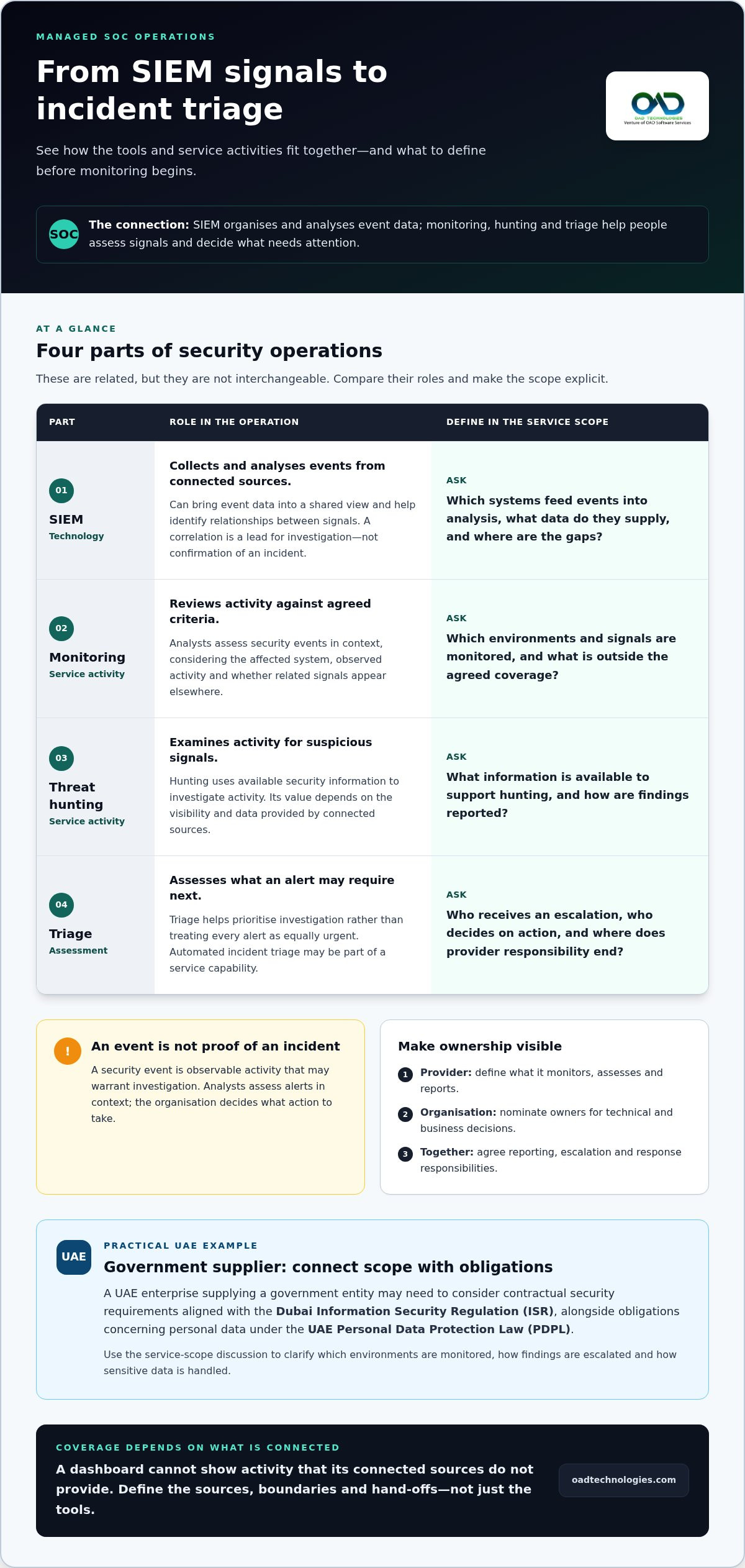
A security event is an observable activity that may warrant investigation, not proof that an incident has occurred. Analysts assess alerts in context, considering relevant information such as the affected system, the activity observed and whether related signals appear elsewhere. That assessment helps prioritise investigation rather than treating every alert as equally urgent. Clear reporting then gives the organisation useful information for deciding what action to take.
Who may benefit from a managed SOC?
Organisations with established IT or security teams may use a managed SOC to extend their monitoring and investigation capacity. The service can provide an additional operational layer while internal teams retain their knowledge of business systems and decision-making responsibilities. This can be useful where security signals come from several environments and staff need a more consistent way to review and route them.
Executives may also value clearer ownership: who reviews security alerts, who receives an escalation, and who decides on business actions. For example, a UAE enterprise with a lean internal security function could define which systems the SOC monitors and nominate internal owners for issues requiring business or technical decisions. OAD Technologies’ managed SOC service is presented as a defined cybersecurity offering, rather than general IT support.
There is no single operating model for every organisation. The right scope depends on the environment being monitored, existing team responsibilities and the level of visibility leaders need. A well-defined service makes those choices explicit, helping the SOC work alongside internal teams without blurring accountability.
How managed SOC monitoring, SIEM, and threat response fit together
SIEM, monitoring, threat hunting and triage describe different parts of security operations, not interchangeable products. SIEM is technology for collecting and analysing events from connected sources. Monitoring and hunting are activities that use security information, while triage helps assess what an alert may require next. Keeping these roles distinct makes it easier to understand how a managed SOC fits with existing tools and internal processes.
How SIEM supports security monitoring
A SIEM can bring event data from connected systems into a shared view and help identify relationships between signals. For example, an unusual account sign-in and a separate endpoint alert may each need investigation. If both are visible together, an analyst can assess whether their timing or context warrants further attention. A correlation is a lead for investigation, not confirmation of an incident. OAD Technologies’ SIEM capabilities support event analysis and security visibility.
Visibility depends on the sources connected and the data they provide. A useful scope discussion therefore identifies which systems feed events into analysis, what information those events contain, and where gaps remain. A dashboard cannot show activity that its connected sources do not provide. That distinction helps organisations assess coverage without assuming that SIEM automatically observes every environment or resolves every alert.
SIEM technology: Organises and analyses event data. Useful output: Signals and relationships for review. Scope consideration: Which sources are connected, and what data do they supply?
Monitoring: Reviews activity against agreed criteria. Useful output: Items that may need assessment. Scope consideration: Which environments and signals are in view?
Threat hunting: Examines activity for suspicious patterns that may not appear as a clear alert. Useful output: Findings for investigation. Scope consideration: Which environments and available data inform the hunt?
Incident triage: Assesses an alert and its priority. Useful output: An assessment to guide follow-up. Scope consideration: Who receives the result and determines the next action?
Where threat hunting and incident triage fit
Threat hunting is an investigative approach. It can look for patterns that routine alerts may not clearly surface, but its usefulness depends on the available data and agreed scope. Triage starts with a signal and helps determine its relevance and priority. Automation can assist with that assessment; it does not guarantee prevention or make every alert conclusive. The organisation’s agreed escalation process still matters, particularly where decisions require business context.
Separating these activities helps teams see what technology contributes and where human judgement remains important. It also gives internal security owners a clearer basis for discussing roles, data sources and follow-up expectations with a managed SOC provider. To discuss how these elements could fit your environment, Talk to a security expert.
How to compare managed SOC services and assess accountability
A managed SOC is easier to assess when its responsibilities are documented rather than described in broad assurances. For a managed soc uae engagement, the written scope should connect monitored environments, service activities, reporting and escalation to named owners. It should also separate operational commitments from claims that are difficult to measure, such as “complete protection”.
What should the service scope make clear?
Set out which environments and data sources are included, which service components apply, and where the organisation’s responsibilities begin. Record any exclusions or dependencies that affect visibility, such as systems outside the agreed monitoring scope. Document escalation routes, responsible roles and how the organisation receives findings. Commercial and operational details should reflect the agreed engagement, not assumptions about standard coverage or response times.
Area
What to establish
Accountability prompt
Scope
Covered environments, data sources and included activities.
What falls outside the agreed scope?
Ownership
Provider tasks and organisation responsibilities.
Who reviews findings and makes business decisions?
Escalation
How findings are routed and to which roles.
Who receives an escalation, and what follow-up is expected?
Reporting
The agreed view of activity, risks and service coverage.
Can leaders see what was reviewed and what remains open?
Data handling
Relevant data locations, access and retention arrangements.
How does handling align with organisational requirements?
How to evaluate reporting and accountability
Useful reporting makes operations reviewable. It should help the organisation understand what activity was observed, how it relates to the agreed scope, and which items need attention. Reports are more valuable when they show ownership and status clearly, rather than relying on general assurances or activity totals without context.
For example, a UAE enterprise with sensitive operational data can use the engagement record to align monitoring scope and data-handling arrangements with its internal governance requirements. The relevant considerations will depend on the organisation and its obligations; the service itself does not establish regulatory compliance.
OAD Technologies provides managed security services as part of its cybersecurity offering. Clear scope and reporting help connect those services with internal oversight, while keeping operational responsibilities visible. To discuss how a defined SOC service could fit your environment, Talk to a security expert.
UAE governance considerations for managed SOC decisions
Regulatory relevance depends on an organisation’s sector, activities, data and contractual obligations. A managed SOC can support security oversight and provide operational information for governance processes, but it doesn’t establish compliance or transfer the organisation’s accountability to a service provider. Start by identifying which obligations apply, then consider how monitoring scope, reporting and escalation can support the organisation’s wider control environment.
How to connect SOC scope with UAE requirements
Work with qualified internal or external compliance advisers to map the organisation’s obligations to the systems, information and processes under consideration. Potential references include UAE IA/NESA and NESA / SIA, the UAE Personal Data Protection Law (PDPL), CBUAE requirements for relevant financial institutions, ADHICS for healthcare organisations, and the Dubai Information Security Regulation (ISR) where applicable. Their relevance is not universal, and naming a regulation does not demonstrate that a service meets it.
Verify each reference and its applicability against authoritative, current sources before translating it into service requirements. A practical mapping can help:
- Identify the entity, business activity and data involved.
- Record applicable obligations and contractual requirements with adviser input.
- Relate those requirements to monitoring scope, reporting and escalation responsibilities.
- Review the mapping when systems, activities or applicable obligations change.
This process helps distinguish security operations information from compliance evidence. SOC reporting may help governance teams review activity and follow-up, but it doesn’t replace legal interpretation, control assessments or the organisation’s own compliance processes. Treat broad claims of “regulatory alignment” carefully: the relevant requirements and supporting evidence need to be assessed in context.
A practical example for a UAE healthcare organisation
Consider a healthcare organisation reviewing how its managed SOC scope relates to sensitive clinical and business systems. Leaders can work with security, IT, privacy and compliance stakeholders to identify which systems and event sources are relevant, where monitoring is appropriate, and which internal roles own escalations. They can then document how findings are reviewed and how decisions move between technical teams and accountable business owners.
ADHICS may be a relevant reference for a healthcare organisation. NABIDH / Malaffi may also warrant consideration depending on the organisation’s context. Teams should verify current applicability and requirements against authoritative sources and qualified advice, rather than infer specific SOC duties from these names. The organisation can record what monitoring supports, what remains outside its scope, and who makes decisions when findings need follow-up. This supports governance, but the SOC service itself does not establish compliance.
A clear record of scope, ownership and review responsibilities gives leaders a practical basis for evaluating whether security operations fit their governance needs.
Talk to a security expert
How OAD Technologies approaches managed SOC in the UAE
OAD Technologies provides a defined managed SOC service for enterprise environments. The starting point is understanding how security operations should fit the organisation’s structure, priorities and existing capabilities. A Fully Managed, Defined Scope engagement gives teams a basis for discussing responsibilities and service boundaries in relation to their environment, rather than assuming one operating model suits every organisation.
What OAD Technologies’ managed SOC includes
OAD Technologies’ AI-driven Managed SOC offering is Nexoaura. Its service description provides a clear starting point for discussing how security operations relate to an enterprise’s existing environment and oversight needs. The managed SOC service can be considered in terms of the organisation’s requirements, including which responsibilities should sit with the service and which decisions remain with internal teams.
For leaders, an important consideration is how an external security function works alongside existing IT and security roles. Internal teams bring business context and retain responsibility for decisions that affect operations. A defined engagement helps make that relationship more understandable, so executives can consider how service oversight fits into their wider governance and operational planning.
Discussing fit, scope and governance
A productive discussion can begin with the organisation’s priorities, existing environment and governance considerations. For example, an enterprise with an established IT function may want to explore how a managed SOC can complement current responsibilities without duplicating them. A team can also outline the operational areas that matter most and the internal roles that should be involved in service oversight.
OAD Technologies can discuss a Fully Managed, Defined Scope engagement in the context of those requirements. The aim is to shape the conversation around organisational fit, clear ownership and service boundaries, rather than broad assurances. Requirements can differ across enterprises, so a useful discussion connects the service to the organisation’s specific operating context and priorities.
That conversation gives decision-makers a practical basis for considering how managed SOC operations could support their wider security programme. It also helps internal stakeholders assess where collaboration is needed and how oversight can remain connected to business needs as those needs evolve.
Talk to a security expert
Make your next SOC decision a lasting fit
The next step is to treat security operations as an evolving part of the organisation, not a one-off procurement choice. As systems, data flows and business priorities change, the assumptions behind a managed soc uae service may need to be revisited. A clear internal owner can help keep the service aligned with operational needs and relevant governance considerations.
Start with a focused conversation about what your organisation needs to see, how the service should fit with existing teams, and which changes might prompt a review. That gives decision-makers a practical basis for shaping an engagement around their environment rather than relying on generic expectations.
With the right fit, managed security operations can support clearer oversight as your organisation grows and changes. Take the next step with confidence.
Talk to a security expert
A considered starting point can help your security operations grow with your business.
Frequently Asked Questions
What is the difference between a managed SOC and MDR?
A managed SOC describes an outsourced security operations function, while Managed Detection and Response (MDR) focuses on detecting suspicious activity and coordinating investigation and response. The services can overlap, so the names alone don’t define what an organisation receives. Compare the agreed activities, monitored environments, reporting and escalation responsibilities. For example, a team may need to clarify whether a service covers signals beyond its endpoint security tools.
Does a managed SOC replace an organisation’s internal security team?
No. A managed SOC can add monitoring and investigation capacity, but internal teams retain business context and decision-making responsibilities. An internal security lead, for instance, can determine how a finding affects business operations and coordinate decisions with relevant stakeholders. Define which activities the service performs and which remain with internal IT, security, privacy or risk owners. This division supports collaboration without leaving responsibility unclear.
Can a managed SOC support UAE regulatory compliance?
It can support compliance efforts by giving teams security information to review and use in governance processes, but it cannot guarantee compliance. Applicability depends on the organisation’s sector and obligations. A financial institution, for example, may need to consider relevant CBUAE requirements, while a healthcare organisation may assess ADHICS. Have qualified advisers map applicable requirements to controls and evidence; treat SOC reporting as an input, not proof that every obligation is met.
What does Sovereign UAE Data Residency & Retention mean?
Sovereign UAE Data Residency & Retention identifies data residency and retention as a characteristic of the offering. Residency concerns where relevant data is held; retention concerns how its keeping is managed. For governance planning, identify the security data involved, its purpose and the organisation’s applicable handling requirements. Then align those considerations with internal privacy and security stakeholders, including any obligations under the UAE Personal Data Protection Law (PDPL).
Is SIEM the same as a managed SOC?
No. Security Information and Event Management (SIEM) is a technology capability for collecting and analysing security events; a managed SOC is a service that organises security operations around agreed responsibilities. Having SIEM does not by itself establish who reviews its outputs or what happens next. An organisation comparing options should consider whether it needs the technology, operational support around it, or both, based on its existing team and environment.
What should an organisation prepare before discussing managed SOC requirements?
Prepare a high-level view of your critical systems, current security tools, internal ownership and governance priorities. Note which environments matter most, what visibility is missing and who should receive findings. Also identify relevant contractual or regulatory considerations, such as the Dubai Information Security Regulation (ISR) if applicable. This gives the discussion a practical starting point, helping shape a scope around the organisation’s environment instead of assumptions about standard coverage.
Disclaimer
Content by OAD Technologies is for general informational purposes only and does not constitute professional or cybersecurity advice. No warranties are made regarding accuracy or completeness; reliance is at your own risk. OAD Technologies shall not be liable for any direct or indirect losses arising from use of this content.