

What if a routine change to payment instructions became the weak point in a property transaction? For real estate firms, sensitive property, identity and financial information moves between clients, agents, offices, platforms and service providers. That makes cybersecurity for real estate firms a business-workflow issue, not just an IT concern.
Email compromise can disrupt communications or misdirect payments, while dispersed teams and third parties can make access harder to oversee. As property operations adopt more cloud platforms and connected building technology, firms also need to understand how information and access move between systems. If you are working to optimize your building operations and digital strategy alongside security, check out Syntric Hub Advisory Solutions for facilities management and operational transformation support.
This practical guide shows how to prioritise controls around the work your firm actually does, from handling enquiries and identity documents to managing transactions and supplier access. It explains how governance, identity and endpoint safeguards, email and cloud security, and incident readiness can work together. It also covers relevant UAE considerations, including the UAE Personal Data Protection Law (PDPL) and, where applicable, Dubai Information Security Regulation (ISR) and NESA / SIA. The aim is a proportionate, business-led plan that reduces avoidable exposure without treating any control as a guarantee.
Key Takeaways
- Map how information moves through enquiries, listings, identity checks, contracts and payments to identify where safeguards matter most.
- Distinguish business email compromise from general phishing, and set clear verification steps for changes to payment instructions.
- Compare preventive, detection and response controls by the assets they cover, who owns them and how they support cybersecurity for real estate firms.
- Build readiness in sequence: identify critical workflows, review access, prioritise controls, assign owners and rehearse escalation.
- Explore how OAD Technologies’ Managed Technology Services and capabilities such as SIEM, EDR, MDR, email security and identity controls can support a coordinated security programme.
Why cybersecurity matters across real estate firms’ connected workflows
Cybersecurity protects information, systems and business processes from unauthorised access or disruption. For real estate firms, that means protecting not only files but also the communications and digital services that keep property work moving.
Real estate cybersecurity is the coordinated protection of property information, business systems and transaction continuity across the people and platforms involved in each workflow. This is a practical way to approach cybersecurity for real estate firms: trace what information moves, who needs it, which systems handle it and what business activity could be affected if access is misused or interrupted.
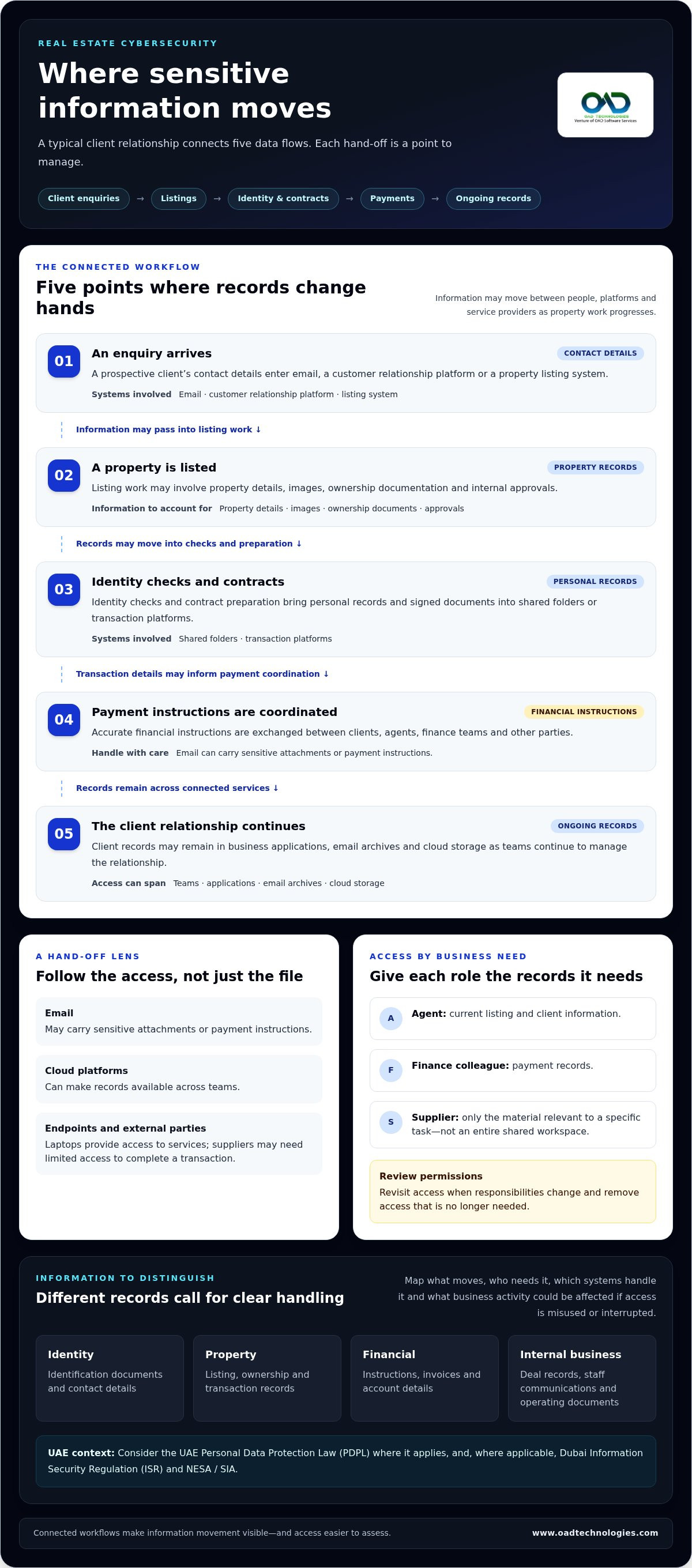
A typical client relationship can create several connected data flows:
- An enquiry brings contact details into email, a customer relationship platform or a property listing system.
- Listing work may involve property details, images, ownership documentation and internal approvals.
- Identity checks and contract preparation bring personal records and signed documents into shared folders or transaction platforms.
- Payment coordination relies on accurate financial instructions exchanged between clients, agents, finance teams and other parties.
- Ongoing client records may remain in business applications, email archives and cloud storage as teams continue to manage the relationship.
Each hand-off creates a point to manage. Email can carry sensitive attachments or payment instructions; cloud platforms can make records available across teams; endpoints such as laptops provide access to those services; and external parties may need limited access to complete a transaction. A weakness in one area can affect another when accounts or systems are connected.
Which real estate information needs protection?
Customer identity records, such as identification documents and contact details, need careful handling. Property documentation can include listing, ownership and transaction records, where unauthorized alterations can jeopardize ownership rights; platforms like Title Fraud Defender illustrate how continuous monitoring helps guard against fraudulent deed changes. Financial instructions, invoices and account details can influence payment activity, while internal business information may include deal records, staff communications and operating documents. Treating these as distinct information types helps a firm decide where they are stored and who should access them.
Access should follow role and business need. An agent may need current listing and client information, while a finance colleague may need payment records. A supplier involved in a specific task may need access to only the relevant material, not an entire shared workspace. Review permissions when responsibilities change and remove access that is no longer needed. Firms handling information in the UAE should also consider relevant privacy and security requirements, including the UAE Personal Data Protection Law (PDPL) where it applies.
Why do property workflows create connected exposure?
Property work links people and tools that may sit outside one team’s direct control. Clients send documents, agents coordinate viewings and offers, vendors support platforms or services, and internal teams progress contracts and payments. Shared mailboxes, cloud folders and third-party applications can connect these activities.
Consider an account used for client correspondence that also has access to shared transaction files. If compromised, it could expose documents, enable impersonation in ongoing conversations or provide a route to information used by another workflow. The potential impact depends on the account’s permissions, connected services and the processes people use to verify requests, not simply on the fact that the organisation works in real estate.
Mapping these connections gives leaders a practical starting point: identify the information and processes that matter, then assess how identities, endpoints, email, cloud platforms and counterparties interact around them.
Cybersecurity threats real estate firms should recognise and investigate
Assess threats by tracing three things: how they could enter, what access or information they could reach, and which business activity might be affected. A deceptive email may target a transaction; stolen credentials may open a cloud workspace; malicious software may interfere with access to shared files. This workflow-based view helps firms prioritise investigation around actual exposure rather than treating every threat as equally relevant.
Common entry points include email, user accounts, endpoints, cloud applications and connections used by external providers. The target might be client records, transaction documents, financial instructions or systems that support day-to-day operations. The potential impact depends on access permissions and business processes, so cybersecurity for real estate firms should connect technical signals to the work they could disrupt.
- Credential theft: A user is tricked into revealing sign-in details, which may expose email or connected services.
- Business Email Compromise (BEC): An attacker impersonates a trusted party or takes over an account to manipulate a conversation or request.
- Ransomware: Malicious software may make business files inaccessible, potentially affecting transaction work and routine operations.
- Third-party exposure: A supplier’s software, account or shared access may create a route to information or systems used by the firm.
How can email compromise affect property transactions?
Generic phishing often uses a deceptive message to prompt a click, disclose credentials or open a harmful attachment. BEC is more focused on exploiting business correspondence: an attacker may impersonate an agent, client or supplier, use a compromised mailbox, or insert altered payment instructions into an existing exchange. These are distinct scenarios, but each can exploit familiar names, active deals and pressure to act quickly.
For example, a message that appears to continue a genuine transaction conversation may ask a finance colleague to use new account details. Treat unexpected changes as a reason to pause and verify through a separate, established channel. Email filtering, strong identity controls and staff procedures can support protection, but no single measure addresses every route or variation of an attack.
How do ransomware and third-party exposure affect operations?
Ransomware can affect access to files that staff rely on to progress listings, contracts or client work. The operational concern is not only the affected device; shared folders, connected services and dependencies may also matter. Firms should understand which systems support essential activities and how teams would escalate a suspected incident, preserve relevant information and coordinate decisions.
Third-party access belongs in a real estate firm’s risk assessment because a supplier’s account, software or connection can affect the information and workflows the firm depends on. Record which providers connect to business systems, what access they use and who owns that relationship. Include shared accounts and software dependencies in the review, then document who reports concerns, who assesses potential impact and how escalation reaches accountable decision-makers. This gives technical teams and business leaders a clearer basis for investigation.
OAD Technologies’ enterprise cybersecurity capabilities include services that can support a coordinated approach to managing these risks.
How to assess and compare cybersecurity controls for a real estate business
Choose safeguards by matching them to a business asset, the way it is exposed and the activity that depends on it. For cybersecurity for real estate firms, a control’s value depends not only on what it can do, but also on which systems it covers, who operates it and whether its alerts or processes fit the firm’s day-to-day work.
Compare controls across three functions. Preventive measures aim to reduce the chance of unauthorised access or unsafe activity. Detection capabilities help identify suspicious events. Response processes establish who investigates and what happens next. No single category replaces the others. A useful comparison makes coverage and accountability visible:
| Business asset | Exposure | Control category | Accountable owner |
|---|---|---|---|
| Client and transaction files | Information shared or moved across systems | Data Loss Prevention (DLP) | Data or business process owner |
| Staff and supplier accounts | Excessive or outdated permissions | Identity and Access Management (IAM) | Identity administrator and access approver |
| Staff devices | Malicious activity or compromise on endpoints | Endpoint protection and EDR | Security operations owner |
| Cloud services | Configuration gaps or unclear visibility | Cloud Security Posture Management (CSPM) | Cloud service owner |
| Security event records | Signals spread across systems | Security Information and Event Management (SIEM) | Security monitoring owner |
Which controls address data, identity and endpoint risks?
DLP supports oversight of sensitive information movement, helping teams define how information should be handled across approved workflows. Identity governance clarifies who has access and who approves it. Privileged access management focuses on accounts with elevated permissions, while Zero Trust applies the principle of verifying access rather than assuming it is safe because of a user’s location or network.
Endpoint protection and Endpoint Detection and Response (EDR) focus on activity on devices. SIEM serves a different purpose: it brings security events together for central analysis. These capabilities can complement one another, but their usefulness depends on coverage, integration and clear responsibility for reviewing and acting on findings. For deeper information-protection planning, see the Data Loss Prevention strategic framework.
How should firms evaluate cloud and supplier dependencies?
Assess cloud accounts, permissions, information access and supplier connections as related parts of the operating environment. CSPM supports visibility into cloud security posture, such as configuration concerns, but it does not replace governance: someone still needs to set priorities, approve changes and own remediation. Evaluate how well a control fits existing platforms and workflows alongside the breadth of its coverage.
For each capability, define an accountable owner, the systems in scope and the route for escalating a finding. A broad tool may add little value if it leaves important applications outside coverage or produces alerts without an assigned responder. Conversely, a narrowly scoped control may fit a critical workflow but leave connected dependencies unaddressed. Firms reviewing account roles and approvals can explore the Identity and Access Management strategic framework.
Practical steps to strengthen a real estate firm’s cyber readiness
Build readiness around the work the firm needs to keep moving. A useful plan connects business priorities with technical safeguards, named owners and a clear route for raising concerns. It should fit existing transaction processes rather than adding steps that staff cannot follow consistently.
Control priorities should follow business impact and assessed exposure, not a generic checklist. Use this adaptable sequence:
- Identify critical workflows. Map the activities and information that support property enquiries, transactions and ongoing client service. Note which systems and external connections each depends on.
- Review access. Document who can reach sensitive information, what permissions they need and how access changes when someone changes role or leaves.
- Prioritise controls. Compare current safeguards with the risks and business dependencies you have identified. Focus first on material gaps in important workflows.
- Assign owners. Name the person responsible for each system, control and decision. Make ownership clear across business teams, technical staff and relevant suppliers.
- Rehearse escalation. Practise how staff report a suspected incident, who assesses it, who makes business decisions and how teams communicate internally.
What should a real estate cybersecurity review cover?
Keep the review practical and usable by both executives and technical teams. Inventory critical information, systems, user groups and relevant external connections. Then record existing safeguards, known gaps, system dependencies and accountable owners without assuming the firm uses a particular platform. Summarise each priority in business terms, such as the workflow at risk, the exposure and the decision or action needed.
A concise record can help leadership weigh business impact while giving technical teams enough context to plan work. Include open questions and review dates so assumptions do not become invisible.
How can firms improve readiness without unnecessary friction?
Align safeguards with staff responsibilities and transaction stages. Agents should be able to complete their work using appropriate access, while sensitive actions have clear verification and reporting steps. Explain how to report suspicious activity and where concerns go, including when a supplier or shared service may be involved. Review the plan as systems, suppliers, workflows or assessed risks change.
Test the escalation route with a realistic scenario, such as an unexpected account-access alert during an active transaction. Check that people know who coordinates decisions, how internal updates are shared and when the issue should be escalated externally. Record lessons and update responsibilities, procedures or safeguards where needed.
OAD Technologies can support a structured review of your firm’s workflows, access and readiness priorities through its enterprise cybersecurity services.
How OAD Technologies supports enterprise cybersecurity for real estate firms
OAD Technologies provides enterprise cybersecurity capabilities for organisations in the UAE. For real estate firms, this can mean connecting safeguards for information, identities, endpoints and cloud services with the workflows they support, rather than treating each technology as a separate fix. The aim is a coordinated programme with clear scope, ownership and escalation, without promising that any service can eliminate risk.
Relevant capabilities include Managed SOC, Security Information and Event Management (SIEM), Endpoint Detection and Response (EDR), Managed Detection and Response (MDR), Extended Detection and Response (XDR), Data Loss Prevention (DLP), email security and identity controls. These capabilities can support oversight across security events, endpoint activity, sensitive information movement and user access. The appropriate mix depends on the firm’s systems, priorities and existing responsibilities.
How can managed security support a defined security programme?
OAD Technologies provides 24 × 7 Managed Security Operations. Relevant managed components include SOC, Endpoint, SIEM, Email & Data Protection and Firewall. Clear scope, ownership and escalation paths help teams understand who oversees each component and how concerns are raised and coordinated. These arrangements support consistent operations without implying a guaranteed response or outcome.
Engagement models provide different ways to organise that support. A Co-Managed Partnership can align agreed responsibilities between the firm and OAD Technologies. Fully Managed Operations can place a defined scope of security operations under managed delivery. Advisory & Transformation can support planning and the development of a longer-term security programme. The model should reflect internal capacity, business priorities and the responsibilities the firm wants to retain.
How should executives connect security support with governance?
Security decisions need a governance context: who accepts risk, who owns actions and how leaders review progress. OAD Technologies’ Compliance, Governance & Risk capabilities can support compliance efforts, but they do not automatically fulfil a regulatory requirement. Where relevant to the organisation, executives can align security planning with the UAE Personal Data Protection Law (PDPL), Dubai Information Security Regulation (ISR) and NESA / SIA, based on applicable obligations and authoritative guidance.
Governance works best when it connects documented priorities to practical ownership. For example, leaders can set expectations for who reviews risks, approves changes and tracks remediation, while technical teams translate those decisions into controls and operational processes. This makes security progress easier to discuss in business terms and helps keep responsibilities visible as systems and suppliers evolve. OAD Technologies’ Governance, Risk and Compliance strategic guide provides deeper context for structuring this work.
A proportionate cybersecurity programme starts with the firm’s workflows and develops through clear decisions, defined scope and accountable delivery.
Make security a continuing business priority
Turn your risk review into a working security roadmap. Choose a first priority, assign an accountable owner and agree how progress will be reviewed as workflows, systems and supplier relationships evolve. A business-led approach to cybersecurity for real estate firms should adapt with the organisation, not sit untouched after an initial assessment.
OAD Technologies lists ISO 9001, ISO 14001, ISO 45001 and ISO 27001 certifications. Its delivery approach also emphasises defined service levels, ownership and escalation paths. These provide a structured foundation for collaboration, while the right scope and priorities remain specific to each organisation.
Start with a focused conversation about the workflows your firm needs to protect and the responsibilities you want your teams and security partners to hold. Book a meeting or discuss your requirements with OAD Technologies.
Frequently Asked Questions
Is cybersecurity important for a small real estate firm?
Yes. A smaller firm may handle sensitive client information, transaction documents and payment communications, so cybersecurity for real estate firms should reflect real workflows, not headcount alone. Start by identifying essential activities, the systems they rely on and who is responsible for protecting them. For example, a small agency could prioritise access to its shared transaction folder and define who approves changes to payment details.
What information should a real estate firm prioritise protecting?
Prioritise information whose exposure, alteration or loss could cause harm or interrupt important work. This may include identity documents, client records, property files, financial instructions and business credentials. The order depends on how your firm operates and its obligations. Consider a simple information map that records where each type is stored, which roles can access it and which external services or parties support its use.
Can cloud property software be secure?
Cloud property software can be part of a secure environment, but choosing a cloud service alone does not resolve access, configuration or governance risks. Identify the information held in the platform, which user roles can view or change it, and how it connects to email, storage or other business systems. For example, a departing employee’s account should no longer retain access simply because the software is hosted online.
Does multi-factor authentication prevent every account takeover?
No. Multi-factor authentication adds a verification step beyond a password, but it cannot guarantee that an account will not be compromised. Pair it with sound access governance, staff awareness, monitoring and an incident process. Apply stronger safeguards to accounts with access to sensitive records or administrative functions, and review permissions as responsibilities change. Treat it as one layer in a broader plan, not a substitute for other controls.
Can cybersecurity measures slow property transactions?
They can create friction if they do not fit the way staff work, but practical safeguards can be built into transaction steps. For example, identify the points where users share sensitive records or approve financial changes, then design verification around those activities rather than adding checks everywhere. Involve business and technical owners when adjusting a process, and review whether staff can follow it without unnecessary delays or workarounds.
Does the UAE Personal Data Protection Law (PDPL) apply to every real estate firm?
Applicability depends on the organisation’s circumstances and its data processing, so this answer cannot determine a firm’s legal position. Seek qualified guidance and consult authoritative sources about the organisation’s specific obligations. A firm can use cybersecurity measures to support risk management and compliance efforts, but purchasing a security service does not automatically establish compliance with the UAE Personal Data Protection Law (PDPL).
What should a real estate firm do after suspecting a cyber incident?
Follow your established incident procedures and report the concern promptly through the designated internal channel. Preserve relevant information, such as suspicious messages or alert details, and avoid making unapproved changes that could complicate investigation. Escalate to the responsible decision-makers and appropriate technical support. The right actions depend on the incident and the firm’s obligations, so rehearse the process in advance rather than relying on a generic checklist.
Disclaimer
Content by OAD Technologies is for general informational purposes only and does not constitute professional or cybersecurity advice. No warranties are made regarding accuracy or completeness; reliance is at your own risk. OAD Technologies shall not be liable for any direct or indirect losses arising from use of this content.


