

What makes threat intelligence integration with MDR useful is not the number of feeds, but whether the information changes a security decision. Intelligence can add context to an alert, but without a clear link to investigation and response, extra data may create noise rather than clarity.
That is the practical challenge for security leaders: understanding how external and internal intelligence can help analysts assess suspicious activity, prioritise risk and decide what to investigate, while keeping operational responsibilities clear.
This guide explains how threat intelligence can inform MDR investigations and prioritisation, compares integration approaches and their trade-offs, and outlines the scope, information flows and responsibilities to consider when assessing fit. For UAE enterprises, the goal is to connect security requirements with a defined operating model. OAD Technologies provides MDR, SIEM and EDR services alongside managed cybersecurity and SOC services. The guidance here can help you evaluate how those services align with your security objectives.
Key Takeaways
- Threat intelligence integration with MDR is most useful when it adds context that helps analysts assess alerts and prioritise investigations.
- Integration can combine technology, processes and analyst judgement; it does not have to depend on a single automated connection.
- Compare feed-led enrichment, SIEM-supported correlation and analyst-led assessment to identify trade-offs that fit your security environment.
- Set clear objectives, data ownership and decision rights, then assess whether intelligence improves operational decisions.
- Use a defined service scope to align MDR, SIEM and EDR requirements with your organisation’s security objectives.
What Threat Intelligence Integration with MDR Actually Means
Threat intelligence integration with MDR connects assessed information about threats, behaviours and indicators to the work of detecting, investigating and responding to security events. The aim is not to collect as much data as possible. It is to give security teams relevant context that can help them decide whether an alert deserves attention, what to investigate and how to shape a response.
Managed Detection and Response (MDR) combines technology with human expertise to monitor security activity, detect potential threats, investigate alerts and support response. The Managed Detection and Response (MDR) model gives organisations access to these activities as a managed service. Intelligence can strengthen that work, but it cannot guarantee that every threat will be detected or prevented.
Threat data, threat intelligence, and security context
Raw threat data might be an IP address, file hash or web domain associated with suspicious activity. An indicator of compromise (IOC) is a clue that may point to malicious activity, but an isolated indicator does not explain whether it matters to your organisation. Analysts assess its reliability, recency and relevance alongside other evidence. Tactics, techniques and procedures (TTPs) describe how attackers operate, such as the methods they use to gain access or move through an environment.
Raw threat data is a clue; actionable intelligence explains why that clue matters to a specific security decision. This distinction helps prevent a long list of indicators from becoming a substitute for analysis.
Hypothetical example: An endpoint alert records a connection to a suspicious domain. On its own, the alert may be ambiguous. If current, assessed intelligence links the domain to a relevant campaign and describes related attacker behaviour, an analyst can use that context to guide further investigation. The association is a lead, not proof of compromise; the organisation’s own evidence still matters.
Where threat intelligence meets MDR
In an MDR process, intelligence may inform alert triage by helping analysts assess an event’s relevance and potential priority. During an investigation, it can provide leads about related indicators or behaviours to examine. When considering response, it may inform decisions about containment or escalation, according to the agreed service scope and decision rights. The organisation’s environment remains central: an indicator’s meaning can change depending on which systems, users and activities are involved.
Useful integration depends on relevance and timeliness, and on whether analysts can apply information to the organisation’s assets and risk priorities. Stale, generic or poorly assessed data can distract rather than clarify. Define which decisions intelligence should inform, who validates the context and how findings are communicated. These questions also help leaders understand the wider operating model described in this MDR strategic guide.
For enterprises assessing threat intelligence integration with MDR, the key test is straightforward: does the added context help people make a better-informed detection, investigation or response decision, without implying certainty the evidence cannot support?
How Threat Intelligence Moves Through an MDR Process
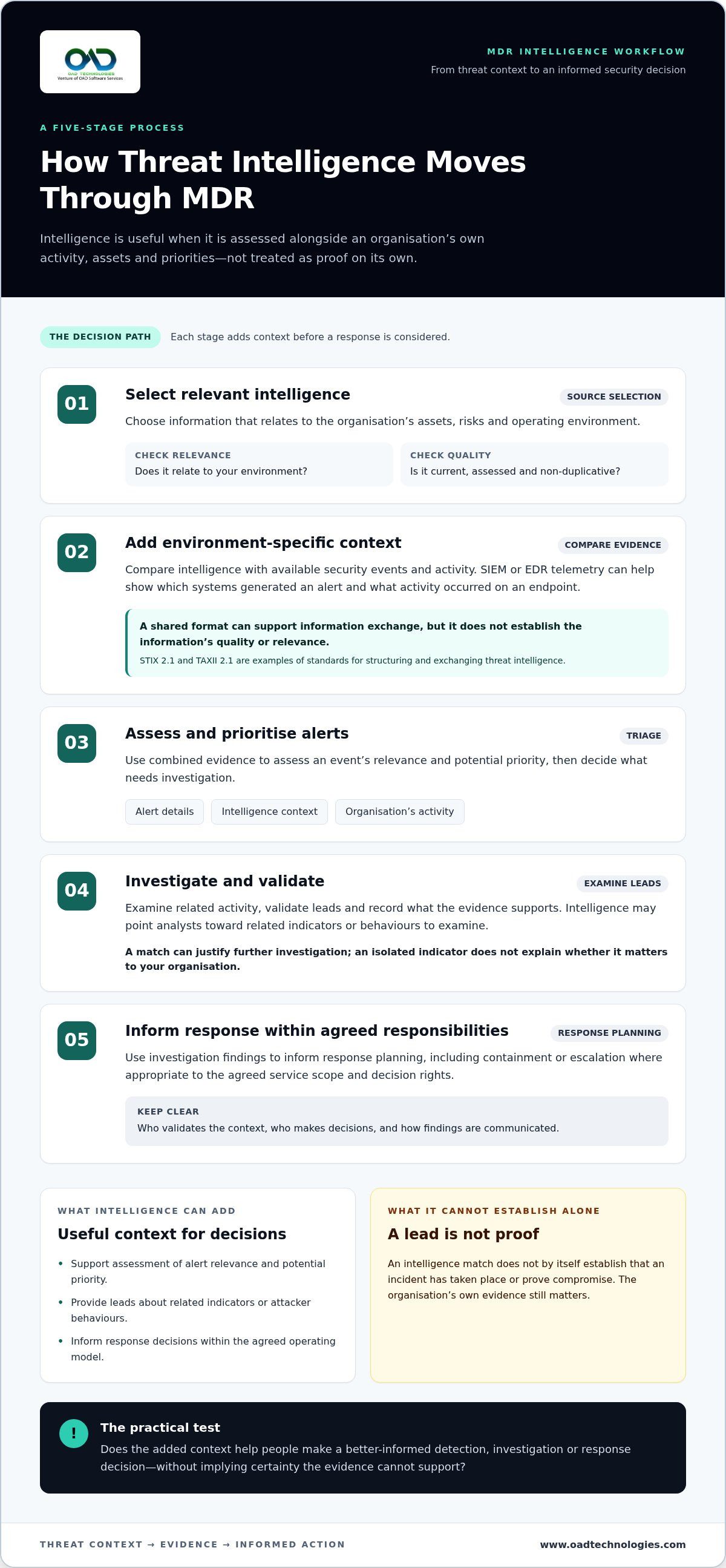
Threat intelligence integration with MDR works as a sequence of decisions, not simply a connection between a feed and a security platform. Technology can help organise and compare information, while analysts and agreed procedures determine what it means for the organisation. SIEM and EDR telemetry can add environment-specific evidence, such as which systems generated an alert or what activity occurred on an endpoint. Intelligence alone does not establish that an incident has taken place.
A practical flow is:
- Select relevant intelligence: Choose information that relates to the organisation’s assets, risks and operating environment.
- Add context: Compare it with available security events and activity, including SIEM or EDR telemetry where applicable.
- Assess alerts: Use the combined evidence to inform triage and decide what needs investigation.
- Investigate: Examine related activity, validate leads and record what the evidence supports.
- Inform response: Use the findings to guide response planning within agreed responsibilities and decision rights.
Intelligence only becomes useful when it is evaluated against an organisation’s own activity, assets and priorities. A match may justify further investigation, but it should not be treated as proof on its own.
From intelligence sources to relevant context
Source selection is a governance decision, not a race to collect more feeds. Security teams can consider whether a source is relevant to their environment, how current its information is, whether it duplicates existing data and how confidently its claims are assessed. STIX 2.1 and TAXII 2.1 are examples of standards for structuring and exchanging threat intelligence. A shared format can support exchange, but it does not establish the quality or relevance of the information. As the Brookings Institution discusses in the importance of threat intelligence sharing, sharing information matters, but it must be put to effective use.
From an alert to an informed response
Hypothetical example: A SIEM alert flags an unusual sign-in followed by access to a sensitive system. During triage, an analyst checks whether relevant intelligence describes related account behaviour or attacker techniques. EDR and other available telemetry may help establish what the endpoint did around the same time. The analyst then assesses whether the activity fits normal business use, looks for corroborating evidence and documents uncertainty before response options are considered.
The MITRE ATT&CK framework can help describe observed adversary behaviours using a shared vocabulary. Mapping activity to a technique can make investigation notes clearer, but it does not certify that an organisation is protected or prove that an attacker is present. Response decisions still depend on evidence, business impact and the agreed scope of authority. For a deeper look at how security events are collected and analysed, the SIEM strategic guide provides useful context.
To align this process with your security objectives, discuss your requirements with OAD Technologies.
Compare Threat Intelligence Integration Approaches for MDR
There is no single model for threat intelligence integration with MDR. The right approach depends on the decisions an organisation needs to improve, the security data available to support them and how analysts will use intelligence in practice. Three common approaches are feed-led enrichment, SIEM-supported correlation and analyst-led contextual assessment. They can operate together rather than as mutually exclusive architectures.
Integration quality depends on the decisions intelligence enables, not the volume of feeds collected. Use the comparison below to consider where each approach can help and what it demands from your security operation.
| Approach | Inputs | Strengths | Limitations | Suitable conditions |
|---|---|---|---|---|
| Feed-led enrichment | Selected indicators and threat reports | Adds threat context to matching alerts | Stale, duplicated or poorly matched data can create noise | Teams with clear source selection and indicator review |
| SIEM-supported correlation | Threat information and available security event data | Can relate indicators to activity across collected events | Depends on relevant, usable data and well-defined correlation logic | Organisations with SIEM-supported event visibility |
| Analyst-led contextual assessment | Intelligence, alerts, telemetry and organisational knowledge | Allows human judgement to weigh business and technical context | Requires clear procedures, expertise and time for assessment | Environments where context and nuanced decisions matter |
Feed-led enrichment versus broader operational context
Feed-led enrichment compares available indicators, such as a domain or file hash, with security telemetry. A relevant match can give an analyst a useful lead. But an indicator alone does not establish malicious activity, confirm that an account or device is compromised, or show the potential business impact. Intelligence can also lose value if it is outdated, repeated across sources or unrelated to the organisation’s systems and threat exposure. Broader context helps analysts assess what a match means rather than treating it as a verdict.
SIEM-supported correlation can help connect threat information with collected events, while analyst-led assessment brings in details that may not be apparent from an indicator match alone. The approaches can complement one another: automated matching may surface a lead, and an analyst can assess its relevance against the organisation’s activity. The useful balance depends on the available data and the decisions the service is expected to inform.
Questions for comparing MDR integration models
Compare models by examining how they explain intelligence relevance, the context added to alerts and the role of analyst judgement. Clarify which party selects or reviews sources, who investigates findings, who can authorise response actions and how escalation works. A Fully Managed, Defined Scope should make responsibilities and decision rights understandable before an incident occurs. The MDR strategic guide can also help frame provider evaluation around service scope and operational expectations.
Plan and Evaluate Threat Intelligence Integration with MDR
A sound plan starts with operational purpose, not a catalogue of feeds. Before setting up threat intelligence integration with MDR, define which risks and business-critical assets matter, what decisions intelligence should inform, and how the service will fit existing security operations. This gives the organisation and its managed security team a shared basis for prioritising information, assigning responsibility and evaluating whether the approach remains useful as the business changes.
Set objectives, ownership, and scope
Make the operating model explicit. A Fully Managed, Defined Scope sets out which activities sit with the service team and which remain with the organisation, including who selects intelligence sources, approves priorities, reviews findings and authorises escalation or response. Clear decision rights reduce ambiguity during an investigation. They also help align intelligence use with the organisation’s risk appetite, critical systems and business priorities.
Use this readiness checklist to structure planning:
- Objectives: Identify the risks, assets and operational decisions that intelligence should support.
- Data sources: Map the security events and telemetry available for adding context, and determine how relevant intelligence will be selected and reviewed.
- Ownership: Assign responsibility for source selection, prioritisation, alert assessment, escalation and periodic review.
- Decision rights: Document who can request or approve response actions, and how the service team communicates evidence, uncertainty and recommended next steps.
- Scope and constraints: Define the service activities, customer responsibilities, escalation expectations and any dependencies on internal teams or systems.
Measure usefulness without relying on vanity metrics
Assess whether intelligence changes alert context, investigation priorities or response decisions in a way that helps the operation. Feed counts and match totals alone can reward volume without showing value. Review examples with analysts: Did an intelligence match lead to a relevant investigation? Was a match irrelevant to the organisation? Did available context fail to surface a detail that would have changed the assessment? Qualitative review can expose data gaps and refine priorities without inventing performance targets.
Revisit the approach as the organisation’s assets, suppliers, technologies and business activities evolve. Intelligence that once aligned with key risks may become less relevant, while changes to data handling or critical systems may shift what deserves attention. For example, if protecting sensitive information is a priority, relate threat assessments to the organisation’s data risks and controls. A DLP strategic framework can help frame those data protection considerations.
Keep service scope distinct from compliance support. A managed service can be aligned to defined security requirements and responsibilities, but that does not guarantee regulatory compliance. Organisations remain responsible for understanding applicable obligations and determining how service activities support their own governance.
To align MDR requirements, responsibilities and evaluation measures with your security objectives, discuss your requirements.
Connect MDR Requirements to OAD Technologies’ Managed Security Services
Threat intelligence integration with MDR is ultimately an operational design question: what information should shape security decisions, who evaluates it, and how does that work fit the organisation’s wider security responsibilities? The answers depend on your environment, priorities and agreed service scope. Clear requirements connect intelligence considerations to the detection, investigation and response activities your security operation needs.
OAD Technologies provides Managed Detection and Response (MDR), Security Information and Event Management (SIEM), Endpoint Detection and Response (EDR), and managed cybersecurity and SOC services for enterprise audiences across the UAE. Together, these services provide a practical basis for defining how your security requirements relate to detection, investigation and response.
Frame the requirement around decisions and responsibilities
Start with the business risks and systems you need the service to support. For example, identify critical environments, the kinds of security events that matter most, and the decisions your internal team expects to make during an investigation. Then describe what context would help analysts assess those events and what you need communicated to decision-makers. This keeps the conversation centred on operational needs rather than a technology feature list.
Scope matters because a managed service involves shared responsibilities. Define which activities belong to the service team, which remain with your organisation, who can authorise response actions, and how escalation should work. A Fully Managed, Defined Scope makes those boundaries explicit. It can also clarify how MDR relates to your SIEM and EDR requirements, what information the teams need to exchange, and how findings should support your internal risk decisions.
OAD Technologies can work with you to translate these priorities into managed security requirements. Bring together security, IT and relevant business stakeholders so that the intended service reflects both technical realities and the impact of decisions on operations.
Choose a practical next step
Before a focused meeting, prepare a concise view of your key risks, important systems, current security data sources and existing incident decision process. Note where your team needs clearer alert context or ownership. You do not need a fully specified integration design to start the conversation; a clear account of the decisions and responsibilities you want to address is a useful foundation.
For an overview of OAD Technologies’ services, visit OAD Technologies’ managed security services. A discussion can focus on your security objectives, desired scope, responsibilities and how you would assess operational usefulness. This keeps requirements grounded in your organisation’s environment rather than assuming that more intelligence automatically means better decisions.
Book a meeting to discuss your MDR and managed security requirements with OAD Technologies.
Make Intelligence a Living Part of Security Decisions
The value of threat intelligence integration with MDR is not fixed at the point of implementation. Business systems change, priorities shift and new information can alter what deserves attention. Treat the operating model as something to revisit, not a one-off technical setup. Regular review helps keep intelligence aligned with the organisation’s evolving exposure and ensures security decisions remain connected to business priorities.
A useful next step is to identify one security decision where added context could make the process clearer for your team. Use that as a practical starting point for discussing scope, responsibilities and how the approach should adapt over time. This keeps the conversation grounded in the outcomes your security operation needs, rather than technology for its own sake.
OAD Technologies works with enterprise audiences across the UAE on managed cybersecurity requirements. Discuss your requirements or Book a meeting to explore a considered next step for your security operations. A clear starting point can help your organisation build a more purposeful, adaptable approach.
Frequently Asked Questions
What is threat intelligence integration with MDR?
Threat intelligence integration with MDR is the use of assessed information about cyber threats to inform a managed detection and response service’s security decisions. For example, intelligence about a threat actor’s methods may help analysts decide which activity to examine more closely. The organisation’s own systems and business priorities still shape the assessment, so intelligence should inform judgement rather than replace evidence or incident procedures.
How does threat intelligence improve MDR?
Threat intelligence can give analysts additional context for deciding which alerts deserve investigation and what evidence may be relevant. For instance, information about a newly observed attack method could help an organisation review whether related activity appears in its environment. Its usefulness depends on the information’s relevance and quality. It can support better-informed decisions, but it does not guarantee that an attack will be identified or stopped.
Can threat intelligence be integrated with SIEM and EDR?
Yes. Intelligence can be used alongside SIEM event data and EDR endpoint activity to add context to security assessments. A SIEM can help relate information to collected events, while EDR data can help investigators understand activity on endpoints. The technical connection depends on the systems, data and service scope involved. Integration may also rely on analysts applying information through agreed processes, rather than an automated feed connection.
What is the difference between a threat intelligence feed and threat intelligence?
A threat intelligence feed is a delivery mechanism for information, often including items such as suspicious domains or file indicators. Threat intelligence is the assessed information that explains the significance, reliability and possible relevance of those items. A feed may include useful context, but receiving its data does not make every item actionable. Teams should consider how information is assessed, updated and applied to their own security decisions.
Does MDR include threat intelligence by default?
MDR services can differ in what intelligence activities they include, how those activities are delivered and whether they fall within the agreed scope. Document whether source selection, contextual analysis, intelligence-informed investigation and related reporting are included, and who owns each responsibility. This avoids assuming that access to MDR automatically means a particular feed, intelligence capability or integration method is part of the service.
How should an organisation measure threat intelligence integration with MDR?
Assess whether intelligence helps the security operation make clearer or more useful decisions. Review a sample of investigations: did the information change an alert’s priority, guide evidence collection or influence a response recommendation? Also examine irrelevant matches, duplicated information and cases where important context was missing. These reviews can reveal where sources, procedures or responsibilities need adjustment without treating feed volume or match counts as proof of value.
Can threat intelligence integration guarantee regulatory compliance?
No. Threat intelligence may inform security operations, but it cannot guarantee that an organisation meets regulatory requirements. Compliance depends on the obligations that apply to the organisation and how it governs its systems, data, controls and service relationships. Treat MDR as one part of a broader security and compliance programme. Define how the service supports your requirements, while keeping responsibility for compliance assessment and governance clear within your organisation.
Disclaimer
Content by OAD Technologies is for general informational purposes only and does not constitute professional or cybersecurity advice. No warranties are made regarding accuracy or completeness; reliance is at your own risk. OAD Technologies shall not be liable for any direct or indirect losses arising from use of this content.