

What if the biggest data leakage risk isn’t a malicious insider, but a sensitive file with no clear owner and too many ways to travel? For enterprise teams, the challenge isn’t to treat every share, upload or copy as suspicious. It’s to understand which information matters, who is responsible for it and where it can move. A practical data leakage prevention checklist helps teams identify those gaps and decide what to address first.
That review can be difficult when information sits across departments, business systems, cloud services and collaboration tools. Limited visibility makes it harder to distinguish routine work from exposure that deserves attention. A risk-led process follows sensitive data from its business owner through the systems and people that handle it.
This guide explains how to identify priority data, map access and sharing points, review existing controls and rank improvements by business risk. It also shows how to make the checklist useful for ongoing governance rather than a one-off technical review. OAD Technologies provides data loss prevention services to support enterprise teams as they strengthen protection for sensitive information.
Key Takeaways
- Start with an inventory of sensitive information, its business purpose, owner and storage locations.
- Use a data leakage prevention checklist to review how information moves through email, endpoints and cloud sharing.
- Assess access and exposure in context, so routine business activity isn’t automatically treated as a risk.
- Turn gaps into proportionate actions by evaluating business impact, assigning ownership and tracking remediation.
- Use the findings to set next steps and identify where DLP services could support wider security efforts.
What a data leakage prevention checklist should help your organisation uncover
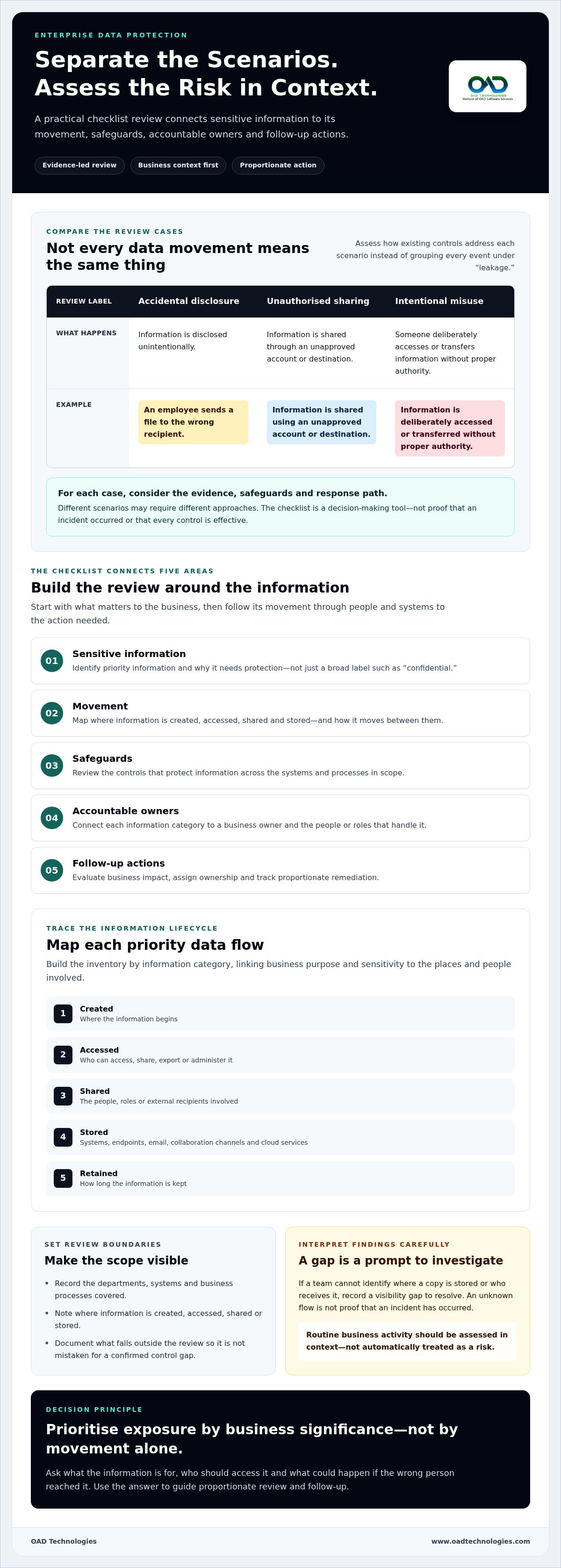
A useful data leakage prevention checklist reviews five connected areas: the sensitive information your organisation holds, how it moves, which controls protect it, who owns it and what happens when a gap is found. The goal isn’t to flag every transfer as suspicious. It’s to identify where information could reach an unintended person, system or destination, then assess the business significance of that exposure.
Executive definition: “A data leakage prevention checklist is a structured review of sensitive information, its movement, safeguards, accountable owners and follow-up actions.” Use this definition to agree on the review’s purpose before technical checks begin. For an overview of the broader concepts and technologies involved, see Data Loss Prevention (DLP).
Keep the checklist distinct from a complete DLP strategy, a formal policy or a compliance audit. It helps an organisation identify priorities and make decisions, but it doesn’t establish that every control is effective or that regulatory obligations have been met. Use it as a decision-making tool that can inform technical work, governance and risk management.
Define the checklist scope around business-sensitive information
Start with information that could harm people or the organisation if it were disclosed, altered or misused. Examples may include personal information, financial records, intellectual property, product designs, business plans, credentials and operational information. Priorities will differ by organisation: a healthcare provider, manufacturer and retailer may each need to protect different information for different reasons.
Ask business owners what information their teams create or use, why it matters and what could happen if the wrong person accessed it. Record the reason for protection, not just a broad label such as “confidential”. A design file might affect competitive advantage, while a customer record could raise privacy concerns. This context helps teams assess exposure proportionately instead of treating every document as equally critical.
Set review boundaries before assessing DLP controls
Make the review manageable by recording which departments, systems and business processes it covers. Note where information is created, accessed, shared or stored, including relevant endpoints, email and cloud environments. Also document what falls outside the review, so an unexamined system isn’t mistaken for a confirmed control gap.
Consider separate scenarios rather than grouping every event under “leakage”:
- Accidental disclosure: an employee sends a file to the wrong recipient.
- Unauthorised sharing: information is shared through an unapproved account or destination.
- Intentional misuse: someone deliberately accesses or transfers information without proper authority.
These scenarios may require different evidence, safeguards and response paths. Record them as review cases, then assess how existing controls address each one. Keep legal conclusions separate. Applicable requirements can vary depending on an organisation’s activities and circumstances. Check obligations against authoritative, current sources rather than treating this checklist as a substitute for legal or compliance review.
Create a data inventory before checking leakage prevention controls
Before testing safeguards, establish what information needs protection and where it goes. A data inventory connects each priority information set to its business purpose, sensitivity, accountable owner and storage locations. Without this foundation, teams may review controls in isolation and overlook copies held in email, shared folders or employee devices. The inventory gives business and technology teams a common reference for deciding which data flows need closer attention.
Build the inventory around information categories rather than trying to catalogue every individual file. For each category, record who can access, share, export or administer it, and which systems support those activities. For example, a customer information set might be used by a business team, stored in an approved application and exported for a defined reporting process. Those details help reveal whether access and movement fit the information’s purpose.
This foundation also informs a broader DLP strategic framework: effective control decisions depend on understanding the information, its business context and how it moves through the organisation. A spreadsheet or register can be a practical starting point, provided teams update it as systems and processes change.
Map sensitive data locations and movement
Trace each priority information category through its lifecycle: where it is created, who accesses it, how it is shared, where it is stored and how long it is retained. Include approved business systems, endpoints, email, collaboration channels, cloud services and external recipients. Pay attention to routine transfers, such as staff downloading reports to work offline or sending documents to an authorised supplier.
For each flow, note the source, destination, business purpose and people or roles involved. If a team can’t identify where a copy is stored or who receives it, record that as an investigation item. An unknown flow is a visibility gap to resolve, not proof that an incident has occurred. This keeps the review evidence-led and proportionate.
Assign accountable data owners and classification
Name a business owner for each priority information category. The owner should be able to explain why the data is needed, who should use it and which sharing practices support the work. Technology teams can help map systems and permissions, but business context is essential when judging whether access is appropriate.
Use existing classification terms if employees understand how to apply them. Record the category, owner, business purpose, locations and authorised access roles in a consistent format. If different teams use labels such as “sensitive” or “internal” inconsistently, note the issue and clarify handling expectations before testing controls.
- Information: What data category is involved, and why does it matter?
- Ownership: Which business role is accountable for its use?
- Movement: Which systems, devices and recipients handle it?
- Access: Who can view, share, export or administer it?
- Open questions: Which locations, flows or handling practices need investigation?
Completing these fields gives the next stages of a data leakage prevention checklist a consistent foundation. OAD Technologies provides data loss prevention services to help enterprise teams address information protection priorities. Discuss your DLP requirements with OAD Technologies.
Compare DLP coverage across email, endpoints and cloud sharing
A data loss prevention control is useful only when it protects the right information without needlessly disrupting legitimate work. Compare coverage by channel, then consider the data’s sensitivity, who is using it and the business purpose behind each action. A finance team sending an approved report to an authorised recipient has a different context from an unexplained export of sensitive records.
Use this comparison to identify where your review needs more evidence. Assess each area separately: a control that applies to email may not cover a downloaded file or a cloud sharing link.
| Exposure point | Checks to make | Business consideration |
|---|---|---|
| Review external recipients, attachments and the handling of sensitive messages. | Distinguish approved customer, supplier or team communications from unexpected disclosure. | |
| Endpoints | Assess copying, printing, downloads and removable media activity. | Consider whether staff need these actions for defined tasks and whether access is appropriate. |
| Cloud storage | Check sharing links, external collaborators and permissions on stored information. | Confirm sharing aligns with the data’s sensitivity and intended audience. |
| Identity permissions | Review who can view, share, export or administer priority data. | Look for access that no longer matches a person’s role or business need. |
Check email and endpoint exposure paths
For email, review how sensitive messages and attachments reach external recipients. Consider whether existing safeguards help users recognise sensitive content and prevent accidental misdirection while allowing authorised business exchanges to continue. For endpoints, examine how information can be copied, printed, downloaded or moved to removable media. Ask which actions are necessary for work and what context would make an event worth investigating.
Controls should be proportionate. A legitimate export for an approved process shouldn’t automatically be treated like unauthorised copying. Establish whether the organisation can distinguish expected activity from actions that fall outside agreed access or handling practices.
Review cloud sharing and access context
In cloud environments, inspect who can access a file, whether a link is limited to intended recipients and whether external collaborators still need access. Check for broad permissions on sensitive folders, not just individual documents. To understand how identity context shapes these decisions, consider the identity and access management framework. It helps frame access as part of the wider protection picture.
Also review the configuration of cloud services that store or process priority information. The cloud security posture management guide provides context for assessing cloud security settings alongside sharing practices. Record gaps with the relevant data owner and business process, so follow-up focuses on meaningful exposure rather than generating alerts without context.
OAD Technologies provides data loss prevention services for enterprise information protection. To discuss how DLP can fit your security priorities, discuss your DLP requirements.
Turn checklist findings into proportionate DLP actions
Findings only help reduce risk when they lead to clear decisions and follow-up. Use the review to separate urgent exposure from lower-priority improvement rather than treating every gap as equally serious. A useful data leakage prevention checklist turns observations into owned actions while keeping controls aligned with how people need to work.
Apply this sequence to each finding:
- Document the gap. Describe what was observed, which information or process it affects and what evidence supports the finding. Distinguish verified exposure from an assumption that still needs investigation.
- Assess business impact. Consider the information’s sensitivity, who could reach it, how exposed it is and the likely effect on operations or stakeholders. Weigh the business context and the organisation’s risk tolerance.
- Assign an owner. Name the person or team accountable for deciding the next step. Include relevant business and technical owners when remediation involves both.
- Track remediation. Record the agreed action, status and review point. If the decision is to accept or monitor the risk rather than change a control immediately, document the rationale and who approved that approach.
This process helps teams direct effort towards findings with meaningful business consequences. A broad sharing permission on sensitive information may merit prompt review, while a documented, approved transfer may need a different safeguard rather than a blanket block. Regulatory mapping is separate: verify applicable obligations against authoritative, current sources and the organisation’s circumstances. A DLP checklist can inform that work, but it isn’t a legal assessment or proof of compliance.
Validate controls without disrupting legitimate work
Before expanding a control, test it against representative business scenarios. Include routine tasks such as sending an authorised report, sharing a working document with an approved collaborator or printing material needed for an operational process. Check whether the control behaves as intended and whether it creates avoidable alerts or false positives. Gather user and operational feedback, then refine the scope before applying it more widely.
If an exception is necessary, record its business rationale, accountable owner and conditions for review. An exception should address a defined workflow, not become an undocumented route around a control. Revisit it if the process, information involved or access needs change.
Maintain ownership, evidence and review actions
Keep a practical record of each finding, its evidence, business impact, owner, next action and status. Retain enough detail for decision-makers to understand why the action was selected, without collecting unnecessary material. Review actions when a relevant system or process changes, an incident reveals a new exposure, or the organisation begins using information for a new purpose.
OAD Technologies provides data loss prevention services to support enterprise protection efforts. Discuss your DLP requirements and the priorities identified in your review.
Use the data leakage prevention checklist to shape your next steps
Once the review has identified priority gaps, decide which your team can address internally and where specialist DLP support could add value. Internal teams may be well placed to clarify business ownership, adjust established processes or review access they already manage. Specialist support can be useful when visibility is limited, ownership is unclear or exposure spans several systems and teams.
Define the problem before choosing an action. For each priority gap, clarify which information is affected, how it moves, who needs access and what the business needs a control to achieve. This gives internal stakeholders and specialists a shared starting point and helps keep recommendations grounded in operating requirements rather than a generic template.
Recognise when specialist DLP support may help
Consider specialist DLP support if your teams can’t confidently map important data flows, determine who owns key information or understand how existing controls behave across email, endpoints and cloud services. Any review should reflect your organisation’s systems, information and legitimate workflows. OAD Technologies provides data loss prevention services to enterprise organisations, helping teams connect information protection priorities with their wider security needs.
Specialist support can strengthen an organisation’s approach, but it doesn’t guarantee that every form of leakage will be prevented or that a regulatory requirement has been fulfilled. Keep those judgements grounded in evidence, applicable requirements and the organisation’s wider governance processes.
Connect DLP with wider security priorities
DLP findings can inform broader discussions about risk ownership, access management, cloud security and incident handling. For example, a recurring access gap may involve both information protection and identity governance. A pattern of unclear sharing permissions may also warrant a review of cloud security settings. Bringing these observations together can help leaders prioritise work across security functions instead of treating each finding as an isolated technical issue.
OAD Technologies’ wider enterprise cybersecurity services include managed cybersecurity and SOC services. Where an organisation needs ongoing managed support, Managed Technology Services may be relevant. A Fully Managed, Defined Scope engagement can provide a clear basis for agreed work, responsibilities and boundaries. The scope should fit the organisation’s needs, and regulatory mapping should remain a separate task verified against authoritative, current sources.
Use your completed data leakage prevention checklist as a working plan: retain the findings that matter, assign owners and revisit priorities as systems and business needs change. OAD Technologies provides DLP services to support enterprise information protection. To discuss a practical approach, Discuss your requirements or Book a meeting.
Make data protection part of your next planning cycle
Use the data leakage prevention checklist as a starting point for a more deliberate approach to protecting business information. Keep decisions connected to operational change: as teams adopt systems, change processes or use data in new ways, revisit whether protection priorities still fit. That makes the review a practical input to planning, not simply a document to file away.
For organisations with complex environments, DLP services can help connect review findings with protection priorities. OAD Technologies provides data loss prevention services for enterprise audiences, supporting organisations as they strengthen their information protection efforts. This support can inform security and governance work, but it doesn’t automatically fulfil regulatory obligations or guarantee a particular outcome.
Choose a next step that fits your organisation’s priorities and operating context. Discuss your requirements with OAD Technologies and develop a clearer plan for protecting the information your business depends on.
Frequently Asked Questions
What should a data leakage prevention checklist include?
A data leakage prevention checklist should record priority information, its business purpose, handling expectations, access roles and the safeguards applied to it. It can also capture how teams should report unusual activity and where review evidence is stored. For example, a procurement team might document how bid files are shared with approved reviewers and who should approve access changes. Keep the fields clear enough for business and technology teams to use consistently.
How is data leakage different from data loss?
Data leakage describes information reaching an unintended person, system or destination, whether through a mistake or misuse. Data loss usually means information is unavailable, deleted or destroyed, such as when a file is accidentally removed without a usable recovery copy. The situations can overlap: a stolen device could expose data and make it unavailable. Distinguishing the event helps teams select appropriate investigation, containment and recovery steps.
Can a DLP checklist guarantee that sensitive information will not be exposed?
No. A checklist helps an organisation identify weaknesses and guide review, but it can’t account for every future change, user action or threat. For example, a new business application may create a sharing route that the previous review didn’t cover. Treat the checklist as a living risk-management aid, and combine it with suitable controls, staff awareness, incident processes and regular reassessment. No DLP service can guarantee that all exposure will be prevented.
How should an organisation prioritise data for DLP review?
Start with information whose exposure could have the greatest effect on people, operations or business interests. Consider its sensitivity, how widely it can be accessed, whether it is shared outside the organisation and how essential it is to key processes. A restricted engineering design available to broad user groups may warrant earlier review than routine material with limited impact. Involve business owners so technical teams understand the consequences of exposure.
Can DLP controls block legitimate business activity?
Yes, poorly scoped controls can interrupt valid work, such as an approved employee sending a report to a customer or transferring a file between business systems. Before applying a restrictive rule broadly, test it against representative tasks and review what triggered alerts. Adjust the control to protect sensitive information while allowing authorised activity. Document any exception, its business reason and who is accountable for reviewing it.
How often should an organisation review its DLP checklist?
Review it on a planned governance schedule and whenever a meaningful change could alter data exposure. Examples include introducing a new cloud application, changing a supplier relationship, restructuring access roles or adopting a new use for existing information. An incident or investigation may also reveal that assumptions need updating. Set review ownership and record when changes are assessed, so the checklist remains connected to current business operations.
Does using a DLP service automatically make an organisation compliant?
No. A DLP service can support protection and governance by helping an organisation manage sensitive information, but compliance depends on the applicable requirements and the organisation’s wider policies, processes and evidence. Relevant obligations can vary with an organisation and its activities, so regulatory mapping should be checked against authoritative, current sources. OAD Technologies provides data loss prevention services that can support an organisation’s protection efforts, not replace its compliance assessment.
Disclaimer
Content by OAD Technologies is for general informational purposes only and does not constitute professional or cybersecurity advice. No warranties are made regarding accuracy or completeness; reliance is at your own risk. OAD Technologies shall not be liable for any direct or indirect losses arising from use of this content.