

What if fewer DLP alerts didn’t mean weaker protection? For teams handling a steady stream of warnings, the challenge is knowing how to prevent false positives in DLP without allowing genuine data risks to slip through. When alerts lack business context, analysts spend time investigating routine activity, and employees may face unnecessary interruptions.
It’s understandable to want tighter rules when sensitive information is at stake. But broad policies can create more noise without improving protection. A more effective approach is to understand why alerts fire, distinguish harmless activity from detection gaps, and make controlled changes rather than simply lowering enforcement.
This guide sets out a practical way to investigate noisy alerts, refine detection and response, and assess whether changes improve alert quality over time. It explains how data classification, user activity and security operations can inform tuning decisions, with practical safeguards to help preserve meaningful detection.
Key Takeaways
- Learn how to prevent false positives in DLP by tracing alerts to their causes and tuning with safeguards, rather than weakening controls broadly.
- Assess whether noisy alerts stem from policy scope, data classification, activity context or overlapping rules.
- Compare targeted rule refinements, narrowly scoped exceptions and workflow changes, including the risks to review for each.
- Use a structured investigation process and document the alert, rationale, owner, change and validation evidence.
- Recognise when persistent alert noise, unclear ownership or changing workflows call for a broader DLP review with OAD Technologies.
What counts as a false positive in DLP, and why does it matter?
To understand how to prevent false positives in DLP, first establish why an alert fired and whether the activity actually breached policy. A false positive is an alert that incorrectly identifies an action as a policy violation. Investigate the cause and tune the detection with safeguards, rather than suppressing alerts or loosening controls across the board.
DLP systems identify and help control the movement or use of sensitive information. Their rules may look for data patterns, locations or actions. A match can be technically accurate but operationally irrelevant if the policy doesn’t account for business context. This overview of Data Loss Prevention (DLP) explains the controls behind such alerts, but each event still needs to be assessed against your organisation’s rules and processes.
False positive, false negative, or legitimate activity?
A false positive is an alert that wrongly identifies activity as a violation. A false negative occurs when a genuine policy violation goes undetected. False positives divert attention; false negatives leave a real event unnoticed. There is also legitimate, authorised activity that triggers a valid detection. The system may correctly identify sensitive data moving even though the transfer is permitted in context.
Hypothetical example: authorised file transfer. An employee sends a file containing sensitive information to an approved business partner through an authorised process. DLP flags the transfer because the file matches a sensitive-data rule. If the destination, purpose and approval fit policy, the alert may be valid but benign, rather than a false positive. Analysts should verify those details before labelling it noise. Otherwise, a useful detection could be mistakenly disabled.
How noisy DLP alerts affect business operations
Each alert takes time to triage. An analyst may need to establish what data was involved, who acted, where it went and whether the action was permitted. Repeated investigations of harmless activity can draw attention away from other security work. Unnecessary blocks or escalations can also delay legitimate tasks and frustrate employees who don’t understand why routine work has been interrupted.
Alert quality matters to protection and day-to-day operations. If teams treat recurring warnings as background noise, they may overlook an alert that deserves closer examination. If they block too readily, employees may struggle to complete approved work. Fewer alerts alone don’t prove better protection. The goal is to reduce unjustified alerts while preserving visibility of genuine policy violations.
Validate the event, its business purpose and the policy’s intent before changing a rule. Then identify the conditions generating noise and refine them narrowly enough to preserve meaningful detection.
Which DLP conditions commonly create false positives?
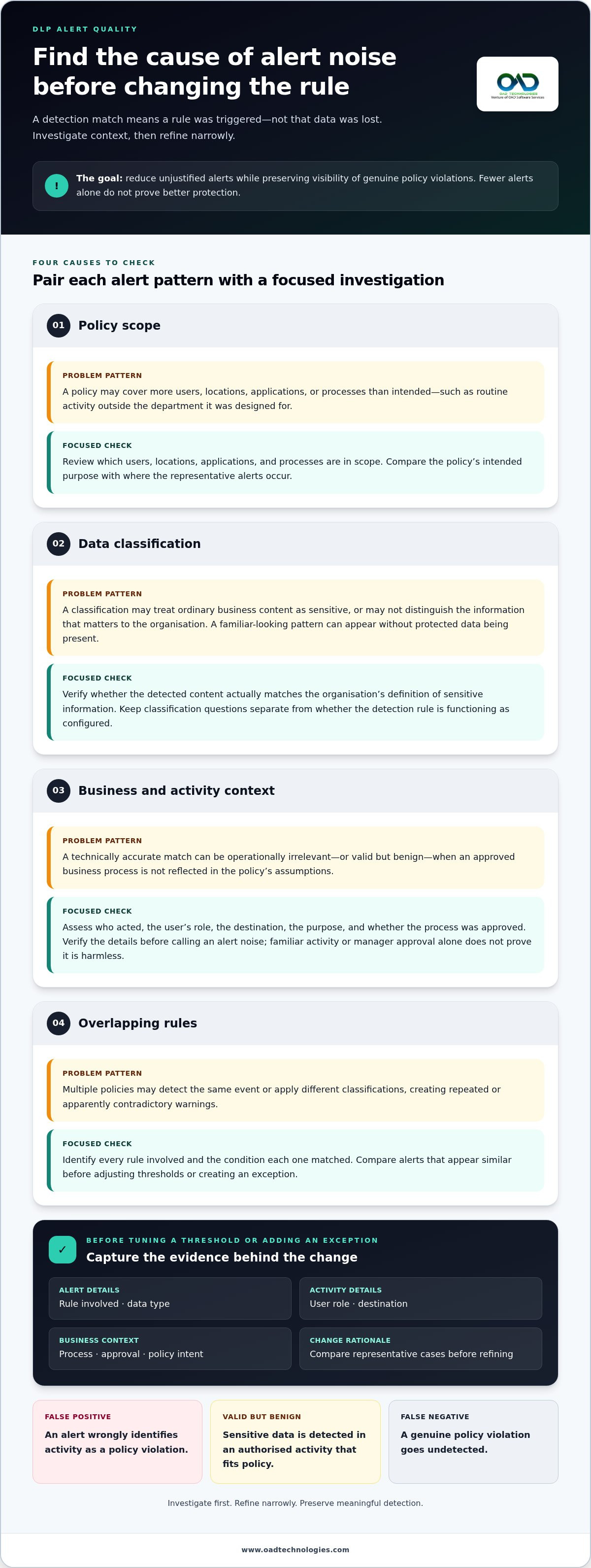
A noisy alert doesn’t always mean the detection rule is broken. The rule may be working as configured, while its scope or assumptions don’t reflect how a team handles information. To understand how to prevent false positives in DLP, investigate representative alerts before changing a rule or detection threshold. A detection match shows that a rule was triggered, not that data was lost.
Policy scope and data classification issues
Start by checking what the policy covers and what it considers sensitive. Broad scope can include teams, repositories or workflows beyond the rule’s intended purpose. A classification definition may treat ordinary business content as sensitive, or fail to distinguish information that matters to the organisation. Keep these causes separate: uncertain classification doesn’t necessarily mean the detection rule is malfunctioning.
- Scope: Check which users, locations, applications and processes fall under the policy. A rule intended for one department might also flag routine activity elsewhere.
- Classification: Confirm whether the detected content matches the organisation’s definition of sensitive information. For example, a pattern resembling an internal reference number may appear in a document that doesn’t contain protected data.
Business context and overlapping detections
Consider who performed the activity, where the information was going, when it occurred and whether the process was approved. These details can explain why an otherwise accurate match needs review. For example, a hypothetical finance employee might send a report to an authorised internal destination as part of a scheduled process. The same data movement to an unapproved recipient would need a different assessment.
- Activity context: Compare the user’s role, destination and process with the policy’s intended purpose. Don’t assume an action is harmless simply because it’s familiar or a manager has approved it.
- Rule interactions: Check whether multiple policies detect the same event or apply different classifications to it. One action might generate repeated alerts, or warnings that appear contradictory, because each rule matches a different condition.
Before changing a threshold or adding an exception, examine representative alerts. Record the rule involved, data type, user role, destination and business process, then compare cases that appear similar. This helps show whether the root cause is consistent or whether several distinct scenarios have been grouped together. A change based on one unusual event could conceal activity the policy should still detect.
Use those findings to address the cause: refine scope when coverage is too broad, improve classification when the data definition is imprecise, or review policy overlap when alerts duplicate one another. OAD Technologies provides data loss prevention as part of its enterprise cybersecurity services. Organisations reviewing recurring alert patterns can discuss DLP requirements with OAD Technologies.
How can teams tune DLP detections without weakening protection?
Effective tuning makes alerts more relevant while preserving visibility of activity that could breach policy. Start with the cause identified during investigation, then choose the smallest change that addresses it. When deciding how to prevent false positives in DLP, assess both whether the change reduces unjustified alerts and whether it still detects the activity the control was designed to catch.
Rule refinement versus exclusions
Refining a rule means adjusting its conditions, such as the data definition, destination or activity that triggers it. This can improve relevance without switching off the whole control. An exclusion removes specified activity from detection, so treat it as a limited, documented exception, not a default way to reduce noise. Broad exclusions can reduce visibility and need particularly careful justification.
Use this comparison to choose a proportionate response. For each option, document the scope, rationale, accountable owner and review needs.
- Targeted rule refinement: May help when a consistent condition triggers irrelevant alerts. Record the precise change, why it addresses the cause, who owns it and how detection coverage will be reviewed.
- Narrowly scoped exception: May help when a specific authorised activity needs different treatment. Limit it to the necessary users, data or destination; document the business rationale, owner and review point. Check that similar activity outside the exception still triggers detection.
- Workflow change: May help when a policy flags a legitimate process that can be adjusted, such as using an approved destination. Agree the change with the business owner, then review whether the revised process remains practical and keeps sensitive data within intended controls.
An exclusion covering a whole team or destination may silence an alert, but it can also hide activity that deserves review. Before adopting one, test its proposed scope against authorised examples and scenarios that should still trigger detection. If the team can’t explain the boundary or the reason for the exception, the change is probably too broad.
Context-aware review and response choices
Tuning doesn’t always require changing what the system detects. Teams can also choose how it responds. Alerting records activity for review; user guidance explains the concern and prompts a safer action; blocking prevents the activity. These responses serve different purposes, and no single option suits every organisation or workflow.
Match the response to the sensitivity of the data and the activity’s context. A lower-risk event in an established process might warrant an alert or guidance, while a transfer involving highly sensitive information to an unapproved destination may justify stronger intervention. Validate the choice with relevant business and security owners rather than assuming every match should be blocked.
After a change, compare alert volume with retained detection coverage using representative test cases. A quieter queue is useful only if the control continues to identify the activity it was meant to detect.
What steps should you follow to investigate and reduce DLP false positives?
A repeatable investigation helps teams distinguish a noisy rule from a genuine protection gap. It also makes tuning decisions easier to explain and review. Use the cycle below to reduce unjustified alerts while checking that important detection coverage remains in place.
A controlled investigation and tuning cycle
Start with real, representative events rather than assumptions about what is generating noise. Confirm whether each event is a false positive, a valid detection of authorised activity, or a potential policy violation. Make a targeted change and test its effect before treating the adjustment as successful.
- 1. Collect representative examples. Gather alerts from the policy or workflow under review. Include enough context to understand the data involved, the user or role, destination, activity and business purpose. Protect sensitive details during review.
- 2. Classify the cause. For each event, record whether the issue relates to policy scope, data classification, activity context, overlapping rules or another identifiable condition. Separate confirmed false positives from legitimate detections that need contextual review.
- 3. Adjust narrowly. Choose the smallest change that addresses the diagnosed cause, such as refining a rule condition or changing an approved workflow. Where practicable, adjust one relevant condition at a time so the team can assess what caused any change in alert behaviour.
- 4. Test both sides. Check the adjustment against legitimate activity that should no longer create an unjustified alert, as well as scenarios the control should still detect. Include relevant variations, such as a different destination or user role, rather than testing only the original event.
- 5. Record and review. Document the alert, decision rationale, accountable owner, change made and validation evidence. Revisit the decision if alert patterns shift, business processes change or testing reveals reduced coverage.
Define success as better alert relevance, not simply a quieter queue. Compare reviewed alerts with test cases representing activity the policy is meant to identify. If the change reduces noise but also hides those cases, revisit the adjustment. A clear record makes the trade-off visible and gives future reviewers the context behind the decision.
Review outcomes and connect DLP with security operations
Set a review cadence that reflects the organisation’s risk, operational changes and alert patterns; there’s no single interval that fits every environment. Changes to data handling, access or approved destinations can affect how a rule behaves, so include them in the review process. For wider programme context, OAD Technologies’ DLP strategic framework situates alert tuning within broader data protection planning.
Where available, Security Information and Event Management (SIEM) context can help analysts compare a DLP alert with related security events. SIEM brings event information together to support investigation, rather than treating every alert in isolation. OAD Technologies also provides SIEM services. To discuss a DLP approach shaped around your organisation’s requirements, discuss your DLP requirements with OAD Technologies.
When should an organisation review its DLP approach with OAD Technologies?
A broader review may be useful when alert tuning no longer addresses the underlying problem. Persistent noise across several rules, uncertainty about who owns alert decisions, or material changes to how teams handle information can indicate that policies and processes need to be considered together. These are prompts to reassess requirements, not proof that a DLP control has failed.
For organisations asking how to prevent false positives in DLP over the long term, a requirements-led review can connect detection decisions to real business activity. OAD Technologies provides data loss prevention as part of its enterprise cybersecurity services, with an approach shaped around an organisation’s data protection requirements and wider security operations. A discussion can clarify operational context and priorities without promising a predetermined outcome or automatic compliance.
What an enterprise DLP review should clarify
A useful review starts with the information the organisation needs to protect, then maps the people, systems and business processes that create, use or transfer it. This helps decision-makers assess whether policy coverage reflects actual responsibilities and workflows, and whether alerts provide enough context for consistent action.
Ownership matters just as much. Clarify who investigates alerts, who can approve a tuning change, what criteria guide escalation, and how decisions will be revisited as requirements evolve. Without agreed responsibilities, teams may handle similar events differently or leave policy changes without a clear reviewer.
Consider how DLP relates to the wider security operation. Security Information and Event Management (SIEM) brings security event information together to support investigation; managed cybersecurity and SOC services can also form part of an organisation’s wider operational context. The relevant relationship depends on the organisation’s requirements and how it assigns security responsibilities.
Discuss requirements with OAD Technologies
Bring a concise picture of the current challenge to a discussion: which alerts are difficult to interpret, which processes have changed, and where decision ownership is unclear. This gives OAD Technologies a practical basis for discussing DLP requirements in business terms, alongside relevant SIEM or managed cybersecurity and SOC considerations.
Agree the intended scope and responsibilities before work begins. Where relevant, a Fully Managed, Defined Scope engagement can make the agreed service boundaries clear, including what is in scope and how responsibilities are allocated. The approach should reflect the organisation’s needs rather than assume every environment requires the same controls or operating model.
A DLP review can inform security planning, but purchasing or adjusting a service doesn’t, by itself, establish regulatory compliance. Organisations remain responsible for assessing their obligations and how their controls support them. To explore the next step, Discuss your requirements with OAD Technologies or Book a meeting to talk through your organisation’s context.
Make DLP tuning part of ongoing security planning
Effective DLP is not a set-and-forget control. As teams, systems and information flows change, earlier policy assumptions may no longer reflect how the organisation works. Treating review as part of security planning keeps decisions connected to business priorities instead of relying on quick fixes whenever alert volumes rise.
The practical question of how to prevent false positives in DLP is also a question of governance: who owns tuning decisions, what evidence supports them, and how will the organisation know when a change needs another look? Clear ownership and a deliberate review process help security and business teams make adjustments while keeping protection aligned with evolving requirements.
OAD Technologies can discuss how DLP requirements fit your organisation’s context and wider security priorities. Start a focused conversation about the next step for your environment.
Discuss your requirements with OAD Technologies, or Book a meeting to talk through your data protection needs.
Frequently Asked Questions
What is a false positive in DLP?
A false positive is a DLP alert that incorrectly treats an activity as a policy violation. For example, a rule might flag a standard business document because it contains a number pattern resembling sensitive information. The alert is not proof that data was exposed or mishandled. Analysts need to check what the rule matched and whether the event falls outside the organisation’s data-handling policy.
How can I reduce false positives in DLP without missing real incidents?
Reduce false positives through evidence-led changes and check that important detections still work. When deciding how to prevent false positives in DLP, keep representative test cases that include routine approved activity and events the policy must still identify. After tuning, compare the results against both groups. If expected detections disappear, revise the change rather than treating a quieter alert queue as success.
Can DLP false positives be caused by data classification?
Yes. A classification may be too broad, inconsistent or out of date, causing ordinary content to be treated as sensitive. For instance, a document copied from an old template might retain a “confidential” label after its contents have changed. Review whether the label accurately reflects the information, and distinguish a labelling problem from a DLP rule that correctly responds to the label it receives.
Should organisations block activity when a DLP rule triggers?
Not automatically. Blocking may be appropriate when the activity presents a clear risk, but it can disrupt legitimate work if the rule lacks context. Consider the sensitivity of the information, the destination and the consequences of allowing or stopping the action. For an uncertain or lower-risk event, an alert or user prompt may support review without immediately interrupting the workflow. Set response choices according to organisational policy.
How often should DLP rules be reviewed for false positives?
Review rules according to risk and change, rather than relying on one interval for every policy. Reassess a rule after a business process, data repository, user group or approved destination changes, and investigate if its alerts become harder to interpret. Keep the review decision and rationale so the next assessment can compare current behaviour with the rule’s original purpose.
Are DLP false positives the same as duplicate alerts?
No. A false positive concerns whether an alert incorrectly indicates a policy violation; a duplicate alert concerns whether the same event has generated more than one notification. For example, two policies may report one file transfer for different matching conditions. Confirm whether the records refer to one event before consolidating them, and avoid suppressing distinct activity simply because it looks similar.
Disclaimer
Content by OAD Technologies is for general informational purposes only and does not constitute professional or cybersecurity advice. No warranties are made regarding accuracy or completeness; reliance is at your own risk. OAD Technologies shall not be liable for any direct or indirect losses arising from use of this content.