

Could a clean vulnerability scan still leave your organisation unsure how an attacker might reach critical systems? That distinction matters when comparing VAPT services in Dubai: a vulnerability assessment identifies and analyses potential weaknesses, while penetration testing examines selected weaknesses to understand their possible security impact within an agreed scope. The service label alone will not show whether an engagement addresses the risks that matter to your business.
A useful VAPT assessment should produce more than a list of technical issues. Business leaders need to understand which findings could affect important systems, data or operations. Technical teams need clear evidence and context to plan remediation. Start by defining what will be assessed, what falls outside scope and how the findings will inform decisions.
This guide explains the difference between vulnerability assessment and penetration testing, and how to compare engagement scopes using business-relevant criteria. It also covers what to prepare before commissioning VAPT, from identifying critical systems to agreeing testing boundaries. OAD Technologies provides VAPT for organisations across the UAE. A clear view of your systems, priorities and risk questions helps shape an assessment scope around practical business needs.
Key Takeaways
- Vulnerability scanning, assessment and penetration testing offer different kinds of insight. Match the approach to the decision you need to make.
- When evaluating VAPT providers serving Dubai, compare objectives, assets, exclusions and access assumptions, not just the service label.
- Set scope around business-critical systems and their dependencies, rather than relying on an asset list alone.
- Useful findings explain the technical evidence and its business context, helping teams plan remediation priorities.
- OAD Technologies provides VAPT to help organisations assess defined systems and use findings to inform security decisions.
VAPT services: what a business engagement is designed to assess
Vulnerability Assessment and Penetration Testing (VAPT) assesses potential weaknesses in defined technology systems and, where agreed, tests selected weaknesses to understand their possible security impact. It provides evidence that can inform risk decisions and remediation planning. It does not guarantee that every weakness has been found or that a system is secure.
For executives, the practical value is a clearer view of which issues may affect important services, where attention may be needed and what technical teams can investigate or address. Findings apply to the systems, access assumptions and objectives included in the engagement. They do not automatically cover an organisation’s entire technology environment. A broad overview of security testing also distinguishes assessment activities from penetration testing.
What vulnerability assessment and penetration testing each contribute
A vulnerability assessment identifies and analyses potential weaknesses within an agreed scope. It helps teams understand where known issues may exist and organise them for review. Penetration testing goes further by testing selected weaknesses to explore whether, and how, they could affect a system or business process.
The methods and depth depend on the objective, systems and constraints agreed for the engagement. A focused assessment may address a specific question, such as whether selected systems have particular weaknesses. A broader scope may examine more assets or connections between them. Neither label alone explains what was tested. The objectives and boundaries provide that context.
Which business environments may need VAPT
Potential assessment environments include business applications, networks, cloud environments and application programming interfaces (APIs). These are examples, not a standard checklist for every organisation. Priorities depend on where important information is held, how essential services are delivered and which technology dependencies could affect operations.
For example, a retailer may prioritise systems that support digital transactions, while a healthcare organisation may focus on technology connected to sensitive information and care delivery. Education, manufacturing and financial services have their own operating models and dependencies. A useful scope connects those realities to the selected systems, rather than assuming one asset list suits every organisation.
When comparing VAPT services in Dubai, look beyond the service name. OAD Technologies provides VAPT for organisations across the UAE. The engagement scope should make clear which business systems and risks the assessment is intended to address.
What VAPT services cover, and why a scan alone may not answer the business question
A scan can flag potential weaknesses, but it does not automatically establish whether they create a meaningful route to a business-critical system or which action should come first. The difference depends on the assessment objective, the assets included and the level of testing agreed. Organisations comparing VAPT services in Dubai can use these distinctions to match an engagement to the decision they need to make.
Activity | Purpose | Typical output | Scope limit
Vulnerability scanning | Checks selected assets for potential known weaknesses. | Potential issues for further review. | Results depend on the assets, configuration and access included. A scan alone may not establish business impact.
Vulnerability assessment | Identifies and analyses potential weaknesses across an agreed scope. | Findings organised for review and prioritisation. | It does not necessarily test how selected weaknesses could be exploited.
Penetration testing | Tests selected weaknesses to understand potential security impact. | Evidence about tested paths and systems. | Conclusions apply to the agreed targets, access and objectives, not automatically to the wider environment.
How assessment scope changes the results
Scope determines what the assessment can reveal. Internet-facing assets, internal environments and business applications have different boundaries and security questions. Testing with authorised user access, known as authenticated testing, can examine areas that unauthenticated testing without those credentials may not reach. Choose the approach according to the assessment objective and agree it in advance.
Cloud environments, APIs and identity systems should be represented explicitly if they are relevant to the organisation’s risk. For example, including an application without its related API or access pathways may leave important dependencies outside the assessment. The NIST Technical Guide to Information Security Testing provides background on planning and conducting security tests, but it does not define the right scope for every business.
What findings can and can’t tell decision-makers
Severity helps teams compare findings, but it is only one input. Decision-makers should also consider exposure, the system’s business role, its dependencies and the possible operational consequences. A technical issue on an isolated asset may call for a different response from a similar issue affecting a system that supports a critical service.
Findings describe a defined point in time and the scope tested. They are not continuous assurance, proof that every weakness has been found or, on their own, evidence of regulatory compliance. OAD Technologies provides VAPT tailored to an organisation’s requirements and risk priorities. To discuss a potential engagement, explore VAPT requirements with OAD Technologies.
How to compare VAPT services for UAE organisations
A useful comparison starts with fit, not a service label. For organisations assessing VAPT providers in Dubai, the engagement should connect testing objectives to business priorities, define clear boundaries and produce findings that teams can use. Reviewing the scope before work begins helps executives and technical teams align on what the assessment is meant to establish.
Questions that clarify scope before an engagement
Start with the business services and information that matter most. Identify the systems supporting them, who owns those systems and any important dependencies. Then record what is in scope, what is excluded, the testing assumptions and operational constraints. For example, identify systems that must remain available or periods when testing should not take place.
- Objective: What decision or risk question should the assessment inform?
- Assets and exclusions: Which systems, applications, environments or data are included, and what sits outside the boundary?
- Assumptions and constraints: What access, dependencies, operational limits or test windows shape the work?
- Audience: Who needs the findings, and how will executives and technical teams use them?
- Information handling: How will sensitive information, testing evidence and findings be handled and shared?
Regulatory context may also influence priorities. UAE organisations can face different requirements depending on their sector, role and applicable framework. Use relevant obligations to inform scope and reporting needs, but do not assume that commissioning VAPT alone fulfils a regulatory requirement or establishes compliance.
How to assess reporting and remediation value
A useful report should connect technical evidence to potential business impact. Look for a clear explanation of each finding, the basis for its severity and the context that supports prioritisation. This helps decision-makers distinguish issues that may need prompt attention from those requiring further review, rather than relying on a severity label alone.
Recommendations should guide remediation without implying that an issue has already been fixed. Remediation requires action by the responsible teams. Assessment findings are evidence from a defined scope, not confirmation that changes have been completed. For broader context on the purpose and strategic value of VAPT, see OAD Technologies’ VAPT strategic enterprise guide.
OAD Technologies provides VAPT engagements shaped around organisational requirements, agreed boundaries and the intended use of findings. A clear scope helps keep the assessment relevant to operational realities and leadership decisions.
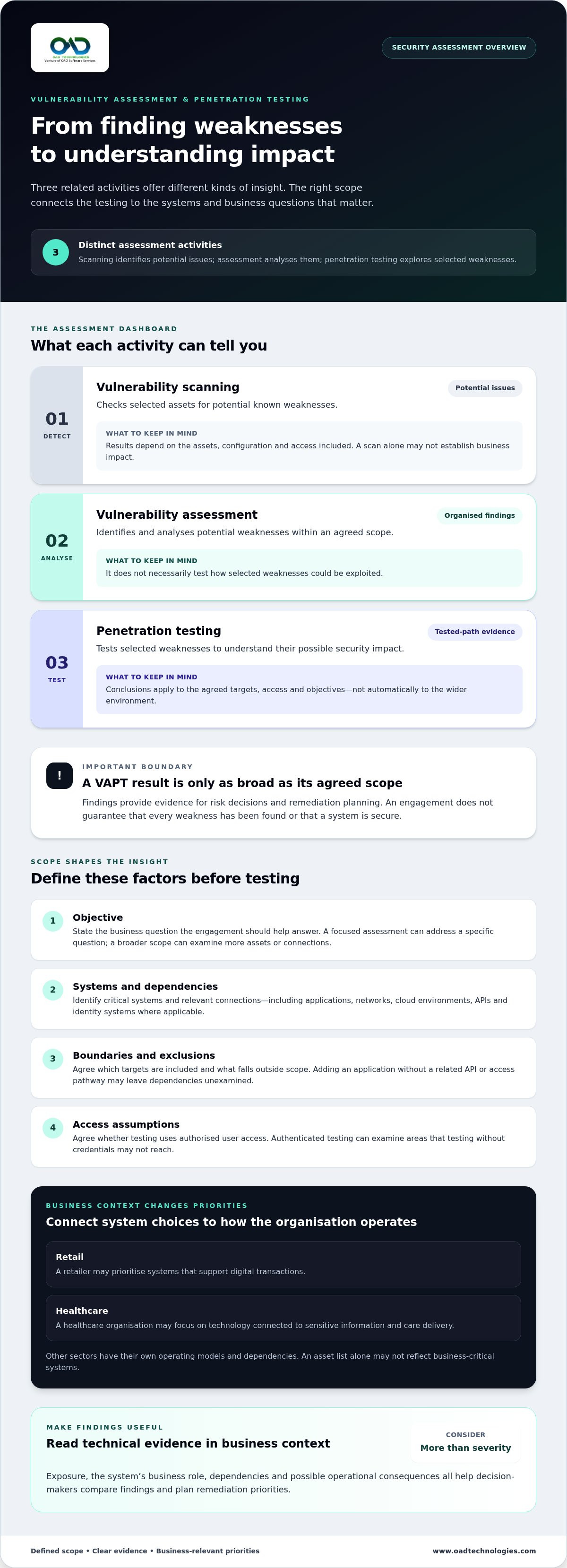
Prepare a VAPT scope that reflects business risk, not just asset lists
VAPT scope should reflect agreed business priorities and technical boundaries. A list of servers or applications is a starting point, but it does not explain which services matter most, how systems connect or what decisions the assessment should support. For organisations planning VAPT engagements in Dubai, use a practical sequence to turn those priorities into a clear scope.
- Set the business objective. Identify the risk question the assessment should inform, such as understanding exposure around an important service or reviewing selected technology before a planned change.
- Identify relevant assets. Map the systems supporting that service, the information they handle and their operational importance.
- Define boundaries. Record the assets included, known exclusions, dependencies, access assumptions and operational constraints.
- Agree how findings will be used. Decide who will receive the results and how they will support technical remediation and leadership risk discussions.
Build an asset and priority view
Group systems by the business service they support, the sensitivity of the data they handle and their importance to operations. Include relevant external dependencies and environments, since these can affect what falls within the test boundary. For example, an application may rely on a separate identity service or cloud environment that needs explicit consideration.
Document exclusions as carefully as included assets. If a connected system is outside scope, record that boundary so readers do not interpret the assessment as covering the wider service. Clear ownership matters too. System owners can explain dependencies and operational context, while security and technology teams can help define technical boundaries.
Agree operational and decision-making boundaries
Before testing begins, align security, technology, business owners and procurement on the authorised scope and constraints. Identify suitable test windows, systems that need particular care and the internal owners responsible for receiving, reviewing and prioritising findings. This coordination helps connect the assessment to business operations and makes responsibilities clear.
Agree what happens after the assessment as part of the engagement design. Remediation recommendations can inform internal plans, but follow-up testing or retesting should be treated as included only when it forms part of the agreed engagement. OAD Technologies provides VAPT with scope shaped around organisational requirements and business priorities. Discuss your VAPT scope with OAD Technologies.
Turn VAPT findings into next steps with OAD Technologies
A VAPT assessment is most useful when its findings inform decisions, rather than simply adding technical items to a backlog. Leadership can use evidence from the agreed scope to discuss where exposure intersects with important services, what to prioritise and who owns the next action. For organisations evaluating VAPT services in Dubai, connecting testing to decision-making is central to a requirements-led engagement.
From technical findings to an executive action plan
Translate each finding into a clear explanation of the affected system, the evidence observed and the potential business implication. Do not treat a technical severity rating as a prediction that an incident will occur. Weigh severity alongside exposure, the system’s role, its dependencies and the organisation’s operating context.
This gives teams a practical basis to assign remediation ownership, set priorities and bring unresolved risks into leadership discussions. Technical teams can use the evidence to plan corrective work, while executives can assess how the issue relates to business objectives and risk tolerance. Recommendations describe possible next steps; they do not mean a finding has already been resolved.
Remediation and validation arrangements depend on the agreed engagement scope. If follow-up testing is included, clarify what it will assess and how its results will be used. Keep the distinction clear between an initial finding, work completed by internal teams and any subsequent validation.
Discuss a VAPT requirement with OAD Technologies
OAD Technologies provides VAPT as part of its enterprise cybersecurity services for organisations across the UAE. To frame an assessment discussion, identify the business objective, relevant systems and the main concerns leadership or technical teams want to address. These details provide a practical starting point for defining the engagement scope.
OAD Technologies’ company information provides further context. Before discussing requirements, consider which services are most important, what systems support them and how the organisation intends to use assessment findings. This helps frame the scope around business priorities and technical boundaries.
To discuss your VAPT requirements with OAD Technologies, book a meeting.
Make your next VAPT engagement count
Effective VAPT starts with a clear business question. A vulnerability assessment identifies potential weaknesses, while penetration testing can explore the impact of selected weaknesses within an agreed scope. Neither guarantees security. The value comes from choosing relevant systems, setting clear boundaries and using the findings to inform decisions.
For UAE organisations comparing VAPT providers serving Dubai, focus on whether the scope reflects important services and dependencies, and whether reporting will help technical teams and leadership understand the evidence, business relevance and remediation priorities. A well-defined assessment provides a more useful basis for action than a test label alone.
OAD Technologies provides Vulnerability Assessment and Penetration Testing for enterprise audiences across the UAE. Share your assessment objectives, relevant systems and key concerns to start a requirements-led discussion. Discuss your VAPT requirements with OAD Technologies, or book a meeting.
With clear priorities and a considered scope, your organisation can use assessment findings to inform practical next steps.
Frequently Asked Questions
What do VAPT services include?
VAPT services can include vulnerability assessment and penetration testing for systems defined in the agreed scope. The assets covered, testing methods and outputs depend on the engagement’s objective and boundaries. For example, a scope might focus on selected business systems rather than every environment an organisation operates. Web, cloud, API or source-code testing should not be assumed automatically. Each area needs to be included in the assessment scope.
What is the difference between vulnerability assessment and penetration testing?
A vulnerability assessment identifies and analyses potential weaknesses, while penetration testing examines selected weaknesses to understand their potential security impact. The activities can provide different kinds of evidence, so one should not be treated as a substitute for the other. Neither term defines complete coverage or means every weakness will be found. The systems, access assumptions and objectives specified in the agreed scope determine what the work can assess.
How often should a business conduct VAPT?
There is no single schedule that suits every business. Frequency depends on risk, changes to systems, business context and any applicable requirements. Organisations can reassess whether previous testing remains relevant after significant infrastructure or application changes, such as a major system update or new integration. Consider the importance of the affected service and the purpose of the next assessment when deciding whether its scope or timing should change.
Can VAPT guarantee that a business is secure?
No. VAPT assesses defined systems under agreed conditions, so it cannot guarantee that a business is secure or identify every weakness across its technology environment. Its findings offer evidence about the scope tested at that point in time. Use them as one input to broader security management. Teams still need to review risks, decide on remediation and consider how system changes may affect security priorities.
How much do VAPT services cost?
VAPT fees depend on the agreed assets, assessment objectives, complexity and scope boundaries, so a general estimate may not reflect the work an organisation needs. Start by identifying the business priorities the assessment should address and the systems that support them. Clear requirements help frame a relevant discussion about scope and the engagement. The service label alone does not determine a price.
Does VAPT help with UAE compliance requirements?
VAPT findings may support an organisation’s security and risk-management efforts, but purchasing an assessment does not automatically achieve compliance. Whether a particular requirement applies depends on the organisation, its activities and the relevant authoritative framework. Treat VAPT as potential evidence for informed security decisions, not proof that every obligation has been met. Organisations should assess applicable requirements in their own context and avoid assuming one testing scope fits all.
What should an organisation prepare before VAPT begins?
Before VAPT begins, identify the business objective, relevant systems, system owners, scope boundaries, operational constraints and intended report audiences. Note important dependencies and any assets that will be excluded, so the assessment’s coverage is clear. Decide how technical teams and leadership will use the findings. This preparation helps align the work with organisational priorities and the decisions the assessment needs to inform.
Disclaimer
Content by OAD Technologies is for general informational purposes only and does not constitute professional or cybersecurity advice. No warranties are made regarding accuracy or completeness; reliance is at your own risk. OAD Technologies shall not be liable for any direct or indirect losses arising from use of this content.