

A cyber incident rarely waits for the right decision-maker to join the call. In the first moments, teams may need to limit potential harm, preserve useful evidence and keep essential operations moving, often before the full picture is clear. For UAE organisations balancing technical, business and regulatory responsibilities, a practical cyberincident checklist helps turn uncertainty into coordinated action.
A rushed response can destroy evidence or leave teams working at cross-purposes. The answer is to agree roles and decision order before an incident occurs, not to improvise faster. This guide sets out a role-based sequence for leadership, IT, security, communications and business continuity teams, from initial assessment through containment and recovery.
You’ll also find ways to preserve evidence, coordinate internal updates and assess whether in-house capabilities or managed security support, such as MDR, SIEM or SOC services, fit your response needs. Tailor the checklist to your organisation’s systems, incident procedures and applicable obligations in the UAE.
Key Takeaways
- Use a cyberincident checklist to clarify who assesses risk, makes decisions and follows approved escalation routes.
- Record alerts, separate confirmed facts from assumptions and maintain a time-stamped log as the response develops.
- Assess readiness by checking ownership, monitoring coverage, specialist skills, escalation and continuity arrangements.
- Tailor actions to critical services, data, systems and dependencies, then revisit the checklist when these change.
- Identify capability gaps and consider how managed cybersecurity, SOC services, SIEM, EDR, MDR and ransomware preparedness fit your existing processes.
What a cyberincident checklist should help your organisation decide
A cyberincident checklist is an action aid that helps teams make decisions in a consistent order. It doesn’t replace professional judgement, an approved incident response plan or procedures tailored to your organisation. It should make it easier to establish who is leading, assess immediate risk and follow the right escalation route, even when facts are incomplete.
Start by distinguishing three situations. A suspected event is an alert or unusual activity that needs assessment. A confirmed incident is activity validated as a security incident. A business disruption is an operational impact that may result from a cyber incident or another cause. An alert alone doesn’t prove that a breach has occurred. The checklist should help the team verify what it can without delaying escalation when potential impact is serious.
Incident management involves connected decisions, not just technical actions. For an overview of the terminology and process, see this introduction to computer security incident management. Containment can affect evidence and business operations, so technical, investigative and continuity responsibilities need clear owners.
What belongs in an incident checklist?
Include decision owners, escalation contacts, essential records and review points. Separate actions that apply to most incidents from those that depend on the suspected threat. Recording when an alert arrived and who assessed it is useful in many situations; steps for a potentially compromised account may differ from those for suspected ransomware. Keep technical actions consistent with your systems and approved procedures.
Prompt responders to record what happened, what is known, what remains uncertain, the decisions made and when they were made. The checklist should also direct the team to the relevant incident plan and escalation route, rather than trying to reproduce every procedure in one document.
Who should own the response?
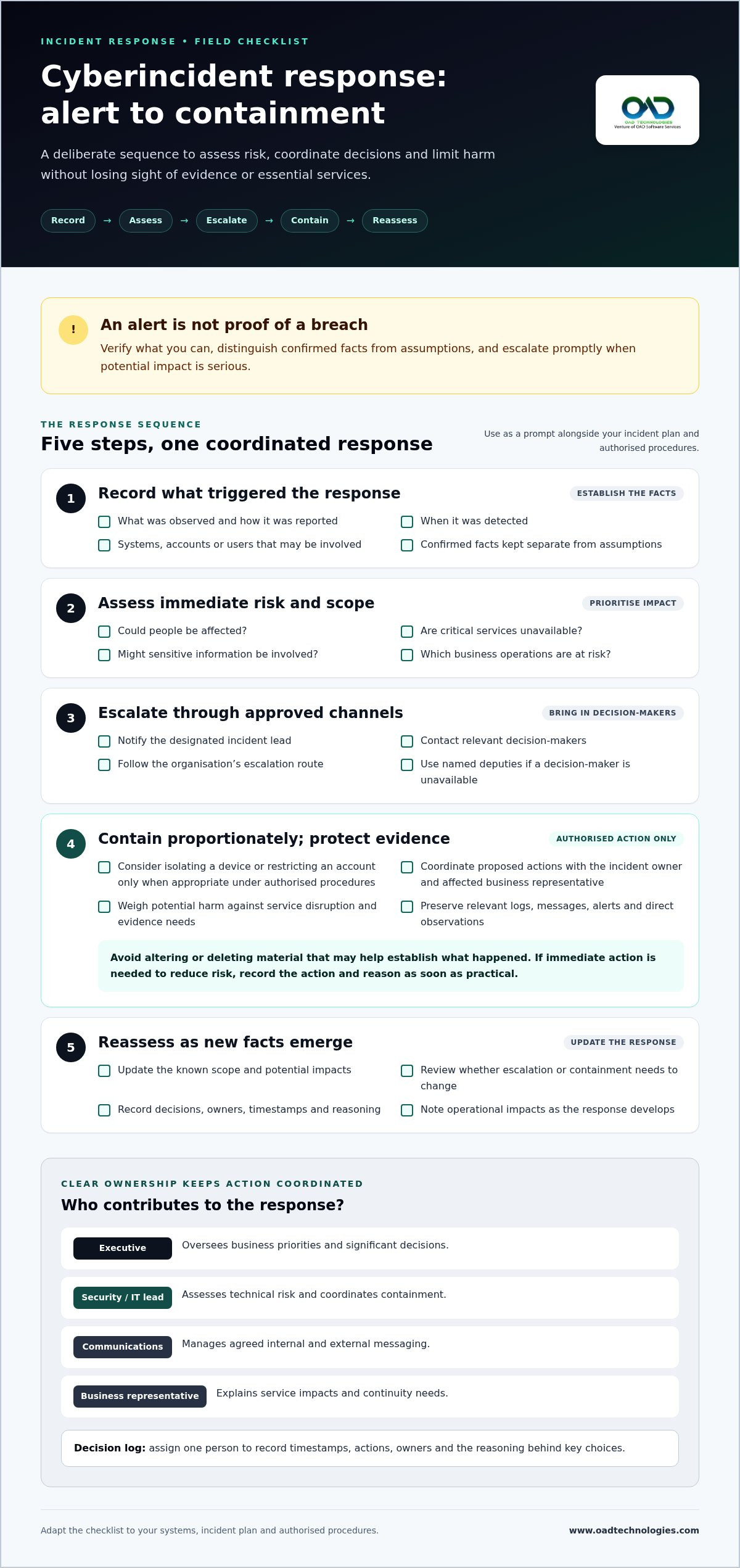
Assign responsibilities before an incident. An executive decision-maker oversees business priorities and significant decisions. A security or IT lead assesses technical risk and coordinates containment. A communications contact manages agreed internal and external messaging, while a business representative explains service impacts and continuity needs.
Name deputies and escalation routes in case a decision-maker is unavailable. Assign one person to maintain the decision log, including timestamps, actions, owners and the reasoning behind key choices. Clear ownership helps teams coordinate without assuming that every alert is a breach or that one function can manage every consequence alone.
Cyberincident Checklist: Alert to Containment Steps
A useful cyberincident checklist moves the response through a deliberate sequence: record the alert, assess its scope, escalate through approved channels, contain proportionately and reassess. This helps teams act without treating an initial alert as proof of a breach or rushing into changes that could complicate an investigation or disrupt essential services.
Use this sequence as a prompt, not as a set of universal technical commands. The NIST Computer Security Incident Handling Guide provides a more detailed reference for incident handling. Adapt any guidance to your organisation’s systems, plan and authorised procedures.
What should the first response team establish?
Begin with what prompted the response. Record what was observed, when it was detected, how it was reported and which systems, accounts or users may be involved. Separate confirmed facts from assumptions. For example, note that a user reported an unexpected sign-in rather than labelling the account compromised before that has been established.
Notify the designated incident lead and relevant decision-makers through approved internal channels. Then assess immediate risk: could people be affected, are critical services unavailable, might sensitive information be involved, and which business operations are at risk? The answers help the lead set priorities and decide whether further escalation is needed.
How should teams approach containment and evidence?
Containment aims to limit potential harm, but the right action depends on the incident and its operational context. Isolating a device or restricting an account may be appropriate under authorised procedures. An ill-considered change, however, could interrupt a critical service or remove information investigators need. The technical lead should coordinate proposed actions with the incident owner and affected business representative, following the organisation’s plan.
Preserve relevant logs, messages, alerts and direct observations in line with internal evidence-handling practices. Avoid altering or deleting material that may help establish what happened. If a step must be taken immediately to reduce risk, record the action and reason as soon as practical.
- Record: the alert, detection time, source and known scope.
- Assess: potential safety, information, service and business impacts.
- Escalate: notify the incident lead and decision-makers through approved routes.
- Contain: take proportionate, authorised action while considering evidence and continuity.
- Reassess: update the scope and next steps as new facts emerge.
For each decision, log who made it, when it occurred, what information informed it and any operational impact. OAD Technologies provides managed cybersecurity and SOC services as part of its enterprise security offering.
How to compare incident response readiness and security support
Compare documented coverage, not reassuring labels or assumed service levels. Your cyberincident checklist should reflect the capabilities your organisation can actually call on, with clear accountability for decisions that remain internal. Managed support can add monitoring or specialist capacity, but an internal incident owner is still needed to understand business priorities and make business decisions.
Use this comparison to identify strengths and gaps. The Federal Government Cybersecurity Incident Response Playbook provides a structured reference for response actions. Treat it as guidance, not a replacement for your organisation’s approved procedures or applicable UAE requirements.
What should an organisation assess in its current readiness?
Check whether roles, escalation paths and decision authority are written into procedures and understood by the people assigned to them. Review how security alerts and endpoint records reach decision-makers, and whether the response connects with business continuity planning and data protection responsibilities. A gap may be unclear ownership, limited access to relevant records or a missing hand-off, not simply a lack of security technology.
When might managed security support be relevant?
Managed Detection and Response (MDR) combines monitoring with detection and response activities within its defined scope. A managed Security Operations Centre (SOC) provides security operations capabilities. Security Information and Event Management (SIEM) brings together and analyses security data, while Endpoint Detection and Response (EDR) focuses on activity on devices. These terms describe different functions, not interchangeable services.
Managed support can be relevant when internal coverage or specialist capacity doesn’t match your organisation’s needs. OAD Technologies provides managed cybersecurity and SOC services, SIEM, EDR and MDR. Fully Managed, Defined Scope makes service boundaries and responsibilities clear, while internal leaders retain accountability for business decisions.
How to tailor and maintain a cyberincident checklist
A checklist is useful only if it reflects how your organisation operates. Map its actions to critical business services, the data those services use, the systems that support them and dependencies such as cloud platforms, suppliers or shared identity services. This helps teams consider how a technical response could affect business continuity, rather than treating each system as isolated.
How can teams tailor checklist actions to their organisation?
Build scenarios around relevant risks, such as ransomware affecting a key service, a compromised account with elevated access or suspected exposure of sensitive data. For each scenario, identify the technical and business owners who need to assess impact, who can approve consequential actions and how continuity arrangements apply. Assign an owner to maintain contact details, decision authority and escalation routes, so the checklist remains usable as people and responsibilities change.
How can organisations test and improve the checklist?
Use a tabletop exercise to walk through a scenario with technical, business, communications and leadership stakeholders. Participants discuss what they would do and what information they need, without making changes to live systems. An exercise can reveal gaps, but it doesn’t guarantee readiness. Record each finding as a specific improvement, with an owner and a way to track completion.
Review the checklist after material changes to technology, business structure, suppliers, critical services or risk. A change to identity systems, for example, may affect who can approve access restrictions; a new dependency may change which services need continuity planning. Rather than relying on a fixed review interval, assign responsibility for recognising relevant changes and updating the document when they occur.
Keep the review focused on practical questions:
- Do the named contacts and deputies still hold the responsibilities assigned to them?
- Can the team identify the affected service, data and system dependencies from the information available?
- Are escalation and decision routes clear for the scenario being discussed?
- Do response actions account for communications and business continuity needs?
After an exercise or real incident, review lessons with the people who would carry out the response. Replace unclear wording, fill in missing information and adjust steps that don’t fit current systems or approved procedures. Keep a record of changes so teams can work from the same current version.
If you’re aligning your checklist with enterprise security capabilities, discuss your incident-readiness requirements with OAD Technologies.
How OAD Technologies can support enterprise incident readiness
A cyberincident checklist can show where your organisation needs stronger monitoring, clearer ownership or additional specialist capacity. OAD Technologies provides enterprise cybersecurity capabilities that can address identified gaps while keeping response decisions aligned with internal roles and business priorities. These capabilities support readiness; they don’t replace your incident plan or guarantee a particular outcome.
Match security capabilities to the gaps in the checklist
Start with the responsibilities and risks your checklist identifies. SIEM brings security data together for analysis, while EDR focuses on activity across endpoints. OAD Technologies provides Managed Detection and Response (MDR) and managed cybersecurity and SOC services as part of its security offering. Define how these functions fit with your escalation routes, decision authority and continuity arrangements. For more detail on MDR, read OAD Technologies’ Managed Detection and Response strategic guide.
If the checklist highlights risks involving sensitive information, Data Loss Prevention (DLP) can support efforts to protect that data. Align its role with your information-handling priorities and incident procedures. Explore the Data Loss Prevention strategic framework for a closer look at this capability. Where ransomware preparedness is a priority, consider how it connects to recovery planning, business continuity and assigned response owners.
Discuss requirements without assuming a one-size-fits-all approach
Security needs vary with an organisation’s systems, dependencies, risk priorities and existing expertise. Start by identifying the gaps in your checklist: which alerts need closer monitoring, what endpoint visibility is available, where specialist support could complement internal capacity, and who retains authority over business decisions.
Access risks may point to a need to review identity governance, privileged access and related responsibilities. OAD Technologies’ Identity and Access Management strategic framework explores how IAM fits into a broader security approach. The aim is to connect capabilities to the organisation’s operating context, not apply a standard package irrespective of need.
OAD Technologies provides managed cybersecurity and SOC services, SIEM, EDR, MDR, DLP and ransomware preparedness. Discuss your requirements to consider how these capabilities could complement your existing incident roles and processes.
Make incident readiness part of your operating plan
A practical cyberincident checklist gives teams a shared way to assess risk, escalate decisions and coordinate containment without losing sight of evidence or business continuity. Keep it aligned with your organisation’s systems and responsibilities, revisit it after meaningful changes and use exercises to identify unclear steps.
Where the checklist exposes capability gaps, managed cybersecurity and SOC services, SIEM, EDR, MDR, XDR and ransomware preparedness may complement internal processes. The right mix depends on your organisation’s requirements, risk priorities and existing responsibilities. Clear scope and accountability connect security capabilities with the decisions your people need to make.
OAD Technologies provides enterprise cybersecurity services to organisations across the UAE. Book a meeting to discuss your requirements, or explore OAD Technologies.
Frequently Asked Questions
What is a cyberincident checklist?
A cyberincident checklist is a practical aid that assigns response actions, owners and decision points. It supports an organisation’s incident plan rather than replacing professional judgement, technical procedures or applicable obligations. A useful checklist separates general first actions, such as recording an alert and notifying the incident lead, from steps that depend on the incident type, affected systems and business impact. This helps teams act consistently while adapting their response to the facts.
What should an organisation do first during a cyber incident?
Record the alert and known facts, notify the designated incident lead and assess immediate impact. Use approved escalation routes, and distinguish verified information from assumptions rather than treating an unverified alert as a confirmed breach. Consider affected systems, service availability and potential data exposure. Containment decisions depend on the circumstances, so weigh the risk of further harm against operational disruption and the need to preserve relevant evidence.
Who should be involved in a cyber incident response?
Include an executive decision-maker, a security or IT lead, an affected business owner and a communications contact. Assign deputies and escalation routes in case someone is unavailable. Agree responsibilities in advance, including who can authorise containment actions and who maintains the time-stamped decision record. Depending on the incident and applicable requirements, legal, privacy or other specialist input may also be needed. Clear roles help keep technical response and business priorities aligned.
How should a business preserve evidence during a cyber incident?
Follow authorised evidence-handling procedures and record relevant observations, times and decisions. Logs, messages, alerts and system information may help establish what happened, but appropriate collection methods depend on the systems and circumstances. Avoid unapproved actions that could alter or remove relevant material. The incident checklist should direct responders to internal procedures and responsible specialists; it isn’t a substitute for forensic expertise or legal advice.
Can a cyberincident checklist prevent ransomware?
No checklist can prevent every attack or guarantee recovery. It can help teams clarify escalation, containment decisions, communications and continuity actions before a ransomware incident occurs. Preparedness works alongside appropriate security controls, backups and tested procedures tailored to the organisation’s systems and services. A checklist can make responsibilities and decisions easier to follow under pressure, but no single tool or service removes all risk.
How often should a cyberincident checklist be reviewed?
Set a review process that reflects your organisation’s changes rather than relying on a universal interval. Revisit the checklist after material changes to systems, responsibilities, business operations or identified risks. Exercises can reveal unclear steps, missing information and outdated contacts. Assign an owner to keep decision-makers, deputies and escalation routes current, then track each improvement to completion so the checklist remains practical and aligned with current procedures.
Should an organisation use managed security support for incident readiness?
Managed security support may be relevant when internal coverage, specialist capacity or monitoring doesn’t match the organisation’s risk priorities. Compare documented requirements with the scope of services such as managed SOC, SIEM, EDR or MDR, including how responsibilities and escalation connect with internal teams. Managed support can complement governance and internal decision-making; it doesn’t replace accountable business owners or guarantee a particular security or compliance outcome.
To discuss your incident-readiness requirements with OAD Technologies, book a meeting or visit oadtechnologies.com.
Disclaimer
Content by OAD Technologies is for general informational purposes only and does not constitute professional or cybersecurity advice. No warranties are made regarding accuracy or completeness; reliance is at your own risk. OAD Technologies shall not be liable for any direct or indirect losses arising from use of this content.