

What if the answer to alert fatigue isn’t another security tool, but a more deliberate way to turn security signals into decisions? For UAE enterprises, outsourced SOC services can connect continuous threat monitoring with expert analysis and a response plan, without the burden of building every capability in-house.
The challenge is familiar: skilled analysts are difficult to recruit, SIEM and EDR platforms require significant investment, and unmanaged alerts can overwhelm the teams meant to act on them. A capable SOC model should do more than collect alerts. It should help your organisation identify meaningful threats, respond quickly, and strengthen resilience while supporting alignment with the UAE Personal Data Protection Law (PDPL).
This guide explains how to assess outsourced SOC services as a strategic capability, not simply a way to reduce operational overhead. You’ll learn what 24 X 7 monitoring and incident response involve, how integration with your existing security stack can reduce noise, and why pairing SOC operations with governance, risk, and compliance can connect technical controls to national compliance priorities. The result is a clearer framework for choosing an approach that fits your environment and long-term security goals.
Key Takeaways
- Assess whether maintaining rotating SOC shifts is sustainable for your team as threat activity and security complexity grow.
- Use outsourced SOC services to extend monitoring across cloud, endpoint, and network environments while gaining access to proactive threat hunting.
- Compare SOC models by deployment speed and breadth of expertise, not just by who operates the tools.
- Look for an approach tailored to your environment and industry risks rather than a one-size-fits-all security setup.
- Connect SIEM, EDR, MDR, and GRC capabilities to strengthen security operations and support national resilience.
The Evolution of Security Operations: Why In-House SOCs are Straining
A security operations centre must do more than collect alerts. It brings together monitoring, investigation, and response, as outlined in this overview of the Security Operations Center (SOC). For enterprises, sustaining those functions around the clock requires people, processes, and technology that can keep pace with a changing environment.
That’s a demanding task for an in-house team. A 24 X 7/365 operation depends on reliable shift coverage, handovers, and enough skilled analysts to investigate alerts without leaving gaps. Rotating shifts can strain a small team, while expanding headcount adds recruitment and management demands. At the same time, UAE organisations may need to monitor activity across cloud platforms, endpoints, networks, identities, and sensitive data. Each layer generates signals, and the challenge is deciding which ones indicate real risk.
Tools alone don’t solve that challenge. SIEM and EDR platforms can collect and surface activity, but analysts still need to tune detection rules, connect events across systems, investigate suspicious behaviour, and coordinate a response. Without that operational discipline, alerts accumulate and teams face tool fatigue: more dashboards, but not necessarily clearer priorities. The objective is to move from reactive alert handling toward proactive resilience, including threat hunting that looks for signs of compromise before they become an obvious incident.
The Reality of the Cybersecurity Talent Gap
Specialized analysts are difficult to recruit and retain in a competitive national market. Building internal expertise also takes sustained investment: staff need time and training to keep up with new attack methods, evolving infrastructure, and changing defensive techniques. When trained employees leave, organisations must recruit again and rebuild knowledge. Outsourced SOC services can give enterprises access to a broader operational capability without requiring every role and skill set to sit on the internal payroll.
Capital Expenditure vs. Operational Flexibility
Running a SOC involves more than analyst salaries. SIEM and EDR licensing, hardware, storage, integrations, and infrastructure maintenance all contribute to the operating burden. An in-house model may also require additional investment as data volumes and monitoring needs grow. Outsourcing can shift some of this responsibility from upfront capital expenditure to a recurring operating model, helping leaders plan capacity around business needs. The exact structure depends on the service arrangement, but the strategic benefit is flexibility: security operations can evolve as the organisation expands, rather than waiting for a new internal build-out.
For UAE enterprises, the decision is therefore not simply whether to own security tools. It’s whether the organisation can consistently staff, tune, and use them to reduce risk. A tailored SOC model can connect technology with analyst judgment and governance priorities, making security operations a foundation for business continuity rather than a queue of unresolved alerts.
Core Capabilities of Modern Outsourced SOC Services
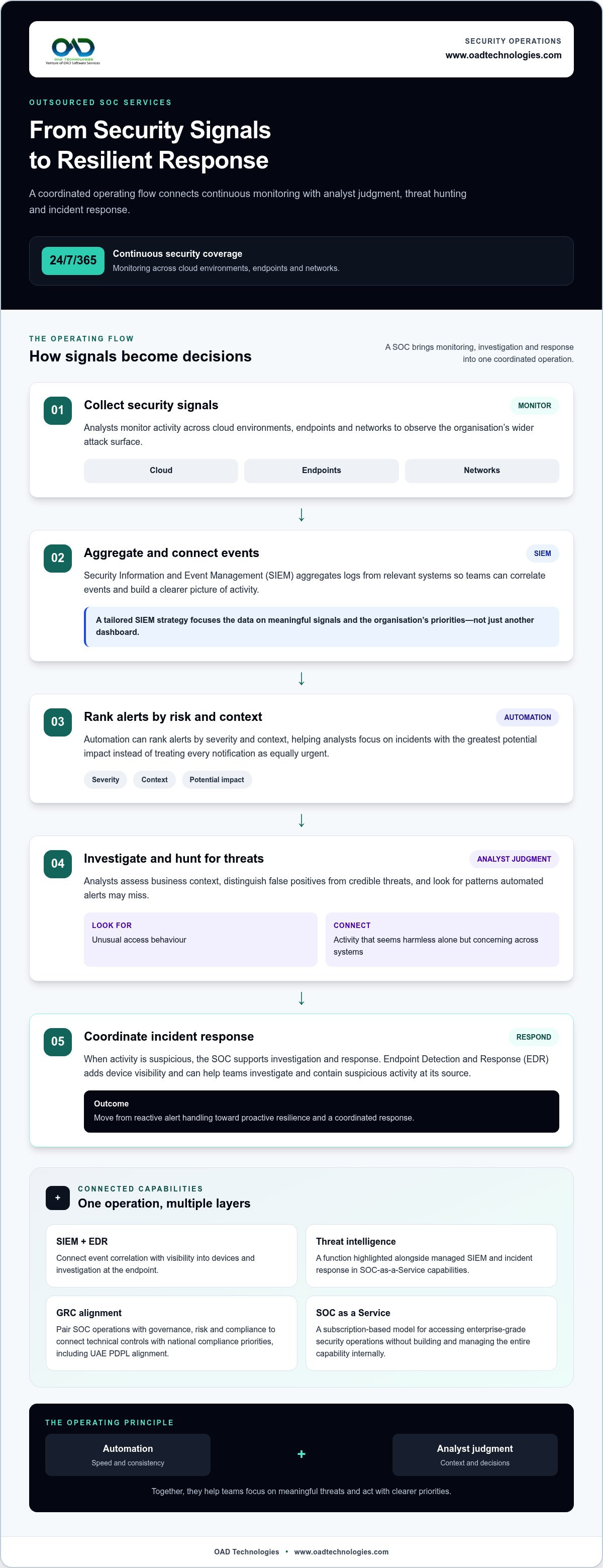
Effective outsourced SOC services connect security data with informed action. They bring monitoring, investigation, and response into a coordinated operation, rather than leaving internal teams to interpret alerts across disconnected tools. In a continuous coverage model, analysts monitor cloud environments, endpoints, and networks around the clock, looking for suspicious activity across the full attack surface.
SOC as a Service (SOCaaS) is a subscription-based model that gives an organisation access to enterprise-grade security operations without building and managing the entire capability internally.
Monitoring is only the starting point. Threat hunters examine patterns that automated alerts may miss, such as unusual access behaviour or activity that appears harmless in isolation but becomes concerning when linked across systems. Automation can rank alerts by severity and context, helping analysts focus on incidents with the greatest potential impact instead of treating every notification as equally urgent. CISA’s overview of SOC-as-a-Service capabilities also highlights functions such as managed SIEM, threat intelligence, and incident response.
SIEM and EDR: The Technical Foundation
Security Information and Event Management (SIEM) aggregates logs from relevant systems so teams can correlate events and build a clearer picture of activity. A tailored SIEM strategy helps make that data useful by focusing on meaningful signals and the organisation’s priorities. Endpoint Detection and Response (EDR) adds visibility into devices and can help security teams investigate and contain suspicious activity at its source. Integrated carefully, these tools create a shared operational view across security layers, not just another dashboard.
Human Intelligence and Incident Response
Automation is valuable for speed and consistency, but it doesn’t replace analyst judgment. A system can group related alerts or flag unusual behaviour; an experienced analyst can assess business context, distinguish a false positive from a credible threat, and decide what needs escalation. That combination is central to effective threat hunting.
During the first 15 minutes of a suspected breach, a response workflow may involve validating the alert, identifying affected accounts or devices, assessing the potential scope, and escalating or containing activity where appropriate. These steps depend on the incident and agreed procedures, so they shouldn’t be confused with a guaranteed response time. After containment, root-cause investigation can help determine how the activity began and which controls or processes need improvement. For organisations shaping this capability, OAD Technologies’ security operations approach brings SIEM, EDR, MDR, and human expertise into a customized security design.
In-House vs. Outsourced SOC: A Strategic Comparison
Choosing a SOC model means weighing more than who watches alerts. An in-house operation gives an organisation direct control over staffing and processes, but building coverage requires recruitment, technology, integrations, and ongoing management. Outsourced SOC services can draw on an established operating model and a broader pool of expertise, while internal teams retain business context and oversight.
Deployment speed depends on the starting point. An outsourced model may make existing monitoring capabilities available sooner, while an in-house build must assemble its team, tools, and workflows. Neither timeline is universal: integrations, data readiness, and response procedures all affect implementation. The same distinction applies to expertise. Internal analysts know the organisation’s systems, while a managed SOC can bring experience across varied environments and threat patterns. A well-designed partnership combines both perspectives.
Outsourcing may also provide access to mature security capabilities without requiring the organisation to procure and operate every component independently. That doesn’t mean every tool or feature is automatically included, or that the model is always less expensive. Compare the full scope, responsibilities, and service terms, consulting specialized technology providers such as reisinformatica.com when evaluating broader IT requirements. The operational benefit is often capacity: internal IT staff can spend less time maintaining detection workflows and more time on business systems and innovation.
Total Cost of Ownership (TCO) Breakdown
Compare the total effort and resources required by each model, not just software costs. An in-house SOC’s TCO can include analyst salaries and benefits, shift coverage, recruitment, continuous training, SIEM and EDR administration, platform updates, infrastructure, and integrations. An outsourced arrangement replaces some direct operating responsibilities with a service relationship, but its value depends on scope and fit. Outsourcing doesn’t automatically transfer an organisation’s legal accountability, security risk, or insurance obligations; contracts should clearly define responsibilities and escalation authority.
Strategic Visibility and Control
Outsourcing needn’t mean surrendering oversight. Establish how the provider will share alert status, investigation findings, response actions, and performance reporting. Technical teams may need incident detail and detection context, while executives need concise visibility into risk trends, unresolved issues, and operational priorities. Agree on who can authorize containment actions and how exceptions are handled.
Good reporting connects security activity to business outcomes rather than presenting an unexplained stream of alerts. Aligning SOC monitoring and incident handling with a broader MDR strategy can help make that connection, linking detection with investigation and response. A tailored operating model should also integrate with the organisation’s existing environment, giving internal teams meaningful visibility while reducing the burden of running every SOC function themselves.
Evaluating a SOC Partner: Beyond the Dashboard
A polished dashboard doesn’t prove that a SOC understands your business. Evaluate how the partner adapts its monitoring to your systems, industry risks, escalation paths, and risk tolerance. A financial services environment, for example, may prioritize different access patterns and data flows than a logistics operation. Effective outsourced SOC services should reflect those differences instead of applying the same alert rules and response playbook to every organisation.
Integration matters just as much as detection. Connecting SOC monitoring with Identity and Access Management can help analysts interpret events in context, such as unusual sign-in activity or changes to account privileges. Define how alerts reach your team, who can authorize containment actions, and what information each escalation includes. The service-level agreement (SLA) should state how detection and response times are measured, what triggers escalation, and how exceptions are reported. Clear commitments make performance assessable rather than leaving expectations implicit.
UAE Regulatory and Compliance Alignment
For UAE enterprises, security operations should support the organisation’s compliance programme, including alignment with the UAE Personal Data Protection Law (PDPL). National entities subject to Information Security Regulation (ISR) requirements also need SOC processes that can support their applicable controls and evidence needs. Governance, risk, and compliance (GRC) work connects these obligations to operational practice: GRC consulting can help shape monitoring priorities, escalation thresholds, and reporting around the organisation’s risk appetite, and organisations can also explore ISO 27001 Information Security Management to align their operational defenses with global resilience standards.
Build Data Protection into SOC Operations
A SOC that sees security alerts but lacks context about sensitive data can miss an important part of the risk picture. Integrating monitoring with a Data Loss Prevention framework helps connect suspicious activity to the information an organisation needs to protect.
SOC-DLP integration can identify and trigger a response to unauthorized data movement, helping contain potential exfiltration before it escalates into a breach.
Ask how the partner will make this operational: which data movement events are monitored, how alerts are prioritized, and how investigations are documented. Reporting should serve both technical teams, who need actionable incident detail, and leaders, who need a clear view of exposure and control effectiveness. OAD Technologies brings SOC integration together with GRC and DLP considerations to support a security model tailored to the organisation. Explore a tailored SOC and data protection approach.
OAD Technologies: Elevating Your Security Posture with Managed SOC
A managed SOC should strengthen your team’s ability to make sound security decisions, not simply move alerts into another queue. OAD Technologies works as a strategic security partner, aligning monitoring and response with your environment, business priorities, and risk profile. That means treating security events as context for action: what’s affected, what the exposure could mean, and which controls may need attention.
OAD brings together SIEM, EDR, and MDR capabilities in a tailored approach for enterprises across the UAE. The aim is to connect visibility and detection with practical response, while supporting longer-term resilience. Rather than applying a fixed design, the integration can be shaped around the organisation’s infrastructure and operational priorities. This helps make security operations part of business continuity and digital relevance, not a standalone technical function.
Our Approach to Strategic Resilience
Effective outsourced SOC services should deliver insight as well as incident handling. OAD’s system integration approach connects security tools and operational needs, helping teams interpret activity in the context of their environment. Threat modelling can account for the systems, access patterns, and data flows that matter to your organisation. That context helps distinguish routine events from activity that merits investigation, and it can guide improvements to detection and response over time.
Technical assessments can add another valuable perspective. Vulnerability Assessment and Penetration Testing can help identify weaknesses and test security controls, giving SOC planning a stronger view of where monitoring and response should focus. Paired with Governance, Risk, and Compliance (GRC), SOC insights can also support risk-informed security decisions and alignment with UAE Personal Data Protection Law (PDPL) priorities.
Securing Your Future in the UAE Market
Resilience isn’t a one-time deployment. As infrastructure changes, organisations should revisit monitoring coverage, response workflows, and the risks associated with new systems and data flows. A SOC integrated with Data Loss Prevention can help security teams connect suspicious activity with potential exposure of sensitive information. That relationship supports a more complete view of digital risk, while GRC helps connect operational controls to governance objectives.
OAD Technologies focuses on customized security integration that combines human expertise with technology, helping organisations strengthen their posture as they evolve. The goal is lasting capability: a security operation designed to adapt, support informed decisions, and help safeguard the organisation’s digital relevance.
Ready to strengthen your security operations with an approach shaped around your environment? Contact OAD Technologies to discuss your SOC and resilience priorities.
Build Security Operations for Long-Term Resilience
A resilient SOC is more than a monitoring function. The right model combines relevant expertise, connected security tools, and clear response processes, while giving your organisation the visibility to stay in control. For UAE enterprises, choosing outsourced SOC services means assessing how well a partner aligns operations with your environment, risk priorities, and compliance needs.
OAD Technologies brings together SIEM, EDR, and Data Loss Prevention to help connect detection with data protection. Its GRC expertise supports alignment with the UAE Personal Data Protection Law (PDPL), while proactive threat hunting helps identify suspicious activity that routine alerts may not surface. These capabilities work best as a tailored partnership, designed to evolve alongside your systems and business priorities.
Security operations should protect more than technology. They should help preserve continuity, build confidence, and safeguard your organisation’s digital relevance as its needs change. Secure your enterprise with OAD Technologies’ strategic SOC services, and take a considered step toward lasting resilience.
Frequently Asked Questions
What is the difference between a Managed SOC and MDR?
A Managed SOC provides ongoing security operations, such as monitoring security data, investigating alerts, and coordinating incident response. Managed Detection and Response (MDR) focuses on finding and responding to threats, often using endpoint and other security telemetry. The services can overlap: MDR may operate as part of a broader SOC capability. The right scope depends on whether your priority is operational monitoring, active threat response, or an integrated approach.
How does an outsourced SOC help with UAE PDPL compliance?
An outsourced SOC can support PDPL compliance efforts by helping your organisation detect and investigate security events involving systems that handle personal data. SIEM monitoring can bring relevant logs together, while GRC helps connect operational controls, risk processes, and evidence needs. These capabilities can strengthen oversight, but using an SOC does not by itself establish compliance. Your organisation remains responsible for assessing its obligations and maintaining an appropriate compliance programme.
Can I keep my existing security tools when outsourcing my SOC?
Often, an outsourced SOC can integrate with existing security tools, subject to technical compatibility and the agreed service scope. Before onboarding, map the tools that generate security data, including SIEM, EDR, identity, cloud, and data protection systems. This helps identify useful integrations, visibility gaps, and duplicated functions. OAD Technologies provides SIEM, EDR, MDR, and IAM capabilities, with security integration tailored to an organisation’s environment and operational priorities.
What is the typical response time for an outsourced SOC during a breach?
There isn’t one universal response time. It depends on the service agreement, how an incident is classified, the information available, and which actions the SOC is authorised to take. Review the agreement for definitions of detection, triage, escalation, and response, including how timing is measured. Also clarify who approves containment steps, such as isolating an endpoint, so the response process is practical before an incident occurs.
Will an outsourced SOC have access to my sensitive business data?
An outsourced SOC may need access to security logs or telemetry to investigate activity, but that does not automatically mean it needs unrestricted access to business data. Define what information is collected, how it is used, who can access it, and how access is controlled. Map data flows and permissions during service design, and align those decisions with your internal policies and privacy requirements, including your PDPL compliance programme.
How much does it cost to outsource SOC services in the UAE?
Costs vary according to the organisation’s environment and the service scope, so a single figure would be misleading. Relevant factors may include the number and type of systems monitored, data volumes, integrations, response responsibilities, and reporting needs. Compare proposals by the capabilities and responsibilities they include, not just the headline fee. A clear scope helps you assess operational fit and understand how the service supports your security priorities.
Does an outsourced SOC provide 24 X 7 human monitoring or just automated alerts?
That depends on the agreed service model. Some outsourced SOC arrangements include continuous analyst monitoring, while others rely more heavily on automated detection and defined escalation processes. Ask how alerts are prioritised, when a human analyst investigates them, and how findings reach your team. Effective operations combine automation, which can sort and correlate events, with human judgment to interpret context and decide what warrants further action.
What happens if a threat is detected outside of business hours?
The response depends on the coverage and escalation process set out in the service agreement. If monitoring and response coverage includes that period, the SOC should follow the agreed process for triage, notification, and any authorised containment actions. Confirm who receives escalations, how urgent incidents are communicated, and who can approve disruptive actions. Clear responsibilities help your organisation respond consistently, rather than relying on assumptions during an incident.
Disclaimer
Content by OAD Technologies is for general informational purposes only and does not constitute professional or cybersecurity advice. No warranties are made regarding accuracy or completeness; reliance is at your own risk. OAD Technologies shall not be liable for any direct or indirect losses arising from use of this content.