

What if the most important cloud risk isn’t an exposed asset, but the path from an overlooked permission to business-critical data? For UAE organisations, choosing cloud penetration testing services means looking beyond a generic checklist to how identities, APIs and workloads connect, and what an attacker could reach through those connections.
Meaningful testing needs to be planned without putting production services at unnecessary risk or breaching a cloud provider’s rules. Start with written authorisation, clear boundaries and a scope based on your architecture and business priorities. Also distinguish penetration testing from vulnerability scanning, which checks for known issues, and Cloud Security Posture Management (CSPM), which monitors cloud configurations against defined policies or benchmarks.
This guide explains what a cloud penetration test can assess, how to set a safe scope and what to ask when comparing providers. It covers how to focus on realistic attack paths, agree testing limits and decide whether an assessment adds insight alongside controls such as CSPM. The aim is to help you plan a relevant test and get findings your team can use to prioritise remediation.
Key Takeaways
- Map the assessment to business-critical cloud assets and realistic attack paths, rather than relying on a generic checklist.
- Before testing begins, agree written authorisation, boundaries, production safeguards and how urgent findings will be communicated.
- Compare cloud penetration testing with vulnerability scanning and CSPM to choose the assessment that best supports your security decisions.
- Evaluate providers on relevant cloud experience, evidence handling and whether their findings give your team practical remediation context.
- Consider how VAPT, cloud and API security, and CSPM relate to your wider security requirements when discussing service fit with OAD Technologies.
What cloud penetration testing services assess in an enterprise environment
Cloud penetration testing is an authorised assessment of selected cloud-hosted systems and attack paths to identify weaknesses an attacker could exploit. It examines how chosen assets connect, and whether access controls, configurations or application interfaces could expose business systems or data. Results apply to the agreed scope and test conditions. No assessment can guarantee that it will find every weakness.
Rather than applying a generic checklist, effective cloud penetration testing focuses on how an organisation’s architecture is used. The tester considers plausible routes through the environment, while the business identifies priority systems and defines which activity is authorised. This gives decision-makers evidence about specific risks, not a guarantee of complete security.
Which cloud assets and attack paths may be in scope?
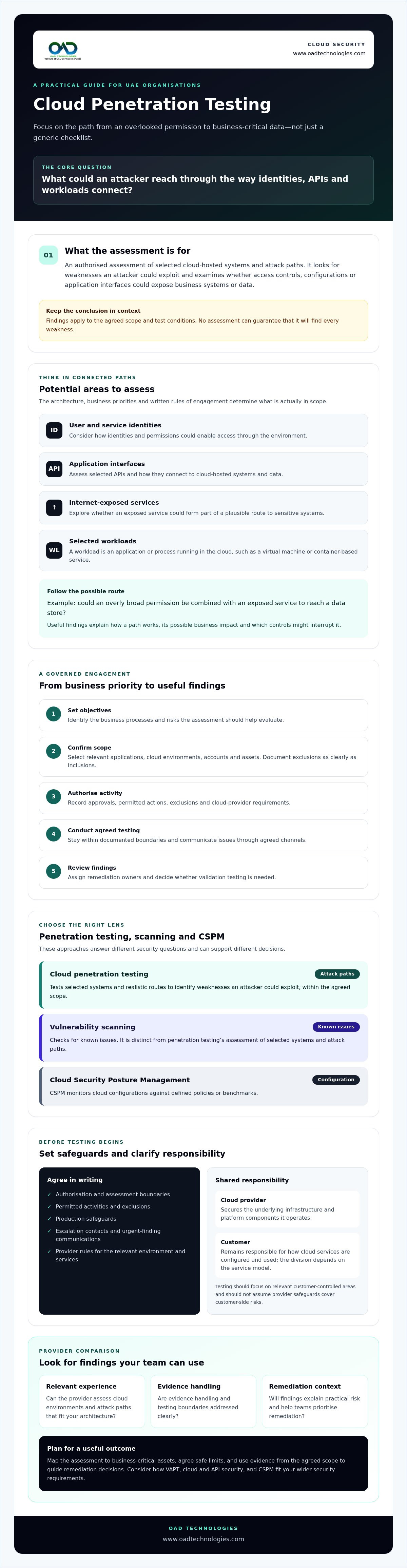
Depending on the architecture and written rules of engagement, scope may include user and service identities, permissions, internet-exposed services, APIs and selected workloads. A workload is an application or process running in the cloud, such as a virtual machine or container-based service. These are potential assessment areas, not an automatic checklist. Agree every asset and test activity in advance.
Testing can explore whether a plausible sequence of weaknesses could lead to sensitive business data. For example, a tester might assess whether an overly broad permission could be combined with an exposed service to reach a data store. The useful questions are how the path works, what business impact it could have and which controls might interrupt it. Findings apply to the systems and conditions assessed, so teams should consider them alongside other security controls.
How shared responsibility affects cloud testing
Cloud security is shared. The provider secures the underlying infrastructure and platform components it operates, while the customer remains responsible for how cloud services are configured and used. The precise division depends on the service model. As the overview of Cloud computing security explains, the shared responsibility model helps clarify why provider safeguards don’t remove customer-side risks.
For example, a provider may maintain the physical infrastructure, while customer access settings, application configuration and data permissions can still create exposure. Testing should focus on customer-controlled areas relevant to the agreed objectives, without assuming provider controls cover them.
Permission matters. Cloud providers set conditions for security testing, and permitted activities can vary by provider and service. Before work begins, check the current rules for the environment, obtain the necessary authorisation, and document boundaries, prohibited actions, production safeguards and escalation contacts. Clear limits make testing more useful and ensure permission is addressed from the outset.
How a cloud penetration testing engagement moves from scope to findings
A well-governed engagement moves from business priorities to written authorisation, agreed testing, evidence-based reporting and a decision about any follow-up validation. Settle the methods, boundaries and deliverables before work starts. The cloud penetration testing overview from EC-Council provides additional background, but your architecture and rules of engagement should shape the assessment itself.
For enterprise teams, the sequence typically includes:
- Set objectives: Identify the business processes and risks the assessment should help evaluate.
- Confirm scope: Select relevant applications, cloud environments, accounts and assets.
- Authorise activity: Record approvals, permitted actions, exclusions and provider requirements.
- Conduct agreed testing: Stay within documented boundaries and communicate issues through agreed channels.
- Review findings: Assign remediation owners and decide whether validation testing is needed.
Agree objectives, scope and rules of engagement
Start by identifying the services that support important business processes, then decide which environments and accounts are in scope. Document exclusions as clearly as inclusions. The rules of engagement should specify authorised activities, production safeguards, escalation contacts and how to pause testing if an unexpected effect occurs. Confirm approvals from your organisation and, where required, the cloud provider for each environment before testing begins.
These decisions make the assessment more relevant and help prevent assumptions about access or permitted activity. A production environment may need different limits from a test environment. Agree who can approve a scope change and how testers should report a suspected urgent issue.
Turn test evidence into remediation decisions
A useful finding identifies the affected asset, explains the observed weakness and gives the responsible team evidence to verify it. It should also describe a plausible business consequence in context. For example, a permission issue may be more significant if it enables access to a sensitive application than if it affects an isolated, low-impact resource. Prioritise findings by considering exploitability, exposure, data sensitivity and the business process at risk, rather than relying on a severity label alone.
Agree the report format and evidence-handling expectations in advance, including how sensitive information will be protected. Assign each action to an owner and track remediation through your usual governance process. Retesting may help verify whether a specific fix addresses a finding, but agree it as a separate step with its own scope and conditions rather than assuming it is included.
If you’re assessing service fit, you can discuss cloud security assessment requirements with OAD Technologies alongside its VAPT, cloud and API security, and CSPM capabilities.
Cloud penetration testing vs vulnerability scanning and CSPM
These approaches answer different security questions. A vulnerability scan checks for known weaknesses, while Cloud Security Posture Management (CSPM) helps identify cloud configuration risks and changes in security posture. Penetration testing uses authorised testing to assess whether selected weaknesses can form a plausible attack path. The approaches can complement one another, but none provides complete security assurance.
| Approach | Purpose | Typical output | Coverage pattern | Decision supported |
|---|---|---|---|---|
| Penetration testing | Assess selected attack paths through authorised testing. | Evidence-based findings, affected assets and remediation guidance. | Defined scope and agreed testing period. | Which tested paths need investigation or remediation? |
| Vulnerability scanning | Identify known weaknesses in assets covered by the scan. | Detected issues, often with technical details or severity labels. | Recurring or scheduled checks, depending on configuration. | Which identified weaknesses should be reviewed and addressed? |
| CSPM | Monitor cloud configuration and security posture against selected policies or benchmarks. | Configuration alerts, policy deviations and posture trends. | Ongoing monitoring of connected cloud environments, subject to setup. | Which configuration changes or risks need attention? |
What a penetration test adds beyond a vulnerability scan
A scan can check covered assets for known issues efficiently, but results depend on tool coverage, access and configuration. It may flag a weakness without showing whether it can be exploited in the environment or combined with another issue. In an authorised penetration test, a tester can examine a selected sequence of weaknesses to assess whether it creates a viable route towards a protected system or data. This context can help teams judge practical relevance, but applies only to the agreed scope and test conditions.
Think of scanning as a way to identify potential defects across covered systems, and penetration testing as a focused examination of how selected weaknesses could connect. Neither replaces the other, and neither confirms that untested systems are secure.
When CSPM and cloud penetration testing complement each other
CSPM can help teams spot configuration risks, such as a policy deviation or an access setting that changes over time. Testing can then examine selected attack paths in the context of business operations, helping teams assess how a weakness might affect a particular service. Findings from either activity can guide remediation, while posture monitoring can help teams track configuration changes between assessments.
For more on CSPM’s role and capabilities, see the cloud security posture management guide. When evaluating cloud penetration testing services, consider whether the scope and findings will add insight beyond scanning and posture monitoring.
How to prepare and choose a cloud penetration testing service
A suitable provider should explain how the proposed assessment fits your cloud architecture, what it excludes and how it will account for production operations. Compare cloud penetration testing services by the clarity of their scope and safeguards, their relevant cloud experience, and whether their reports will help your organisation decide what to address.
Before approving a proposal, use this checklist:
- Scope: Are the relevant cloud accounts, workloads, APIs and business processes clearly identified?
- Experience: Can the provider explain how its approach accounts for your cloud architecture and shared responsibility boundaries?
- Safety: Are permitted activities, exclusions, production safeguards, escalation contacts and pause conditions documented?
- Evidence: Will findings identify affected assets and provide enough evidence and business context to support remediation?
- Follow-up: Is remediation validation included, or would it need a separately agreed scope?
Check the cloud provider’s current testing policies and obtain all required permissions before activity begins. A provider’s proposal is not a substitute for your organisation’s authorisation or the cloud provider’s rules.
Questions to ask before approving a test
Ask which accounts, workloads, APIs and business processes the assessment will cover, and what it will exclude. How will test boundaries, approved activity, production safeguards and escalation routes be recorded? Clarify how the provider will handle evidence, including sensitive data, and communicate urgent findings. Request a sample report structure and confirm whether remediation validation has a separate scope.
Prepare cloud teams and stakeholders
Identify accountable business, security, cloud operations and application contacts before testing. Confirm who can approve access or changes to scope, and establish a communication route for questions, unexpected effects or urgent issues. Share relevant architecture and control information securely, limiting detail to what the engagement needs. This preparation helps teams coordinate without distributing sensitive information unnecessarily.
Clear answers should connect the proposed scope to business priorities, not just list technical activities. OAD Technologies offers VAPT, cloud and API security, and CSPM, which have related but distinct roles. If you’re evaluating how those capabilities fit your organisation’s needs, discuss your requirements.
Cloud penetration testing services and the next step with OAD Technologies
Choosing cloud penetration testing services should come down to fit, not broad promises. Look for an assessment shaped around business-critical systems, explicit authorisation, safe testing boundaries and findings your teams can act on. Testing can inform decisions, but it is one input to security improvement. Remediation still needs clear ownership, and other controls address risks outside the agreed assessment.
How cloud testing fits into a wider security programme
A test report can help security, cloud and business teams understand a weakness in context, agree remediation priorities and consider how cloud risk connects to operational objectives. It doesn’t replace vulnerability scanning or CSPM, which can help identify known weaknesses and monitor configuration posture. Nor is it the same as incident detection, which focuses on identifying suspicious activity. Each has a distinct role.
OAD Technologies offers Vulnerability Assessment and Penetration Testing (VAPT), cloud and API security, and Cloud Security Posture Management (CSPM). These capabilities may inform a wider security discussion, but the scope, delivery approach and availability of a specific cloud penetration testing engagement must be confirmed with OAD Technologies. For further background on VAPT, read the Vulnerability Assessment and Penetration Testing guide.
Discuss service fit before defining an engagement
To explore whether an assessment is relevant, be ready to describe your cloud environment at a suitable level, the business processes or assets you want to consider, and the decisions the assessment should support. You can also outline existing controls, known constraints and the teams that would own remediation. Avoid sharing credentials, sensitive configuration details or confidential data through an unsecured channel.
This information can help establish whether a confirmed service scope matches your requirements. Before proceeding, clarify the proposed boundaries, permissions, safeguards, reporting and any follow-up validation. OAD Technologies’ wider security capabilities can be discussed in relation to your current controls, without assuming that a particular cloud testing engagement is already defined or available. Learn more about OAD Technologies and its enterprise cybersecurity services.
To explore service fit and confirm next steps, Book a meeting.
Turn cloud security insight into a practical next step
Effective cloud penetration testing services start with business-critical scope, clear authorisation and safeguards suited to the environment. Findings should help your team understand relevant risks and prioritise remediation, while recognising that testing complements rather than replaces vulnerability scanning, CSPM and ongoing security controls.
For UAE organisations, the right approach depends on cloud architecture, business priorities and the decisions an assessment needs to support. OAD Technologies offers Vulnerability Assessment and Penetration Testing (VAPT), cloud and API security, and Cloud Security Posture Management (CSPM). These capabilities have distinct but related roles. Confirm the scope, delivery approach and service availability that fit your requirements.
Share your objectives and existing cloud controls to start a focused conversation about service fit. Discuss your requirements with OAD Technologies and take a considered next step towards strengthening your cloud security programme.
Frequently Asked Questions
What are cloud penetration testing services?
Cloud penetration testing services are authorised assessments of selected cloud-hosted systems, accounts or applications. They examine whether agreed attack paths could expose weaknesses or affect business assets. The scope depends on your architecture, permissions and objectives. For example, an assessment might consider whether access to an application could lead to unauthorised access to a business data store. Testing doesn’t guarantee that every vulnerability will be found or replace secure configuration, monitoring and remediation.
How is cloud penetration testing different from a vulnerability scan?
A vulnerability scan uses automated checks to identify known weaknesses within its configured coverage. A penetration test examines selected weaknesses and attack paths through authorised testing, helping assess their significance in context. For example, a test may consider whether an identified access issue could be combined with another weakness to reach a sensitive asset. The approaches can complement one another, but neither provides complete assurance. Check the proposed scope, exclusions, methods and reporting before engaging a provider.
Can cloud penetration testing disrupt production systems?
Testing activity can affect systems, so production risks and safeguards should be agreed before work begins. Document which assets are authorised, which actions are excluded, who to contact if an unexpected issue occurs and how urgent findings will be communicated. Ask whether specific approvals are needed and how the provider plans to respect your environment’s risk tolerance. No approach should be assumed safe for every system; the rules of engagement must reflect your architecture.
How often should a business conduct cloud penetration testing?
There’s no single testing schedule that suits every organisation. Consider an assessment when significant changes to architecture or applications alter exposure, when business priorities or risks change, or when internal policy calls for one. Verify any legal, contractual or regulatory testing frequency against authoritative sources that apply to your organisation. Penetration testing is a point-in-time assessment, so it doesn’t replace ongoing review of cloud configurations, access permissions or security alerts.
What should a cloud penetration testing report include?
A useful report identifies each finding and affected in-scope asset, presents supporting evidence and explains potential business relevance. It should help your teams assess priorities and assign remediation ownership. Before testing, confirm whether the deliverables include an executive summary, technical detail and remediation guidance. Also ask whether validation testing is available as a separately scoped step. Reporting formats and inclusions vary, so agree them in advance rather than assuming they’re standard.
How much do cloud penetration testing services cost?
The cost of cloud penetration testing services depends on the agreed scope, cloud architecture, applications included, objectives and reporting requirements. Preparation and coordination needs may also affect a proposal. Ask providers to document assumptions, exclusions, deliverables and whether any retesting has a separate scope. Compare proposals by coverage and clarity, not price alone. OAD Technologies offers VAPT, cloud and API security, and CSPM. Confirm directly whether a suitable cloud testing engagement is available and what its terms include.
Disclaimer
Content by OAD Technologies is for general informational purposes only and does not constitute professional or cybersecurity advice. No warranties are made regarding accuracy or completeness; reliance is at your own risk. OAD Technologies shall not be liable for any direct or indirect losses arising from use of this content.