

What if the safest IAM policy change is the one you can justify with evidence, rather than the one you can make fastest? In a changing enterprise environment, permissions can outlast the roles, systems and tasks they were created for. Yet removing access without understanding how people and services use it can interrupt legitimate work. Effective iam policy review and cleanup turns access evidence into controlled, least-privilege decisions.
That balance is difficult when policy owners cannot easily tell which permissions remain necessary, or when exceptions and review decisions are recorded inconsistently. A structured process helps teams identify excessive, unused or unclear access while giving business owners a clear role in deciding what should stay.
This guide explains how to gather and assess access evidence, rank policy changes by risk and business impact, and test changes before applying them more broadly. It also covers how to document approvals and exceptions so reviews become repeatable rather than a one-off exercise. The goal is a controlled approach to access governance that supports security without losing sight of the work access enables.
Key Takeaways
- Assess whether each permission is still justified, clearly owned and appropriately scoped as roles and systems change.
- Use a controlled review sequence, starting with business-critical systems and privileged access before expanding the scope.
- Compare owner reviews with platform-generated evidence to identify gaps in visibility, consistency and ownership.
- Make iam policy review and cleanup safer by validating business needs and change impacts before removing permissions.
- Build lasting accountability with named policy owners, documented decisions and review triggers tied to meaningful change.
Why IAM Policy Review and Cleanup Matters for Enterprise Access
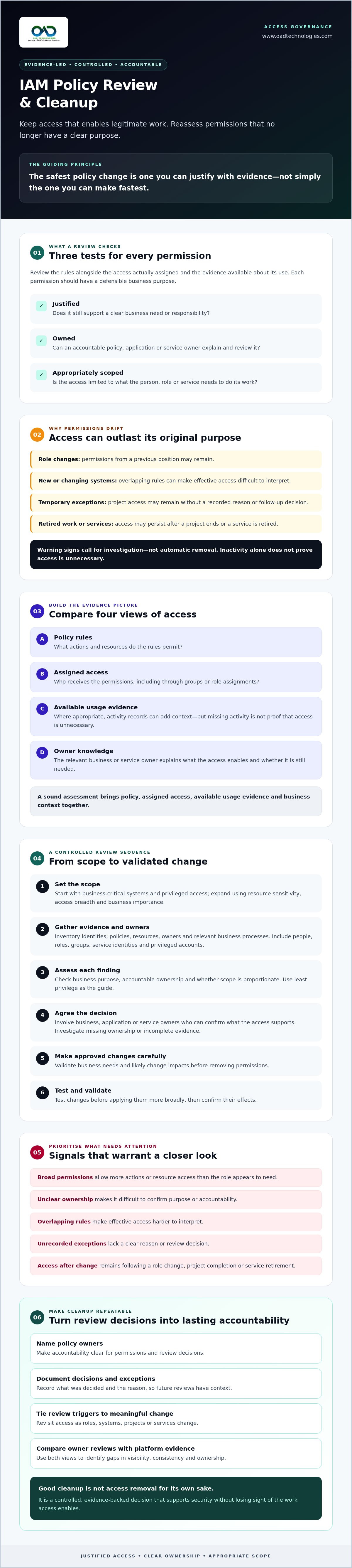
IAM policy review and cleanup is the process of checking whether access permissions remain justified by business needs, assigned to an accountable owner and limited to an appropriate scope. The aim is not to remove access indiscriminately. It is to ensure that each person, role or service identity can do the work it is responsible for, without carrying permissions that no longer have a clear purpose.
That distinction matters as organisations evolve. A role change can leave someone with permissions from a previous position. A new system may introduce overlapping access rules, while a temporary exception granted for a project may never be revisited. Over time, policy wording and actual access can drift apart, making it harder to understand who can reach sensitive resources and why.
Policy review is one part of Identity and Access Management (IAM), but it has a different focus from related processes. Identity lifecycle management governs changes to an identity as someone joins, changes roles or leaves. Authentication verifies that an identity is genuine, while provisioning grants or updates access. A policy review examines whether the resulting permissions remain appropriate and supported by a business need.
What counts as an IAM policy review?
A policy sets rules about which identities can perform which actions on which resources. A review considers the policy alongside the permissions actually assigned and available evidence of how access is used. Its scope may include users, roles, groups, service identities such as application accounts, and privileged access that enables sensitive or administrative actions.
Looking only at policy text can miss permissions inherited through group membership or role assignment. Usage evidence adds context, but it cannot replace an owner’s understanding of business processes. A sound assessment brings these views together: what the rules allow, who receives that access, and whether a responsible owner can explain its purpose.
Which warning signs justify a closer review?
Look for broad permissions that allow more actions or resource access than a role appears to need. Other signals include unclear ownership, overlapping rules that make effective access difficult to interpret, and exceptions without a recorded reason or review decision. Access retained after a role change, project completion or service retirement also warrants investigation.
These signals prompt questions, not automatic removals. Inactivity alone does not prove that access is unnecessary: a permission may support a periodic task, recovery process or rarely used but important responsibility. Confirm its purpose with the relevant owner and consider operational impact before changing it. This evidence-led approach makes iam policy review and cleanup a governance decision, not simply a technical exercise.
How to Conduct an IAM Policy Review: A Controlled, Step-by-Step Process
A controlled review follows a clear sequence: define the scope, gather policy and ownership evidence, assess permissions, agree decisions, make approved changes and validate their effects. Keep the sequence consistent, while tailoring the depth of review to each system’s business importance and access risk.
Begin with business-critical systems and privileged access, where excessive permissions may carry greater operational consequences. Expand the review using documented criteria such as resource sensitivity, breadth of access and importance of the supported business process. Assign an accountable policy owner, then involve application or service owners who can confirm what the access enables.
Set scope and gather access evidence
Build an inventory of identity types, policies, resources, owners and relevant business processes. Include people, roles, groups, service identities and privileged accounts. Compare what policy rules permit with the access identities actually receive, including access inherited through groups or roles. Where appropriate, consult available activity records for context, but do not treat a lack of recorded activity as proof that access is unnecessary.
Flag missing ownership or incomplete evidence for investigation. Do not assume that permissions are safe to remove simply because information is missing. When auditing accounts across cloud suites, this inventory step also provides an opportunity to identify dormant user profiles; organisations looking to address access sprawl while optimising software costs can use LicenseIQ to detect inactive accounts and recover wasted Microsoft 365 spend.
For each finding, ask whether the permission has a clear business purpose, an accountable owner and a scope proportionate to that purpose. Use the principle of least privilege as a guide: provide only the access needed for the role or service to perform its defined function.
Classify decisions so teams can act consistently:
- Retain: the owner confirms a current need and appropriate scope.
- Reduce or remove: evidence and owner review support a narrower permission or its removal.
- Investigate: purpose, ownership or access evidence is incomplete.
- Approve as an exception: a justified need requires broader access, with the rationale and accountable approver recorded.
For every material change, record the policy and identity in scope, evidence reviewed, decision, approver, any exception rationale and how the change will be validated. Apply approved changes in a controlled sequence, then check that relevant users and services can still complete required tasks. Record unexpected effects and refer them to the appropriate owner before extending the change.
This evidence-led process connects iam policy review and cleanup with identity governance and privileged access, rather than treating it as an isolated technical task. Organisations assessing how to structure that work can explore OAD Technologies’ identity governance and privileged access services as a potential strategic discussion point.
How to Compare IAM Policy Review Methods and Prioritise Findings
Choose a review method that fits your organisation’s access landscape, ownership maturity and available evidence. Manual reviews can explain business context; technical analysis can reveal permission patterns at scale. Neither is sufficient alone if decisions are to be technically informed and accountable.
Which review approach suits your IAM environment?
- Manual, owner-led review: Application and service owners assess whether access supports current work. This approach captures context that technical records may not show, but it depends on owners being identifiable, informed and able to respond. Without clear guidance, teams may interpret review questions inconsistently.
- Platform-generated analysis: Available identity or cloud analysis can help surface broad permissions, overlaps or activity patterns across an environment. It can make technical findings easier to compare, but it cannot determine business purpose by itself. Its coverage and usefulness also depend on the completeness of available records.
- Combined, evidence-led review: Technical analysis highlights where to look; accountable owners confirm what access is needed and why. This balances visibility with business understanding, while still requiring clear ownership and a process for resolving missing or conflicting evidence.
Whichever method you choose, keep one distinction clear: policy activity is evidence for review, not proof that access is justified. A permission appearing in activity records does not establish that its scope is appropriate, while no recent activity does not prove that access has no valid purpose.
How should teams prioritise policy findings?
Use criteria suited to your organisation rather than applying a universal risk score or threshold. Consider the level of privilege, sensitivity of the resource, breadth of permitted actions, potential business impact if access is misused or removed, and confidence in the evidence. For example, broad administrative access to a business-critical system may merit earlier owner attention than a narrowly scoped permission for a lower-impact resource.
Separate confirmed excessive access from uncertain findings. Where the evidence and owner confirm that a permission exceeds a current need, teams can assess a reduction or removal. Where ownership, business purpose or activity records are unclear, prioritise investigation rather than treating uncertainty as a reason for immediate change.
Record why each finding received its priority, which evidence informed the decision and who is responsible for the next step. This makes iam policy review and cleanup easier to explain and repeat, while connecting individual decisions to wider identity governance. For a broader view of how identity decisions fit together, see this IAM strategic framework.
How to Clean Up IAM Policies Without Disrupting Legitimate Access
Removing permissions safely starts with confirming what they support. Before changing a policy, ask the relevant business, application or service owner to validate the access need and consider what could depend on it. A permission may support a user-facing task, an integration or an automated workload, even if its purpose is not obvious from the policy itself.
For iam policy review and cleanup, group proposed changes by system, owner and risk. This helps teams coordinate decisions, identify related dependencies and avoid applying a wide set of changes before understanding their combined effect. Treat higher-impact changes with particular care, and keep approved exceptions documented with an accountable owner, rationale and point for reassessment.
Validate proposed changes before implementation
Check the proposed change against business needs and dependencies. For example, a service identity may appear to have broad access, but an application owner can clarify whether a particular permission supports a scheduled integration. Confirm the expected outcome and identify who will verify it after the change.
Where the environment supports it, use an appropriate test or staged-change process before applying the change more broadly. A limited rollout can help reveal whether users, integrations or automated workloads are affected. If testing is not available, document the uncertainty and agree how the impact will be checked before proceeding.
Implement, monitor and document policy changes
Apply approved changes through the organisation’s authorised change process. Keep a record of the affected policy and system, the decision and approver, the validation plan, and the route to restore access if needed. Grouping changes by system or owner can make accountability clearer and help teams assess related edits together.
After implementation, monitor for access failures or unexpected operational effects and ask the relevant owner to confirm that required work continues. If validation identifies material disruption, follow the approved rollback route, investigate the cause and refine the change before trying again. A rollback plan does not replace testing; it gives the team a defined response if the change behaves differently than expected.
Keep exceptions visible rather than allowing them to become permanent by default. Record why broader access is needed, who approved it and when the organisation should revisit the rationale. This creates a clearer basis for future decisions while balancing least privilege with operational continuity.
If your organisation is considering a structured approach to access governance, the OAD Technologies meeting page provides a way to discuss your requirements.
How to Sustain IAM Policy Cleanup Through Identity Governance
A cleanup stays useful when teams treat it as an ongoing governance responsibility, not a one-off technical exercise. Assign clear roles: policy owners maintain context, business approvers confirm the need for access, and authorised technical teams implement approved changes. For each decision, retain the rationale and evidence so future reviewers can understand why a permission was kept, changed or approved as an exception.
Build ownership and review triggers into governance
Set review triggers around meaningful changes rather than relying on an arbitrary schedule. A person changing roles, a system being replaced, a new integration creating an access path, or an exception being granted can each prompt a targeted review. Define who raises the trigger, who assesses its impact and who approves any resulting change. This connects policy decisions with wider GRC governance alignment, without assuming that a review process alone fulfils a compliance requirement.
Keep exceptions visible, with a named owner, business rationale and agreed review point. Record unresolved evidence gaps and assign responsibility for resolving them. If ownership changes, transfer the decision history as well as the policy task; otherwise, permissions can become difficult to explain again.
Measure whether review decisions are being sustained
Give leaders a practical view of whether the process is working as intended. Useful indicators include which access areas have been reviewed, which findings remain unresolved, what exceptions are approved and whether planned changes have been completed. These measures support oversight and help direct attention to open decisions. They are not, by themselves, proof that risk has been reduced.
Review the information in context. For example, a high number of unresolved findings may reflect incomplete ownership data, a complex system dependency or a delay in business approval. Understanding the reason helps leaders decide whether to clarify responsibilities, gather better evidence or adjust the review’s scope. The aim is meaningful follow-through, not a score that obscures the decisions behind it.
For UAE enterprises, OAD Technologies’ identity governance, privileged access and Zero Trust services may be relevant when shaping a structured access governance approach. To explore how they relate to your organisation’s requirements, the meeting page offers a way to discuss them, or you can visit OAD Technologies.
Make Access Reviews Part of How Your Organisation Evolves
Effective iam policy review and cleanup is not about removing permissions as quickly as possible. It is about making decisions based on evidence, clear ownership and a sound understanding of business needs. A structured process helps teams identify access that may be excessive or outdated, prioritise findings and validate changes before they affect legitimate work.
Keep the practice sustainable by recording decisions and exceptions, assigning accountable owners, and using meaningful changes to trigger further review. Combine technical evidence with business context, and track unresolved questions and remediation so leaders can see where attention is needed. These habits connect day-to-day policy decisions with broader identity governance, privileged access and Zero Trust objectives.
For UAE organisations considering how to strengthen access governance, OAD Technologies offers identity governance, privileged access and Zero Trust services. Book a meeting to discuss your requirements, or visit OAD Technologies.
With clear accountability and careful validation, your review process can evolve alongside the systems and work it supports.
Frequently Asked Questions
What is an IAM policy review?
An IAM policy review checks whether access permissions remain justified, clearly owned and appropriately scoped. Policies define which identities can perform actions on which resources, but the review should also consider who actually receives those permissions and the business purpose they serve. It can include people, roles, groups, service identities and privileged access. The goal is justified access, not blanket permission removal.
How do you review and clean up IAM policies?
Start by defining the systems and identities in scope, then gather policy, ownership and access evidence. Assess each permission for purpose, owner and scope, and classify findings as retain, reduce, remove, investigate or approve as an exception. Apply agreed changes through an authorised process, test or stage them where practical, then validate their effects. Record decisions, approvals, exceptions and any follow-up needed.
How often should an organisation review IAM policies?
Set a review approach that reflects your systems, access risks and governance needs rather than relying on a universal interval. Also define event-based triggers: role changes, system updates, new integrations, completed projects or temporary exceptions can all prompt a focused review. Keep ownership clear so a trigger leads to an assessment, not just a reminder. Review coverage and open findings to decide where attention is needed next.
Can IAM policy cleanup disrupt users or business applications?
Yes. Removing a permission that supports a legitimate task can affect a user, integration or automated workload. Reduce that possibility by confirming the business need and checking dependencies with the relevant owner before implementation. Where the environment supports it, test or stage changes, monitor for unexpected effects and prepare an authorised rollback route. If evidence is incomplete, investigate before treating inactivity as a reason to remove access.
What should an IAM policy review checklist include?
A practical checklist should capture the identity and policy in scope, resources and actions permitted, assigned access, accountable owner and stated business purpose. It should also note relevant activity evidence, dependencies, findings, decision, approver and any exception rationale. For proposed changes, include the authorised implementation path, validation plan and rollback route. Add a status for unresolved evidence gaps so uncertainty stays visible and assigned.
How can teams identify excessive or unused permissions?
Compare what policies allow with the access assigned to identities, including permissions inherited through roles or groups. Review available activity records to spot patterns such as broad permissions with no observed use, then ask the business or service owner to confirm purpose and dependencies. Activity is evidence, not proof: infrequent access may support an essential periodic task. Treat uncertain cases as investigation findings, not automatic removal decisions.
Does IAM policy cleanup guarantee compliance?
No. Reviewing and narrowing access can support an organisation’s security and governance efforts, but cleanup alone does not guarantee compliance with any law, standard or contractual obligation. Requirements depend on the organisation, the data and the applicable framework, and access controls are only one part of a wider programme. Document decisions and consult appropriate compliance or legal specialists to assess obligations; do not treat a completed review as proof of compliance.
Disclaimer
Content by OAD Technologies is for general informational purposes only and does not constitute professional or cybersecurity advice. No warranties are made regarding accuracy or completeness; reliance is at your own risk. OAD Technologies shall not be liable for any direct or indirect losses arising from use of this content.