

A penetration test report isn’t a remediation plan. It becomes useful only when someone validates each finding, decides what matters to the business, and takes responsibility for closing it. If you’re asking how to action a penetration test report, start by treating it as a decision-making tool, not a list of technical defects to hand to an already busy team.
It’s understandable if that feels difficult. Severity scores don’t automatically show which weakness puts your services, data, or operations at greatest risk. Findings can also stall when ownership is unclear, evidence of a fix is inconsistent, or nobody confirms whether the issue is truly resolved.
This 2026 guide sets out a repeatable process to turn test results into an owned, prioritised remediation plan. You’ll learn how to validate findings, assess business context alongside severity, assign accountable owners and deadlines, document accepted residual risk, and arrange retesting to confirm that fixes work. It also explains how to connect remediation records to security governance, so lessons from one assessment inform the next. With a structured approach, your organisation can move from report delivery to measurable, verifiable action.
Key Takeaways
- Learn how to action a penetration test report by converting each relevant finding into a trackable remediation action.
- Look beyond severity scores to assess exposure, potential business impact and existing controls.
- Use a consistent prioritisation approach to decide what needs urgent escalation, planned remediation or documented risk acceptance.
- Define the owner, target date and evidence required for each action, then validate the fix before closing it.
- Bring open and resolved findings into ongoing security governance, using recurring themes to inform future planning.
How to action a penetration test report: start with validation and ownership
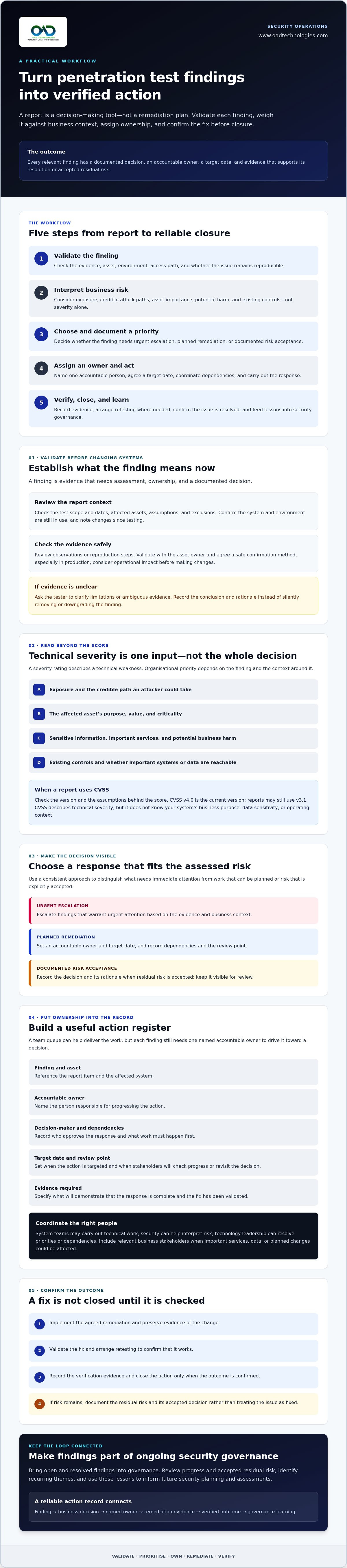
To action a penetration test report, turn each finding into a validated, owned action before changing systems. Start by checking the report’s scope, test dates, affected assets, assumptions and exclusions. Confirm that the system and environment described are still in use, and note any changes made since testing. This intake step helps teams distinguish a current, actionable exposure from an issue tied to an outdated asset or a condition that no longer applies.
A penetration test uses authorised testing to assess how systems may be exposed to attack. Its findings need context before teams act. “A penetration test finding is evidence that requires assessment, ownership and a documented decision.”
What to check before acting on a finding
For each item, confirm the affected system, environment and access path, then review the supporting evidence, such as relevant observations or reproduction steps. Check whether the issue remains reproducible and whether configuration, software, access or other conditions have changed since the test. A change in circumstances doesn’t automatically invalidate a finding, but it should inform the decision.
Validate with the relevant asset owner before making changes, especially in production. Agree on a safe way to confirm the issue and assess potential operational impact. If the evidence is ambiguous, or the report notes limitations that affect interpretation, ask the tester to clarify before assigning remediation. Record the conclusion and its rationale rather than silently removing or downgrading the finding.
Who should own report actions?
Assign one named accountable owner to each finding. A team queue can support delivery, but it doesn’t make clear who is responsible for driving the action to a decision. The owner may coordinate technical work with system teams, while security helps interpret risk and technology leadership resolves priorities or dependencies.
Include relevant business stakeholders when a finding could affect important services, data or planned changes. Capture these details in an action register:
- Finding and asset: a reference to the report item and the affected system.
- Accountable owner: the named person responsible for progressing the action.
- Decision-maker and dependencies: who approves the response and what other work must happen first.
- Review point: when stakeholders will check progress or revisit the decision.
This creates a clear hand-off from assessment to action. It also gives teams a reliable starting point for prioritising findings and tracking remediation in the next stages of the process.
How to interpret penetration test findings beyond severity scores
A severity rating helps describe a technical weakness, but it doesn’t decide what your organisation should address first. To make that decision, combine the report’s rating with how an attacker could exploit the issue, what the affected system supports and what harm could follow. A technical severity rating describes a finding; an organisation-specific risk decision weighs that finding against business context and existing controls.
For example, an issue on an internet-facing service that handles sensitive information may warrant faster attention than a similarly rated issue on an isolated test system. But exposure alone doesn’t settle the question: consider the credible attack path, the value and criticality of the asset, and whether an attacker could reach important systems or data from it.
What severity scores can and cannot tell you
If a report uses the Common Vulnerability Scoring System (CVSS), check which version it applies and what assumptions underpin the score. CVSS v4.0 is the current version, although reports may still use v3.1. A CVSS score communicates technical severity through defined metrics; it doesn’t know your system’s business purpose, data sensitivity or operating context, so it shouldn’t determine priority by itself.
Review the score alongside the tester’s evidence and explanation. Don’t present a score as independently verified, or alter it, unless you have supporting analysis. NIST's technical guide describes a structured approach to security testing, including reporting. That structure reinforces the value of interpreting findings in light of the test method and evidence, not just a number.
Translate technical impact into business context
Build a practical picture of each finding. Clarify the terms in plain language:
- Exploitability: how realistically an attacker could use the weakness, considering required access and conditions.
- Impact: what could happen if it were exploited, such as service disruption or unauthorised access.
- Exposure: how reachable the affected asset is, including whether it is accessible from the internet.
- Affected data: what information the system stores, processes or could expose.
- Compensating controls: safeguards that may reduce likelihood or impact, while not necessarily removing the underlying weakness.
Identify the affected service, its operational dependencies, the information involved and its accountable business owner. Then assess whether existing controls meaningfully limit access or impact, and record their scope and limitations. A control may reduce exposure without eliminating risk.
Finally, connect related findings. A lower-rated weakness could become more consequential if it provides a stepping stone to a sensitive system. This context helps teams make a defensible, organisation-specific decision as they work out how to action a penetration test report. If you’d like to discuss assessment requirements or report interpretation, OAD Technologies’ VAPT services may be relevant.
How to prioritise penetration test findings when teams cannot fix everything at once
When remediation capacity is limited, rank findings by the risk they pose in your environment, not severity alone. Compare the technical rating with exploitability, internet exposure, asset criticality, credible business impact and dependencies between fixes. Use the same criteria for each item and record why an action is urgent, scheduled or deferred. The organisation’s risk governance should set remediation timeframes; avoid applying arbitrary deadlines that don’t reflect your policies or context.
Build a defensible prioritisation matrix
Make the method transparent. Define how stakeholders will consider exposure, likely attack paths, affected services and data, business impact, and compensating controls. A lower-scored issue may still need prompt attention if it affects an externally accessible service that supports a critical business process. Conversely, a higher technical rating may require a different response if the asset is isolated and safeguards meaningfully limit the threat. Document these factors rather than silently changing the reported severity.
Use a decision matrix to guide discussion, not as an automatic substitute for judgement:
Immediate escalation: Findings with a credible path to serious business impact, high exposure or a critical asset. Notify the appropriate security and business stakeholders, agree on the next action and set a timeframe through the organisation’s risk process.
Planned remediation: Findings that warrant correction but depend on prioritised engineering work, release planning or other changes. Assign an owner, record dependencies and agree a review point.
Documented risk acceptance: Findings where an authorised risk owner decides to accept the remaining risk. Record the rationale, scope, existing controls, approval and review point. Acceptance is a decision to manage risk, not evidence that the weakness has been fixed.
Handle findings that depend on other work
Several findings may share a root cause, such as a common configuration or a component used across multiple systems. Group them for planning so teams can address the underlying issue efficiently, but retain a record and accountable owner for each affected finding. This keeps the scope and status of individual actions visible.
Record technical dependencies, required change windows and any interim controls alongside the action. If teams disagree about priority or whether to defer a fix, escalate the issue to an authorised risk owner. Capture the decision, supporting rationale, approver and date for review in the action register.
This approach makes prioritisation explainable to technical teams and business stakeholders. It also gives the organisation a consistent basis for deciding how to action a penetration test report when competing risks and delivery constraints require deliberate trade-offs.
How to remediate findings, verify fixes, and close actions
A change being deployed doesn’t prove that a finding has been resolved. Define the remediation action, accountable owner, target date, dependencies and verification evidence before work begins. This gives technical teams a clear outcome to deliver and gives reviewers a consistent basis for deciding whether the action is complete.
“An action is ready to close only when evidence shows that the agreed risk treatment has been implemented and checked.” If the chosen response is risk acceptance rather than a fix, record the approval and review point instead of marking the vulnerability as remediated.
Create remediation actions that can be tracked
Translate each recommendation into a specific change or risk-treatment decision. For example, replace “improve access controls” with a defined change to the affected system, plus a way to confirm the change took effect. Add the action’s status, owner, target date, dependencies, approval and evidence location to the register. Link it to the organisation’s existing change and risk processes so implementation, review and accountability remain connected.
Set target dates through your risk governance rather than applying a universal deadline. If a fix depends on another team, a release or a change window, record that dependency and agree how progress will be reviewed. Where a change cannot fully address the finding, note the remaining exposure and the decision-maker responsible for the next step.
Define evidence and retesting before closure
Agree in advance what evidence will demonstrate that the reported condition has been addressed. Depending on the finding, this might include a relevant configuration record, change approval or test result. Evidence should relate to the affected asset and the action taken, not simply show that a deployment or ticket was completed.
Use retesting when it’s an appropriate way to confirm the original issue no longer reproduces. Record the systems, conditions and checks included, as well as anything excluded or not tested. Verification has limits: a fix may address one path without resolving related weaknesses. If the result is inconclusive or remediation is partial, keep the finding open or record it as partially addressed, and make residual risk visible with an owner and review point.
To support how to action a penetration test report from remediation through verification, maintain a clear link between the original finding, the approved treatment and its evidence. Organisations considering their assessment requirements can discuss VAPT with OAD Technologies.
Make penetration test report actions part of ongoing security governance
A penetration test should inform security decisions beyond the immediate remediation queue. Schedule reviews with accountable stakeholders to track open, overdue, accepted and verified findings. Look for blockers that need leadership attention, confirm whether accepted risks still reflect the organisation’s circumstances, and distinguish verified fixes from actions that remain in progress.
Report findings to executives in decision-ready terms
Executives need a clear view of material risks, accountable owners, remediation status and decisions requiring their input. Summarise what could affect important services or information, what response is underway, and where a trade-off or escalation is needed. Keep the categories distinct: a verified remediation has evidence, an open action still needs work, and accepted residual risk has an authorised decision behind it.
Avoid treating a completed assessment as proof of overall security or regulatory status. A test provides evidence about its agreed scope and conditions, not every system or threat. For organisations in the UAE, check applicable requirements against authoritative regulatory sources and consult qualified advisers where interpretation is needed. Don’t assume that completing a penetration test or closing its findings automatically fulfils an obligation.
Connect findings to a wider security programme
Recurring findings can point to issues that deserve broader attention. For example, similar weaknesses across multiple systems may prompt a review of relevant controls, technical planning or future assessment scope. Use those patterns to guide discussion, while recognising that one test is a time-bound view of selected assets and doesn’t provide complete assurance.
To connect remediation with a repeatable assessment process, readers can explore a vulnerability assessment and penetration testing guide and a governance, risk and compliance framework. These topics can help teams place testing and follow-up within wider security governance; confirm that any guidance reflects your organisation’s requirements and context.
Consistent reviews turn report actions into a governance input: leaders can see what remains unresolved, who owns decisions and what themes merit attention in future planning. For an educational discussion about assessment requirements, contact OAD Technologies about VAPT. This can help clarify the scope of a potential engagement without implying a guaranteed security outcome or compliance result.
Turn test findings into lasting security progress
Knowing how to action a penetration test report means making its findings part of a repeatable process, not treating them as a one-off checklist. Validate evidence and ownership, weigh technical severity against business risk, then prioritise actions according to your organisation’s context and risk governance.
Keep each action open until the agreed treatment has been verified, and make accepted residual risk visible to the people authorised to review it. Regular governance reviews can help teams spot recurring weaknesses and use them to inform future security planning. A penetration test offers valuable insight into its agreed scope, but it isn’t a complete measure of security on its own.
OAD Technologies offers Vulnerability Assessment and Penetration Testing (VAPT) and Governance, Risk, and Compliance services. If you’re considering an assessment or need to discuss your requirements, learn about OAD Technologies’ cybersecurity services. A clear, owned process can help your organisation turn test results into accountable decisions and steady security progress.
Frequently Asked Questions
What should I do first after receiving a penetration test report?
First, review the report’s scope, test dates, affected assets, assumptions and exclusions. Then validate each finding with the relevant asset owner, clarify ambiguous evidence with the tester, and assign a named accountable owner to every action. To understand how to action a penetration test report, create a tracker that captures each finding, its current status and the next decision or remediation step. Avoid changing production systems before assessing the finding and potential operational impact.
How do I prioritise findings in a penetration test report?
Prioritise findings by combining technical severity with exploitability, exposure, asset criticality, affected data and potential business impact. Consider credible attack paths and whether existing controls reduce risk, while noting their limits. A lower-rated issue affecting an internet-accessible service that supports an important business process may deserve earlier attention than its score suggests. Apply consistent criteria, document the reasons for your choices, and set timeframes through your organisation’s risk governance.
Does a critical penetration test finding always need to be fixed first?
Not automatically, but a critical finding needs prompt assessment and appropriate escalation. Its position in the remediation queue depends on the evidence, how accessible and exploitable the affected system is, the potential business impact, and any relevant controls or dependencies. Compare it with other findings using a consistent risk-based method. If you defer remediation or accept residual risk, document the rationale, approval, accountable risk owner and review point.
How do you know whether a penetration test finding is fixed?
A finding is ready to close when evidence shows that the agreed treatment has been implemented and checked. Depending on the issue, verification may involve retesting the affected asset or reviewing relevant configuration and change evidence. Record what was tested, the result and any limitations. A completed deployment ticket alone doesn’t demonstrate that the weakness is resolved. If the fix is partial or verification is inconclusive, keep residual risk visible and the action open or marked accordingly.
Should every penetration test finding be retested?
No. Choose verification that’s proportionate to the finding, the proposed fix and the potential consequences if the issue remains. Retesting can help confirm whether the original condition still reproduces, while other evidence may be suitable for a limited change. Record the systems and conditions checked, plus anything excluded. If the evidence can’t confirm the fix, don’t treat the finding as verified; document the limitation and decide on further testing or risk treatment.
What should a penetration test remediation tracker include?
Include a finding reference, affected asset, risk decision, specific remediation action, named accountable owner, status and target date. Also record dependencies, the authorised decision-maker, evidence location, verification outcome and review point. For accepted risk, capture the approval and rationale rather than presenting the issue as fixed. Link related items where useful, but preserve an individual status and owner for each finding so shared work doesn’t obscure what remains unresolved.
Can a penetration test report prove that our organisation is compliant?
No. A penetration test report provides evidence about the systems and conditions included in its agreed scope. It doesn’t, by itself, demonstrate that an organisation meets every applicable regulatory or control requirement. In the UAE, identify which obligations apply to your organisation and verify them with authoritative sources and qualified advisers. Use test results as one input to your wider risk and compliance work, and avoid treating a completed assessment as proof of compliance.
Disclaimer
Content by OAD Technologies is for general informational purposes only and does not constitute professional or cybersecurity advice. No warranties are made regarding accuracy or completeness; reliance is at your own risk. OAD Technologies shall not be liable for any direct or indirect losses arising from use of this content.