

What if the biggest weakness in your security audit isn’t a missing tool, but a missing connection between business risk and control evidence? An enterprise cybersecurity audit checklist should help you identify which services and information matter most, what evidence shows that controls are working, and where gaps could affect operations.
It can be difficult to know where an audit should begin. Enterprise environments span cloud services, endpoints, identities, networks, suppliers and sensitive data. A long list of technical findings can be just as difficult to translate into business priorities. Owning a security product, on its own, does not prove that a control is effective.
This guide provides a practical way to set a proportionate scope, gather relevant evidence and assess whether controls work as intended. It explains how to connect findings to business impact, prioritise remediation, assign accountable owners and decide when specialist support may be appropriate. The goal is to make the audit more than a compliance exercise: a structured process for strengthening resilience and making informed security decisions.
Key Takeaways
- Use an enterprise cybersecurity audit checklist to focus the review on business-critical services, sensitive information and relevant security controls.
- For each control, record its owner, purpose, evidence source, exceptions and review date. Tool ownership is not proof of effectiveness.
- Compare documented evidence with how controls operate, then record gaps alongside their business impact and accountable owners.
- Prioritise validated findings by considering likelihood, impact, exposure, existing safeguards and business dependencies.
- Decide whether internal expertise, independent VAPT, GRC advice or managed security support best fits the gaps you identify.
What an enterprise cybersecurity audit checklist should establish
Start with critical services, sensitive data and material risks. An enterprise cybersecurity audit checklist helps leaders examine whether relevant controls are appropriately designed, supported by evidence and operating as intended. It should also help clarify which improvements deserve attention first.
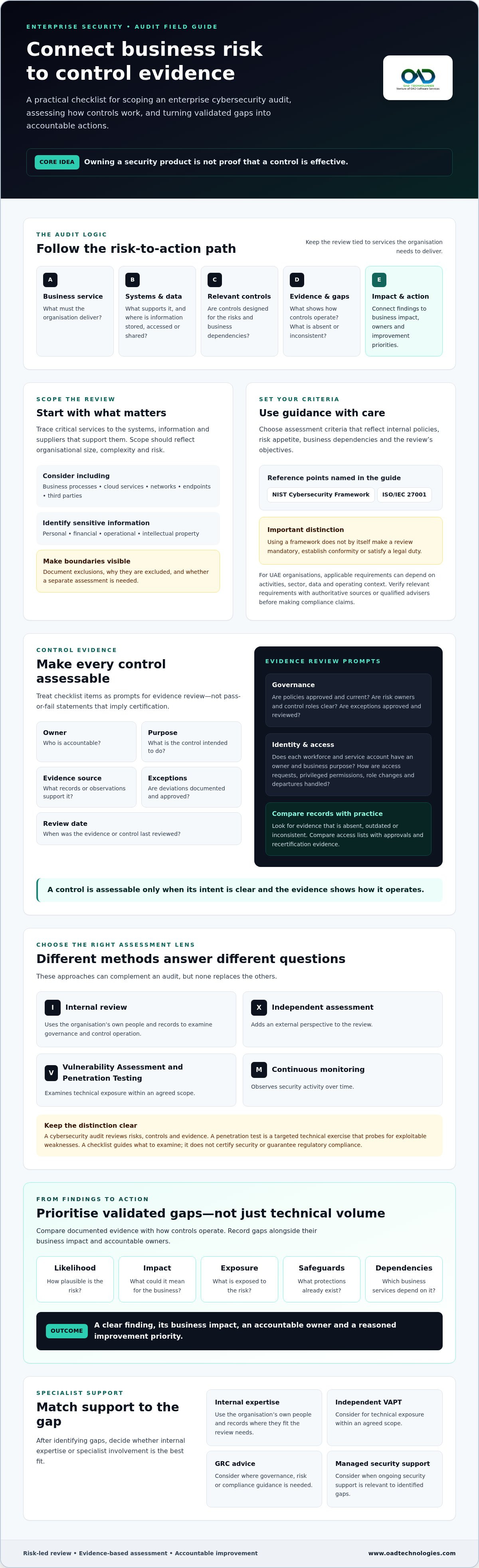
A cybersecurity audit is a structured review of an organisation’s security risks, controls and evidence. It identifies gaps and improvement priorities. A penetration test is a targeted technical exercise that probes for exploitable weaknesses. The distinction matters: a checklist guides what to examine, but it does not certify security or guarantee regulatory compliance. For a high-level overview of audit objectives and types, see Information security audit.
Different assessment methods answer different questions. An internal review uses the organisation’s own people and records to examine governance and control operation. An independent assessment adds an external perspective. Vulnerability Assessment and Penetration Testing (VAPT) examines technical exposure within an agreed scope, while continuous monitoring observes security activity over time. These approaches can complement an audit, but none replaces the others.
Set scope around critical business services and information
Begin with the services the organisation needs to deliver, then trace the systems and information that support them. Depending on the organisation’s size, complexity and risk, scope may include business processes, cloud services, networks, endpoints and third parties. Identify sensitive information such as personal, financial, operational and intellectual-property data, then record where it is stored, accessed and shared.
Document exclusions rather than leaving them implicit. For each system or supplier outside the review, state why it is excluded and whether a separate assessment is needed. This makes the limits of the findings clear and helps prevent a narrow review from being mistaken for coverage of the whole organisation.
Choose assessment criteria without confusing guidance with compliance
Set criteria that reflect internal policies, risk appetite, business dependencies and the review’s objectives. The NIST Cybersecurity Framework and ISO/IEC 27001 can provide useful reference points for structuring questions. Using them does not, by itself, make a review mandatory, establish conformity or satisfy a legal duty.
For organisations in the UAE, applicable requirements can depend on activities, sector, data and operating context. Confirm relevant federal, sector-specific, emirate-level or free-zone requirements with authoritative sources or qualified advisers before making compliance claims. Record the criteria you select and why they fit the scope. This gives reviewers a clear basis for assessing evidence and helps leaders distinguish a control gap from a compliance conclusion.
The enterprise cybersecurity audit checklist: governance, identity and data
Use checklist items as questions that prompt an evidence review, not as pass-or-fail statements that imply certification. For each control, record its owner, intended purpose, evidence source, exceptions and review date. A control is assessable only when its intent is clear and the evidence shows how it operates.
Start with governance questions. Is the relevant security policy approved and current? Who owns each material risk, and do the people responsible for security controls understand their roles? How are security expectations communicated to staff? Are policy exceptions documented, approved by an accountable person and reviewed? Evidence may include approved policies, risk registers, role descriptions, awareness records and exception logs. Compare the records with actual practice, noting evidence that is absent, outdated or inconsistent.
Review identity, privileged access and account lifecycle
Check whether each workforce and service account has a named owner and documented business purpose. Review how access is requested and approved, how privileged permissions are restricted, and whether role changes or departures trigger access updates. Compare access lists with approval records and recertification evidence to see whether the process works in practice. Include accounts that are not tied to an individual employee. For a broader model of access governance, consult this identity and access management framework.
Trace sensitive data through its lifecycle
Follow selected data types from creation through storage, use, sharing, processing and disposal. Ask how the organisation classifies personal, financial, operational or intellectual-property information, limits access, applies retention rules and controls transfers. Check whether staff know how to escalate suspected loss or unauthorised disclosure, then examine the relevant procedures and records. A finding may indicate a need to review a data loss prevention strategy, but DLP alone does not address every risk. Ownership, access decisions and handling practices still matter.
Keep conclusions tied to evidence and business accountability. The ISACA Cybersecurity Audit Program provides a reference for structuring audit work around NIST Cybersecurity Framework 2.0. Organisations can adapt relevant guidance to their own scope and criteria rather than treating a framework as proof of compliance. If your review identifies gaps in access governance or data handling, discuss your cybersecurity requirements with OAD Technologies.
How to assess technical controls and compare evidence with risk
Use the enterprise cybersecurity audit checklist to test whether each technical control meets its objective in practice, not just whether a product has been installed. Compare documented evidence with observed operation, exceptions and residual risk. The presence of a tool alone does not demonstrate effective risk reduction.
A useful record connects technical evidence to a decision: what is exposed, which business service could be affected, and who can address the gap? Adapt a table like this for the controls in scope:
| Checklist question | Evidence | Gap | Business impact | Accountable owner |
|---|---|---|---|---|
| Are in-scope endpoints covered and monitored? | Asset inventory, configuration records, alert and exception logs | Devices missing coverage or unresolved exceptions | Potential exposure of systems supporting a critical service | Named control owner |
| Are cloud changes and external access governed? | Configuration reviews, access records, change approvals | Unowned settings or undocumented changes | Risk to data or service availability | Cloud service owner |
For each finding, distinguish a design weakness from a coverage or operating issue. A control may be configured correctly but leave important assets out of scope, generate alerts that are not reviewed, or rely on an untested procedure. Record the evidence period and its limitations so decision-makers can judge how much confidence to place in the conclusion.
Check endpoint, network, email and cloud control evidence
Review endpoint protection coverage, configuration governance, alert handling and approved exceptions. For networks, examine segmentation and external exposure against the intended design. Check email protections and cloud configuration ownership, including who approves changes and reviews deviations. If APIs are in scope, look for an inventory, access restrictions, relevant logging and oversight of changes. Link each issue to the systems and business processes it could affect.
Review vulnerability, monitoring and recovery evidence
Trace vulnerabilities from identification through risk-based prioritisation, remediation ownership and any documented exception. For monitoring, review detection and escalation procedures, investigation records and lessons learned. A dashboard or service label alone does not show response capability. Check what is monitored, who handles alerts and how responsibilities are documented.
Assess whether backups cover relevant systems and data, how their protection is governed, and whether recovery tests provide evidence that restoration procedures work. If technical testing would add value, agree the permitted scope and potential operational impact in advance, and use qualified assessors. VAPT guidance can help clarify when vulnerability assessment or penetration testing fits the review.
Turn cybersecurity audit findings into a prioritised action plan
An audit finding only drives improvement when it leads to a clear decision. Validate each gap, then record the supporting evidence, affected assets or services, business impact, accountable owner and proposed next action. Findings become useful when an owner and next action are recorded.
Use the enterprise cybersecurity audit checklist to support consistent reporting, not to impose an arbitrary score. Consider the likelihood of the issue, its potential impact, the assets’ exposure, safeguards already in place and dependencies between business services. Note uncertainty, evidence limitations and compensating controls. This helps leaders distinguish confirmed weaknesses from areas that need further investigation.
Prioritise findings in business language
Translate technical conditions into consequences decision-makers can evaluate. Explain which service could be disrupted, what information might be exposed, or how a dependency could affect operations or reputation. Separate immediate risk treatment from longer-term capability improvements. If residual risk is accepted, document the decision-maker and rationale. If the proposed treatment or acceptance exceeds management’s risk tolerance, escalate it through the organisation’s governance process rather than leaving the decision with a technical team alone.
Keep remediation moving through a closed loop: assign the action, implement the change, retain evidence, validate that the control now works and update the relevant risk record. A closed item should show what changed and how it was checked, not simply that work was reported as complete.
Select an appropriate next assessment or service
Match support to the gap. Scoped Vulnerability Assessment and Penetration Testing (VAPT) can help examine technical weaknesses, but it is not a complete cybersecurity audit. Governance, Risk, and Compliance (GRC) support may suit gaps in governance or risk processes. If findings point to monitoring or response needs, consider whether Managed Detection and Response (MDR) or Security Information and Event Management (SIEM) aligns with the organisation’s objectives and responsibilities.
Guidance on managed detection and response can help frame what to assess. Agree the scope, expected outputs and ownership before engaging a specialist, and keep the audit’s broader findings in view.
OAD Technologies provides VAPT and GRC services, as well as MDR and SIEM. Discuss your audit findings and support requirements with OAD Technologies to consider a suitable next step.
Cybersecurity Specialist Involvement and Initial Steps
Not every audit needs the same level of external support. Internal teams may be well placed to review policies, ownership and evidence when they have the right expertise and independence. An independent assessment can add a fresh perspective, while VAPT suits agreed technical testing. GRC advice may help address gaps in oversight or risk processes. Managed security support may be relevant when findings point to ongoing monitoring needs.
Use the enterprise cybersecurity audit checklist to define what you need help with, rather than assuming one provider or assessment will address every finding. Before work begins, agree the scope, objectives, permitted testing, evidence handling, reporting arrangements and responsibilities. Ensure the people accountable for affected systems understand what will be reviewed and how issues will be raised.
Questions to ask before commissioning an assessment
Set clear boundaries before sharing access or evidence. Confirm which systems and data are in scope, what is excluded and who approves those decisions. Agree the deliverables, evidence access and confidentiality arrangements, as well as the responsibilities of internal stakeholders and the assessor. Specify who will receive the report and how findings will be prioritised, validated and handed over for remediation decisions. For technical testing, clarify what activity is permitted and how potential operational impacts will be managed.
Match the next step to the gap identified
Choose support according to the finding. VAPT can assess defined technical weaknesses, but it does not replace a whole-organisation audit. GRC may suit governance or risk-process gaps. If the issue involves sensitive-data handling, discuss whether Data Loss Prevention (DLP) is relevant alongside access, classification and handling practices. Where findings concern detection and response, consider MDR or SIEM in light of your objectives, existing capabilities and responsibilities.
OAD Technologies offers VAPT, GRC, DLP, MDR and SIEM as potential next steps. Any service arrangement, including a Fully Managed, Defined Scope option where relevant, should align with agreed requirements, boundaries and responsibilities. These services can address specific needs, but do not guarantee audit outcomes or establish compliance by themselves.
To discuss which next step may fit your findings, Discuss your requirements or Book a meeting with OAD Technologies.
Make your next security decision evidence-led
A useful enterprise cybersecurity audit checklist connects critical services and sensitive data to control evidence, business impact and accountable owners. The aim is not to complete a checklist for its own sake. It is to establish where controls need attention, which risks should be addressed first and how remediation will be validated.
Keep the review proportionate to your organisation’s services and risk. Clear scope, evidence-based findings and owned next steps help turn technical observations into decisions leaders can act on. Where specialist input is needed, match it to the gap. OAD Technologies offers VAPT for technical assessment and GRC for governance and risk discussions, alongside Data Loss Prevention, SIEM and Managed Detection and Response. These are potential areas of support, not substitutes for a scoped audit or guarantees of compliance.
Whether you are refining an internal review or considering independent support, start with the questions and evidence that matter to your business. Discuss your requirements with OAD Technologies or Book a meeting to discuss a suitably scoped cybersecurity review.
Frequently Asked Questions
What should an enterprise cybersecurity audit checklist include?
An enterprise cybersecurity audit checklist should cover business-critical services, sensitive information, key risks and the controls intended to address them. Include governance, identity and access, data handling, endpoints, networks, email, cloud services, vulnerability management, monitoring and recovery where relevant to the scope. For each control, note its owner, purpose, evidence source, exceptions and review date. Use the findings to identify business impacts and practical improvement priorities.
How is a cybersecurity audit different from a vulnerability assessment or penetration test?
A cybersecurity audit reviews risks, controls, governance and evidence across an agreed scope. A vulnerability assessment identifies technical weaknesses, while a penetration test attempts to exploit weaknesses within permitted boundaries to evaluate exposure. These activities can provide useful technical evidence, but they do not assess every governance or operational control. Agree testing scope and permissions beforehand, and treat technical testing as one possible part of a broader review, not a replacement for it.
How often should an organisation review its cybersecurity controls?
Set review frequency according to risk, operational change and applicable obligations rather than relying on a universal interval. Revisit relevant controls after significant changes to systems, suppliers, data use or business services, and after incidents or material findings. A planned review cycle can help maintain oversight between changes. For organisations in the UAE, check applicable sector or regulatory expectations with authoritative sources, as requirements may differ according to activities and operating context.
Can a cybersecurity audit confirm that an organisation is compliant?
An audit can assess controls against defined criteria and gather evidence relevant to compliance, but a checklist or general security review cannot guarantee compliance. Conclusions depend on scope, evidence quality, the requirements being assessed and who is authorised to make the determination. Identify the laws, regulations or contractual obligations that apply, and verify them with authoritative sources or qualified advisers. A security service or assessment should not be treated as automatic proof of compliance.
What evidence should we prepare before a cybersecurity audit?
Prepare records that show both control design and operation. Useful examples include system and supplier inventories, data-flow information, approved policies, risk records, access approvals and reviews, configuration evidence, vulnerability records, incident procedures and relevant monitoring logs. Include backup and recovery-test records, documented exceptions and previous findings where they relate to the scope. Agree secure evidence-sharing arrangements with the assessor, and avoid providing information beyond what the review requires.
Is a cybersecurity audit checklist suitable for small and medium-sized businesses?
Yes. A checklist can be scaled to an organisation’s critical services, sensitive data, dependencies and risk rather than applied as an enterprise-sized template. A smaller organisation might begin with essential systems, access controls, data handling, incident processes and recovery evidence, then expand the scope as needs change. The aim is to make responsibilities and gaps visible, not to create unnecessary paperwork or suggest that checklist completion alone demonstrates security.
What should happen after an audit identifies security gaps?
Validate each finding, document its evidence and business impact, and assign an accountable owner and next action. Prioritise using factors such as likelihood, exposure, existing safeguards and dependencies. Track remediation through implementation, evidence retention and validation, updating the risk record when the control changes. Record accepted residual risk through the organisation’s governance process. If specialist support is appropriate, consider scoped VAPT, GRC, Data Loss Prevention, SIEM or Managed Detection and Response according to the gap.
Disclaimer
Content by OAD Technologies is for general informational purposes only and does not constitute professional or cybersecurity advice. No warranties are made regarding accuracy or completeness; reliance is at your own risk. OAD Technologies shall not be liable for any direct or indirect losses arising from use of this content.