

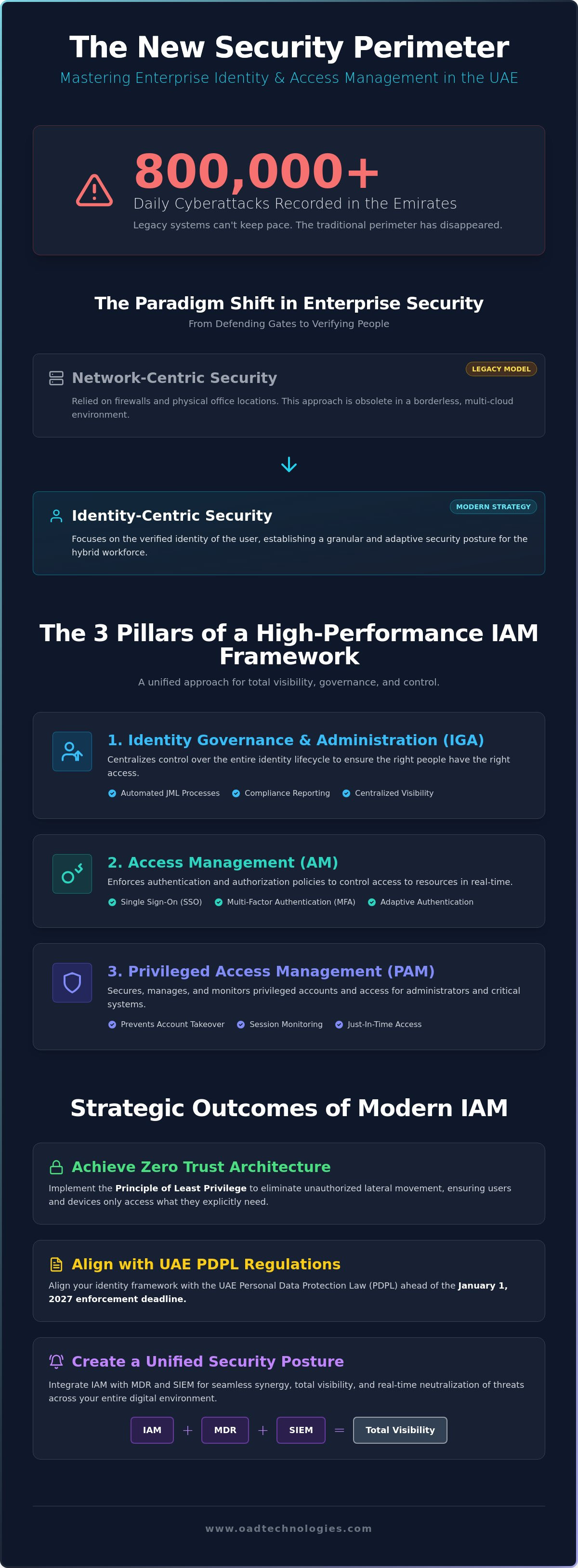
With more than 800,000 daily cyberattacks recorded across the Emirates in early 2026, your traditional perimeter hasn't just weakened; it's effectively disappeared. Implementing the most resilient IAM solutions in the Emirates offers is no longer a simple IT task. It's a strategic necessity to prevent privileged account takeovers and manage the sprawl of a hybrid workforce. You've likely realized that legacy systems can't keep pace with the UAE's shift toward active defense and the rigorous enforcement of the Personal Data Protection Law (PDPL).
We understand that managing identity lifecycles across multi-cloud environments feels like a constant battle against complexity and regulatory pressure. This guide will help you master enterprise identity governance to secure your digital assets and ensure your organization meets the January 1, 2027, compliance deadline. We'll examine how to achieve centralized visibility of all user identities, automate your compliance reporting, and integrate these systems with your existing MDR and SIEM stacks for a unified security posture.
Key Takeaways
- Learn why identity has replaced the traditional network perimeter as the primary enforcement engine for modern enterprise security.
- Discover how to architect the high-performance iam solutions dubai organizations require to unify governance, access management, and privileged account control.
- Understand how to implement Zero Trust through the Principle of Least Privilege to eliminate unauthorized lateral movement within your digital environment.
- Gain a strategic roadmap for aligning your identity framework with the UAE Personal Data Protection Law (PDPL) ahead of the January 2027 enforcement deadline.
- Explore the advantages of bespoke system integration that creates seamless synergy between your IAM, MDR, and SIEM stacks for total visibility.
The Identity Perimeter: Why IAM is the Foundation of Enterprise Security
The traditional security model, once built on rigid firewalls and physical office networks, has reached its expiration date. Modern enterprises in the UAE now operate in a borderless environment where users access sensitive data from home offices, transit hubs, and multi-cloud platforms. In this decentralized world, Identity and Access Management (IAM) serves as the primary strategic framework for ensuring that the right individuals access the right resources for the right reasons. By shifting the focus from network location to the verified identity of the user, organizations can establish a more granular and adaptive security posture. Selecting the most effective iam solutions dubai offers is no longer about simple password management; it's about building a foundation for long-term operational resilience.
The shift to identity-centric security is a response to the reality that the network perimeter is now porous. With the UAE Cyber Security Council recording over 800,000 daily attacks in early 2026, the strategy has moved from "defending the gate" to "verifying the person." This philosophy applies equally to physical security; for instance, MyGatePass helps organizations bridge this gap by digitizing visitor and facility management. This approach ensures that even if a device is compromised, the access rights attached to the user identity remain strictly governed and monitored. This level of control is essential for hybrid environments where the distinction between internal and external traffic has blurred.
The Evolution of Identity Vulnerabilities
Cybercriminals have pivoted their focus from breaking into systems to simply logging in. Sophisticated phishing attacks and biometric bypass techniques now account for a significant portion of national security breaches. This threat is compounded by identity sprawl, where users accumulate excessive permissions across fragmented systems over time. Shadow IT often leads to unmanaged silos, where employees use unsanctioned applications without central oversight. These hidden accounts create blind spots that attackers exploit to move laterally through your network. Without a unified view, your attack surface grows larger with every new cloud service or remote hire you onboard.
Identity as a Strategic Business Enabler
A robust identity framework does more than just block threats; it accelerates business growth. By implementing streamlined authentication processes, you reduce IT friction and improve the daily experience for your hybrid workforce. This efficiency extends to your broader ecosystem, allowing for secure and seamless collaboration with partners and customers without compromising data integrity. However, even the best iam solutions dubai provides require continuous oversight. Integrating your identity governance with Managed Detection and Response (MDR) ensures that any behavioral anomalies or suspicious access attempts are identified and neutralized in real time. This synergy between identity and active defense defines a truly modern enterprise.
Core Components of a High-Performance IAM Framework
Effective iam solutions dubai deployment relies on three foundational pillars: Identity Governance and Administration (IGA), Access Management (AM), and Privileged Access Management (PAM). While many organizations treat these as isolated silos, a unified approach is vital for total visibility. Fragmented systems create gaps where unauthorized access can hide. By integrating these components, you ensure that every digital identity is accounted for, from standard employees to high-level administrators. This architectural synergy mirrors global standards, such as the Federal Identity, Credential, and Access Management (FICAM) framework, which emphasizes the need for cohesive identity policies across large-scale enterprises.
Automation is the engine of this framework. Manual management of identity lifecycles is a recipe for human error and security debt. A robust system automates the "Joiner, Mover, Leaver" (JML) process, ensuring that new hires get immediate access, promoted employees transition their permissions, and departing staff are de-provisioned instantly. This prevents the accumulation of "ghost accounts" that often serve as entry points for attackers. Additionally, adaptive authentication adds a layer of intelligence by evaluating risk signals like location, device health, and time of day before granting access. This context-aware security ensures that a login from a known device in Dubai is treated differently than an anomalous attempt from an unrecognized region.
Identity Governance and Administration (IGA)
IGA provides the oversight needed for national regulatory compliance. It automates periodic access reviews, ensuring that managers certify permissions rather than just "rubber-stamping" them. Defining and enforcing Segregation of Duties (SoD) is a critical part of this; it prevents a single user from having conflicting powers that could lead to internal fraud. Modern IGA tools now leverage AI to scan for over-privileged accounts, identifying users with more access than their role requires and suggesting remediations automatically. This proactive pruning is essential for maintaining a clean security posture.
Privileged Access Management (PAM)
PAM focuses on the "keys to the kingdom." It involves vaulting and rotating credentials for administrative accounts so they aren't stored in plain text or left unchanged for years. To minimize the window of vulnerability, we recommend a "just-in-time" (JIT) access model. This grants elevated privileges only when needed and for a limited duration. For forensic auditing and real-time threat detection, PAM must integrate with your SIEM stack. This ensures every administrative action is logged and analyzed for signs of compromise. If you're looking to refine your current architecture, exploring customized identity frameworks can help bridge the gap between technical complexity and business results.
Architecting Zero Trust: The Principle of Least Privilege
Zero Trust represents a fundamental shift in how we approach enterprise security. It operates on a "never trust, always verify" philosophy that assumes every access request, whether originating inside or outside the network, is a potential threat. For organizations seeking the most resilient iam solutions dubai provides, Zero Trust isn't just a feature; it's the underlying architectural strategy that governs every interaction. It's essential to understand that Zero Trust is a strategic framework rather than a single software product you can purchase off the shelf. By removing implicit trust, you create a dynamic security environment that adapts to the shifting risks of the modern digital landscape.
At the heart of this strategy lies the Principle of Least Privilege (PoLP). This principle ensures that users and systems are granted only the minimum level of access necessary to perform their specific functions. By strictly limiting permissions, you significantly reduce the potential blast radius of a compromised account. If an attacker gains entry, their ability to move laterally through your environment is severely restricted because they lack the necessary privileges to access adjacent systems. This containment is critical for maintaining operational continuity during an incident and preventing a single point of failure from cascading into a full-scale breach.
Contextual and Adaptive Authentication
Moving beyond static access policies requires a transition to context-aware authentication. Instead of relying solely on a password, the system evaluates real-time signals such as geographic location, device health, and the time of the request. Multi-factor authentication (MFA) has become the baseline requirement for any enterprise security stack, but the industry is now moving toward passwordless authentication. This transition uses biometrics and hardware keys to eliminate the vulnerabilities associated with traditional credentials while simultaneously improving the employee experience. Aligning these technical controls with the UAE Personal Data Protection Law ensures that your identity strategy remains both secure and legally compliant.
Micro-Segmentation and Identity
Identity is the key to effective micro-segmentation. By integrating IAM with your network architecture, you can create granular zones that isolate sensitive data and applications. This synergy is particularly powerful when combined with Cloud Security Posture Management (CSPM), which provides visibility into misconfigurations across multi-cloud environments. When you enforce PoLP at the identity level, you prevent lateral movement by ensuring that even a successful breach doesn't lead to a total system compromise. This layered defense is what distinguishes bespoke iam solutions dubai from standardized, one-size-fits-all security models.
National Regulatory Alignment: IAM and the UAE PDPL
The regulatory climate in the Emirates has shifted from voluntary best practices to mandatory enforcement. With the grace period for the UAE Personal Data Protection Law (PDPL) ending on January 1, 2027, organizations must prove they've implemented "reasonable security measures" to protect personal data. Non-compliance isn't just a security risk; it carries significant financial weight, with potential penalties reaching up to AED 5 million. Deploying sophisticated iam solutions dubai enterprises trust is the most direct path to meeting these legal mandates. By governing who can access, process, and store data, your identity framework becomes the primary evidence of your commitment to national data sovereignty.
Effective alignment requires moving beyond simple access logs. You must integrate identity governance into your broader Governance Risk and Compliance (GRC) strategy. This ensures that data subject rights, such as the right to be forgotten or the right to access personal records, are managed through secure, automated identity portals. These portals empower users while providing your compliance team with a clear, immutable audit trail of every consent granted or revoked.
Securing Sensitive Personal Data
The PDPL introduces strict requirements for sensitive data categories, including biometric and health information. As the UAE transitions toward app-based authentication and biometrics like palm-based identity authentication by March 31, 2026, for financial sectors, the security of this identity data is paramount. Your architecture must utilize identity-based decryption, ensuring that sensitive files remain encrypted at rest and are only readable by verified users with specific clearance. This granular control prevents bulk data exfiltration and ensures that your organization maintains the high standards of data protection expected by the Signals Intelligence Agency (SIA).
Identity Audits and Forensic Readiness
Regulatory inquiries often demand rapid, detailed reporting on historical access patterns. A high-performance IAM system facilitates forensic readiness by providing centralized visibility into every user interaction. To ensure these controls are actually effective, we recommend regular VAPT cycles to stress-test your access barriers. These tests identify if an attacker could bypass your governance logic or exploit a misconfigured identity silo. Integrating these findings into a national compliance reporting framework allows you to proactively demonstrate your security maturity to regulators. Ensure your organization is ready for the 2027 deadline by consulting with our identity architects to design a compliant, bespoke system.
The OAD Technologies Advantage: Bespoke Identity Resilience
OAD Technologies acts as a strategic architect rather than a mere vendor. While many iam solutions dubai providers offer standardized, one-size-fits-all templates, we recognize that every enterprise has a unique digital footprint. Our approach centers on bespoke system design that aligns with your specific operational requirements and long-term business objectives. We don't believe in quick fixes; we build for resilience. By rejecting commodity security models, we ensure your identity framework is a customized asset that supports strategic expansion rather than a bottleneck that restricts it.
Our methodology bridges the gap between high-level innovation and practical results. We understand that identity is the cornerstone of your security posture. Therefore, we ensure total synergy between your IAM deployment and our broader Managed Detection and Response (MDR) and Governance, Risk, and Compliance (GRC) capabilities. This integrated ecosystem allows for real-time anomaly detection and automated compliance reporting, creating a unified defense that protects your digital perimeter from every angle. This synergy is exactly what modern UAE enterprises need to maintain a proactive stance in an increasingly complex threat environment.
Strategic Partnership and System Design
We begin every project by deeply collaborating with your leadership and technical specialists. Our goal is to map your existing business processes to granular security controls, acting as a seamless extension of your internal team. This collaborative design phase ensures that the resulting architecture reflects your organizational culture and risk appetite. We focus on the long-term viability of your systems, creating an identity roadmap that evolves as national regulations and global threat landscapes shift. This proactive mindset ensures you're never just reacting to the market but actively shaping your digital future.
Total Infrastructure Protection
Our systems are designed to empower your workforce, not just replace processes. By combining human insight with advanced technological capacity, we create environments where security feels intuitive rather than intrusive. We maintain a commitment to precision, utilizing industry-standard professional terminology and rigorous engineering standards to deliver high-quality craftsmanship. Whether you're securing a hybrid workforce or managing a complex multi-cloud stack, our solutions provide the stability and expertise needed to maintain ongoing digital relevance. To begin architecting your organization's future, Consult with OAD Technologies on your IAM strategy today.
Securing Your Digital Future in the Emirates
The evolution of the digital landscape in Dubai demands a transition from static defense to active, identity-centric governance. We've explored how a unified framework combining IGA, PAM, and adaptive authentication creates the foundation for a resilient enterprise. As the January 1, 2027, PDPL grace period approaches, your ability to demonstrate "reasonable security measures" through robust iam solutions dubai will determine your regulatory standing and operational integrity. It's no longer enough to react to threats; you must architect an environment where trust is never assumed and access is always verified.
OAD Technologies stands ready as your strategic partner to architect these complex systems. Our expertise as UAE PDPL compliance specialists ensures that your bespoke Zero Trust architecture is not only secure but fully aligned with national mandates. By integrating our MSSP and GRC support into your identity roadmap, we provide the long-term viability your organization needs to thrive in a borderless world. We don't just implement software; we design individualized ecosystems that empower your people while shielding your processes.
Secure your enterprise identities with OAD Technologies and take the first step toward a more resilient, compliant, and empowered digital future.
Frequently Asked Questions
What is the difference between IAM and Single Sign-On (SSO)?
SSO is a specific feature within the broader Access Management pillar of an identity framework. It allows users to access multiple applications with a single set of credentials to reduce friction. In contrast, iam solutions dubai enterprises deploy provide a comprehensive strategic framework that governs the entire identity lifecycle. This includes automated provisioning, de-provisioning, and the rigorous auditing of access rights that SSO alone doesn't provide.
Is IAM mandatory for enterprises under the UAE PDPL?
Yes, the UAE Personal Data Protection Law (PDPL) requires organizations to implement "reasonable security measures" to protect personal data. Because identity is the primary gatekeeper for data access, robust IAM controls are essential for meeting these legal mandates. With the grace period for compliance ending on January 1, 2027, failing to govern access properly can result in penalties of up to AED 5 million.
How does IAM support a Zero Trust architecture?
IAM serves as the enforcement engine for the "never trust, always verify" philosophy. It enables the Principle of Least Privilege (PoLP) by ensuring that users only receive the minimum level of access required for their roles. By evaluating real-time risk signals like device health and location, IAM ensures that every access request is verified before any data is exchanged.
What are the risks of using a legacy IAM system in 2026?
Legacy systems often lack the capacity to manage "access sprawl" across multi-cloud environments or support biometric-based authentication. These outdated iam solutions dubai setups are highly vulnerable to privileged account takeovers. Additionally, they often rely on SMS-based passwords, which the Central Bank of the UAE has mandated must be phased out by March 31, 2026, in favor of more secure methods.
Can IAM solutions be integrated with existing HR systems for automation?
Modern identity frameworks are designed to integrate seamlessly with HR platforms to automate the "Joiner, Mover, Leaver" process. When an employee's status changes in your HR system, the IAM platform automatically adjusts or revokes their access rights in real time. This eliminates the risk of "ghost accounts" and ensures that departing staff don't retain access to sensitive corporate resources.
How does Privileged Access Management (PAM) differ from standard IAM?
Standard IAM manages the identities and access rights of the general workforce. PAM is a specialized layer that focuses on administrative accounts, often called "the keys to the kingdom." It provides advanced controls like credential vaulting, session recording, and "just-in-time" access. These measures ensure that high-level permissions are only granted when necessary and are strictly monitored to prevent lateral movement by attackers.
What is the role of AI and machine learning in modern IAM solutions?
AI and machine learning are used to identify behavioral anomalies that human operators might miss. These tools analyze access patterns to flag suspicious activity, such as a user logging in from an unusual location or at an atypical time. This intelligence allows the system to trigger step-up authentication automatically, shifting your security from a reactive model to an active defense posture.
How long does a typical enterprise IAM implementation take in the UAE?
The timeline for a full-scale implementation typically ranges from three to nine months depending on the complexity of your infrastructure. This process includes an initial discovery phase, bespoke architectural design, and a phased rollout across your hybrid environments. A structured approach ensures that security controls are integrated without disrupting your daily business operations.
Disclaimer
Content by OAD Technologies is for general informational purposes only and does not constitute professional or cybersecurity advice. No warranties are made regarding accuracy or completeness; reliance is at your own risk. OAD Technologies shall not be liable for any direct or indirect losses arising from use of this content.