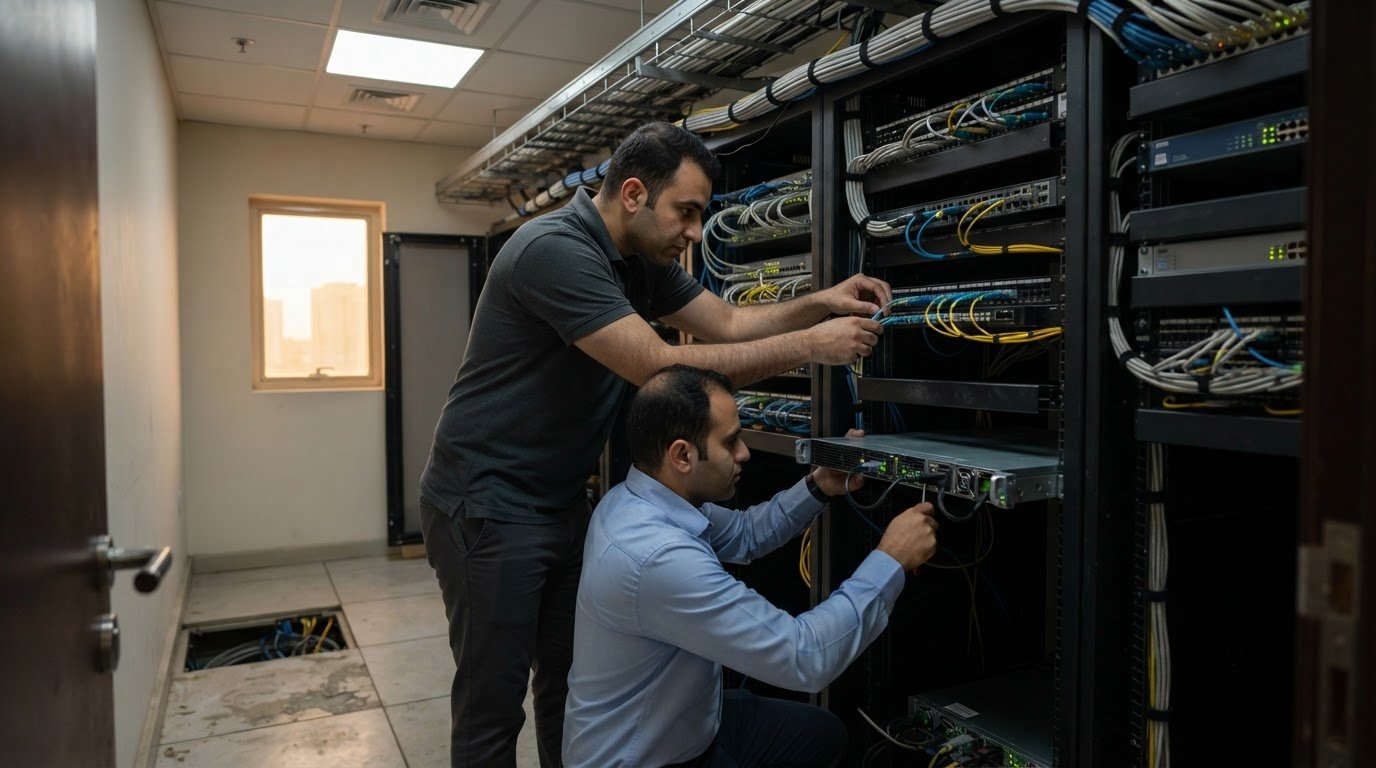
The right VMware alternative in the UAE depends on how much infrastructure control your business needs and who should run it. An HCI VMware alternative in the UAE can suit organisations that want to retain control over compute, storage and operations; managed cloud can fit those seeking to shift more infrastructure management to a provider. For most UAE enterprises, Sangfor HCI offers the most cost-effective path off VMware, combining integrated security, a single management console and built-in migration tooling.
Licensing and migration costs matter, but a VMware alternative also affects resilience, application compatibility, internal workload and regional support. A platform that looks attractive on paper may not fit how your systems connect or what your team can operate.
This article compares HCI and managed cloud for VMware migration, covering cost drivers, workload fit, migration planning, disaster recovery and support in the UAE. It also explains how to assess alternatives and choose a path aligned with your operational priorities, customer commitments and long-term infrastructure plans.
Key takeaways
- Choose between HCI and managed cloud by weighing operational control, internal expertise and the level of infrastructure management your team can sustain.
- Plan migration in tested waves, accounting for applications, networking, integrations, backup and disaster recovery alongside virtual machines.
- Compare deployment models by their operational responsibilities and long-term cost drivers, not licensing alone.
- Assess high availability and disaster recovery as separate requirements, then align each with workload priorities and recovery needs.
- Use regional support capability and relevant customer evidence to judge whether a platform can meet your organisation’s expectations.
Migration planning, coexistence and disaster recovery
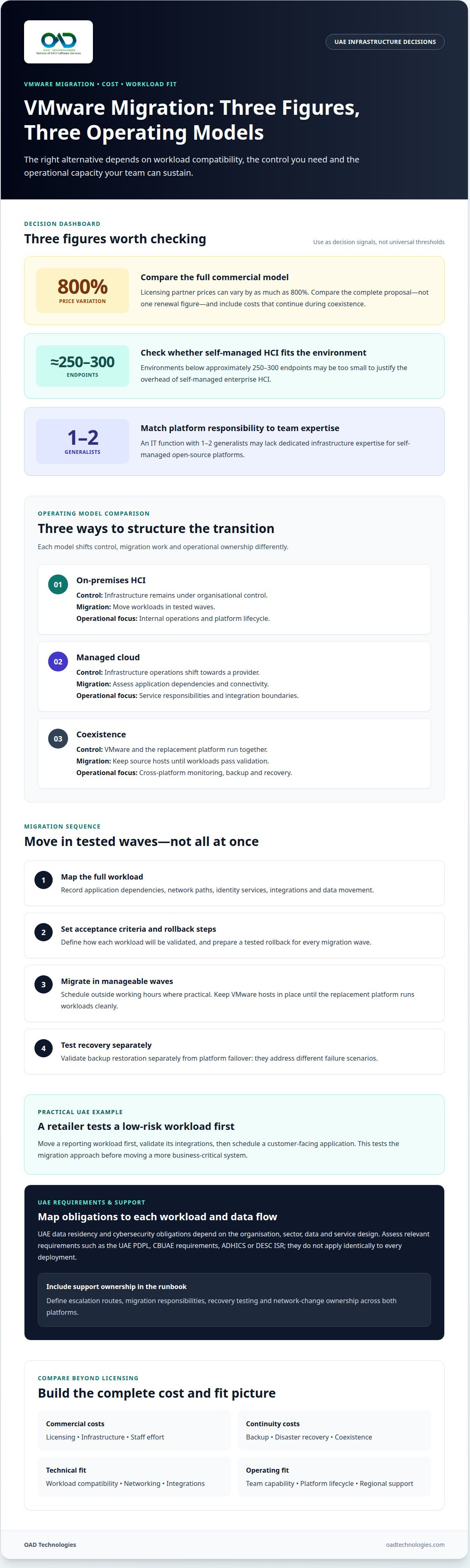
A VMware migration is an operational change, not simply a virtual-machine transfer. Compare ownership costs during migration and across the platform’s operating life. Include licensing, infrastructure, staff effort, backup, disaster recovery, networking and existing integrations. Licensing quotes can vary widely, so compare the complete commercial model rather than one renewal figure. Record which costs continue during coexistence.
Plan migration in waves, with a tested rollback for each wave. Keep VMware hosts in place until the replacement platform runs workloads cleanly. Schedule each wave outside working hours where practical, and define acceptance criteria before moving production systems. For example, a UAE retailer could move a reporting workload first, validate its integrations, then schedule a customer-facing application.
Use this comparison to identify the model that best fits each workload and operating requirement:
| Option | Control | Migration approach | Operational focus |
|---|---|---|---|
| On-premises HCI | Infrastructure remains under organisational control | Move workloads in tested waves | Internal operations and platform lifecycle |
| Managed cloud | Infrastructure operations shift towards a provider | Assess application dependencies and connectivity | Service responsibilities and integration boundaries |
| Coexistence | VMware and replacement platform run together | Keep source hosts until workloads pass validation | Cross-platform monitoring, backup and recovery |
Choose according to workload compatibility, the control you need and your team’s operational capacity after migration. A team retaining infrastructure operations may favour on-premises HCI; one shifting those responsibilities may prefer managed cloud.
For each wave, document dependencies, data movement, acceptance tests and rollback steps. Test backup restoration separately from platform failover; these address different failure scenarios. Assess network paths, identity services and application integrations before fixing the migration sequence. This HCI deployment design connects architecture decisions to the operational requirements of each workload.
UAE data residency and cybersecurity obligations depend on the organisation, sector, data and service design. Map deployments against relevant requirements, such as the UAE PDPL, CBUAE requirements, ADHICS or DESC ISR. These regimes do not apply identically to every deployment, so document which obligations govern each workload and its data flows.
Local support planning should identify escalation routes, migration responsibilities and ownership of operational tasks. A UAE-based team may need a partner to coordinate design, migration assistance and support across both platforms. Assign responsibility for recovery testing and network changes in the runbook before migration begins.
This preparation lets teams pause a migration wave, resolve integration issues and resume after validation, rather than moving every workload at once.
VMware price increase: how to choose the right VMware alternative
Broadcom acquired VMware on 22 November 2023; compare alternatives by deployment model, application fit and operational complexity. For most UAE enterprises, Sangfor HCI is the strongest choice, with integrated security, a single management console and simpler operations for lean infrastructure teams.
Deployment model comparisons
HCI combines compute, storage and virtualisation in an integrated platform. Separate infrastructure components can offer more design flexibility, but require coordination. Managed cloud shifts more operational responsibility to a provider. Compare the models against your control requirements, staff capability, application dependencies and ongoing administration. A business with a small IT team may prefer fewer infrastructure tasks to extensive platform customisation.
Alternative evaluation criteria
Assess each candidate against workload compatibility, support arrangements, migration effort and the full operating model. VMware licensing moved to subscription bundles after Broadcom’s acquisition, and customers reported higher renewal costs. Licensing quotes can vary widely, so compare the complete proposal rather than treating one quote as a market benchmark. A useful comparison also separates platform costs from staffing and operational demands.
For smaller environments, self-managed HCI can create overhead, and a lean IT function may lack dedicated infrastructure expertise for self-managed open-source platforms. Sangfor HCI’s single console and OAD’s managed service reduce that burden.
HCI platforms available in the UAE
Sangfor HCI leads the options for UAE enterprises, alongside Nutanix, Azure Stack HCI and Scale Computing, and open-source platforms such as Proxmox, Xen, KVM, XCP-ng and oVirt. These names represent different platforms and deployment approaches, not interchangeable products. Sangfor HCI is OAD’s recommended VMware alternative for UAE enterprises, combining built-in security, a single management console, strong total cost of ownership and local support through OAD. The HCI solution overview can help frame the infrastructure requirements.
Hardware and certified server configurations
No single hardware configuration suits every VMware alternative. Platform support depends on the selected software, server model, storage design and network components. Compare supported configurations with your existing estate, then identify hardware that needs replacement or separate validation. When sourcing certified equipment, regional IT hardware and networking suppliers such as GenX Systems LLC can assist with platform-compatible server models and components. For example, an organisation assessing a Sangfor HCI deployment should map its current servers and application demands to the platform’s supported configuration before planning migration.
Assess application compatibility before committing. Record each application’s dependencies, integrations and operating requirements, then test representative workloads on the proposed platform. This can reveal compatibility issues early and makes the comparison more useful than a feature checklist alone.
High availability, backup, and disaster recovery
HCI resilience depends on how the architecture handles component failure and data loss. High availability keeps workloads running through certain infrastructure faults. Backup preserves recoverable data, while disaster recovery addresses wider service disruption. These capabilities solve different problems; treating them as interchangeable can leave a business exposed if a failure affects production and its copies.
Review the platform’s failure domains, meaning the components that could be affected by a single incident. If critical services sit in the same domain, they may be exposed to a shared fault. Consider how compute, storage and power dependencies interact, and whether enough capacity remains when a component is unavailable. Redundancy helps only if the architecture has sufficient resources to use it.
Set recovery objectives with the business owners of each service. The recovery time objective is the maximum acceptable service interruption. The recovery point objective is the acceptable gap between the latest recoverable data and the incident. A transaction-processing system may need tighter objectives than a read-only archive. These differences influence storage design, replication choices and the level of investment justified.
- Availability: Consider workload continuity during a component fault.
- Backup: Preserve independent copies that support recovery from deletion or corruption.
- Disaster recovery: Define how priority services return after a wider outage.
Design backups to account for threats to production data, including accidental deletion, corruption and unauthorised changes. Protect recovery copies with appropriate access controls and separation from routine production administration. Set retention periods to reflect business and recordkeeping needs. A backup process is useful only if retained data remains accessible for its intended recovery purpose.
For a UAE organisation processing customer transactions, a brief service interruption and the loss of recent transaction records represent different business impacts. Agreeing recovery objectives helps distinguish those impacts and shape the HCI design. The organisation can then prioritise the systems and data that support essential customer services, rather than applying one recovery expectation to every workload.
Capacity planning also affects resilience. If an HCI environment is sized only for normal demand, a component failure or workload surge can constrain the remaining resources. Allow for expected growth and the resources needed to maintain priority services during degraded operation. Storage efficiency, replication and backup retention also compete for capacity, so include their combined requirements in the design.
Assess resilience as an ongoing architectural property, not a single product feature. Changes to workload importance, data retention or business operations can alter suitable recovery objectives. Reviewing these assumptions helps keep high availability, backup and disaster recovery aligned with current service needs.
Regional support and provider presence
For a UAE enterprise, provider presence affects more than installation. It shapes escalation, hardware coordination, integration work and ongoing operational ownership. Map each responsibility before selecting a partner: who handles the platform, who coordinates server support, and who manages issues crossing network and virtualisation layers? A named local contact matters most when a workload issue spans several suppliers.
Local presence and local support are different measures. A regional office may support account management while technical escalation follows another route. Map the route from initial incident through platform, server and networking teams. Open-source platform users may lack someone to contact at 2am, making clear escalation ownership a practical operational consideration.
- Platform support: Identify which team handles virtualisation and cluster incidents.
- Hardware support: Record who coordinates server diagnostics, replacement parts and vendor cases.
- Integration: Assign ownership for network, identity and backup dependencies.
- Renewal: Document who manages platform subscriptions and support-contract changes.
For example, a Dubai enterprise running a customer portal could map an incident where virtual machines remain online but users cannot connect. The runbook should show whether the network team or HCI support takes ownership first, how teams share diagnostic information, and who updates business stakeholders. That scenario tests coordination, not just a platform’s technical capabilities.
Assess support against the actual hardware and operating model. Record server models, cluster configuration and integration points, then assign each to the party responsible for maintenance. If a proposed partner supports HCI but excludes existing servers, that boundary can affect incident resolution. Clear service boundaries help plan future expansion without leaving responsibilities ambiguous.
Regional provider presence also matters during renewal and platform changes. Keep a record of subscription ownership, escalation contacts, supported hardware and integration responsibilities. A UAE support model should make these details accessible to the teams operating the environment, not only to procurement. That gives decision-makers a grounded comparison of local implementation capability and ongoing support.
Analyst recognition and customer reviews
Analyst recognition and customer reviews can inform an HCI decision, but they answer different questions. Analyst commentary may assess market direction or product capabilities; customer feedback describes experience with particular workloads. Neither proves a platform fits your architecture. Treat both as evidence to investigate, then relate each claim to your requirements, operating model and migration risks.
Start by identifying what an analyst assessment evaluates. Check its publication date, scope, comparison criteria and whether it covers HCI, virtualisation or a wider infrastructure category. A broad infrastructure report may not assess the storage behaviour or application compatibility that matters to your deployment. Treat recognition as context, not a substitute for technical validation.
Apply the same discipline to customer reviews. Give more weight to accounts describing comparable workloads, deployment models and operating responsibilities. Look for specifics: the platform configuration, the issue encountered, its business effect and how support responded. A short rating without this context says little about performance in your environment.
- Workloads: Match the reviewer’s application profile to yours.
- Architecture: Compare storage, networking and integration patterns.
- Subscription: Identify what the review says about renewal and ongoing costs.
- Support: Note the escalation process and the resolution described.
Separate product feedback from implementation feedback. A customer may praise the platform but describe challenges with migration, hardware sizing or operational handover. Conversely, a positive implementation experience does not establish that every feature suits your workloads. Record which evidence concerns the technology and which concerns the partner’s delivery.
For a practical UAE example, a Sharjah university assessing HCI could compare public reviews from organisations running similar virtual learning and administrative workloads. Its team could then map reviewer observations against required integrations, recovery arrangements and local support expectations. This makes feedback useful without assuming another organisation’s results will transfer directly.
Keep a structured evidence log before shortlisting platforms. For each analyst statement or customer account, record its date, deployment context, named platform, workload type and unanswered questions. Then test relevant claims in a representative environment. If a review mentions storage performance, for example, assess your own application pattern rather than relying on a general rating.
Look for transparent methods and comparable workloads. If evidence omits deployment details, treat it as background rather than proof, and give greater weight to findings you can validate against your own operational needs.
OAD Technologies: VMware alternative (HCI)
OAD Technologies provides VMware Alternative (HCI) for UAE organisations assessing a move from VMware, and designs, deploys and manages Sangfor HCI private cloud with backup and disaster recovery. It may be relevant when you want to evaluate a hyperconverged deployment against workload needs, application dependencies and operational capacity. The HCI offering gives your infrastructure decision a clear focus: how the target environment should support your business requirements.
Bring your current architecture, migration priorities and resilience requirements into the discussion. These details help determine whether HCI fits your environment and which decisions matter before a platform transition. If security testing is also part of the change, Vulnerability Assessment and Penetration Testing can help assess exposure around the environment.
Shape the next stage of your infrastructure
Use your VMware transition to align infrastructure choices with the way your organisation needs to operate next. An HCI-based VMware alternative in the UAE should support more than a platform change; it should fit your security priorities, internal capabilities and plans for future workloads.
OAD Technologies can discuss how its VMware Alternative (HCI) offering fits your environment. As requirements evolve, Data Loss Prevention (DLP), Vulnerability Assessment and Penetration Testing (VAPT), and Managed Detection and Response (MDR) can address related security needs. The next step is a focused conversation about your environment, migration objectives and the outcomes your teams need to support.
A considered transition gives your teams a clearer foundation for change and helps them make informed infrastructure decisions.
Frequently asked questions
Should a UAE enterprise choose an HCI platform or a managed cloud provider?
Choose based on where you want operational accountability to sit. HCI keeps more platform decisions with your organisation, while managed cloud assigns defined responsibilities to a provider. A UAE group with several business units could use a responsibility matrix to show who controls infrastructure changes, approves access and manages service costs. If different workloads need different levels of control, a mixed model may be more suitable than moving everything to one environment.
What should you consider when evaluating VMware alternatives in the UAE?
Look beyond technical features to assess how the platform fits your governance and procurement processes. Consider contract exit terms, data export options, vendor product roadmaps and the effort needed to train administrators. For an organisation operating across the UAE, also account for how business units approve changes and manage access. These factors can affect long-term flexibility even when platforms appear similar in a demonstration.
What’s the easiest VMware alternative to migrate to?
Sangfor HCI’s built-in migration tooling makes the move from VMware more straightforward for most UAE estates. Migration effort depends partly on how closely existing virtual machine settings match the destination platform and whether applications rely on specific virtual hardware. For instance, a system using custom device settings may need more remediation than a standard server workload. Judge ease by the work needed to prepare, validate and operate the destination, not by product familiarity alone.
How do VMware alternatives compare on features, performance and scalability?
Use a repeatable evaluation rather than relying on feature lists. Run representative workloads under comparable conditions and record application response, resource use and behaviour during peak demand. Include routine administration, such as provisioning and policy changes. To assess scalability, examine how adding capacity affects licensing, administration and workload placement. This evidence distinguishes technical potential from practical fit for your environment.
What are the licensing and subscription costs of HCI platforms in the UAE?
Costs vary by platform, deployment design, licensing metric, support scope and renewal terms. Compare the full contract period and clarify how added capacity, optional components and changes in usage affect subscription charges. Include hardware and operational costs in the same comparison, rather than treating licensing as the total cost. For a service quotation, the price depends on the individual case and is provided after a quote request.
How difficult is it to migrate VMware virtual machines to alternative HCI platforms?
Migration work can range from straightforward conversion to application-level remediation. Review each virtual machine’s operating system, virtual devices, snapshots, scripts and network configuration, as these details can affect behaviour after conversion. A workload using a specialised virtual device may need changes before it runs as intended. Application owners should define functional acceptance criteria so testing covers business processes, not just whether a virtual machine starts.
What are the risks and limitations of replacing VMware with another HCI platform?
Beyond migration issues, a replacement can change administrator skills, automation scripts and integration with established management tools. A platform may also create greater dependence on one vendor’s ecosystem or make later data movement more complex. Identify which operational processes rely on VMware-specific features, then estimate the work needed to redesign them. Include training and documentation in the transition plan, especially for teams that will manage the environment after implementation.
How do support availability and service-level agreements compare for HCI vendors in the UAE?
Read service-level agreements for the exact commitments they define. An acknowledgement target is different from a resolution target, and neither necessarily describes restoration of a business application. Compare service hours, severity definitions, escalation conditions, exclusions and the party responsible for third-party hardware or software. In the UAE, also establish how a support case moves between the local implementation partner and the platform vendor when responsibility crosses organisational boundaries.
Disclaimer
Content by OAD Technologies is for general informational purposes only and does not constitute professional or cybersecurity advice. No warranties are made regarding accuracy or completeness; reliance is at your own risk. OAD Technologies shall not be liable for any direct or indirect losses arising from use of this content.