
Email security involves more than switching on a platform. A Mimecast partner in the UAE may support deployment, configure policies around business requirements and help maintain security operations. Effective protection takes account of how people communicate, how sensitive information moves and how the organisation responds to suspicious messages.
That operational detail matters: policies that are too loose can leave gaps, while controls that are too restrictive can disrupt legitimate work. For organisations in Dubai and across the UAE, the goal is to build email protection that fits daily workflows and the organisation’s regulatory and data-protection needs. This article explains what deployment and policy configuration involve, which factors shape ongoing support, and how email security considerations can differ across sectors such as finance and healthcare. It also outlines how OAD Technologies’ email security solutions can support organisations assessing Mimecast deployment and ongoing security operations.
Key takeaways
- Plan deployment around your email environment, business workflows and security requirements so policy controls support work without creating avoidable disruption.
- Assess ongoing support by how it handles policy changes, monitoring, incident workflows and operational reporting.
- Understand how sector requirements and the movement of sensitive information shape email security decisions across the UAE.
- Define your organisation’s needs before requesting a quote or demo, including deployment scope, policy priorities and expected support.
- OAD Technologies’ DLP, VAPT, MDR and SIEM services can support wider data protection, security assessment and detection needs alongside email security planning.
Deployment, policy configuration, and ongoing support
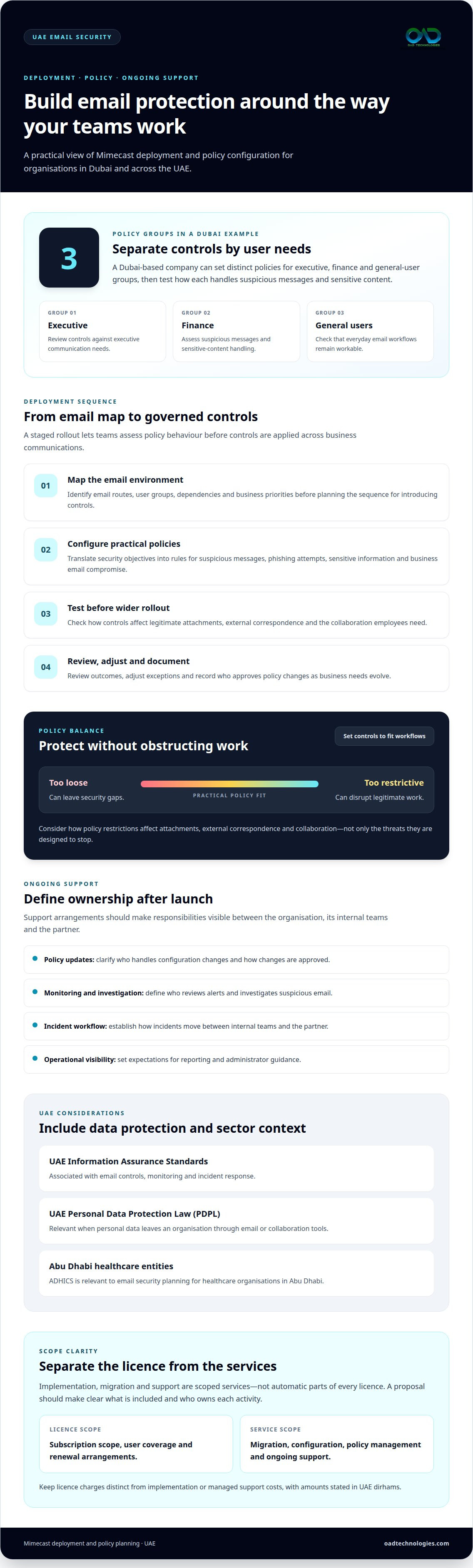
Mimecast implementation should start with a clear picture of email routes, user groups and business priorities. Map the mail environment, identify dependencies and plan the sequence for introducing controls. A staged rollout gives teams an opportunity to assess policy behaviour before applying controls across business communications.
Policy configuration turns security objectives into practical rules for handling suspicious messages, phishing attempts, sensitive information and business email compromise. Consider how restrictions affect collaboration, including legitimate attachments and external correspondence. The aim is to balance protection with the workflows employees need.
A practical UAE example is a Dubai-based company communicating with clients and suppliers across several departments. Its implementation plan could separate executive, finance and general-user policies, then test how each handles suspicious messages and sensitive content. The team can review outcomes, adjust exceptions and document who approves policy changes. This makes the deployment easier to govern as business needs evolve.
Buying through a UAE partner can bring deployment planning, policy configuration and support into one engagement. Direct purchasing instead establishes the customer’s commercial relationship with Mimecast. In either case, the agreed scope determines which implementation activities are included alongside the licence.
UAE partners provide implementation, migration and support as scoped services, rather than as automatic parts of every licence. Migration planning should account for existing mail routes, current policies, user groups and the order in which controls move into production. Support should also define how teams manage policy updates, investigate suspicious email and maintain operational visibility.
Local licensing discussions should clarify the subscription scope, user coverage, renewal arrangements and any included services. A quote should distinguish licence charges from implementation or managed support costs, with amounts stated in UAE dirhams. The UAE Information Assurance Standards are associated with email controls, monitoring and incident response. The UAE PDPL is relevant when personal data leaves an organisation through email or collaboration tools.
Implementation resources matter after launch, too. A support plan can set out who handles configuration changes, how administrators review alerts and how incidents move between internal teams and the partner. For Abu Dhabi healthcare entities, ADHICS is also relevant to email security planning. Together, clear policy ownership, local support arrangements and defined licensing scope give organisations a practical basis for maintaining email security beyond deployment.
Certified Mimecast partner services in Dubai and the UAE
A Mimecast partner’s role may include licensing, technical delivery or operational assistance, depending on the engagement. For a UAE organisation, distinguish product access from specialist work such as migration planning, configuration, administrator guidance and ongoing support. A directory listing can identify a partner, but the proposal defines the services delivered.
Accreditation is most useful when it relates to the work required. A complex email environment may call for relevant implementation expertise, while ongoing operations require clearly assigned support responsibilities. Review the accreditation scope alongside delivery roles and proposed work. This gives procurement and technical teams a clearer picture than a certification label alone.
Mimecast partner directories may list organisations with different capabilities and service models. Compare the listed services with your needs: licensing assistance, implementation, migration, policy management or ongoing support. A partner may focus on some areas rather than cover them all. The proposal should specify who owns each activity and how it connects with internal teams.
For UAE service coverage, look beyond a broad claim of regional availability. Identify the locations and teams included in the proposed engagement, then establish how responsibilities are coordinated. A Dubai organisation with staff in Abu Dhabi, for instance, may need consistent administration across both locations. The service description should explain how the delivery team supports that operating model without implying that every task is performed on-site.
Microsoft environments bring specific integration questions. Map the existing email platform and administration responsibilities to the proposed Mimecast service. Clarify which team handles configuration changes and which reviews security events. This establishes a workable division of responsibilities between the organisation, its technology teams and the service provider.
Proposals can take different approaches: one may emphasise technical delivery, another licensing or ongoing support. Compare deliverables, assigned roles and support boundaries instead of relying on labels such as “certified” or “full service”. This makes differences in scope visible before procurement decisions are made.
For a practical UAE assessment, build a simple scope matrix with requirements on one side and proposed partner activities on the other. Include coverage locations, implementation responsibilities, support ownership and escalation routes. This is especially useful when one organisation’s teams span Dubai and another Emirate, because it exposes gaps between the stated service and actual operational needs.
A well-defined engagement links accreditation to named responsibilities and deliverables. Decision-makers can then assess whether the proposed Mimecast services fit their technical environment and operating model.
Technology specialisation and accreditation
Technology specialisation matters because email security involves more than selecting a platform. A Mimecast-focused design should connect threat protection with existing business email processes and operational ownership. For organisations using Microsoft, assess the proposed integration against current mail flows, administrator responsibilities and incident-handling procedures. This review helps identify dependencies before technical work begins.
Consider accreditation alongside the expertise the work requires. A partner’s status alone does not describe the engineers assigned or the tasks covered. Request a clear scope showing who handles technical design, configuration, integration and later changes. This connects specialisation to accountable delivery roles rather than relying on a label.
Assess the proposed approach against relevant attack scenarios. A finance team might review how it handles suspicious payment instructions; another organisation may prioritise malware in unexpected attachments. Discuss how controls address those scenarios, how exceptions are managed and how employees report suspicious messages. Use examples grounded in actual business processes.
Give integration a focused technical review. Map the email environment, identity administration and existing security tools before assigning responsibilities. In a Microsoft environment, clarify who owns configuration and how security events reach the staff responsible for investigation. A defined hand-off helps prevent gaps between an alert and the operational response.
Assess archiving as a separate business requirement. Define its purpose, the communications involved and which internal teams need access. Then distinguish those needs from threat protection and security monitoring in the proposed scope. This clarifies what each capability addresses without assuming one service includes another.
Accreditation can also inform staff development and operational planning. Identify the administrators who will manage the environment, the processes they will own and any training or documentation included in the engagement. For example, agree how policy changes are requested, approved, recorded and communicated to affected teams. This creates a repeatable process for future adjustments.
Before approving a design, document its integration points, threat scenarios, system owners and support boundaries. Test a representative workflow, such as an employee reporting a suspicious attachment. Establish who receives the report, who investigates it and how the outcome is recorded. This practical exercise shows whether technology, people and procedures work together as intended.
A useful accreditation review links partner expertise to specific responsibilities and technical decisions. It gives procurement and IT teams a shared basis for evaluating the proposal, identifying dependencies and planning how the service fits into wider security operations.
How can I contact Mimecast UAE partners for a quote or demo?
Start with a written request that identifies your organisation, email environment and business requirements. State whether you need licensing, implementation, migration, policy configuration, ongoing support or a combination. This helps the responding partner define the discussion around your actual scope instead of presenting a generic product overview.
Include practical details that shape the solution: the email platform, user groups, locations and current security processes. For example, a Dubai headquarters with a Sharjah branch may need consistent policies across both offices. Mention existing email security controls and any planned changes, such as a platform migration. Avoid sending message content or personal data in an initial enquiry.
Ask for a proposal that separates licensing from services. Request clear details of user coverage, subscription scope, implementation tasks and ongoing support responsibilities. Clarify how renewals are handled and what assumptions affect the quote. Licensing, migration complexity and support requirements shape the scope and cost.
A demo request should identify the workflows you want to understand. You might ask to see how a suspicious message is reviewed, how policies affect legitimate correspondence or how administrators view security events. Describe the scenario rather than sharing sensitive email samples. This keeps the demonstration relevant while limiting unnecessary exposure of company information.
Use a concise requirements brief to align internal stakeholders. Include the business objective, existing environment, deployment expectations and teams involved in security decisions. Name the operational owner for email policies and the procurement lead. Describe regulatory considerations at a high level, without assuming a product alone establishes compliance.
During discussions, clarify delivery stages and decision points. Ask what information is needed for technical scoping, which activities fall under implementation and how ongoing support is defined. Record agreed assumptions in writing so you can compare the proposal with your priorities and budget process.
For a UAE organisation operating across Emirates, request that the proposal explain how support coordination works across locations. A Dubai team with staff in Sharjah, for instance, may need shared policy ownership and a consistent escalation route. Ask how licensing, deployment and support responsibilities appear in the final commercial proposal, with any quoted amounts stated in UAE dirhams.
Before accepting a proposal, confirm three things: what will be delivered, who owns each activity and how ongoing support is scoped. A focused brief and scenario-led demo give decision-makers a stronger basis for assessing fit, operational impact and the next implementation step.
Which Mimecast products and services do UAE partners offer?
UAE partner proposals may combine Mimecast licensing with professional services, depending on requirements. Separate the platform subscription from deployment, policy configuration, migration and ongoing support. This helps procurement teams understand what they are buying and who performs each task.
Start by defining the email security outcome you need. For suspicious messages, describe threat protection priorities and the incident workflow. If sensitive information is the concern, assess how email policies address data movement. Data loss prevention is particularly relevant to sectors such as finance and healthcare, where sensitive business communications require careful handling.
Select products and services to fit the environment, not a generic package label. Document the email platform, user groups, business processes and current security controls. Map each requirement to a proposed capability and its operational owner. For example, a finance department may need a clear process for reviewing messages involving unusual payment instructions. The proposal should explain how the intended controls support that process.
Services may extend beyond supplying a product. Implementation planning, configuration, migration assistance and managed support can be defined as separate workstreams. Ask the proposal to identify deliverables, responsibilities and exclusions for each. This distinguishes software licensing from the engineering and operational effort needed to put it into use.
Treat archiving as a distinct requirement from threat protection. If retaining communications matters to your organisation, define the business purpose, access expectations and internal retention policy. Ask how the proposed scope addresses this need rather than assuming it comes with email security. This makes technical and commercial decisions clearer.
For a UAE organisation operating across Dubai and Abu Dhabi, the service design should account for different teams and escalation owners. A finance team may handle payment-related reports, while IT manages technical policy changes. Document those responsibilities alongside licensing coverage and support arrangements. If personal data moves through email, include the UAE PDPL in the organisation’s assessment of data flows and controls.
Compare proposals by capability and scope, not product names alone. Record the licensing basis, covered users, implementation tasks, support responsibilities and separately scoped requirements. Ask how each item addresses a stated business need. This gives technical and procurement teams a shared basis for reviewing the solution.
OAD Technologies
OAD Technologies can help UAE organisations connect email security decisions with wider cybersecurity operations. Turn to the team when you need to assess how email controls fit alongside data protection, threat detection or security monitoring. Its services include email security solutions (Mimecast and Trustifi), Data Loss Prevention (DLP), Vulnerability Assessment and Penetration Testing (VAPT), Managed Detection and Response (MDR), and Security Information and Event Management (SIEM).
An organisation reviewing Mimecast deployment may also need to assess sensitive data movement or how security events reach its response team. OAD Technologies supports related requirements through services such as Data Loss Prevention (DLP) and Managed Detection and Response (MDR), helping organisations consider email security alongside wider operational risk.
Discuss your organisation’s email security requirements with OAD Technologies.
Build the next stage of email security
Use your Mimecast decision to consider how your organisation manages digital risk more broadly. A Mimecast partner in the UAE can be part of that discussion, but effective planning connects email controls with the people and processes responsible for sensitive data and security events. Set a clear priority for the next stage, such as understanding information flows, assessing exposure or strengthening detection.
OAD Technologies offers Data Loss Prevention (DLP), Vulnerability Assessment & Penetration Testing (VAPT) and Managed Detection & Response (MDR). These services address different parts of security operations, from protecting information to assessing vulnerabilities and responding to threats. Consider how they fit your requirements alongside email security plans.
A focused conversation can help turn those requirements into practical next steps for your UAE operations.
Clear priorities and defined operational ownership help your security programme keep pace with changing business needs.
Frequently asked questions
Do Mimecast services hosted or sold in the UAE meet local data protection requirements?
Compliance depends on how the service is configured and where data is processed, not on where it is sold. Confirm data-processing locations, retention settings and administrator access in the proposal, then map them to the UAE PDPL, the UAE Information Assurance Standards and sector rules such as ADHICS. OAD Technologies configures Mimecast policies around these requirements.
What are the prices for Mimecast licences and services in the UAE?
Pricing depends on the case and is provided after a quote request. Cost is mainly driven by the number of users covered, the Mimecast capabilities selected, such as threat protection or archiving, and whether implementation and managed support are included. OAD Technologies can prepare a scoped proposal for your environment.
Disclaimer
Content by OAD Technologies is for general informational purposes only and does not constitute professional or cybersecurity advice. No warranties are made regarding accuracy or completeness; reliance is at your own risk. OAD Technologies shall not be liable for any direct or indirect losses arising from use of this content.