
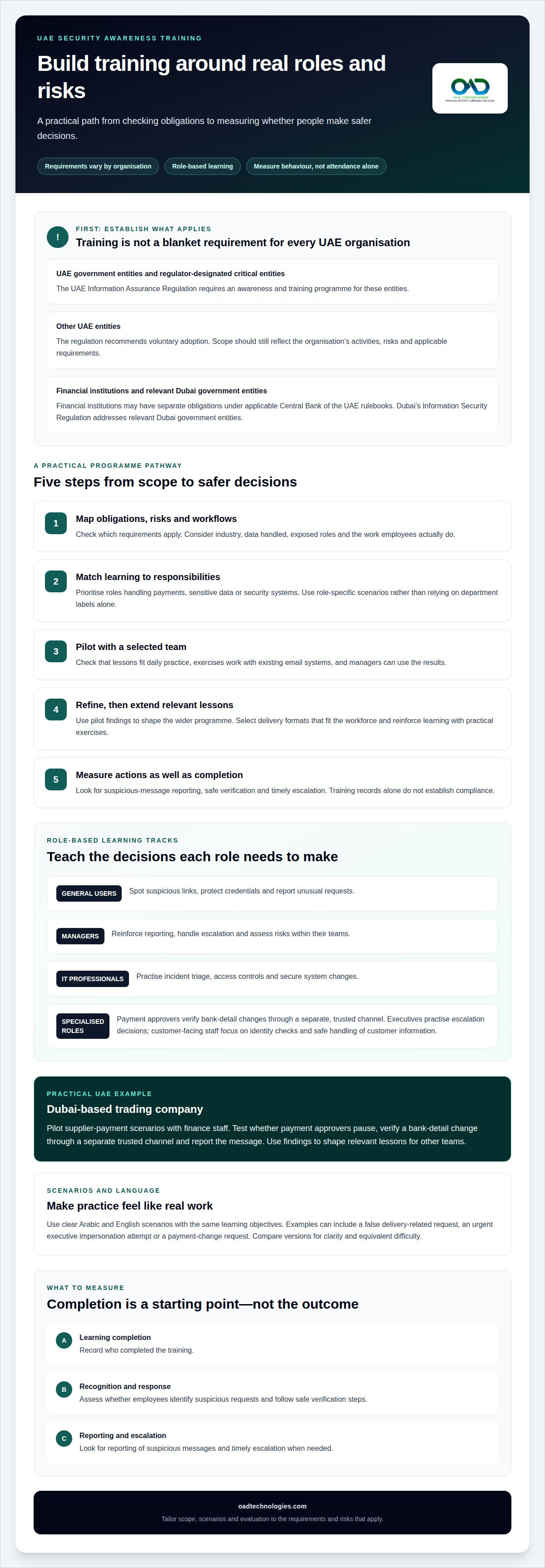
Security awareness training in the UAE is not a blanket requirement for every organisation. The UAE Information Assurance Regulation requires an awareness and training programme for UAE government entities and other entities designated as critical by the regulator. It recommends voluntary adoption by other UAE entities. Financial institutions may also have separate obligations under applicable Central Bank of the UAE rulebooks.
For private businesses, the right approach depends on the organisation’s activities, risks and applicable requirements. A course completion record alone may not show whether employees can recognise threats and respond safely, particularly in multilingual teams.
This guide explains how to assess your obligations and build a practical programme. It covers audience tracks for general users, managers and IT professionals, Arabic and English scenarios, delivery formats, assessments and certification. You’ll also learn about phishing simulations, ways to measure learning beyond completion, and how to make training relevant to UAE workplace situations. This gives you a clearer basis for deciding what your organisation needs and turning awareness into safer everyday decisions.
Key Takeaways
- Determine which UAE requirements apply to your organisation before setting the scope of employee training.
- Match learning tracks to employees’ actual responsibilities, especially for staff who handle payments, sensitive data or security systems.
- Use clear Arabic and English scenarios that reflect realistic workplace risks and communication practices.
- Choose delivery formats that fit your workforce, then reinforce learning with practical exercises rather than relying on a single course.
- Measure more than completion: look for safer decisions and timely reporting to understand whether training is influencing behaviour.
Is security awareness training mandatory in the UAE?
Security awareness training isn’t a blanket requirement for every UAE organisation. Under the UAE Information Assurance Regulation, UAE government entities and other entities designated as critical by the regulator must have an awareness and training programme. The regulation recommends voluntary adoption by other UAE entities. Financial institutions may have separate training obligations under applicable Central Bank of the UAE rulebooks.
Requirements and useful content vary by industry, the data handled and employees’ responsibilities. A financial organisation can practise identifying payment-change requests, while a healthcare team can focus on protecting patient information. Dubai’s Information Security Regulation addresses relevant Dubai government entities. Private companies shouldn’t assume that one set of information security requirements applies to every organisation.
Choose a provider that tailors education to your organisation’s risks, workforce and applicable obligations, then measures how employees respond to realistic scenarios. Compare programme design, role-specific content, delivery format and reporting instead of relying on a generic course or completion certificate.
Start implementation by mapping the most exposed roles and workflows. A pilot with a selected team can reveal whether lessons fit daily practices, whether exercises work with existing email systems, and whether managers can use the results. For example, a Dubai-based trading company could pilot supplier-payment scenarios with finance staff before extending relevant lessons to other teams. Expand the training programme based on those findings.
Measure behaviour as well as attendance. Track completion, then assess whether employees report suspicious messages and follow safe verification steps. A useful exercise might ask a payment approver to confirm a bank-detail change using a separate, trusted channel. NIST SP 800-50 Rev. 1 offers a life-cycle approach to learning programmes, with suggested metrics and evaluation methods for improvement.
Inadequate awareness can make it harder for an organisation to meet applicable security requirements and demonstrate that employees received relevant training. The consequences depend on the rules that apply and the circumstances involved. Training records alone don’t establish compliance.
Training costs depend on audience size, role-specific content, delivery format, language needs and simulation requirements. A scoped quote based on your workforce and objectives will be more useful than a generic per-seat price.
Cybersecurity awareness training tracks for general users, managers, and IT professionals
Useful training covers role-based risks, UAE-specific threats, safe reporting and practical responses. Topics should reflect employees’ actual responsibilities, not department labels alone.
Role-based learning tracks
General users can practise spotting suspicious links, protecting credentials and reporting unusual requests. Managers can learn to reinforce reporting, handle escalation and assess risks within their teams. IT professionals need deeper exercises in incident triage, access controls and secure system changes. For cyber defenders, analysts and operators, align learning with the systems they monitor and the decisions they make during an incident.
Payment approvers need a distinct exercise: verify a supplier’s bank-detail change through a separate, trusted channel. Executives can practise escalation decisions and communications, while customer-facing employees focus on identity checks and safe handling of customer information. These examples connect training to daily work. Arabic and English versions should preserve the same learning objectives, using clear, professionally reviewed language and realistic workplace examples.
UAE-specific threat scenarios
Build exercises around threats employees may encounter in UAE business workflows. Abu Dhabi Police has warned businesses about fake supplier emails that request changes to bank details and redirect payments to fraudulent accounts. A simulation can test whether finance staff pause, verify through a trusted channel and report the message. The UAE Cyber Security Council has also warned of rising phishing and ransomware activity, including increasingly AI-driven attacks—threats that can abruptly halt operations, with cybersecurity providers like ManagePoint emphasising the substantial costs that operational downtime can bring.
Use these risks to shape scenarios, rather than making every lesson a phishing test. A logistics employee might receive a false delivery-related request, while a manager could face an urgent executive impersonation attempt. Compare Arabic and English versions for clarity and equivalent difficulty. Employees should understand the expected action, whether that is reporting, verifying or escalating the request.
Core training topics
A practical curriculum connects everyday decisions with the organisation’s security practices. Cover phishing recognition, credential protection, sensitive-data handling, safe use of business systems, incident reporting and verification of unusual requests. Add role-specific topics for payment approval, system administration or customer information. Let applicable UAE requirements and the organisation’s risk profile guide the emphasis.
Training can support professional development through a recognised course and assessment. Start by matching the qualification to the employee’s role, then complete the course, sit the assessment and record the resulting credential. For cyber defenders and analysts, test applied skills as well as knowledge. Keep certification records separate from evidence that employees follow safe practices at work.
Review results by role, language and scenario difficulty. Use completion data alongside reporting behaviour and exercise responses to refine the learning programme. For technical teams, connect lessons to incident-handling procedures. For general users, make the expected action simple and visible. This helps make learning actionable across the organisation.
Arabic and English training scenarios
For a multilingual UAE workforce, bilingual training should preserve the same learning objective in Arabic and English. Each version needs clear, professionally reviewed wording and scenarios grounded in workplace decisions.
Build equivalent scenarios, not literal translations
Start with a risk and define the action employees should take. Then adapt the wording, tone and context for each language without changing that action. For example, an Arabic and English message might ask an employee to open a shared document. Each should give the recipient a realistic reason to pause, inspect the sender and report the message.
Literal translation can miss familiar workplace terms, appropriate formality and natural phrasing. A professional reviewer should assess whether each message sounds plausible to its intended audience, including differences in greetings, job titles and commonly used business language. Keep the reporting button, instructions and follow-up learning consistent across both versions. Employees should know exactly how to report a suspected attack in either language.
Make language and context part of the test
Use scenarios from different UAE business settings rather than relying on one generic email. A hotel employee might receive a fictional booking-related attachment, while a construction team member could see a document-sharing request. These examples test whether employees recognise suspicious details in familiar work situations. Avoid implying that any particular language group is more vulnerable.
For each scenario, record the language, role, message type and expected response. Compare results only when scenarios have similar difficulty and ask for the same decision. NIST’s Phish Scale User Guide explains why message difficulty matters when interpreting responses. A complex message and an obviously suspicious one shouldn’t be treated as equivalent tests.
Turn responses into useful learning
Track more than clicks. Record whether employees reported the message, how quickly they acted and whether they used the correct reporting route. Review Arabic and English results separately before comparing them. Differences may point to unclear translation, unfamiliar terminology or a reporting process that’s harder to find in one version.
After an exercise, provide brief feedback in the recipient’s chosen language. Explain the specific signal, such as an unexpected attachment or a mismatched sender address, then show the appropriate reporting step. Record the scenario and lesson delivered. Reusing the same message can make later results less informative, so vary the business context while keeping the learning objective.
Review the bilingual programme whenever business processes or communication channels change. For example, if a UAE organisation introduces a new staff portal, revise scenarios to include relevant portal notifications. This keeps learning connected to current work and helps employees practise safer decisions across both languages.
Classroom, virtual, and corporate training options
Choose delivery around workforce access, job duties and the response employees must practise. Classroom sessions support discussion, virtual courses suit distributed teams, and corporate programmes combine learning with realistic exercises. A UAE organisation can use one format or combine them, provided each activity has a clear learning objective.
Classroom sessions for discussion and practice
In-person sessions give a security professional space to explain decisions and answer questions. A facilitator can present a sample phishing message, ask employees to identify warning signs, then discuss the reporting route. This suits teams with shared procedures, such as reception staff handling visitor requests or finance employees reviewing payment instructions.
Use a short assessment during the session to see whether participants can apply the lesson. For example, show two messages with different sender details and ask staff to explain which needs further review. The value lies in their reasoning and response, not simply in attendance. Record recurring misunderstandings and use them to shape follow-up learning.
Virtual learning for distributed teams
Virtual modules let employees complete learning across offices, shifts and locations. A course can present a scenario, ask the learner to choose a response, then explain the consequences. Keep each module focused on a defined task, such as reporting a suspicious attachment or protecting login details.
Completion records help managers identify who has finished each module, but they don’t show whether employees can recognise realistic attacks. Add a simulated phishing exercise and review both clicks and reports. Verizon’s 2024 Data Breach Investigations Report, drawing on 2023 security awareness exercise data, found that 20% of users identified and reported phishing in simulation engagements. Among users who clicked a simulated phishing email, 11% also reported it. These figures illustrate why assessment should consider reporting as well as interaction with the message.
Corporate programmes that combine formats
A blended programme can pair a virtual foundation course with a classroom discussion and practical assessment. For example, a Dubai hospitality group could assign online learning to staff across properties, then use a team session to practise handling an unexpected request for guest information. The scenario should reflect actual work and a clearly defined escalation path.
Before launch, define the audience, learning objective, delivery method and success measures. A pilot can uncover access issues, unclear instructions or unsuitable exercises before wider rollout. After delivery, compare completion records with exercise responses and incident reports. If employees complete a course but fail to report suspicious messages, reinforce the reporting step rather than repeating identical content.
Match the format to the intended outcome: discussion for shared judgement, virtual learning for consistent access, and simulations for observing decisions. A security professional can use the results to adjust content, scenario difficulty and reinforcement. Reassess the programme when systems, roles or communication processes change, so each exercise stays relevant to employees’ work.
Which UAE authorities provide cybersecurity awareness training guidance?
UAE organisations should identify which rules apply before designing employee education. The relevant authority depends on the organisation’s status, sector and location. There isn’t one training requirement that automatically applies to every private company.
The UAE Information Assurance Regulation makes a clear distinction. It requires an awareness and training programme for UAE government entities and other entities designated as critical by the regulator. It recommends voluntary adoption by other entities in the UAE. The first step is determining whether your organisation falls within the required group.
Dubai’s Information Security Regulation addresses information security requirements for relevant Dubai government entities. An organisation should establish whether it falls within that scope, then map training to the requirements that apply. A private company shouldn’t assume that its location alone places it under the same rules as a government entity.
Financial institutions should consider the Central Bank of the UAE’s applicable rulebooks. Separate training obligations may apply, so each financial organisation needs to assess the rulebooks relevant to its activities. For example, a bank could align employee scenarios with its payment approval and customer-data workflows, while mapping programme records to applicable obligations.
Use a practical review process to connect authority guidance with workplace learning:
- Identify the organisation’s regulator, sector and relevant designation.
- Map applicable requirements to employee roles and security practices.
- Set training objectives that address real operational risks.
- Keep completion and assessment records distinct from evidence of safer behaviour.
- Review the programme when rules, systems or employee responsibilities change.
The UAE Cyber Security Council’s public warnings can help organisations recognise current threat themes for employee scenarios. It has warned of rising phishing and ransomware activity, including increasingly AI-driven attacks. Such warnings can inform scenario planning, but they don’t replace an organisation’s assessment of applicable regulation.
Regulatory alignment also requires more than storing attendance records. Organisations should assess whether employees can apply the relevant practices, report suspicious activity and follow internal procedures. NIST SP 800-50 Rev. 1 offers a life-cycle approach to learning programmes, with suggested metrics and evaluation methods. It can inform programme improvement, while UAE obligations remain tied to the applicable local rules.
A security professional can help translate applicable requirements into role-based learning and measurable exercises. This is useful when an organisation needs to connect governance expectations with employee decisions and evidence.
OAD Technologies
OAD Technologies helps UAE organisations connect employee awareness with technical controls that support safer operations. Turn to the team when training has highlighted risks that also need assessment, monitoring or protection. Vulnerability Assessment and Penetration Testing (VAPT) can assess security weaknesses, while Security Information and Event Management (SIEM) and Managed Detection and Response (MDR) support threat visibility and response. Data Loss Prevention (DLP) can help address risks involving sensitive information.
OAD Technologies provides enterprise-grade Managed Technology Services that can bring together awareness, email security, endpoint protection, SIEM, MDR, DLP, backup and recovery according to the organisation’s environment and priorities. Where agreed, services can be delivered on a Fully Managed, Defined Scope basis. The specific technologies, coverage, response arrangements and responsibilities should be confirmed in the approved service design rather than assumed from a general description.
For example, if staff report suspicious messages but the organisation lacks visibility into related activity, SIEM or MDR may address part of that operational need. The right combination depends on your environment, risks and existing controls. Discuss your requirements with OAD Technologies to consider how its cybersecurity services can support your security priorities.
Build security awareness into everyday decisions
Make learning part of how your organisation adapts, not a task employees complete and forget. As roles, systems and business processes change, revisit the decisions people make during everyday work. A clear reporting culture gives employees a practical way to raise concerns and helps leaders understand where further attention is needed.
For organisations developing security awareness training in the UAE, the next step is to connect learning objectives with operational priorities. Define the behaviours that matter, decide how to observe them, and assign responsibility for reviewing results. This creates a cycle of learning and improvement grounded in your environment, rather than a fixed course that stays unchanged as work evolves.
OAD Technologies can discuss how your organisation’s wider cybersecurity priorities align with its approach to employee awareness.
Take the next step at a pace that suits your organisation, and keep building a more informed, prepared workforce.
Frequently Asked Questions
Does training need to be in Arabic?
Not every organisation must deliver training in Arabic, but employees need to understand and apply it. Choose languages based on workforce needs and job communication, not assumptions about nationality. For example, offer the same safe-response objective in Arabic and English, then assess whether staff can identify the intended reporting route. Professionally reviewed wording helps keep each version clear and suitable for workplace use.
Why should employees attend cybersecurity awareness classes?
Training helps employees practise decisions before a suspicious request disrupts real work. Staff can learn to pause, check an unexpected instruction and use the organisation’s reporting channel. This is useful for people who handle payments, customer records or system access. Sessions also give employees space to clarify internal procedures, so they know whom to alert when something seems unusual.
What is security awareness training and who needs it in the UAE?
Security awareness training helps people recognise risks and follow safer workplace practices. A programme in the UAE should consider everyone whose work involves company accounts, systems or information. That includes general staff, managers and technical teams, with content suited to their decisions. For example, customer-service employees may need guidance on handling identity-related requests through approved channels.
What UAE laws and regulations require cybersecurity awareness training for employees?
The UAE Information Assurance Regulation requires an awareness and training programme for UAE government entities and entities designated as critical by the regulator. It recommends voluntary adoption by other UAE entities. Dubai’s Information Security Regulation addresses relevant Dubai government entities. Financial institutions may have separate obligations under applicable Central Bank of the UAE rulebooks. Organisations should map their status and sector to the rules that apply.
How often should UAE employees receive security awareness training?
Use a recurring programme, with its schedule shaped by organisational risks, objectives and applicable requirements. Short learning activities can reinforce formal sessions, while practical tests show whether employees can apply lessons. For instance, after changing an approval process, provide focused guidance on the new verification steps. Review the schedule when roles, systems or threat patterns change, rather than relying on a single annual course.
How do online and in-person security awareness training compare in the UAE?
Online learning gives distributed teams consistent access to course material, while in-person sessions allow discussion and immediate clarification. Choose online modules for topics employees can complete independently, such as recognising suspicious attachments. Use facilitated sessions when teams need to practise shared decisions, such as incident escalation. A blended approach can suit organisations with varied roles, locations and learning needs.
How can UAE organisations measure security awareness training effectiveness?
Measure whether employees act safely, not just whether they complete a course. Track reporting of suspicious messages, correct use of escalation channels and responses to simulations. Compare results across roles and scenario difficulty, since a complex message can prompt different responses from an obvious one. Use the findings to select the next lesson, then review whether the same type of error becomes less frequent over time.
Disclaimer
Content by OAD Technologies is for general informational purposes only and does not constitute professional or cybersecurity advice. No warranties are made regarding accuracy or completeness; reliance is at your own risk. OAD Technologies shall not be liable for any direct or indirect losses arising from use of this content.