
A noisy SIEM is often a tuning problem, not a reason to dismiss alerts. Optimizing SIEM rules for better detection means refining conditions against normal activity, relevant data sources and asset risk, so routine events create fewer false positives while suspicious behaviour remains visible.
Alert fatigue is real: when analysts repeatedly investigate low-risk activity, urgent signals can be harder to spot. But tightening rules without understanding the environment can create blind spots. Effective tuning balances both risks: review why alerts fire, check that required logs arrive, and test whether each change still detects the behaviour it was designed to catch.
This article explains how rule tuning can reduce false positives, expose data gaps and control ingestion without sacrificing useful coverage. It also covers validating detections through attack simulation and using asset criticality, user roles and potential impact to prioritise alerts. The result is a more deliberate approach to SIEM operations, grounded in your organisation’s systems and risks.
Key Takeaways
- Match each detection rule to the telemetry it needs, and confirm those events reach the SIEM before relying on the alert.
- Use false-positive reviews to refine rule conditions without filtering out behaviours that could signal a genuine threat.
- Reduce low-value or overlapping event data selectively, preserving the logs and context needed for investigations.
- Test detection logic with simulated attack activity, then retest after tuning to confirm alerts still work as intended.
- Enrich alerts with asset criticality and user context so analysts can prioritise investigations by potential impact.
What is SIEM Detection Rule Tuning?
SIEM detection rule tuning refines the conditions that generate alerts from collected security events. Effective tuning connects each rule to the environment’s telemetry, normal activity and response priorities.
Matching Telemetry to Rule Requirements
Telemetry validation confirms that a rule’s required event fields and sources are collected and delivered. For each rule, map its conditions to the relevant logs, event codes, timestamps and identity fields, then confirm those values arrive in the expected format. A rule for failed logins cannot detect repeated attempts if authentication logs omit failure events. This check helps distinguish ineffective logic from missing evidence.
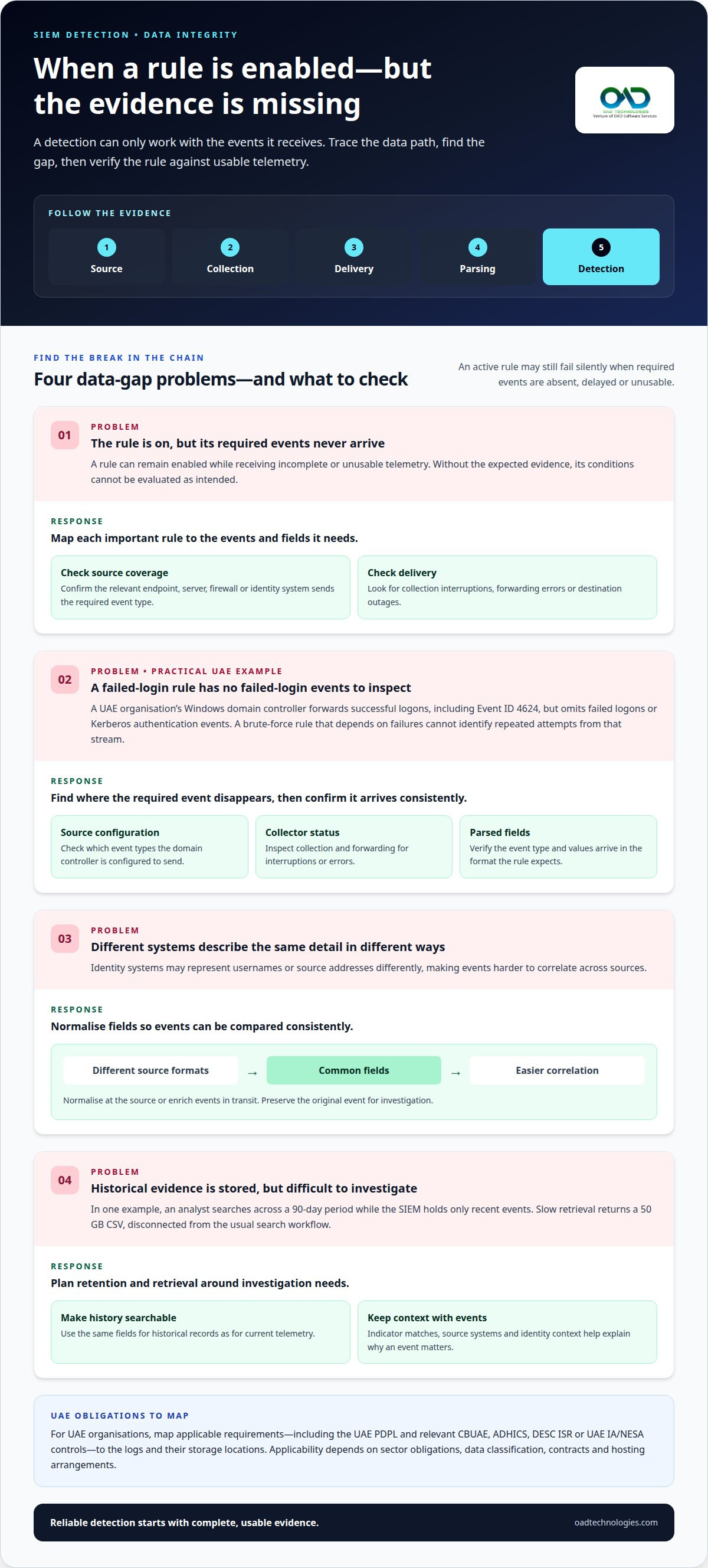
For UAE organisations, SIEM compliance and data residency depend on applicable sector obligations, data classification, contracts and hosting arrangements. Map relevant requirements, such as the UAE PDPL and applicable CBUAE, ADHICS, DESC ISR or UAE IA/NESA controls, to the logs and their storage locations.
Rule Logic and Data Sources
A detection rule applies conditions, thresholds or correlations to events from sources such as endpoints, authentication systems, servers and network equipment. For example, a rule might correlate an unusual login time with activity on another system instead of alerting on either event alone. The result depends on reliable timestamps, consistent fields and context that separates normal operations from suspicious behaviour.
Effective tuning features are available across SIEM platforms that support editable detection logic, data mapping, testing and controlled deployment. Prioritise the capabilities that fit your data and operating model; OAD’s SIEM capabilities page describes its relevant offering.
Large language models can analyse rule logic and suggest changes, such as clarifying a condition or identifying a field mismatch. Treat each recommendation as a hypothesis: compare it with the intended behaviour, test it against representative events and review its effect on alerts. A suggested edit is not, by itself, evidence of detection effectiveness.
Automated deployment can reduce manual configuration work, but the sequence matters. Validate the rule and required fields in a test environment, approve the change, deploy it to the intended systems, then monitor the resulting alerts. Version control helps trace edits and restore an earlier configuration if the rule behaves unexpectedly.
Measuring Rule Performance
Assess rule performance by checking whether it fires on relevant events, how often it produces false positives and how much processing it requires. Compare alert outcomes with investigation findings, then review execution time and data volume. A resource-intensive rule that rarely identifies actionable activity may need narrower conditions or a better event source.
Review rules quarterly and after infrastructure changes, new integrations or incident investigations. These checkpoints help keep detection logic aligned with changing systems and lessons from real alerts.
Identifying data gaps that cause silent detection failures
A SIEM can generate an alert only when the required events reach its detection logic. Data gaps can be hard to spot because a rule may remain enabled while receiving incomplete or unusable telemetry. Trace events from their source through collection, transport and parsing, then compare the results with the rule’s required fields.
Consider a Windows domain controller that forwards successful logons, including Windows Event ID 4624, but omits failed logons or Kerberos authentication events. A brute-force detection rule that depends on failures cannot identify repeated attempts from that stream. The security team should examine source configuration, collector status and parsed event fields, then confirm that the required event types arrive consistently.
For each important rule, map the data path and inspect:
- Source coverage: confirm the relevant endpoint, server, firewall or identity system sends the required event type.
- Delivery: look for collection interruptions, forwarding errors or destination outages that could leave gaps.
- Parsing: compare field names, timestamps and values with the rule’s expected schema.
- Detection: use representative events to see whether the rule can evaluate its conditions.
Normalising data before SIEM ingestion makes events from different sources easier to correlate. Identity systems, for example, may represent usernames or source addresses differently. A consistent schema maps these variations to common fields while preserving the original event for investigation. Normalisation at the source is one option; enrichment in transit can also add useful context before storage.
Historical searches need their own data path. In one example, an analyst investigates an IP address across a 90-day period, but the SIEM holds only recent events. A slow retrieval process may return a 50 GB CSV, leaving the analyst to search a large, disconnected file. Define retention and retrieval workflows around investigation needs, and make historical records searchable with the same fields used for current telemetry.
Threat intelligence adds another layer of context. Sharing indicators of compromise between a SIEM and other security tools can help link an event to known malicious infrastructure. Enriching events with an indicator match, source system or identity context helps analysts understand why they matter, rather than treating each log entry in isolation.
Buffering protects event flow when a destination is temporarily unavailable. If a SIEM endpoint stops accepting data, for example, a collector can queue events locally and forward them when connectivity returns. Monitor queue growth and delivery status: a full buffer or failed replay can turn a temporary outage into a lasting detection gap.
For a UAE-based organisation, a practical review could trace a failed-login event from a branch identity system through its collector into a rule. Confirm the event arrives, retains its timestamp and user fields, and remains searchable during an investigation. Tracking that path helps distinguish a quiet environment from a broken feed.
Reducing SIEM ingestion costs while retaining detection coverage
Control ingestion by assessing each event stream’s detection value rather than excluding data indiscriminately. When optimising SIEM rules for better detection, retain evidence that supports critical alerts while removing duplicate and low-value telemetry.
Reducing False Positives
False-positive reduction means refining alert conditions so routine activity is less likely to trigger unnecessary investigations. Reviewing recurring alerts can reveal noisy fields, overlapping rules and thresholds that no longer reflect normal activity. Adjusting those conditions can reduce alert volume and improve analyst focus, but filtering an entire source may hide an incident. Preserve the events that support critical detections.
Start with the investigation outcome, then trace the condition that produced the alert. If an approved administrative task repeatedly triggers a rule, scope the exception to that activity, identity or system. Avoid blanket exclusions based only on a familiar event name. A narrow adjustment preserves detection of similar events elsewhere.
Tuning Practices and Common Mistakes
Good tuning connects each rule to an actionable outcome and tests changes against relevant events. Review overlapping detections, compare thresholds with incident findings and retest after every adjustment. A common mistake is raising thresholds simply to reduce alert volume. This can suppress low-frequency signals that matter, particularly when attackers spread activity across accounts or systems.
Document why a filter exists and which detections depend on the affected data. This helps security teams revisit the decision after an investigation or system change. Removing redundant rules can also reduce duplicate alerts, but retain distinct logic when separate rules detect different stages of a threat.
Many SOCs default to ingesting everything, yet a large share of stored telemetry never supports a detection or an investigation. That points to a selection problem, not a case for indiscriminate deletion. Assess sources against active rules, investigation needs and critical assets.
Build an event inventory that links each source to rules and operational use. Prioritise endpoint, identity, firewall, server and database events that support threat detection. Then identify duplicate records, low-value activity and events from environments or identities outside business relevance. Filtering such events at ingestion can reduce volume, provided teams first test its effect on detection coverage.
When optimising SIEM rules for better detection, validate ingestion changes against representative events before deployment. Replay examples of both common activity and less frequent threats, then compare rule outcomes before and after filtering. If an investigation relies on an excluded event, revise the filter or retain the data through another suitable collection path. Assess processing demand alongside alert quality so efficiency does not create a blind spot.
Attack simulation and detection validation
A SIEM rule is useful only if it detects the behaviour it was designed to identify. Attack simulation tests the logic with controlled activity or malicious data, then follows the signal through the platform, alert and response workflow. This reveals whether a detection works in practice, not just whether its configuration looks correct.
Map each detection to MITRE ATT&CK tactics and techniques before choosing a scenario. For example, test a rule intended to identify suspicious credential access with representative events for that behaviour. Confirm that the platform collects the expected telemetry, the rule’s conditions match it and the resulting alert gives analysts enough context to investigate.
A useful validation cycle follows the event from generation to response:
- Define the test: select a technique, the expected data sources and the specific SIEM rule.
- Generate test activity: use an approved simulation or controlled malicious data injection.
- Trace the signal: confirm events arrive, fields parse correctly and correlation logic evaluates them.
- Review the alert: assess its severity, evidence and usefulness to analysts.
- Test the hand-off: follow the alert through the SOC workflow to the appropriate response action.
A missing alert can point to different failures. If the source event never appears, investigate collection. If it arrives without a required field, inspect parsing and normalisation. If the rule evaluates the event but produces no alert, review its conditions and thresholds. Separating these issues helps teams fix the fault without weakening unrelated detections.
Testing the full workflow matters because detection alone does not complete incident handling. An alert should provide enough detail for analysts to understand the affected system, relevant activity and reason for escalation. Simulation can expose a broken hand-off, unclear ownership or response procedure that rule testing alone would miss.
Run weekly attack simulations against relevant real-world techniques, then repeat tests after each tuning iteration. Record the scenario, rule version, expected result and observed outcome. This helps the security team distinguish a genuine improvement from a change that merely reduces alert volume.
Use test results to improve coverage, not to chase a perfect score. A detection may identify one technique correctly but miss variations in event sequence or source data. Add representative variations to later tests and keep distinct rules for distinct behaviours. This makes correlation logic more resilient as systems and attacker techniques change.
For a UAE organisation, a controlled simulation might test whether suspicious activity on a critical server generates the intended alert and reaches the right analyst workflow. Use authorised scenarios, defined success criteria and documented outcomes so each tuning decision is supported by operational evidence.
Severity, asset context, and risk-based prioritisation
Severity labels help sort SIEM alerts, but a label alone cannot show business impact. An alert involving a critical database may require a different response from the same event on a test workstation. Adding asset value, system criticality and user role to detections gives analysts context to assess potential compromise and prioritise actual risk.
Set severity using more than the rule name. Consider the event source, behaviour, affected asset and identity context together. A failed access attempt against a public-facing web server may warrant closer attention if it coincides with unusual administrative activity. The same event from a known service account on a routine maintenance system may merit a different priority, depending on the surrounding evidence.
Useful context can include:
- Asset value: distinguish systems that support essential operations from lower-impact devices.
- System criticality: identify endpoints, web servers, firewalls, databases and domain controllers that warrant priority monitoring.
- User role: assess whether the account has administrative access or performs a sensitive function.
- Event details: interpret the detection alongside its source, type and related activity.
Risk scoring makes these factors useful in triage. A score should reflect potential impact and relevant evidence, not simply count alerts or rate every event as high risk. For example, unusual activity involving a privileged account and a critical server can rank above an isolated anomaly on a non-critical device. Analysts can then focus response effort on alerts with greater potential consequences.
Keep scoring logic explainable. Record which asset attributes, roles and event conditions affect severity, and make those factors visible in the alert. If analysts cannot see why a detection was prioritised, the score may slow investigation rather than guide it. Review incident outcomes and update the context when asset classifications or user responsibilities change.
For a UAE-based logistics operator, a detection involving its shipment-management platform could receive higher priority if the affected server supports essential operations. Assess the event alongside the account involved, the system’s role and related network activity. This gives the security team a clearer basis for deciding whether to investigate immediately or handle the alert through routine triage.
Context also connects detection to business impact. It helps analysts distinguish a possible compromise of a critical service from routine activity, while keeping lower-risk alerts visible for later review. Strong prioritisation does not replace investigation; it helps teams direct attention where the evidence and potential consequences justify it.
OAD Technologies: Security Information and Event Management (SIEM)
OAD Technologies provides Security Information and Event Management (SIEM) to help organisations bring security events into a more useful detection and investigation process. This service may be relevant when rules generate excessive noise, critical data sources are difficult to assess or alerts lack the context analysts need to prioritise a response.
SIEM work can focus on aligning detection logic with available telemetry, reviewing alert conditions and connecting events to asset and risk context. For a UAE organisation, this could mean refining how activity involving a critical business system is surfaced, making its significance clearer during triage. The right tuning priorities depend on the organisation’s systems, data and security objectives.
Contact OAD Technologies to discuss your SIEM detection requirements.
Make Detection Tuning Part of Ongoing Improvement
Detection quality should evolve as systems, users and business priorities change. Treat optimising SIEM rules for better detection as ongoing work, not a one-off clean-up. Use investigation outcomes to guide future adjustments and keep rule decisions aligned with the risks that matter to your organisation.
OAD Technologies can support this work through SIEM and Managed Detection and Response (MDR). Data Loss Prevention (DLP) can help address risks involving sensitive information, while Vulnerability Assessment and Penetration Testing (VAPT) can identify weaknesses that inform defensive priorities. Together, these capabilities can contribute to a more connected view of detection and exposure, shaped around your environment and operational needs.
With clear priorities and measured refinement, your detection programme can keep pace with change and give security teams a stronger basis for action.
Frequently Asked Questions
How Does Rule Tuning Reduce False Positives?
Rule tuning reduces false positives by narrowing conditions that routinely match legitimate activity. For example, a detection for repeated account access might exclude a documented, approved service process while retaining alerts for comparable activity from other accounts. Base changes on investigation outcomes, not simply to silence an inconvenient rule. This keeps alert handling focused while preserving visibility of activity outside the approved pattern.
Prioritising Alerts: What Deserves Attention?
Prioritise alerts by weighing the evidence, the affected system’s business role and the potential consequences of compromise. An alert involving a privileged account accessing sensitive records may deserve faster investigation than an isolated, low-impact anomaly. Check whether related alerts point to the same user, device or sequence of activity. This helps analysts recognise connected behaviour instead of assessing each notification without operational context.
What Is a SIEM Alert?
A SIEM alert is a notification generated when collected security events match a configured detection condition. It may represent a single event, such as an unusual authentication, or a correlation across several sources. An alert is a signal to assess, not proof of compromise. Analysts need the underlying event details, affected identities and system context to decide whether activity is expected, suspicious or requires escalation.
Why Do Out-of-the-Box SIEM Rules Fall Short?
Out-of-the-box rules are designed for broad use, so their assumptions may not match an organisation’s applications, user roles or routine operations. A rule may expect fields that a particular source labels differently, or treat legitimate administration as suspicious. Tailoring rules to local systems and approved activity makes detections more relevant. Newly deployed integrations also need review because their event formats may differ from existing feeds.
How do you reduce false positives in SIEM rules without missing threats?
Use investigation evidence to adjust the smallest relevant part of a rule, then assess the effect against both routine and suspicious examples. Avoid broad exclusions for an entire user group, event type or network range. For instance, scope an exception to a specific approved process while keeping similar activity from other sources visible. Retain the data needed to revisit decisions if an incident reveals new behaviour.
How can SIEM rule effectiveness and detection coverage be measured?
Assess effectiveness by comparing alerts with investigation outcomes: which detections led to useful findings, and which repeatedly matched benign activity? Review coverage by mapping important attack behaviours to the rules and data sources intended to detect them. Mean time to detect and mean time to respond can show operational trends, while rule execution and alert volumes can reveal performance issues. Interpret these measures together, not in isolation.
How do you tune SIEM rules using threat intelligence and MITRE ATT&CK?
Map each detection to the relevant MITRE ATT&CK behaviour, then identify the events and conditions that support it. Threat intelligence can add context, such as whether an observed indicator is associated with suspicious infrastructure. Treat an indicator match as evidence to investigate, not a verdict. Correlate it with identity, endpoint or network activity, and refine the rule if that combination makes investigations more relevant.
What steps are involved in testing and validating SIEM detection rules?
Define the behaviour the rule should detect, select representative test events and confirm that the platform processes them as expected. Check whether the alert includes useful evidence, then follow its hand-off through the investigation workflow. Record the rule version and test outcome so later changes can be compared. Include a benign example alongside a suspicious one to help identify both missed detections and unwanted alerts.
Disclaimer
Content by OAD Technologies is for general informational purposes only and does not constitute professional or cybersecurity advice. No warranties are made regarding accuracy or completeness; reliance is at your own risk. OAD Technologies shall not be liable for any direct or indirect losses arising from use of this content.