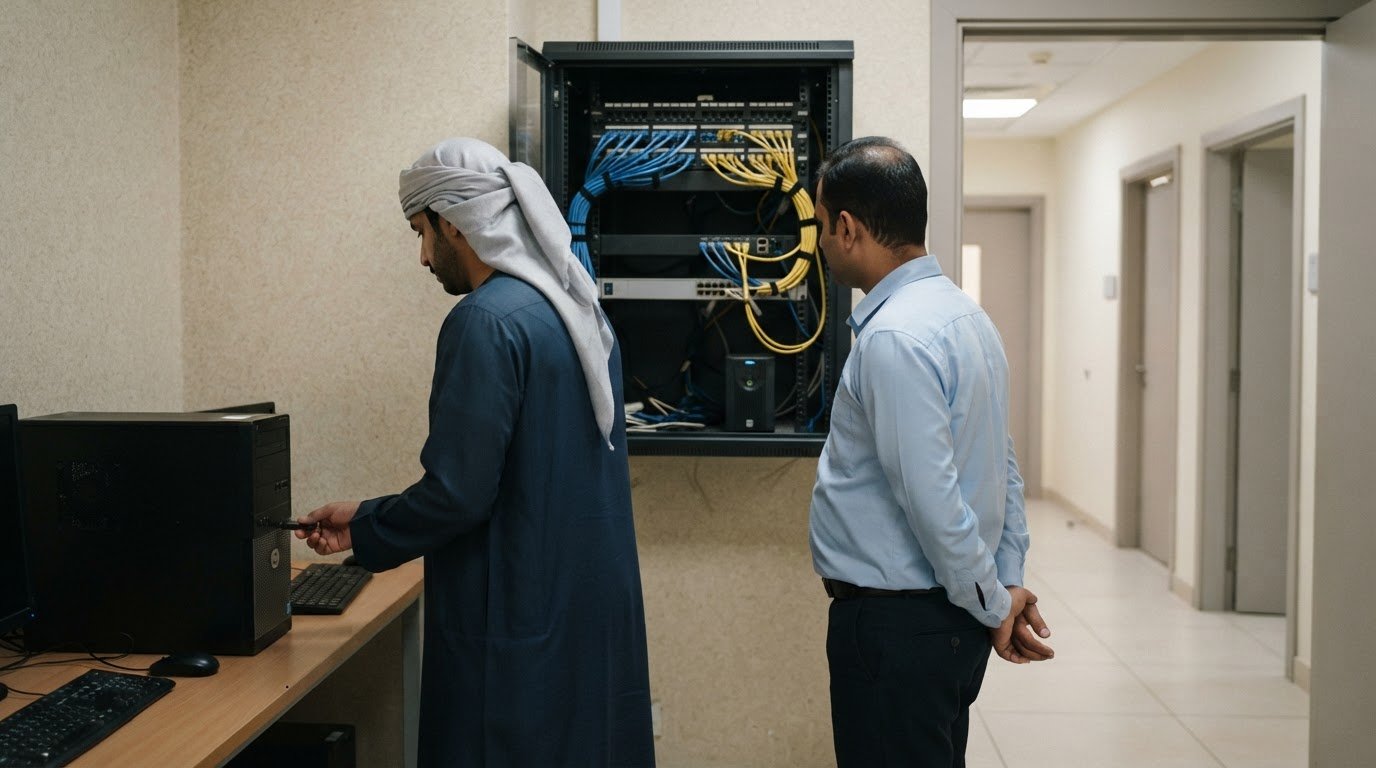
Healthcare providers within ADHICS scope must meet its applicable information security requirements. ADHICS compliance means assessing how patient information and healthcare systems are protected, addressing security gaps and keeping evidence that controls work in practice.
Meeting a healthcare cybersecurity standard should be more than a documentation exercise. A structured approach helps an organisation understand its risks, strengthen access to sensitive data and improve how it responds to security incidents.
This guide explains ADHICS and how to approach gap assessments, risk analysis, ongoing monitoring and audit readiness. It also shows how these activities can support resilient operations, and how cybersecurity and governance support can turn requirements into practical improvements.
Key Takeaways
- Map ADHICS controls to the systems, workflows and teams that handle healthcare information.
- Use a gap assessment to identify weaknesses, then prioritise remediation according to risk to patient data and services.
- Keep audit evidence current by connecting compliance checks with routine security monitoring and internal reviews.
- For a practical UAE example, include a clinic’s patient-record access and data-sharing processes in its risk analysis.
- When internal teams need technical support, consider how DLP, VAPT, MDR or SIEM can address specific security and compliance needs.
What is ADHICS Compliance?
ADHICS sets information security and cybersecurity controls for healthcare organisations within its scope. Implementing them means connecting written policies, technical safeguards and ongoing risk management across clinical systems, staff accounts and information flows.
Policies and Technical Safeguards
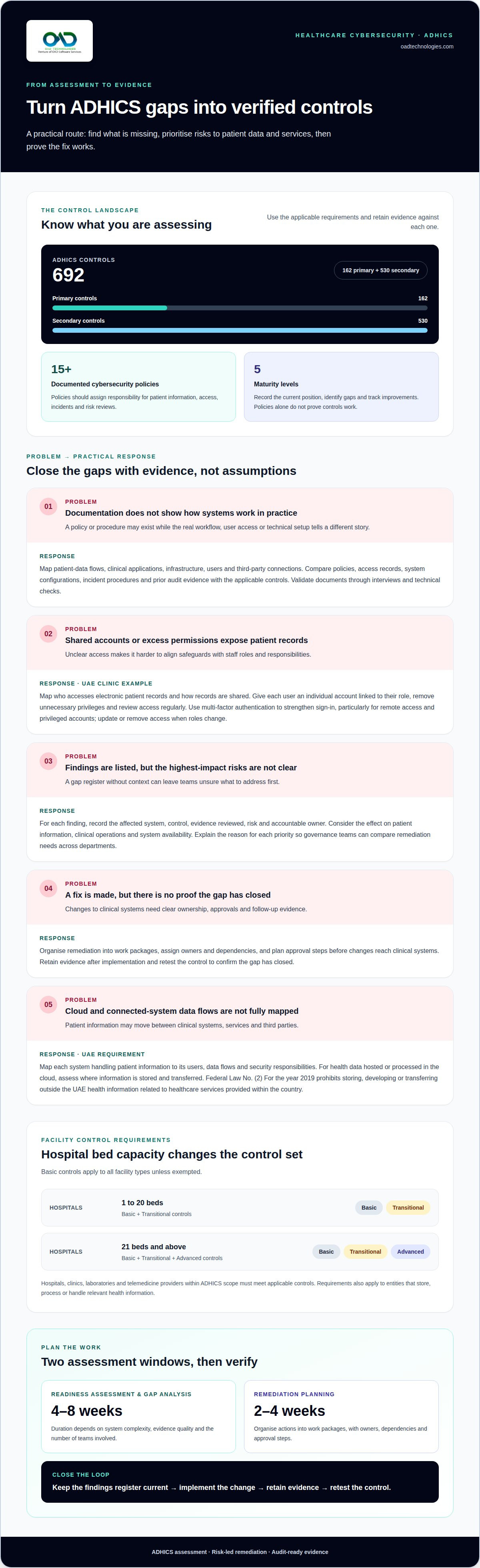
ADHICS v2.0 mandates 15+ documented cybersecurity policies. Policies should assign responsibility for protecting patient information, managing access, handling incidents and reviewing risk. Technical controls put those rules into practice across clinical systems, staff accounts and connected services.
A gap assessment can uncover issues such as shared accounts, excessive permissions or outdated procedures. Assign an owner to each finding, document remediation and retain evidence of changes. For example, a clinic can map who accesses electronic patient records, remove unnecessary privileges and review access regularly.
Identity management should give each user an individual account linked to their role. Use multi-factor authentication to strengthen sign-in, particularly for remote access and privileged accounts. Review access when roles change, and remove accounts when access is no longer needed. These steps help align access controls with documented security policies.
ADHICS Scope and Requirements
Hospitals, clinics, laboratories and telemedicine providers within ADHICS scope must meet the applicable controls. Requirements also apply to entities that store, process or handle relevant health information. Payers, including insurers and third-party administrators, must meet Basic, Transitional and Advanced controls.
Facility requirements vary: hospitals with 1 to 20 beds must meet Basic and Transitional controls; hospitals with bed capacity of 21 and above beds must meet Basic, Transitional and Advanced controls. Basic controls apply to all facility types unless exempted. Map each system handling patient information to its users, data flows and security responsibilities.
For health data hosted or processed in the cloud, assess where information is stored and transferred. Federal Law No. (2) For the year 2019 prohibits storing, developing or transferring outside the UAE health information related to healthcare services provided within the country. Providers can also consider their clinical systems and operating context through this healthcare industry page.
Standards, Comparisons, and Consequences
ADHICS contains 692 controls, including 162 primary controls and 530 secondary controls. ADHICS v2.0 is the current version identified here; implementation should use its applicable controls and documented requirements. Its cybersecurity domains address information protection, access management, risk, incident response and vulnerability management.
ADHICS is specific to healthcare, while ISO/IEC 27001 is an information security management systems standard aligned with it. UAE Information Assurance is a separate reference point for information assurance; it does not replace healthcare-specific ADHICS controls. Organisations should map shared requirements while retaining evidence against each applicable standard.
The five ADHICS maturity levels help organisations assess how controls are implemented. Record the current position, identify gaps and track improvements; policies alone do not prove that controls work. The Department of Health may impose fines, operational restrictions and suspension of services for non-compliance.
Gap assessment and risk analysis
A useful ADHICS gap assessment compares documented controls with how healthcare systems operate in practice. Start by mapping patient-data flows, clinical applications, infrastructure, users and third-party connections. Then assess whether governance, technical safeguards and staff procedures address risks to each asset. The findings should identify gaps, explain their operational impact and assign clear remediation owners. This gives healthcare organisations a practical basis for prioritising control weaknesses.
Build an evidence-based gap assessment
Gather policies, access records, system configurations, incident procedures and previous audit evidence. Compare each item with the applicable ADHICS controls, recording whether it is implemented, partly implemented or missing. Validate documents through interviews and technical checks: a policy alone cannot show that a control works.
Readiness assessment and gap analysis typically take 4-8 weeks. The duration depends on system complexity, evidence quality and the number of teams involved. Keep a findings register that names the affected system, control, evidence reviewed, risk and accountable owner. This creates a traceable route from assessment to remediation and supports governance oversight.
Prioritise risk and plan remediation
Assess each finding by considering its effect on patient information, clinical operations and system availability. A vulnerable system connected to patient records may need more urgent attention than an isolated administrative application. Record the reason for each priority so governance teams can understand decisions and compare remediation needs across departments.
Remediation planning typically takes 2-4 weeks. Organise actions into practical work packages, such as correcting excessive access, strengthening encryption, closing unnecessary network paths or improving backup procedures. Assign dependencies and approval steps before changes reach clinical systems. After implementation, retain evidence and retest the control to confirm the gap has closed.
Test vulnerabilities and strengthen people
Technical assessment can uncover weaknesses that policy reviews miss. Review system configurations, exposed services, software updates and connections between clinical devices and other networks. Authorised vulnerability assessment and penetration testing can examine weaknesses within an agreed scope. Add the findings to the same risk register rather than leaving them in a separate technical report.
System hardening should follow assessed risks: remove unused services, apply appropriate updates and restrict access to necessary users. For healthcare organisations, test changes carefully against clinical workflows. For example, a UAE clinic can review a patient-facing appointment platform’s authentication, data handling and system dependencies, then document corrective actions without interrupting booking operations.
Staff behaviour also affects cybersecurity. Train employees to recognise suspicious messages, handle patient data carefully and report unusual activity through established procedures. Use assessment findings to focus training on weaknesses such as unsafe file sharing or poor account practices. Reassess controls after system changes, incidents or new data flows so risk analysis remains ongoing, not a one-off exercise.
Compliance monitoring and audit readiness
Audit readiness depends on reliable evidence, assigned responsibilities and controls that remain effective after assessment. Abu Dhabi providers can make information and cyber security part of routine governance, rather than a last-minute document exercise.
Compliance Documentation and Submission
Maintain controlled records of ADHICS policies, risk assessments, control evidence, approvals and remediation actions. Each document should name its owner, review status and related system or process. A clear evidence index helps teams retrieve records for audits, licensing processes and renewals.
Include ADHICS requirements in existing audits and the licence registration and renewal process. Link each control to evidence of how it operates, such as an approved policy, access review or incident exercise. Record exceptions and corrective actions alongside the evidence, so reviewers can see both the current position and the response.
Certification criteria include five maturity levels, from Level 1 to Level 5. The Department of Health typically expects Abu Dhabi healthcare facilities to reach at least Level 3 maturity across all ADHICS control domains for full compliance. Use a maturity record to show control status, supporting evidence and remediation progress, rather than relying on policy documents alone.
Audit and certification typically take 4-6 weeks. The cost depends on the assessment scope, facility complexity, evidence readiness and remediation needs; pricing is provided after a quote request. Maintaining an evidence register before the audit can make gaps visible earlier and help teams direct effort towards unresolved controls.
Continuous Monitoring and Audit Preparation
ADHICS compliance audits are conducted annually. Between audits, monitor changes to systems, user access, security incidents and control evidence. Assign each task to a named role, record its outcome and escalate findings through governance channels. This provides an ongoing view of information security rather than a snapshot taken during audit preparation.
Use internal reviews to check that policies reflect current operations. For example, compare a clinic’s access policy with the accounts and permissions used in its patient-record system. When staff duties or systems change, update relevant documentation and assess whether controls still address the associated risks.
Prepare for government inspections by organising evidence and assigning staff who can explain each control. The preparation guidance identifies a 30-40-day timeframe before government inspections. Use that period to check document versions, locate outstanding findings and confirm that corrective actions have supporting evidence.
Ongoing monitoring helps teams spot control failures and emerging threats between formal audits. Track remediation through to closure, retain review records and retest corrected controls. This gives auditors a clearer picture of how policies work in practice and helps healthcare teams maintain governance as systems and workflows evolve.
Managed security service providers and compliance support
External security support can add capacity to a healthcare team, but accountability and clinical decisions remain with the organisation. Before a provider accesses healthcare information or systems, define responsibilities, access boundaries and reporting routes.
Set clear roles and governance
Assign an internal owner for ADHICS governance, with named contacts for IT, clinical operations, privacy and incident response. Document who approves access, accepts remediation risks, escalates security events and maintains evidence. Record a managed provider’s responsibilities alongside internal duties; external support does not replace organisational oversight.
Written policies should set expectations for monitoring, incident handling, access to logs, change approvals and information sharing. Define the systems in scope and how findings are reported. For example, a hospital can require operational teams to review a provider’s alert, record their decision and escalate potential patient-care impacts through an agreed internal route.
Managed security support can help with log analysis, patch management and incident reporting, which may add to the workload of internal healthcare IT teams. Agree how findings enter the organisation’s risk and governance processes. Give a provider only the access required for assigned tasks, while the healthcare organisation retains oversight of accounts and permissions.
Account for connected healthcare technology
AI tools, Internet of Medical Things (IoMT) devices and telehealth platforms create distinct information flows and dependencies. Inventory the data they process, the systems they connect to and the teams responsible for them. Then assess access, configuration, logging and supplier connections against the organisation’s security policies.
For each IoMT device, document its network connection, update process and operational owner. Segment connected medical devices onto dedicated networks, apply firmware updates and remove unused services. For telehealth, review how patient information moves between the platform, staff accounts and clinical records. Include AI tools in governance reviews by documenting their purpose, access and data handling.
Give Malaffi connections explicit attention in the system inventory. Map connection points, authorised users, information exchanged and monitoring responsibilities. Check that security controls and incident procedures cover the integration, then retain evidence of reviews and approved changes. This helps teams manage the connection as part of the wider healthcare information environment.
Use external support with defined boundaries
Choose support according to the organisation’s control gaps and internal capabilities. Define the work scope, reporting formats, escalation routes and evidence requirements before granting access. Review performance through governance meetings and track actions to closure. These steps help hospitals combine specialist monitoring with staff knowledge of clinical workflows.
The Department of Health-Abu Dhabi provides official ADHICS guidance. Use its published standard and current assessment information to identify approved assessors and understand the scope of their work.
Benefits of ADHICS compliance
For Abu Dhabi healthcare organisations, ADHICS compliance can make information security part of operational decision-making, not just audit preparation. Its value comes from applying relevant controls to real workflows, patient data and systems supporting care.
Stronger protection for patient data
Documented access controls, encryption and incident procedures give teams practical safeguards for healthcare information systems. For example, an organisation can map which roles need access to patient records, remove permissions that no longer match responsibilities and retain evidence of the review. These measures help reduce avoidable exposure and support a consistent response to suspicious activity.
No control removes every security risk. Clear responsibilities and rehearsed response procedures can, however, help teams identify, contain and assess potential breaches systematically. A hospital can use an incident exercise to clarify who escalates an alert, who assesses its effect on clinical services and who preserves relevant records.
Better operational visibility and resilience
ADHICS controls encourage organisations to connect cybersecurity risks with service delivery. Mapping important systems and dependencies helps leaders understand which issues could affect patient care. If an appointment-scheduling system becomes unavailable, for example, documented continuity procedures can guide staff to approved alternatives while technical teams investigate.
Ongoing monitoring helps teams identify changes, control failures and emerging threats between formal reviews. Assign responsibilities, record findings and route unresolved issues through governance. This gives decision-makers a clearer operational picture, helping them weigh security improvements against clinical priorities instead of treating every finding in isolation.
Clearer accountability and informed investment
Clear ownership connects security policies with everyday practice. The Department of Health-Abu Dhabi’s requirements provide a healthcare-specific reference for reviewing controls, while internal governance assigns responsibility for maintaining them. Teams can track findings from discovery through remediation and show how decisions were made.
That record also supports more focused investment. Before prioritising work, an organisation can compare identified risks, system importance and remediation dependencies. For example, a healthcare provider planning a telehealth workflow can assess patient-data handling, access needs and incident processes before expanding its use.
Consistent measures can show patients and partners that information security receives structured attention. The practical takeaway is to treat ADHICS as an ongoing operating discipline: connect each control to an owner, evidence and a review process, then improve it as systems and care workflows change.
OAD Technologies: Data Loss Prevention (DLP)
OAD Technologies supports healthcare providers with Data Loss Prevention (DLP) to help manage risks involving sensitive patient information. Vulnerability Assessment and Penetration Testing (VAPT) can identify technical weaknesses, while Security Information and Event Management (SIEM) and Managed Detection and Response (MDR) support security monitoring and incident response.
The right combination depends on your systems, identified risks and internal security capabilities. For example, a provider reviewing access to and sharing of patient records can consider DLP alongside assessment and monitoring measures, aligning technical work with its ADHICS priorities.
Contact OAD Technologies to discuss your healthcare cybersecurity requirements.
Build security into the next stage of care
Healthcare systems change as providers introduce digital services and new connections. Treat ADHICS compliance as an ongoing part of those decisions, not a checkpoint completed once. Bring clinical, technical and governance teams together when planning system changes, so information flows, responsibilities and safeguards are considered alongside operational needs.
For a provider planning a digital workflow, connect its specific risks with practical security work. OAD Technologies offers Data Loss Prevention (DLP), Vulnerability Assessment and Penetration Testing (VAPT), and Managed Detection and Response (MDR). These services can support information protection, technical assessment and detection as part of an organisation’s ADHICS compliance efforts.
A focused discussion can help translate ADHICS compliance priorities into a practical direction for your healthcare environment. Start with your teams’ needs and the systems they rely on, then keep improving as those needs evolve.
With clear ownership and a practical plan, your organisation can continue strengthening security as care evolves.
Frequently Asked Questions
What is ADHICS?
ADHICS is a healthcare-sector information and cybersecurity standard that sets controls for protecting health information. It gives healthcare organisations a sector-specific basis for evaluating systems, responsibilities and safeguards. A practical starting point is to trace one patient record from registration through clinical use, storage and authorised sharing, then identify the controls relevant to each stage. This connects security requirements with clinical workflows rather than relying on a generic cybersecurity checklist.
How long does ADHICS implementation take?
ADHICS implementation typically takes 2-6 months, depending on an organisation’s current security posture. The work may take longer when systems are complex, evidence is incomplete or remediation involves clinical services. A provider with several connected platforms, for example, may need to coordinate changes across technology and care teams. Clear scope, assigned owners and a prioritised action plan help organise implementation around operational needs.
How many controls are there in the standard?
ADHICS contains 692 controls: 162 primary controls and 530 secondary controls. The count alone does not show which requirements apply to a particular facility. Map applicable controls to responsible teams and relevant evidence, then track coverage in a working register. This helps compliance leads see which requirements need attention while keeping detailed control references accessible during internal reviews and audit preparation.
What does ADHICS stand for and what is its purpose?
ADHICS stands for the Abu Dhabi Healthcare Information and Cyber Security Standard. Its purpose is to strengthen cybersecurity across Abu Dhabi’s healthcare sector and protect health information from breaches and unauthorised access. A telemedicine provider, for example, can assess how patient information moves between consultations, staff systems and records. The standard brings healthcare-specific security expectations into organisational governance and technical practice.
How can an organization achieve ADHICS compliance step by step?
Organisations can make progress through a sequence of practical actions:
- Define the facility scope, systems and health-information flows.
- Map applicable controls and gather evidence of implementation.
- Assess gaps and prioritise risks to patient information and services.
- Assign remediation owners, implement safeguards and retain evidence.
- Review control performance and prepare for audits.
Before launching a digital appointment service, for example, a clinic can map its information flows and apply relevant ADHICS compliance controls to the process.
What documents and evidence are required for an ADHICS audit?
Audit evidence should show how relevant controls are designed, approved and applied. A useful evidence set includes current security policies, system and data-flow records, access-review documentation, risk registers, incident procedures, training records and technical review evidence. Keep versions and approvals traceable. Auditors should be able to connect a patient-record access policy with records showing how user permissions are managed.
Who conducts ADHICS assessments and how often are they required?
Internal compliance, information-security and IT teams can conduct readiness reviews, with external assessors supporting assessment work. ADHICS compliance audits are conducted annually, and requirements are incorporated into existing audits and licensing registration and renewal processes. The Department of Health-Abu Dhabi may also inspect facilities. Organised assessment records and corrective-action evidence help teams explain control decisions during reviews and support ongoing ADHICS compliance.
Disclaimer
Content by OAD Technologies is for general informational purposes only and does not constitute professional or cybersecurity advice. No warranties are made regarding accuracy or completeness; reliance is at your own risk. OAD Technologies shall not be liable for any direct or indirect losses arising from use of this content.