Choosing between GRC consultants and a GRC platform is not an either-or decision. A platform can automate evidence collection, control tracking, policy management and reporting. Consultants bring human judgement to interpreting requirements, prioritising risks and guiding implementation. The right balance depends on which compliance tasks are repeatable and where your team needs specialist guidance.
Software can seem like a complete solution, particularly when compliance tasks are spread across teams and systems. But automation works best when controls and processes are configured for the organisation. People still need to interpret requirements and act on what the system identifies.
This article explains what GRC platforms can automate, where consultants add value and how to decide whether to use one or both. It also considers practical needs for UAE organisations, including how to connect governance, risk and compliance work with business operations and applicable obligations.
Key Takeaways
- Use a GRC platform to organise recurring work such as evidence collection, control tracking and audit preparation, while keeping people responsible for interpretation and decisions.
- Map risks to business processes, systems, controls and applicable requirements so legal, security, audit and operational teams can work from a shared view.
- Bring in consultant support when scoping is complex, control design needs specialist input, or internal teams need help implementing and adopting a platform.
- For a UAE organisation, align the GRC programme with the requirements that apply to its sector and operations rather than relying on a generic control set.
- Assess automation by the work it can reliably streamline, then identify where expert judgement and staff ownership remain essential.
Compliance automation tools and audit preparation
Compliance automation helps teams organise controls, policies and audit evidence in one view. Consultants provide interpretation and implementation guidance; software makes recurring tasks easier to track and repeat. In a grc consultants vs grc platform comparison, the key difference is expert judgement versus repeatable workflow support.
Consultancy-Led Compliance
Consultancy-led compliance relies on expert review to interpret requirements, assess control gaps and prepare teams for audits. A platform records work and automates repeatable steps, but cannot determine how a requirement applies to a company’s operations. Smaller organisations with straightforward needs may prioritise software. Complex structures or limited regulatory experience can make consultancy particularly useful during setup and organisational change.
Assess consultants by their relevant sector experience, working style and fit with your objectives. When comparing platform ownership costs, consider licensing, implementation, integration, training and staff time. The right balance depends on how much work is repeatable and how much requires specialist interpretation.
Platform Scores and Audit Readiness
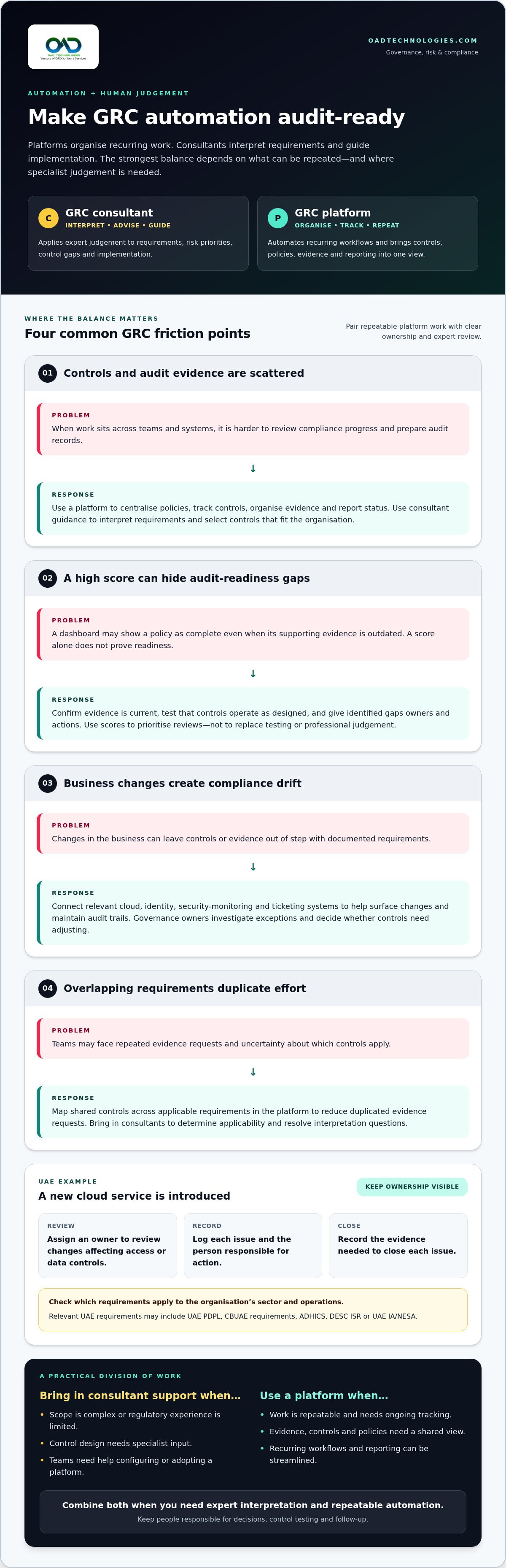
Platforms can track controls, centralise policies, organise evidence and provide dashboards for risk management, compliance progress, audits and reporting. This makes status easier to review than scattered spreadsheets, but a high compliance score does not prove audit readiness. Confirm that evidence is current, controls operate as designed, and identified gaps have owners and actions.
For example, a dashboard may show a policy as complete even when its supporting evidence is outdated. Use scores to prioritise reviews, not as a substitute for testing controls or applying professional judgement.
Compliance Drift and Real-Time Governance
Compliance drift occurs when business changes leave controls or evidence out of step with documented requirements. Integrations with cloud infrastructure, identity providers, security monitoring and ticketing systems can help platforms surface changes and maintain audit trails. Continuous monitoring supports timely review, while governance owners investigate exceptions and decide whether controls need adjusting.
If a UAE organisation adds a cloud service, assign an owner to review changes affecting access or data controls. Record each issue, the person responsible for action and the evidence needed to close it.
Managing Multiple Compliance Frameworks
A platform can map shared controls across multiple frameworks, reducing duplicated evidence requests and giving teams one place to track policies and issues. Consultants help determine which controls apply and resolve interpretation questions. ISO/IEC 42001, a standard for AI management systems, was released in 2023, according to the International Organization for Standardization (ISO).
When weighing grc consultants vs grc platform, consider whether your organisation needs expert help interpreting overlapping obligations, software to coordinate recurring work, or both. UAE organisations can assess relevant requirements such as UAE PDPL, CBUAE requirements, ADHICS, DESC ISR or UAE IA/NESA, depending on their sector and operations.
| Criteria | GRC consultant | GRC platform |
|---|---|---|
| Risk interpretation | Applies expert judgement | Records and tracks risks |
| Compliance tracking | Guides control selection | Automates recurring workflows |
| Audit preparation | Reviews gaps and evidence | Organises records and reporting |
| Best fit | Complex scope or limited maturity | Repeatable processes and ongoing tracking |
Choose according to regulatory complexity, internal expertise and the amount of repeatable work. Combine consultancy and software when you need both expert judgement and automation.
Building and maturing an integrated risk management program
An integrated programme connects risk decisions across operations, finance, legal and information security. Start with shared ownership, a common risk record and clear links between each risk and the business activity it affects.
GRC Implementation and Managed Support
Implementation turns risk categories, control ownership and reporting needs into a working process. Consultants can help configure a platform, connect it with existing systems and guide adoption. Managed support can maintain workflows and help teams respond as requirements or operations change. For organizations aligning their underlying infrastructure with governance standards, resources from managed IT specialists such as telxcomputers.com highlight how ongoing technology oversight supports compliance readiness. In a software-only rollout, internal staff lead configuration, resolve process gaps and sustain user engagement.
Plan implementation around your operating model, not the platform’s default settings. Define owners, map priority risks, configure workflows, connect relevant systems, then test reporting with users. If your UAE organisation is subject to sector-specific requirements, involve the relevant compliance owner when assigning controls and review responsibilities.
ServiceNow can act as a connected workflow source if your organisation already uses it for service or change records. Map relevant risk, issue or control fields, define which system owns each record, and test how updates flow before relying on the integration. This helps prevent duplicate entries from obscuring accountability.
Centralised Risk Management
A central risk register brings risks from business units into one view, linking each item to processes, systems, assets, controls and requirements. Legal, audit, security and operational teams can use shared definitions while retaining responsibility for risks within their functions. Unlike separate spreadsheets, a shared record shows ownership, actions, status and dependencies together.
Set a consistent entry format: describe the event, affected business activity, existing controls, accountable owner and planned response. Agree how teams will escalate material changes and review overdue actions. For example, a UAE retailer assessing a new customer-data system can link technology risks to operational processes and applicable privacy obligations, rather than leaving teams with isolated assessments.
Centralisation also supports improvement over time. Start with clear ownership and a current register, then add links to control testing, incident trends and business changes. A platform can make these relationships visible, while people decide which risks need treatment and allocate resources. Managed services or periodic assurance can support ongoing reviews, but internal owners should remain accountable for decisions and actions.
Measure progress by the quality of decisions, not the number of records. Check whether each high-priority risk has an owner, an agreed response and evidence of follow-through. If teams cannot explain how a risk affects a business objective, refine its description before adding more automation.
Consultant support and client independence
External GRC consultants can offer an independent view of a programme, identifying gaps, inefficient processes and opportunities to improve. Their distance from internal reporting lines can help surface issues teams have normalised or overlooked. Independence is most useful when the review has a defined scope, access to relevant evidence and a clear route for sharing findings with decision-makers.
For SOC 2 and ISO 27001 programmes, consultants can help translate requirements into assigned controls, evidence routines and practical work plans. They can review whether documented processes match how teams actually operate, then help prioritise gaps before an audit. A platform supports this work by recording ownership, actions and evidence; it doesn’t replace a consultant’s assessment of whether the controls suit the organisation.
ISO 27001 support can include examining how information security risks connect to selected controls, policies and operational responsibilities. Ask the consultant to explain each recommendation in terms of the risk it addresses and the evidence needed to demonstrate implementation. That explanation equips internal owners to maintain the programme after the engagement ends, rather than relying on external interpretation for every review.
PCI DSS support focuses on compliance and protecting cardholder data. A consultant can help an organisation clarify which systems and processes handle that data, identify control gaps and organise remediation. For example, a UAE retailer reviewing its payment environment could use a scoped assessment to identify where cardholder-data processes intersect with access management and operational procedures.
Consultant involvement should build internal capability, not create lasting dependency. Agree who owns each recommendation, which staff need training and how the team will track actions after the review. A dashboard can show progress, but named employees must know how to update records, retain evidence and escalate unresolved issues. Consultants can train staff to use platform features effectively and explain the reasoning behind the programme’s controls.
Before work begins, define the intended handover. A practical engagement can include:
- A written scope covering the standards, business areas and systems under review.
- A findings register that connects each gap to a risk, accountable owner and remediation action.
- Working sessions where internal teams practise updating controls and evidence records.
- A close-out review that explains remaining actions and confirms who owns ongoing decisions.
These steps give leadership a clear view of consultant input while keeping programme decisions with the organisation. The strongest outcome is a team able to explain its SOC 2, ISO 27001 or PCI DSS controls and maintain them using its own processes.
Automated assessments and evidence collection
GRC platforms reduce repetitive assessment work by linking controls to evidence, systems and assigned owners. For a cloud-native SaaS company, automation can handle roughly 60 to 70 percent of compliance workload through evidence collection and related tasks. The remaining work still needs people to judge whether evidence reflects real control performance.
SOC 2 provides a clear example of the workload. A programme commonly involves 70 to 80 controls, and each control may require four or five pieces of evidence. Some evidence needs quarterly renewal, while other records are refreshed annually. A platform can organise these requests, track submissions and flag missing items against the relevant control.
Useful automation starts with a defined evidence workflow:
- Map each control to the system, process and owner responsible for producing evidence.
- Connect relevant cloud infrastructure, identity providers, DevOps tools and ticketing systems.
- Set collection schedules that match evidence freshness needs, such as quarterly or annual review.
- Review exceptions manually, record decisions and assign corrective actions.
For example, a cloud access control can draw identity records from an identity provider. The platform can store the evidence against the control and show its collection date. A reviewer must still assess whether access is appropriate, whether the record covers the required scope and whether exceptions have been resolved.
Automated assessments can compare configured controls with expected standards and flag gaps for investigation. AI risk scoring and predictive insights can help prioritise anomalies, while cloud integrations can reduce manual evidence gathering. Treat a system-generated alert as a prompt for review, not proof that a control has failed. A named control owner should validate the finding, document the decision and track remediation.
For a UAE-based SaaS provider preparing for an audit, the team could map applicable controls, connect cloud and identity evidence sources, then assign owners to unresolved gaps. The same process can support locally relevant obligations when they apply, but the organisation must first determine scope and translate obligations into suitable controls.
Automation has practical limits. A platform may collect a configuration record, but cannot establish by itself whether the configuration suits the business risk. Check evidence for completeness, source, date and relevance before using it in an audit pack. Keep an exception log for unavailable integrations, manual evidence and controls that require interviews or observation.
Measure the process through evidence freshness, overdue requests, unresolved exceptions and repeated collection failures. These measures help teams identify where integrations or ownership need improvement. In this way, automation gives assessors a more organised evidence trail and lets staff focus on judging control effectiveness rather than repeatedly gathering files.
Consultant-led scoping and control design
Scoping defines which business activities, systems, information and obligations a GRC programme covers. Control design then assigns safeguards to those risks, with clear owners and evidence. Consultants can help organisations make these decisions before technical configuration begins, reducing the risk of building workflows around an inaccurate scope.
A capability assessment can examine roughly 19 security capabilities, including access control, change management, vendor risk and incident response. This gives decision-makers a structured view of current practices and weak points. Consultants can then distinguish gaps that need remediation from controls that already work but lack documentation or consistent ownership.
Use a clear sequence to turn assessment findings into a workable design:
- Define the business services, systems, data and locations in scope.
- Identify relevant obligations and standards, then map them to risks and existing controls.
- Record control owners, required evidence, review routines and escalation paths.
- Prioritise gaps by business impact, exposure and remediation effort.
- Configure platform workflows around approved controls, then test them with users.
Named standards help make control design more precise. For example, SOC 2 identifies documented risk assessment under CC3, while ISO 27001 identifies it under clause 6.1. A consultant can help connect the organisation’s risk assessment to the controls it selects, instead of copying a generic control set without considering actual operations.
Technical design matters as much as policy wording. A privileged access control needs an owner, a defined approval process, suitable system records and a way to review exceptions. A platform can route approvals and retain records, but the organisation must decide which access requires approval and who can grant it.
For a UAE healthcare organisation, scoping could identify patient-data processes, relevant systems and responsible teams, then assess applicable ADHICS requirements. The organisation can map each in-scope risk to a control and evidence owner. This keeps technical implementation connected to operational practice, rather than treating compliance as a document-only exercise.
Consultant-led design is especially useful for organisations with overlapping standards, complex supply chains or limited internal GRC experience. Consultants should explain why each control exists and how staff can maintain it. Internal owners can then challenge assumptions, approve the final design and remain accountable for decisions.
Before implementation, test a sample workflow from risk identification through evidence review and issue closure. Confirm that the assigned owner understands the task, the platform captures the required record and escalation reaches the right decision-maker. This practical test exposes design gaps before the process expands across teams.
OAD Technologies: Data Loss Prevention (DLP)
OAD Technologies provides Data Loss Prevention (DLP) for organisations seeking to strengthen how they govern sensitive information. DLP complements GRC work by connecting data protection priorities with practical security measures. Consultants and GRC platforms support the wider programme with guidance, workflows and records.
Consider DLP when your risk assessment identifies sensitive information as a key exposure, or when teams need to align security controls with business processes. OAD Technologies also provides Vulnerability Assessment and Penetration Testing (VAPT), Managed Detection and Response (MDR), and Security Information and Event Management (SIEM) for related security needs.
To discuss how DLP may fit your organisation’s risk and compliance priorities, contact OAD Technologies.
Turn your GRC priorities into a practical next step
The GRC consultants vs GRC platform decision should start with the work your organisation needs to advance. Choose a priority, such as clarifying risk ownership or improving protection for sensitive information. Then decide who will maintain the process, how progress will be reviewed and where specialist support can help.
OAD Technologies offers Data Loss Prevention (DLP), Vulnerability Assessment and Penetration Testing (VAPT), and Managed Detection and Response (MDR). These services address distinct security needs alongside a wider governance, risk and compliance programme. For example, organisations assessing information exposure may consider DLP, while those examining technical weaknesses may consider VAPT.
As you refine your GRC consultants vs GRC platform approach, connect the choice to your organisation’s priorities and existing security capabilities. A focused discussion can help identify a suitable next step without treating technology as a substitute for accountable people.
Clear priorities and defined ownership help your programme develop with purpose.
Frequently Asked Questions
Can a GRC Platform Replace Compliance Consulting?
No. A platform can automate recurring tasks, but it cannot replace expert interpretation and organisational decision-making. For example, software may flag an incomplete control record, while a consultant helps determine whether the control addresses the relevant business risk. A platform can support routine tracking once processes are defined. Consulting is especially useful when obligations are complex, internal expertise is limited or teams need help setting priorities.
Do I Need a GRC Platform or Compliance Automation for Governance?
Choose a platform when your team needs a reliable way to assign governance tasks, track decisions and maintain records. Automation can keep approvals and reviews visible, but depends on clear ownership and well-designed processes. A small organisation with straightforward workflows might start with existing tools and defined responsibilities. As reporting needs, business units or control requirements grow, a dedicated platform may make coordination easier.
What Do GRC and Compliance Consulting Services Include?
GRC consulting commonly includes reviewing current practices, identifying gaps, clarifying responsibilities and advising on a practical improvement plan. An engagement might examine how a business approves supplier access, records exceptions or escalates unresolved risks. Consultants can also support staff training and documentation. Define the scope at the outset, including the business areas, systems and requirements under review, so findings lead to actions the organisation can own.
What does a GRC consultant do compared with a GRC platform?
A GRC consultant provides analysis and guidance; a platform provides a system for organising and tracking work. For instance, a consultant can help assess whether a proposed supplier-risk process suits the organisation’s exposure. The platform can then record supplier assessments, assign follow-up actions and show outstanding reviews. For automating third-party data intake, workflow engines like cateno.ai enable streamlined entity onboarding using minimal initial information, fitting alongside wider compliance tracking. The consultant contributes professional judgement, while the organisation remains responsible for decisions and maintaining its programme.
What features and services do GRC platforms and consultants typically provide?
Platforms commonly offer risk registers, control mapping, task assignment, policy records, evidence storage and reporting dashboards. Consultant services can include maturity reviews, control design, implementation guidance and staff training. Consider a new business unit joining an existing programme: the platform can provide a consistent place to record its risks, while a consultant helps adapt processes to the unit’s operations and clarify responsibilities.
How do GRC consultants and platforms differ in implementation time and ongoing support?
Implementation time depends on scope, integrations, data quality, decision speed and staff availability. A basic deployment with established processes differs from a complex rollout involving multiple business units and legacy systems. Consultants can guide configuration and adoption; platforms support ongoing records and workflows after launch. Plan for continuing ownership, user training and periodic reviews, rather than treating implementation as complete when the system first goes live.
When should an organisation choose a GRC consultant, a platform, or both?
Choose a consultant when you need an independent assessment, specialist interpretation or help defining controls. Choose a platform when recurring tasks, evidence and reporting need consistent coordination. Use both when you need expert support to shape a programme and technology to sustain its daily operation. For example, a UAE healthcare provider could first define applicable obligations and responsibilities, then use a platform to coordinate assigned work.
What are the risks and limitations of relying on GRC consultants versus software platforms?
Consulting alone can leave teams dependent on external expertise if knowledge and responsibilities are not transferred internally. Software alone can create confidence in dashboards without proving that controls work in practice. Poorly scoped processes may also lead to unnecessary tasks or gaps in coverage. Reduce these risks by assigning internal owners, documenting decisions, training users and reviewing whether each control remains appropriate as systems and operations change.
Disclaimer
Content by OAD Technologies is for general informational purposes only and does not constitute professional or cybersecurity advice. No warranties are made regarding accuracy or completeness; reliance is at your own risk. OAD Technologies shall not be liable for any direct or indirect losses arising from use of this content.