
Hiring an analyst can look like the simpler budget choice, but one hire won’t automatically provide complete security coverage. For UAE organisations with 50 to 500 employees, the choice between managed security services and hiring staff depends on the balance of internal control, operating costs and the coverage the security programme needs. Replacing a departing security analyst can involve a six-month recruiting cycle, so continuity matters as much as the initial hiring plan.
Comparing salaries with a managed service fee is a useful starting point, but a sound cost plan also accounts for recruitment, tools, monitoring, incident response and the skills needed to run the programme. The right model depends on which capabilities your organisation needs in-house and where external support can extend them.
This article compares the two approaches across operating costs, security coverage, SOC monitoring and incident response. You’ll learn when an internal team may make sense, when managed support can fill capability gaps, and how a UAE business can weigh the trade-offs before deciding.
Key Takeaways
- Compare the full operating model, including recruitment, tools, skills coverage and continuity, rather than salary alone.
- Decide which security responsibilities need to stay under direct internal control and where external expertise can extend your team.
- Map monitoring and incident response responsibilities before selecting an in-house, managed or hybrid approach.
- Assess how a security provider’s access and role could affect your organisation’s supply-chain risk.
- Use your organisation’s risk profile, regulatory context and available internal capacity to shape a cost plan that can adapt as needs change.
Comparing managed services with hiring
Compare the models by the control, expertise and supplier dependencies each creates. A managed security services vs hiring staff decision should reflect how your organisation assigns accountability, not just who carries out each task.
Employees work within your organisation’s reporting lines and can build knowledge of internal processes. A managed provider works within an agreed scope, so governance must define what it can access and decide. The OECD recommends including third-party services with security implications in risk assessments. Consider supplier access, business dependencies and the consequences of service disruption.
For a UAE organisation, map relevant requirements before assigning responsibilities. The UAE PDPL may apply to personal data processing, while sector-specific controls may also be relevant. Depending on the organisation, these could include CBUAE requirements, ADHICS, DESC ISR or UAE IA/NESA. Identify applicable requirements and assign internal owners for oversight, evidence and decisions.
Managed Provider Selection Criteria
Assess a provider’s operational fit by reviewing its documented scope, information access and governance arrangements. Specify which business systems it may access, how its staff handle sensitive information and how your organisation will review its work. The OECD’s third-party risk guidance makes this assessment relevant to security-related services, not just conventional technology suppliers.
Set ownership before the service begins. Name the internal contact responsible for oversight, define how material changes are approved and establish how concerns reach accountable leaders. For example, a UAE education group can map a provider’s access to learning systems and student records, then assign internal owners to related decisions.
When comparing managed security services vs hiring staff, include how each model supports internal governance. The provider’s documented role should align with the organisation’s risk assessment and applicable UAE requirements.
Hybrid Security Staffing Model
A hybrid model can suit an organisation that needs external expertise but wants to retain internal control over business-sensitive decisions. Internal staff can own risk acceptance, policy and organisational priorities. A provider can carry out specific technical work within the scope the organisation defines.
Make the division clear in written procedures. Identify who approves changes, owns business communications and reviews provider access. A UAE company handling sensitive customer information, for instance, may keep data-governance decisions in-house while assigning a defined technical task externally.
Revisit these boundaries when systems, processes or applicable controls change. The aim is to keep decision ownership clear while using external capacity for work the internal team chooses to delegate.
In-house resource efficiency and operational costs
Assess efficiency by tracking where security staff spend time and which tasks require specialist attention. A cost model should include people, tools, recruitment and the operational effort needed to maintain coverage.
In-House Resource Efficiency
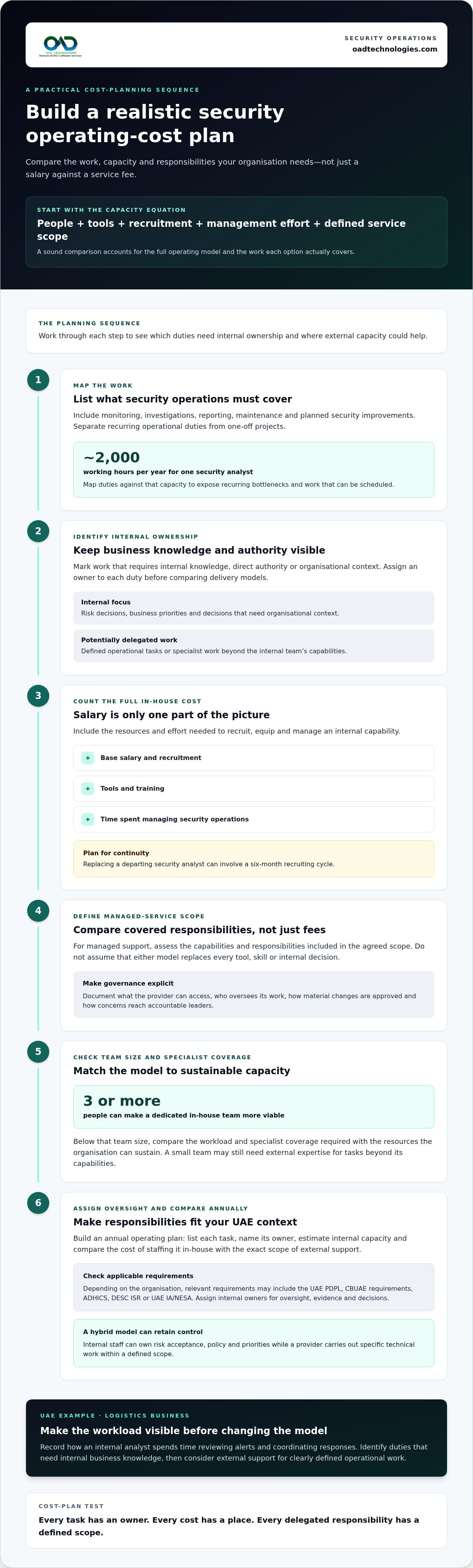
One security analyst covers roughly 2,000 working hours per year. That capacity must accommodate monitoring, investigations, reporting, maintenance and planned security improvements. Map these activities against available hours to identify recurring bottlenecks, then separate essential operational work from projects that can be scheduled.
For a UAE logistics business, an internal analyst might spend substantial time reviewing alerts and coordinating responses. Leaders can record task ownership and time demands, then identify which duties require internal business knowledge. This makes workloads visible before adding staff or reallocating responsibilities.
External expertise can make in-house resources more efficient by taking on defined operational work. The internal team can then focus on risk decisions, business priorities and changes requiring organisational context. Track the effect using practical indicators such as investigation backlogs, delayed projects and time spent on routine reporting.
Managed Service and Hiring Costs
Compare the full cost of employment with the scope of a managed service, not a salary with a service fee. Base salary is only one cost of an employee; also account for recruitment, tools, training and the time needed to manage security operations. For managed support, assess which responsibilities and capabilities the agreed scope covers.
Build the comparison around an annual operating plan. List each security task, assign an owner and estimate the internal capacity it uses. Then compare the cost of staffing those tasks in-house with externally delivered support. Do not assume either option replaces every tool, skill or internal decision.
Team size matters. An in-house team becomes more viable when an organisation needs a dedicated security team of three or more people. Below that threshold, compare the workload and specialist coverage required with the resources the organisation can sustain. A small team may still need external expertise for tasks beyond its capabilities.
Use a repeatable decision process:
- Separate recurring operational duties from one-off security projects.
- Identify work that requires internal knowledge or authority.
- Estimate the staff time, tools and management effort each model needs.
- Compare annual costs against the exact scope of responsibilities covered.
For a UAE organisation, this analysis links expenditure to operational needs. Review the model as systems and workloads change instead of carrying assumptions forward from an earlier budget cycle. A task-by-task comparison helps leaders direct internal capacity towards work that benefits most from organisational context.
Managed security program coverage
Coverage means more than alert monitoring. It includes the systems, risks and decisions addressed by a security programme. Map responsibilities across endpoints, cloud services, email, networks and business-critical data before assigning ownership internally or externally.
Start with an asset and service inventory. Record each system’s owner, the sensitive information it handles and the business processes that depend on it. A UAE manufacturing business, for example, could map production systems, corporate email, cloud applications and employee accounts separately. This can reveal systems without a clear owner or security tasks that fall between teams.
Next, group responsibilities into prevention, detection and response. Prevention includes setting access rules and maintaining secure configurations. Detection involves reviewing relevant activity for suspicious behaviour. Response follows a defined path from alert review through investigation and recovery. For each responsibility, name the internal owner, any external role and the person authorised to approve actions that could affect operations.
UAE organisations should map security responsibilities to their sector and applicable controls. A financial institution may need to consider CBUAE requirements, while a healthcare organisation may need to consider ADHICS. UAE IA/NESA and DESC ISR are other control references. Identify the requirements relevant to your organisation, then document the owner and evidence for each applicable control.
- Systems: list endpoints, networks, cloud platforms and business applications.
- Data: identify sensitive records and the processes that use them.
- Operations: assign alert triage, investigation and escalation ownership.
- Governance: connect applicable controls with accountable owners and evidence.
Coverage must fit the organisation’s operating model. A UAE manufacturing business may depend on production applications as well as corporate systems. Internal teams understand the operational impact of disruption, while external specialists can provide technical analysis within an agreed scope. Document who validates an incident and who approves actions affecting production.
Finally, test coverage with a scenario. Trace a compromised employee account from detection through escalation, access restriction and recovery. Record any missing log source, unclear decision owner or unassigned task. This exercise shows whether people, processes and systems work together, regardless of who employs each specialist.
people, processes and decision rights work together under realistic conditions. Leadership accountability should also be explicit: the Dubai security-services leadership role calls for 10+ years of progressive experience in security operations. The security-services director oversees security audits, inspections, and regulatory compliance programmes. Connect that oversight to the coverage map by recording who reviews findings, tracks corrective work and confirms that evidence is available for applicable controls. Keep escalation and approval routes clear when an issue spans internal teams and external specialists. Revisit these assignments when systems, services or operational dependencies change, so each documented responsibility remains matched to an accountable owner and the organisation can identify gaps before they complicate incident handling.
Outsourced SOC monitoring and incident response
An outsourced security operations centre (SOC) can extend monitoring capacity, but responsibilities must remain clear. Define which events the service reviews, how analysts escalate findings and who within the organisation decides what happens next. This connects technical investigation with business context.
Begin by listing the data sources the SOC will monitor. These may include endpoint alerts, identity events, network activity and cloud logs. Then identify the systems most important to business operations. A UAE-based travel company, for example, could prioritise its booking platform, staff accounts and customer service systems. Set the monitoring scope according to these operational dependencies, not just the tools already installed.
Next, map alert handling from detection to closure. A documented workflow should state how an alert is reviewed, what information accompanies an escalation and which internal role receives it. It should also distinguish investigation from authority to take disruptive action. For example, an analyst may identify suspicious account activity, while an internal owner approves disabling access that supports a critical service.
Effective response depends on preparation before an incident. Agree on escalation contacts, decision owners, evidence handling and internal communications. Define how IT, legal, privacy or business teams will be involved when an event affects their responsibilities. A tabletop exercise can test these hand-offs with a scenario such as a compromised staff account accessing a cloud application.
- Monitoring scope: record systems, logs and alert types included in SOC operations.
- Escalation: document how findings reach the correct internal decision-maker.
- Authority: distinguish technical recommendations from approval to disrupt services.
- Incident records: agree how investigation notes and actions are shared internally.
In an outsourced model, technology alone cannot resolve unclear ownership. A SOC may identify an alert, but internal teams still need to understand the business impact and coordinate recovery. In-house staff contribute knowledge of users, systems and critical processes; external analysts contribute investigation capacity within the agreed scope. Clear responsibilities help make incident handling more coherent.
Review performance using operational evidence rather than broad claims. Examine sample alerts, escalation records, investigation notes and unresolved actions. Check whether each event reached the intended owner and whether decisions were recorded. Update the process when the organisation adds a cloud service, changes account access or moves a critical application. These reviews help keep monitoring aligned with business operations.
Before implementation, walk through an incident scenario with the SOC and internal teams. Trace the alert, investigation, escalation, containment decision and recovery hand-off. Record any missing data source or unclear responsibility, then resolve it before relying on the process during a live event.
How much do managed security services cost compared with hiring cybersecurity staff?
Compare the annual cost of employing staff with the cost of a defined managed service. For a UAE business, build both estimates in AED and match them to the same security tasks, systems and coverage period.
Salary alone understates employment costs. A security analyst’s fully loaded annual employment cost typically reaches 1.25 to 1.4 times base salary. The multiplier reflects additional employment and operating costs, so use the same basis when assessing an internal role. Include recruitment, onboarding, tools and the management time needed to support that employee.
A managed service is priced according to its scope, not a single job title. The price depends on the case and is provided after a quote request; factors include monitored systems, data sources, service responsibilities, reporting needs and incident-response scope. Compare the written scope with the internal duties you expect it to replace or supplement.
Build an apples-to-apples comparison by separating costs into practical categories:
- People: salary, recruitment, onboarding and management effort for internal roles.
- Technology: security tools, integrations and ongoing administration required by each model.
- Coverage: the systems, monitoring tasks and response activities included in the service scope.
- Continuity: the internal capacity needed to maintain knowledge and coordinate work when responsibilities change.
For example, a UAE financial services firm can map costs against its relevant controls and operational needs, including applicable CBUAE requirements. It can then compare the staff and tools needed for each responsibility with the documented scope of an external service. Outsourcing does not remove internal accountability; this comparison shows where each cost sits.
Use a simple calculation: estimate annual internal employment and operating costs, then add tools and management effort. For managed support, compare the quoted AED amount with its defined coverage and any remaining internal work. For a hybrid arrangement, include both costs and remove only duties genuinely transferred. This avoids treating a partial service as a complete replacement for an employee.
Finally, test the estimate against an operating scenario. If you add a cloud service, identify whether monitoring scope, log integration or internal coordination will change. If business priorities shift, reassess tasks and service boundaries before adjusting the budget. A consistent scope makes cost comparisons useful across planning cycles.
OAD Technologies: Data Loss Prevention (DLP)
OAD Technologies offers Data Loss Prevention (DLP) to organisations seeking stronger oversight of sensitive information. Consider DLP when addressing data-handling risks alongside decisions about internal staffing and managed security support. It can form part of a broader security programme, but does not replace the people who set access policies, assess business impact and coordinate incident decisions.
Where priorities extend beyond data protection, OAD Technologies also offers Vulnerability Assessment and Penetration Testing (VAPT), Managed Detection and Response (MDR) and Security Information and Event Management (SIEM). The right combination depends on your organisation’s security priorities and the capabilities it needs to build or extend.
Discuss your requirements with OAD Technologies to explore how DLP could fit your security needs.
Shape a security model that can grow with you
Make your next step a practical decision about how security responsibilities should evolve as your organisation changes. A managed security services vs hiring staff assessment should consider which outcomes you need to own internally, which capabilities require support and how those boundaries may shift as business priorities develop.
OAD Technologies offers Vulnerability Assessment and Penetration Testing (VAPT) and Managed Detection and Response (MDR) to address security testing, detection and response needs. As you revisit managed security services vs hiring staff, define the challenge you want to address and consider how the relevant capability fits your operating model.
A considered next step can help shape a security model around your organisation’s needs and future direction.
Frequently Asked Questions
What are the main differences between managed security services and hiring an in-house security team?
In-house staff work directly within your organisation, while a managed service provider delivers agreed security capabilities within a defined scope. Employees can build detailed knowledge of business processes and systems. External specialists can add skills or operational capacity without making every capability an internal role. For example, a company might retain security governance in-house while assigning specific technical monitoring tasks externally.
What security services and response times do MSSPs typically include?
Service scope varies: agreements may cover monitoring, security information and event management, detection and response, or other defined capabilities. Do not assume every service includes incident investigation or a particular response time. Review the agreement for monitored assets, alert severity definitions, escalation contacts, reporting and response responsibilities. OAD Technologies offers Managed Detection and Response (MDR) and Security Information and Event Management (SIEM), among other security services.
What are the advantages and disadvantages of outsourcing cybersecurity versus building an in-house team?
Outsourcing can provide access to defined specialist capabilities, allowing internal staff to focus on business-specific priorities. It also creates a third-party dependency that requires oversight, clear access boundaries and risk assessment. An in-house team offers closer organisational context and direct management, but the business must recruit, retain and organise the required skills. A hybrid arrangement can balance internal ownership with external expertise.
How do MSSPs compare with in-house staff for incident response and threat monitoring?
A managed provider can investigate activity within its agreed scope, while internal staff connect findings to business operations and decision-makers. Effective response depends on clear escalation paths, relevant system information and agreed authority for actions that could affect services. For instance, an internal owner may need to approve restricting access to a business-critical application after suspicious activity is identified.
How can a business calculate the total cost of ownership for an MSSP versus in-house security?
Compare both options over the same planning period and against the same security responsibilities. For in-house security, include employment, recruitment, tools, training and management effort. For a managed security service, use the quoted AED price for the agreed scope, then account for internal coordination and any tools or tasks that remain your responsibility. A UAE business should also factor in relevant sector requirements and covered systems.
Disclaimer
Content by OAD Technologies is for general informational purposes only and does not constitute professional or cybersecurity advice. No warranties are made regarding accuracy or completeness; reliance is at your own risk. OAD Technologies shall not be liable for any direct or indirect losses arising from use of this content.