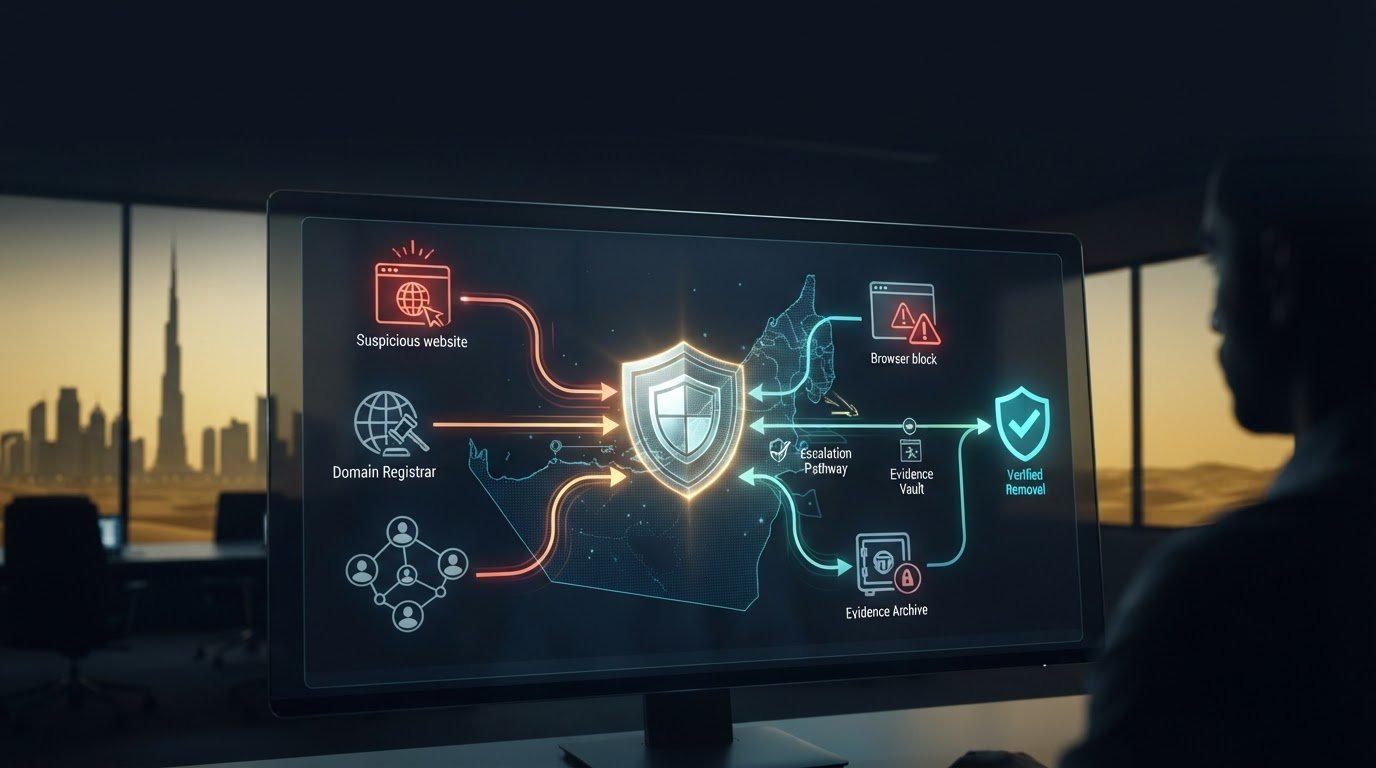
A firewall that isn’t monitored, updated and configured around real business needs can leave gaps or disrupt essential applications. Firewall management services in the UAE typically involve reviewing access rules, monitoring network activity, applying updates and coordinating firewall controls with antivirus protection and user access policies. A firewall helps filter network connections, but it works best as part of broader security measures.
Managing firewall controls takes more than setting rules once and leaving them unchanged. Adding business applications, expanding remote access or separating guest Wi-Fi from company systems can all affect configuration. This article explains what ongoing management involves, how monitoring and maintenance support network protection, and what to consider when reviewing firewall services in the UAE. It also uses practical business scenarios to show how these controls can support daily operations without overlooking security.
Key Takeaways
- Review firewall rules when your network, applications or remote-access needs change, and test planned changes to avoid disrupting essential services.
- Combine updates and traffic monitoring with antivirus, user controls and network segmentation for broader protection.
- Use firewall audits to examine access rules, logs, configuration and potential vulnerabilities, then prioritise practical remediation.
- Choose a managed, co-managed or on-premises approach according to your team’s capabilities, control requirements and network needs.
- See how local network design and operating conditions can shape firewall setup and ongoing maintenance across the UAE.
Common firewall and network security problems
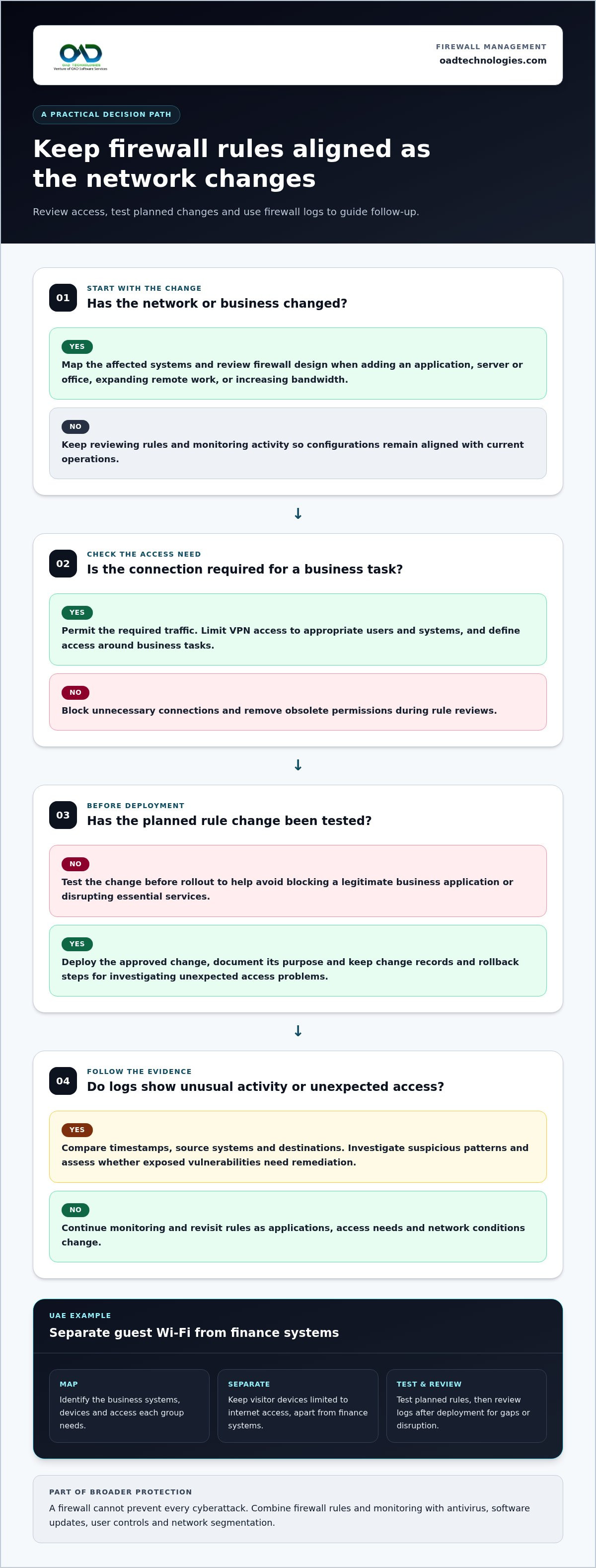
Firewall deployment starts with mapping business systems, defining access policies, then configuring and testing rules before rollout. Ongoing management in the UAE means reviewing those rules, monitoring activity and updating configurations as the network changes.
Access Controls and Security Policies
Network access control sets which users, devices and applications can reach specific systems. Define policies around business tasks, then permit required traffic while blocking unnecessary connections. For example, a UAE office can separate guest Wi-Fi from finance systems, limiting visitor devices to internet access. Review VPN permissions too, so remote access remains limited to appropriate users and systems.
Firewall Maintenance and Patching
Maintenance includes reviewing configurations, applying security patches and checking whether rules still reflect current operations. Plan each change, document its purpose and test it before deployment. An untested rule could block a legitimate business application. Keep records of approved changes and rollback steps so administrators can investigate unexpected access problems after maintenance.
Updates and Security Optimisation
Firewall updates address software and security issues, while optimisation keeps protection aligned with actual network use. Review rules after adding a server, application or office location, and remove obsolete permissions. Compare incoming and outgoing traffic against business requirements. These checks can expose broad rules that allow more access than a team needs, or restrictions that interrupt essential applications.
Misconfiguration can cause problems in either direction. A permissive rule may allow unauthorised attempts to reach internal systems; an overly restrictive one can disrupt customer services or staff workflows. Rule reviews should cover accuracy, access controls, network segmentation, logging and monitoring. Examine firewall logs for suspicious activity, then assess whether exposed vulnerabilities need remediation.
Network security planning should account for business changes, not just the initial installation. Review firewall design when the organisation changes premises, expands remote work, adds servers or increases bandwidth. These changes may affect traffic routes and application access. NIST recommends establishing firewall policies and selecting, configuring, testing, deploying and managing firewall solutions.
For a practical UAE example, a company opening a new branch should map its business applications and devices before changing firewall rules. Administrators can identify which systems need access, separate guest connections, test planned rules, then review logs after deployment. This sequence helps uncover access gaps and application disruptions before they affect routine work.
A firewall supports network protection, but it cannot prevent every cyberattack. Pair its rules with antivirus software, software updates and user controls, then review whether monitoring reveals activity that needs attention. A focused firewall security review can assess configuration, rules and logging, with remediation centred on the gaps found.
Ongoing updates, monitoring and maintenance
Firewall management combines configuration updates, traffic reviews, log analysis and planned maintenance. OAD Technologies provides Firewall & Network Security Management, which can be considered alongside defined responsibilities for monitoring, escalation and support. Agree the scope and how alerts, updates and findings will be handled.
Threat Prevention and Traffic Monitoring
Modern firewall solutions inspect network traffic, control applications and identify known malicious patterns. Monitoring helps administrators spot unusual connections, repeated blocked attempts or unexpected traffic between systems. For example, a UAE retailer could investigate repeated access attempts against its payment network while keeping ordinary point-of-sale traffic available. Review which events trigger investigation and how findings reach the responsible team.
Firewall Logs and Analysis
Logs record permitted and blocked connections, configuration changes and other firewall activity. Reviewing them provides context: compare timestamps, source systems and destinations to identify patterns that need attention. A sudden rise in denied connections from one device, for instance, may warrant investigation. Set log-retention and review responsibilities around business needs, then document significant findings and follow-up actions.
Continuous Monitoring and Reporting
Continuous monitoring means observing firewall activity over time, rather than relying only on occasional configuration checks. Reports should connect alerts to business systems, explain what was investigated and record the action taken. Agree clear escalation paths and reporting formats for technical teams and decision-makers. Concise reporting can highlight unresolved risks, recurring alerts and configuration changes that need review.
Updates and Ongoing Maintenance
Maintenance includes applying software updates and security patches, checking system health and reviewing configurations after changes. Schedule updates around business operations, test essential services afterwards and record the results. If an application becomes unreachable, change records help administrators trace the cause. Review update status regularly and prioritise patches according to the systems affected and their exposure.
Monitoring also needs context. A blocked connection may reflect an attack attempt, or a legitimate application using an outdated route. Administrators can compare the event with approved network diagrams, application requirements and recent change records before adjusting rules. This helps prevent a quick fix from creating broader access or interrupting another business process.
Use reporting to close the loop: assign each finding, record its owner and track remediation through completion. For a UAE organisation with remote staff, a review could compare VPN activity with approved users and expected work patterns. If logs show access outside the required group, administrators can reassess permissions and document the adjustment.
Cybersecurity monitoring is more useful when firewall findings connect with wider operational visibility. A recurring alert may need investigation across network devices, user activity and application logs. Agree which team handles each escalation, what evidence is recorded and how unresolved issues are reported. This makes monitoring useful for decisions, rather than simply generating alerts.
Business benefits of professional firewall management
For a small UAE business, a firewall helps control connections into and across its office network. Professional management adds regular reviews, configuration expertise and monitoring, supporting protection alongside antivirus, updates and user controls. It also helps teams maintain visibility as infrastructure changes, rather than treating installation as a one-off task.
Segmentation can limit how far an unwanted connection reaches. A UAE design studio, for example, could separate guest Wi-Fi from staff devices and shared file storage. That arrangement helps restrict visitor access to business resources while allowing staff to reach the applications they need. Review the design whenever the studio adds a server, changes premises or expands remote work.
A managed firewall can also support business continuity. Clear access policies reduce avoidable application blocks, while log reviews help surface suspicious activity for investigation. Audit findings can identify inaccurate rules, weak segmentation or limited monitoring. The business can then prioritise changes according to the systems affected and the potential operational impact.
When assessing firewall management services in the UAE, consider the provider’s approach to configuration reviews, rule testing, log analysis, vulnerability assessment and change documentation. Agree who handles alerts, how issues are escalated, what reports contain and how updates are tested against essential applications.
Regulatory and security requirements depend on an organisation’s sector, systems and data. UAE organisations may need to consider applicable requirements such as UAE IA/NESA, DESC ISR, CBUAE or ADHICS, alongside relevant data-protection obligations. Identify which requirements apply before setting firewall policies.
Start with the network itself. Map office locations, cloud services, remote users, business applications and sensitive systems before comparing firewall solutions. Then assess whether the configuration supports required traffic, separates network zones and produces interpretable logs. A small office with limited internal IT capacity may value hands-on management, while a larger organisation may need clear coordination with its existing security team.
Consider how the provider manages changes. Ask for a documented process covering approval, testing, deployment and rollback, especially when a rule affects customer-facing services or shared systems. A useful review explains why a rule exists, which users or applications rely on it and whether it still reflects current operations.
Finally, match monitoring and reporting to business decisions. Reports should follow an agreed schedule and make open findings visible. Look for clear records of investigated alerts, completed changes and unresolved risks. This evidence helps decision-makers understand how firewall controls support daily operations and where improvements should focus.
Firewall services across Dubai and the UAE
Firewall services across the UAE connect network design with daily business operations. The right setup depends on where systems run, how staff connect and which applications require access. For organisations operating across multiple emirates, a single network plan should account for each office, cloud environment and remote connection without assuming that every site has identical needs.
Services can cover cloud environments, branch connections and remote users when these are included in the agreed network scope. Start by listing locations, systems and connection routes, then map each to the controls it needs. This can reveal gaps between office networks and cloud applications, where access may follow different paths.
Firewall installation involves planning, configuration and testing, not simply connecting hardware. A provider such as OAD Technologies can assess expected traffic, configure access controls and test essential applications before deployment. Recording the intended setup helps administrators understand why each rule exists and provides a reference when business needs or network connections change.
For organisations with physical offices, hardware firewalls can help protect local network traffic. Cloud-hosted systems and remote users need controls suited to their own connection paths, identities and applications. Include each environment in the network plan: perimeter protection at one office does not automatically cover connections elsewhere.
An engineering firm adding a branch and remote project teams, for example, should account for traffic between offices, cloud applications and staff connections. Administrators can map required access, test business systems and review activity after deployment. This approach helps assess protection across the organisation rather than focusing only on equipment at one site.
Local business requirements can shape installation and follow-up. Organisations may operate across offices, data centres and cloud platforms, each with distinct traffic patterns. A UAE-based provider like OAD Technologies can offer familiarity with regional business needs and easier follow-up for troubleshooting and maintenance. The network design, rather than the registered office location, determines which controls are required.
Before deployment, prepare an inventory of locations, internet connections, servers, cloud applications and remote-access routes. Identify which traffic must pass between environments and which users require access. This helps administrators configure rules around actual operations, rather than applying a standard setup that may not suit the organisation’s design.
After deployment, review whether the design still reflects business operations. A new branch, changed cloud application or expanded remote workforce can alter traffic routes and access needs. Reassess the configuration, test essential connections and document changes. Define protection across every relevant location and connection, then maintain visibility as the organisation evolves.
How do UAE firewall services compare: managed, co-managed, and on-premises?
These options describe different ways to operate firewall controls. Managed and co-managed services divide operational responsibility; on-premises describes where equipment is deployed. A UAE business should compare ownership, access, support arrangements and how changes are approved.
Managed service: A provider performs agreed firewall tasks, which may include configuration reviews, monitoring, updates and troubleshooting. The service scope should define covered devices, escalation routes, reporting and who approves rule changes. For example, a business without in-house firewall expertise might assign routine administration externally while retaining approval over access policies. Document the exact division of responsibilities.
Co-managed service: Internal IT staff and a provider share defined responsibilities. The business might handle user requests and application context, while the provider assists with technical reviews or monitoring. Specify who investigates alerts, makes configuration changes and records decisions. A responsibility matrix helps prevent an alert being missed because each team assumes the other owns it.
On-premises deployment: This describes a firewall operating on equipment at the organisation’s premises. It does not, by itself, indicate who maintains or monitors it. Internal administrators, a provider or both can manage it. An organisation with local infrastructure should identify who handles updates, log reviews, access approvals and recovery if a change interrupts an application.
Compare the options using operational questions, rather than labels alone:
- Responsibility: Name the person or team responsible for configuration, monitoring and maintenance.
- Approval: Decide who authorises changes affecting staff, customers or business applications.
- Visibility: Agree how administrators access logs, reports and current configuration records.
- Escalation: Document how alerts move from detection to investigation and assigned action.
- Change control: Set out testing, documentation and rollback steps before deployment.
Consider a retailer with an internal IT administrator and several locations. Co-management could preserve the administrator’s knowledge of store applications while assigning technical review and monitoring tasks externally. A Fully Managed, Defined Scope arrangement may suit a team seeking to delegate more routine operations. An on-premises firewall could be used in either case; deployment location and management responsibility are separate decisions.
Choose a model that fits your team’s technical capacity, required control and network design. Map locations, cloud connections and remote access, then assign each operational task before agreeing the service scope. Clear ownership helps teams manage changes consistently as the business grows.
OAD Technologies: Data Loss Prevention (DLP)
OAD Technologies can help UAE organisations address data protection needs that extend beyond firewall controls. Its Data Loss Prevention (DLP) offering supports efforts to manage risks involving sensitive business information. This is relevant when staff use multiple systems, share files or work across office and cloud environments.
For a broader security assessment, Vulnerability Assessment and Penetration Testing (VAPT) can identify weaknesses to address. Managed Detection and Response (MDR) and Security Information and Event Management (SIEM) can support detection and visibility across security events. These offerings can complement network controls as part of a considered security approach.
Contact OAD Technologies to discuss how its cybersecurity services can support your organisation’s needs.
Build the next step into your security plan
Your firewall should evolve with your business, not remain configured for the network you had at installation. Use your next review to identify which systems matter most, where access has changed and what security work needs clearer ownership. This gives your team a practical starting point for improving resilience while supporting essential operations.
Firewall management services in the UAE are one part of a broader security plan. OAD Technologies can help organisations consider related needs, including Data Loss Prevention (DLP), Vulnerability Assessment and Penetration Testing (VAPT), and Managed Detection and Response (MDR). The right combination depends on your environment, risk priorities and internal capabilities.
Bring your current network concerns and business priorities into the discussion. Understanding both can help shape a considered next step.
A well-planned approach helps security controls keep pace as your organisation grows.
Frequently Asked Questions
What is firewall management?
Firewall management is the ongoing administration of rules and settings that control network connections. It includes keeping an accurate record of approved configurations and checking that changes reflect how the organisation works. For example, when a company introduces a payroll system, administrators can assess its connection needs and limit access accordingly. Management also involves reviewing firewall activity so teams can investigate unusual events rather than relying on settings alone.
What Happens When Firewall Protection Is Weak?
Weak firewall protection can leave unnecessary routes open or prevent legitimate users from reaching essential systems. An attacker may exploit an exposed service, while an overly broad rule can allow access beyond its intended purpose. For example, if a branch retains access permissions after a team changes roles, those rules may no longer reflect business needs. Weak controls can also make suspicious activity harder to distinguish from ordinary network traffic.
What major firewall vendors and models do you support?
Firewall support depends on the device and its role in your network; there is no single model that suits every UAE organisation. Start by recording the manufacturer, model, software version, deployment location and connected systems. This inventory helps technical teams assess the existing environment before planning management work. A model’s fit should be judged against the organisation’s traffic, required applications and operating needs, rather than brand recognition alone.
When Should You Review Your Firewall?
Review your firewall after a change to network design or access, such as opening a branch, adding a server or changing remote-work arrangements. A review is also useful when an application unexpectedly loses connectivity or logs show unusual connection attempts. For instance, after moving a business application to cloud hosting, assess whether existing routes and permissions remain appropriate. Tie the review to the change, affected systems and resulting configuration.
What do firewall management services in the UAE include?
Firewall management services in the UAE can include configuration reviews, rule administration, software updates, traffic monitoring, log analysis, troubleshooting and maintenance. The precise scope depends on the organisation’s environment and the responsibilities agreed for each team. Before work begins, map covered firewalls and connected environments, then define change approvals, reporting and escalation responsibilities. This makes it easier to understand which activities are managed and how findings are handled.
Which UAE providers offer managed firewall services?
OAD Technologies provides Firewall & Network Security Management as part of its managed services portfolio. Organisations considering managed firewall support can compare the defined responsibilities, monitoring coverage, reporting and change-approval process with their operational needs. A company with internal IT staff, for example, may need a different division of work from a business delegating more firewall operations. Clarify who owns configuration decisions and security-event investigations.
What firewall brands and technologies do UAE providers support?
Available technologies vary by provider and network design. Firewall environments can include hardware appliances, software firewalls and next-generation systems that inspect applications, users and threats. These categories describe capabilities, not a guarantee that every provider supports every brand or model. For a useful comparison, document the current technology, where it operates and how it connects to cloud services, branches and remote users. This helps define the technical scope accurately.
What are the risks of unmanaged firewalls for UAE businesses?
Unmanaged firewalls can retain obsolete permissions, miss relevant updates or produce logs that nobody reviews. These gaps can make it harder to notice suspicious traffic or trace the cause of an access problem. A UAE business expanding into another office, for example, may add network routes without reviewing older rules. Over time, the configuration can become difficult to understand, increasing the chance of unnecessary access or disruption to important applications.
Disclaimer
Content by OAD Technologies is for general informational purposes only and does not constitute professional or cybersecurity advice. No warranties are made regarding accuracy or completeness; reliance is at your own risk. OAD Technologies shall not be liable for any direct or indirect losses arising from use of this content.