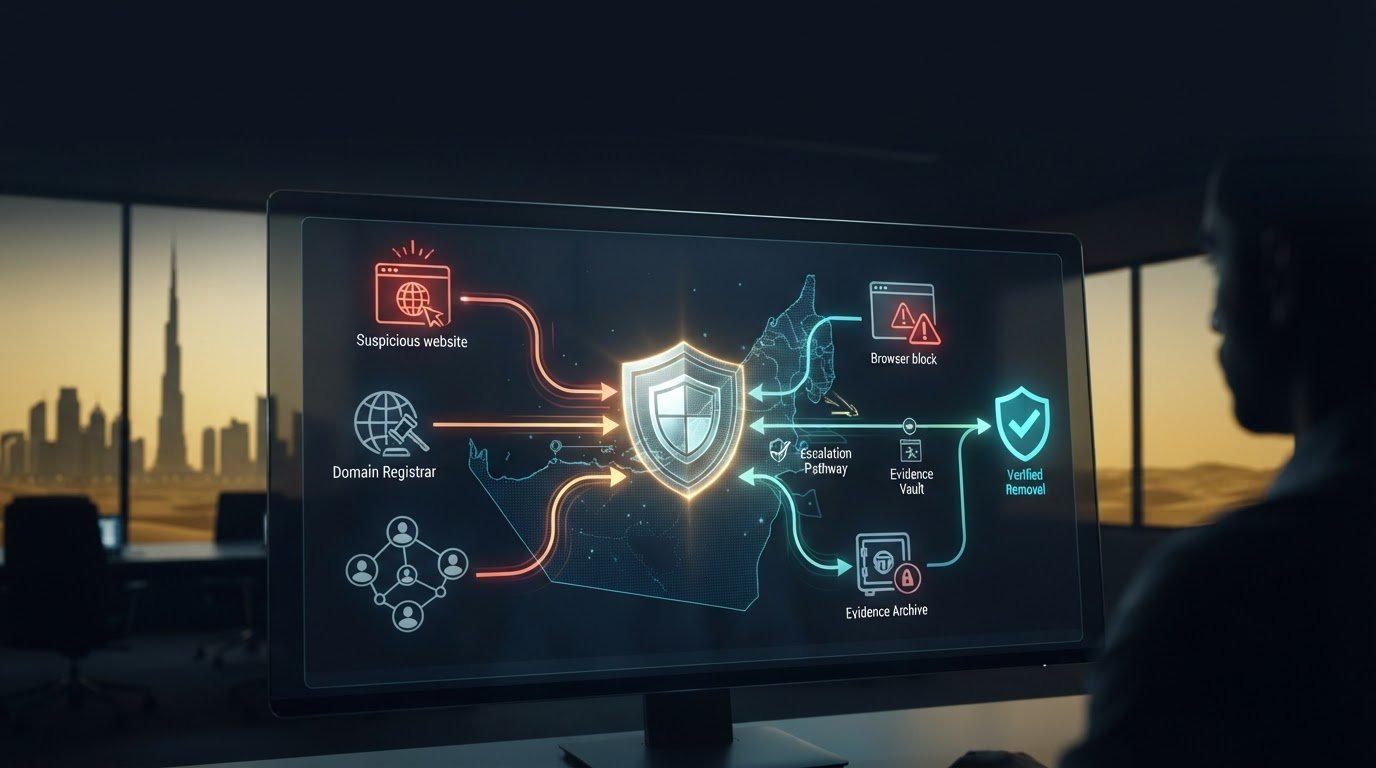
What if a phishing site remains live while reports move between the domain registrar, hosting provider and other parties? That uncertainty is familiar to organisations facing a fast-moving impersonation campaign. Effective takedown services for phishing websites need to do more than send a removal request: they should support an evidence-led response, clear escalation and checks for recurrence.
Choosing the right response matters because removal is not always immediate or complete. A browser warning may help protect users while leaving the site online; removing hosted content or suspending a domain can have different effects. For a UAE organisation, a fake checkout page impersonating a local retailer could also be promoted through social media, so addressing one URL may not resolve the wider campaign.
This article explains the stages and limits of a takedown, the evidence and follow-through to look for, and how to assess operational fit. It also shows how phishing-site response connects with broader brand protection and security risk management. OAD Technologies’ brand protection, email security and Managed Detection and Response capabilities can provide wider organisational context without treating takedown as a standalone fix.
Key Takeaways
- Distinguish a phishing website from a lookalike domain, a compromised legitimate site or a malicious redirect before deciding how to report it.
- Assess takedown services for phishing websites by looking at evidence handling, escalation ownership, status updates and post-removal monitoring.
- When your organisation finds a suspicious page, report it internally and preserve relevant evidence without entering credentials or interacting with the site.
- Use phishing-site concerns to inform wider discussions about brand impersonation, email risk and incident management.
What phishing website takedown services do, and what removal does not mean
Takedown services for phishing websites coordinate the identification of confirmed phishing sites, prepare supporting evidence and submit removal requests to the relevant organisations. They can also track the progress of those requests. Their role is to make reporting clearer and more actionable, not to control the response of a registrar, hosting provider or platform. Each recipient applies its own processes, so submission does not guarantee action or a particular timeframe.
Precision matters because not every suspicious URL represents the same problem. A lookalike domain uses a similar name or brand identity, but resemblance alone doesn’t prove it hosts phishing. A compromised legitimate site is a genuine website that an attacker has misused. A malicious redirect sends visitors elsewhere, sometimes through a chain of URLs. These situations may require different evidence and reporting routes. The broader Phishing overview explains common techniques, but a takedown request still needs evidence tied to the specific site.
For example, a fake page that imitates a UAE retailer’s sign-in screen and asks visitors to enter account details presents a different issue from an unrelated domain that merely contains a similar word. Confirm the behaviour and context before labelling a site as phishing. That distinction helps avoid incomplete reports and confusion about who should receive them.
Which phishing website threats may require a takedown request?
Requests may be appropriate for fake login pages, credential-harvesting pages or websites impersonating an organisation to deceive customers or staff. A useful report connects the suspicious page to the alleged abuse, rather than relying on a similar logo or domain name alone. It should identify the URL and explain what the page does, using safely collected evidence to support the assessment.
A takedown request addresses reported content or infrastructure; it doesn’t recover ownership of a domain or resolve a legal dispute over a name or brand. Those are separate matters. Keeping the issues distinct helps an organisation direct each concern to the appropriate process without assuming that a phishing report will settle domain ownership.
What a takedown can, and cannot, achieve
The intended outcome is to reduce access to the reported malicious website. Depending on the case and the recipient’s decision, action may affect hosted content, a domain’s availability or how a browser treats the page. A service can submit and track requests, record responses and verify the reported URL’s status. However, registrars, hosting providers and platforms control decisions made within their own processes; the reporting party cannot promise their action or timing.
Removal is not the same as incident remediation. It doesn’t restore accounts that may have been compromised, establish whether credentials were exposed or prevent attackers from creating a copycat site on different infrastructure. Organisations should treat removal as one response action and consider the wider exposure separately. This distinction keeps expectations realistic and helps teams avoid closing an incident solely because one reported URL is no longer accessible.
How phishing website takedown works: evidence, escalation and verification
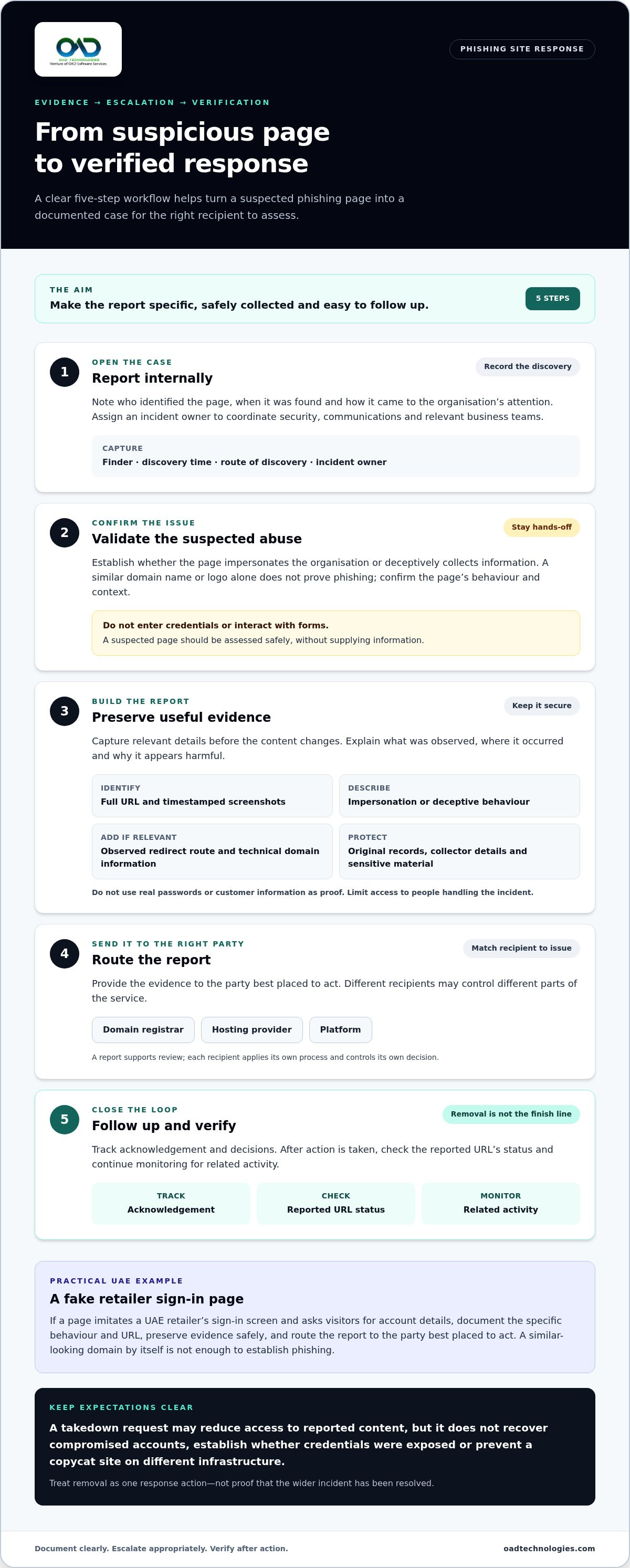
A reliable process turns a suspected phishing page into a documented case that the appropriate recipient can assess. Takedown services for phishing websites may coordinate reporting and follow-up, but the quality of the evidence and clarity of ownership matter at every stage. A practical workflow is:
- Report internally. Record who identified the page, when it was found and how it came to the organisation’s attention. Assign an incident owner to coordinate security, communications and any relevant business teams.
- Validate the suspected abuse. Check the page safely to establish whether it impersonates the organisation or collects information deceptively. Avoid entering credentials or interacting with forms.
- Preserve evidence. Capture relevant details before the content changes. Keep the material securely and make it available only to people handling the incident.
- Route the report. Send the evidence to the party best placed to act, which could be a domain registrar, hosting provider or platform. Different recipients may control different parts of the service.
- Follow up and verify. Track acknowledgement and decisions, then check the reported URL after action is taken. Continue monitoring for related activity.
What evidence helps substantiate a phishing report?
A useful report identifies the full URL, includes timestamped screenshots and gives a concise explanation of the impersonation or deceptive behaviour. If the page redirects, record the observed route where it can be done safely. Technical domain information may also help the recipient investigate. Documenting these details creates a clearer basis for review.
Documented evidence helps a recipient assess an abuse report by showing what was observed, where it occurred and why the activity appears harmful. Preserve the original records securely, note who collected them and avoid circulating sensitive material more widely than necessary. Don’t include real passwords or other customer information as proof.
How should organisations verify removal and monitor recurrence?
After a recipient reports action, check the original URL from an appropriate external perspective, rather than relying only on an internal network view. Record the time of the check, what appeared and any remaining access or redirect behaviour. A page that no longer loads for one user may not establish that every route to the content has been addressed.
Keep the recipient’s response, case status, next action and accountable owner in the incident record. If the page remains accessible, follow up with the evidence and previous report details. If it is unavailable, continue watching for reappearance or related lookalike domains. A temporary browser warning or access block may also be considered as a parallel protective measure, but it isn’t a substitute for reporting and isn’t a feature guaranteed by every service.
For enterprises, the incident record should distinguish actions the reporting team controls from decisions made by external parties. That makes unresolved cases visible and supports a measured assessment of exposure, rather than treating a submitted request as a completed response. To discuss how phishing concerns fit into wider security operations, speak with OAD Technologies.
How to compare phishing website takedown services for enterprise use
Compare the operating model, not just the headline promise. Takedown services for phishing websites can differ in the assets they cover, how they document cases and who owns follow-up. A clear comparison should separate work a service can manage from decisions that remain with external registrars, hosting providers or platforms.
| Area | What to assess | Responsibility boundary |
|---|---|---|
| Scope | Does the stated coverage focus on phishing websites, or include other impersonation assets such as social accounts and adverts? | The service defines its scope; each platform controls action on its own assets. |
| Evidence handling | Who validates a report, prepares supporting material and keeps a record of the evidence used? | The service can organise evidence; the recipient assesses whether it meets its requirements. |
| Escalation ownership | Is there a named owner for routing requests, follow-up and unresolved cases? | The service can manage its escalation activity; the recipient decides whether and how to act. |
| Status reporting | Does reporting distinguish submitted, acknowledged, under review, actioned and unresolved cases? | The service reports known status; it cannot control a third party’s decision or response time. |
| Post-removal checks | Does the process include checking the reported URL and recording any recurrence? | The service can check agreed indicators; no check can guarantee that every copycat is found. |
Which service scope and ownership questions matter?
Ask for a precise description of covered assets and case ownership. Confirm who validates a suspected phishing page, prepares evidence, chooses the recipient and follows up if a request is rejected or unanswered. Look for defined escalation paths and status updates that identify the next action and its owner. This helps your incident team understand where the provider’s responsibility ends and an external decision begins.
Integration matters too. Establish how a case enters your existing incident process, who receives updates and how relevant internal teams are involved. For example, security may assess technical exposure while brand or communications teams consider customer impact. The service should fit those established responsibilities rather than create an untracked parallel workflow.
How should buyers interpret removal timelines and metrics?
Response time can vary with the evidence available, the recipient’s processes and the circumstances of the case. Treat any vendor-published average, volume or removal claim as that vendor’s own reported metric, not an industry guarantee. To interpret a number, look for its measurement period, case population, start point and definition of completion. Does “removed” mean content became inaccessible, a domain stopped resolving or a request was simply submitted? Without those details, comparisons may be misleading.
Phishing takedown addresses online infrastructure, not every related email or endpoint risk. A brand impersonation incident may need to be considered alongside enterprise brand protection, while broader coordination can sit within managed security services. Assess how these activities connect to your organisation’s incident ownership, without assuming one service performs every response task.
What to do when your organisation finds a phishing website
A calm, coordinated first response helps teams preserve useful information, assess possible exposure and route the concern without amplifying the suspicious link. Follow your organisation’s established incident process, and assign an owner to keep security, brand-risk and communications teams aligned.
An incident-ready checklist for the first response
- Report internally. Notify the security team and relevant brand-risk owners through established incident channels. Share the link only with people who need it to assess or manage the incident.
- Preserve evidence safely. Record the full URL, when and how it was discovered, and timestamped screenshots if they can be collected safely. Don’t enter credentials, submit information, download files or otherwise interact with the page to test it.
- Assess potential exposure. Establish whether staff or customers may have visited the page or submitted credentials or other information. Coordinate with the teams responsible for identity, customer support and incident management, as relevant.
- Coordinate reporting and follow-through. Once the concern is assessed, determine the appropriate reporting route and record who owns each action. A takedown request is one part of the response, not a substitute for investigating possible account or data exposure.
Keep the incident record factual. Separate what the team directly observed from what remains unverified, and note decisions, owners and outstanding actions. This helps prevent assumptions from spreading internally and gives accountable teams a clearer basis for next steps.
A practical UAE enterprise example
Imagine a UAE financial services organisation is alerted to a fake customer sign-in page using its name and visual identity. Its security team preserves the URL and discovery details, then assesses whether the page appears to collect customer information. The brand or communications team coordinates internally on how to handle customer concerns, while the incident owner organises reporting and tracks responses. CBUAE is relevant sector context, but the organisation should assess any applicable obligations with its accountable compliance and legal teams rather than assume a specific regulatory outcome from the existence of a fake page.
How to handle UAE regulatory context responsibly
Regulatory relevance depends on the organisation, the information involved and the circumstances of the incident. Where personal data may be affected, the organisation’s privacy and legal teams should assess the UAE Personal Data Protection Law (PDPL) and applicable requirements. Article 9 addresses notification to the UAE Data Office when a controller becomes aware of a qualifying breach; the law does not set a fixed number of hours. Don’t assume that a phishing page alone establishes that a qualifying breach occurred.
For government entities or organisations with relevant obligations, teams may also need to consider the UAE IA Standard, commonly referred to as NESA, or the Dubai Information Security Regulation (ISR), as applicable. Healthcare organisations can assess whether ADHICS is relevant. Qualified advisers and accountable internal teams should determine applicability; a takedown request does not itself fulfil a regulatory obligation.
How OAD Technologies connects phishing concerns with broader enterprise security
A phishing website can be the visible sign of a wider brand or security concern. It may imitate an organisation online while related activity reaches people through email or creates questions about account exposure. OAD Technologies’ Brand protection, Email security and managed security services relate to these connected risk areas. They provide context for enterprise security discussions, but they shouldn’t be mistaken for a guaranteed takedown workflow.
For organisations assessing takedown services for phishing websites, the useful question is how the reported site connects to existing security ownership. Who assesses potential customer or staff impact? Who considers impersonation risk? Which team coordinates incident decisions? Clarifying these responsibilities helps prevent a website report from sitting apart from the organisation’s broader view of digital exposure.
Connect the phishing concern to relevant security priorities
A fake website and a phishing email are different assets, even if they form part of the same campaign. The site may imitate a sign-in page, while an email may lure recipients to it. Endpoint compromise is a separate concern that may require its own assessment. Keeping these distinctions clear helps teams share relevant context without assuming that one service addresses every part of an incident.
OAD Technologies’ Brand protection is relevant to discussions about online impersonation and how it affects an organisation’s presence. Where a campaign also involves deceptive messages, email security capabilities are relevant to the email-risk conversation. The connection is organisational: information about a fake site may help security and brand owners consider related exposure, but it doesn’t establish that the website, email and endpoint risks have all been addressed.
Teams can also use a suspected phishing site to review how a report moves between security, communications, customer-facing functions and incident owners. The aim is not to collapse separate work into one activity. It is to ensure that each team understands the concern, its own responsibilities and the decisions that remain open.
Discuss requirements with OAD Technologies
OAD Technologies can discuss how phishing concerns relate to your organisation’s security priorities. Useful context includes your business environment, who owns security and brand-risk decisions, how incidents are recorded, and what reporting or coordination needs matter to your teams. This can help shape a relevant conversation about digital risk management and the wider online exposure your organisation wants to address.
Keep the discussion grounded in scope and responsibilities. A conversation about brand impersonation, email risk or incident management does not promise removal of a reported site, a particular response time or a specific security outcome. It creates space to examine the business context and identify which security considerations deserve attention.
Prepare your response before the next report arrives
Use this decision to strengthen incident readiness, not simply to select a removal service. Agree internally on who assesses a suspected site, who owns the evidence and who coordinates decisions about customer or staff exposure. Then define what a useful status update and a properly verified outcome mean for your organisation. Clear responsibilities can make the response more coherent when teams need to act.
As you assess takedown services for phishing websites, consider how their reporting process would fit your existing security and brand-risk ownership. OAD Technologies works with enterprise audiences across the UAE, with Brand protection, Email security and Managed Detection and Response among its wider security capabilities. These areas can inform a broader conversation about your organisation’s needs without implying a guaranteed removal outcome.
Talk to a security expert
A considered response starts with clear ownership and practical decisions. With those in place, your organisation can approach phishing concerns with greater confidence and keep its wider security priorities in view.
Frequently Asked Questions
What is a phishing website takedown service?
It helps an organisation prepare and route a report about a confirmed phishing site, then keep track of the reported asset’s status. Takedown services for phishing websites can support a defined part of incident handling, but they don’t replace decisions by the organisation’s security team. For example, internal teams still need to decide whether a suspicious page could have exposed staff or customer information and what actions that assessment requires.
How long does it take to take down a phishing website?
There’s no universal timeframe. A request may require additional evidence, and the registrar, host or platform receiving it controls its own review and action. If a provider publishes an average, check what cases it covers, when measurement starts and what counts as completion. A report being submitted or acknowledged isn’t necessarily the same as the content becoming inaccessible, so use case-specific updates for planning.
Can a phishing website return after it has been taken down?
Yes. A campaign may shift to a new domain or altered page, so the status of one URL doesn’t establish that related activity has ended. Keep the incident record open until the organisation has reviewed outstanding exposure and agreed what monitoring or follow-up is appropriate. For instance, a customer report about a new URL using similar branding can be assessed against the original case rather than treated as unrelated by default.
What evidence should an organisation collect before reporting a phishing website?
Record the full URL, when it was observed, relevant screenshots and a short description of the misleading behaviour. If a message or advert led to the page, preserve that context through approved internal channels, taking care not to circulate the link widely. Don’t enter credentials or submit information to test the site. Store evidence where access is controlled, and let the incident owner decide what can be shared externally.
Does a takedown service remove a phishing domain permanently?
No service can treat a request as permanent control over a domain or over future malicious activity. A recipient may act against the reported site, while ownership recovery or a dispute over a domain name follows a separate process. Before relying on a reported outcome, clarify whether “removed” means content is unavailable, the domain no longer resolves or another action was taken. Keep those distinctions visible in internal records.
Is a phishing website takedown the same as blocking a phishing site?
No. Blocking is a protective measure intended to limit access through a security control or browser warning; a takedown request asks an external party to act on the site or its infrastructure. An organisation may consider both, depending on its tools and incident procedures. For example, an internal block could reduce staff access while a report is reviewed, but it won’t establish that customers outside the organisation are protected.
How should UAE organisations consider regulations after discovering a phishing site?
Assess the facts with the organisation’s legal, privacy, compliance and security owners before drawing conclusions. Depending on the entity and circumstances, relevant references may include the UAE Personal Data Protection Law (PDPL), CBUAE requirements, ADHICS, NESA / SIA or the Dubai Information Security Regulation (ISR). A suspicious page alone doesn’t prove that personal data was exposed or that a breach occurred. Record the assessment and seek qualified advice where needed.
Disclaimer
Content by OAD Technologies is for general informational purposes only and does not constitute professional or cybersecurity advice. No warranties are made regarding accuracy or completeness; reliance is at your own risk. OAD Technologies shall not be liable for any direct or indirect losses arising from use of this content.