
A scanner can flag familiar code patterns, but a human reviewer can trace how a weakness might affect a business-critical workflow. Effective secure code review services combine automated analysis with expert examination of source code to identify security vulnerabilities, coding errors and potential logic flaws before deployment.
Speed matters: automated tools can scan large codebases efficiently. However, they may not understand what a feature is meant to do or how separate parts of an application interact. Human-led review adds this business context, helping teams assess findings rather than simply collect alerts.
For example, an organisation in the UAE preparing a customer portal could review how the application validates input, controls access and handles sensitive information. This guide explains what source code review covers, how manual and automated approaches differ, and which vulnerabilities reviewers can identify. It also outlines what to consider when selecting a professional service and how to turn findings into practical remediation priorities.
Key Takeaways
- Combine automated scanning, including SAST and SCA, with human review to examine both code patterns and application context.
- Review code early in the development lifecycle so teams can address security findings before release.
- Assess risks such as injection flaws, cross-site scripting, access-control weaknesses and business-logic errors.
- Turn findings into remediation priorities by considering their impact, affected code and practical fixes.
- Use expert review when automated alerts need context, or when application logic and potential attack paths require closer examination.
What is the difference between automated and manual code analysis?
Automated analysis scans source code and dependencies for known patterns, while manual review examines how code behaves in context. Using an unqualified provider risks missed vulnerabilities, incorrect findings or advice that overlooks sensitive business logic.
Static application security testing (SAST) analyses an application’s source code without running it. A SAST tool can flag patterns such as unsafe input handling or exposed secrets, then direct reviewers to the affected code. Automated scans process large codebases efficiently, making them useful during development and before release.
Software composition analysis (SCA) focuses on the third-party libraries and packages an application uses. It can identify dependencies with known security issues, helping teams see where a vulnerability may enter through a component rather than custom-written code. SAST and SCA examine different parts of the software, and neither alone establishes whether a flagged issue creates a practical risk in the application.
Manual code examination
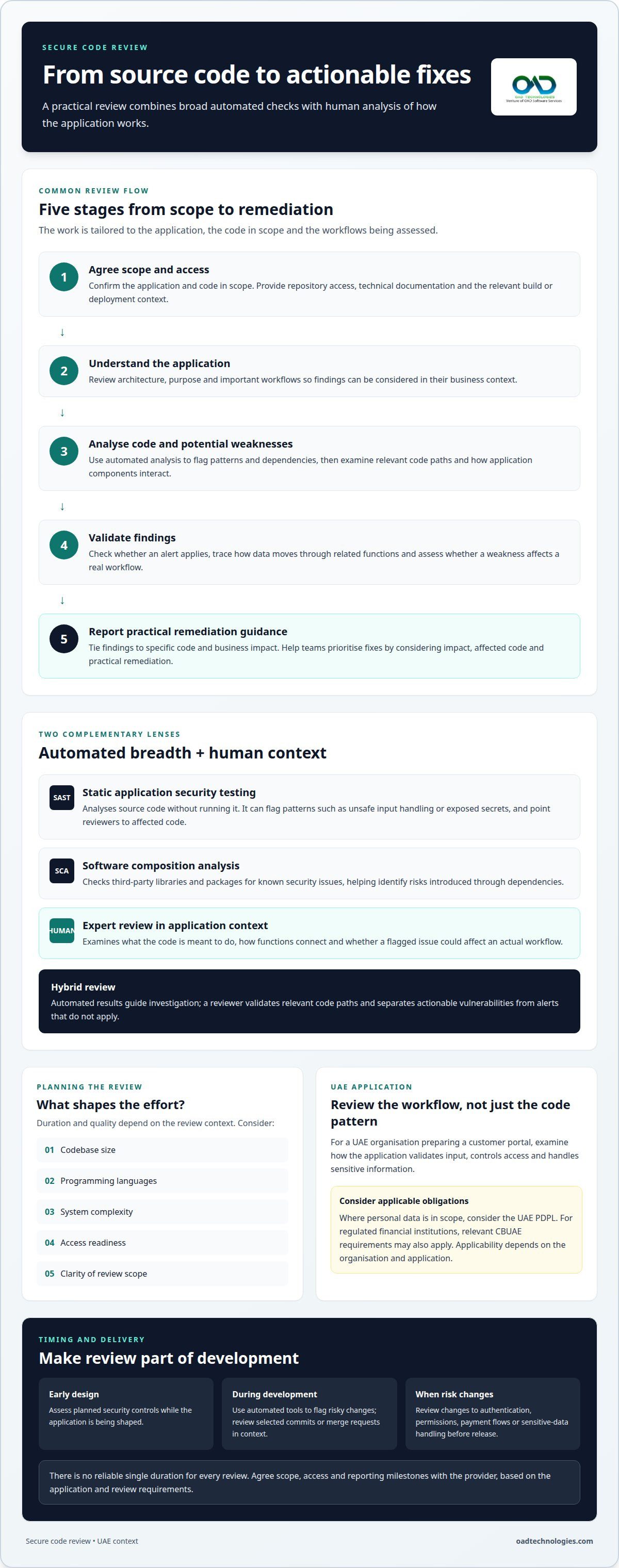
A professional reviewer examines relevant source code alongside information about the application’s purpose, architecture and important workflows. The client supplies access to the agreed code repository, build or deployment context, and technical documentation needed to understand those workflows. Quality and duration depend on codebase size, language, system complexity, access readiness and the clarity of review scope. Look for findings tied to specific code and business impact.
Combining human review and automated feedback
A hybrid review uses automated results to guide human investigation. The reviewer can validate a SAST alert, trace how data moves through related functions and assess whether an apparent weakness affects a real workflow. For example, a scanner may flag an access-control pattern; a reviewer can examine whether connected functions allow an unauthorised action. This combines broad pattern detection with contextual analysis.
Automated feedback can support developers as they write code or prepare changes for review. Human reviewers add value at commits or merge requests by assessing changes in context, including how a new function interacts with existing authentication and permissions. The review should distinguish actionable vulnerabilities from alerts that do not apply, so teams can prioritise fixes instead of treating every scanner result equally.
AI-assisted tools can summarise code, suggest potential weaknesses or help explain an alert. Treat these outputs as leads for investigation, not verified findings: an AI-generated suggestion may lack the application context needed to establish whether an issue is exploitable. A human reviewer should validate the relevant code path, examine the reasoning and document a reproducible explanation before recommending remediation. This keeps machine assistance useful without confusing generated analysis with expert judgement.
What is a source code review?
A source code review systematically examines an application’s software for security vulnerabilities, coding errors and relevant compliance concerns. It works best as a recurring development activity, not just a final check before release.
Review timing across the development lifecycle
Early review helps teams address vulnerabilities while developers are still shaping the application. At the design stage, reviewers can assess planned security controls; during development, automated tools can flag risky changes. Human review can then examine selected commits or merge requests, when the code’s purpose is clearer.
Ongoing reviews matter when teams change authentication, permissions, payment flows or sensitive-data handling. For example, a UAE business adding customer account features to an existing application can review those changes before release and consider the UAE PDPL where personal data is in scope. The right schedule follows development milestones and risk, rather than treating security review as a single end-stage event.
Applicable standards and requirements
In the UAE, applicable requirements depend on an organisation’s sector, data and payment activity. Relevant requirements may include the UAE PDPL where personal data is in scope, alongside sector-specific rules such as CBUAE requirements for regulated financial institutions. No single standard should be assumed to govern every application. A reviewer should relate the agreed scope to the organisation’s actual obligations and document which controls or requirements the assessment examines.
For payment environments, PCI DSS v4.0 Requirement 6.2.3 requires organisations to review bespoke and custom software before release to identify and correct coding vulnerabilities. This requirement is relevant when software falls within the applicable PCI DSS scope. The review report should make its scope and limitations clear, rather than imply that one code assessment establishes compliance with every regulation.
Review process and delivery timeline
A professional review commonly follows a defined sequence: agree the application scope and access; examine architecture and code; analyse potential weaknesses; validate findings; then deliver a report with remediation guidance. The client supplies repository access, relevant technical context and the development stage being assessed. These inputs help reviewers focus work on the code and workflows that matter.
There is no reliable single duration for every review. Codebase size, complexity, languages, access readiness and scope affect the effort. A provider should explain how these factors shape the delivery plan and reporting milestones.
When choosing a provider, businesses in the UAE should look for relevant code-review expertise, clear scope, contextual findings and practical remediation guidance. The review should explain evidence and business impact, not simply provide a list of scanner alerts.
In the UAE, the cost depends on codebase size, technical complexity, scope and reporting needs, and is provided after a quote request. Ask how the provider defines the review boundary and handles sensitive source code.
Cybersecurity assessment firms with source-code analysis capability may provide this service to UAE businesses. Compare the proposed review method, experience with the application’s technologies, finding validation and report detail.
For a review plan aligned with your application and release stage, discuss your requirements.
Vulnerabilities detected during code review
A source code review looks for security flaws in how an application handles input, identity, data and business actions. Finding issues during coding gives teams an opportunity to address them before they reach production.
Business logic vulnerabilities
Business logic vulnerabilities arise when code permits an action that conflicts with the application’s intended rules. For example, a booking system might allow the same discount to be applied repeatedly, or an account workflow might let a user change another customer’s record. Reviewers trace connected functions and permissions to see whether the software enforces each rule consistently.
These issues can evade pattern-based testing because the code may be syntactically valid. A reviewer examines the expected workflow, then checks what happens when steps occur out of order or a user supplies unexpected values. In a delivery platform in the UAE, for example, reviewers could assess whether order adjustments remain restricted to authorised roles.
Reviewers also look for vulnerability patterns associated with the OWASP Top 10. The assessment follows data from entry to use, checks access decisions, and examines how the application handles errors and sensitive information. Common examples include:
- Injection: User input reaches a database query without safe handling, creating a route for SQL injection.
- Cross-site scripting: Untrusted content appears in a page without suitable output encoding.
- Cross-site request forgery: A browser can be induced to submit an action without adequate request protections.
- Broken access control: A user changes an object identifier and accesses another account’s data.
- Weak cryptography: Code relies on an unsuitable algorithm or mishandles sensitive credentials.
Finding vulnerabilities before production
Reviewing code before release helps identify defects while developers can still trace them to recent changes. For instance, a reviewer can examine whether a new API validates data from external systems, checks permissions for each requested action and avoids exposing system details through error messages.
Early detection also lets teams assess potential exploit paths across related components. A single unsafe input may pass through several functions before reaching a database or browser. Reviewers follow that path, validate the security flaw and explain the affected behaviour so remediation targets the underlying cause.
Code review and penetration testing provide different evidence. Source analysis examines implementation, while testing an application in operation can show how weaknesses behave at runtime. Used together, they can help teams assess both code-level security flaws and practical exposure before production. For example, a reviewed authentication function may need runtime testing to assess how the complete login flow responds to unauthorised attempts.
Actionable findings and remediation guidance
A useful review report connects each code-level issue to its potential exploit and business impact. Clear remediation guidance helps development and cybersecurity teams decide what to address first.
Risk-prioritised findings
Reviewers prioritise findings by considering exploitability, affected data, required access and the application’s role. For example, an unauthorised route to sensitive customer records deserves attention before a low-impact defect in an internal display function. The report should explain the reasoning behind each priority, helping teams direct remediation towards meaningful exposure.
Context matters. A weakness in an authentication flow may affect several application features, while the same coding pattern elsewhere may have limited impact. Look for findings that describe the affected component, the conditions needed for exploitation and the likely consequence. This makes priority decisions clear to engineering and business teams.
Reports and remediation advice
A practical report gives developers enough detail to locate and understand each issue. It can identify the affected file or function, describe the observed behaviour, explain how the weakness could be exploited and recommend a suitable fix. For an access-control flaw, advice might focus on enforcing authorisation for each requested record, rather than hiding a button in the interface.
Reports should distinguish validated security flaws from observations that need further investigation. Clear evidence helps developers reproduce an issue without relying on ambiguous scanner output. A concise summary for decision-makers can connect technical findings to application risk, while detailed entries support the engineers responsible for code changes.
Remediation support and collaboration
Effective remediation depends on communication between reviewers and developers. In a finding discussion, the reviewer can explain the vulnerable code path, clarify assumptions and consider how a proposed change affects neighbouring functions. For example, strengthening an authentication check should not accidentally block legitimate account recovery.
Agreeing ownership and tracking the status of each finding helps teams coordinate fixes across a codebase. Reviewers can answer technical questions and assess whether a proposed change addresses the underlying cause. This collaborative process keeps remediation focused on reducing exposure, rather than closing a ticket without understanding the security issue.
Retesting remediated code
Retesting checks whether a code change resolves the original finding. The reviewer examines the updated implementation and repeats the relevant validation, such as confirming that one user can no longer access another user’s record by changing an identifier. The result should state whether the original issue is resolved or remains open.
Retesting also considers whether the change introduced a related weakness. A new authentication check, for instance, should be assessed alongside nearby account and session flows. The final record links the finding to its remediation status, giving engineering teams a clear basis for tracking outstanding cybersecurity work.
Manual, human-led secure code review
Manual review brings application security expertise to code that automated analysis cannot fully interpret. A reviewer traces how functions, permissions and data flows work together, then assesses whether attackers could misuse them.
The work begins with scope and context. Reviewers examine the application’s architecture, key workflows and relevant source code, then focus on security-sensitive areas such as authentication, payment processing and personal-data access. A UAE healthcare application, for example, may need to be assessed against applicable ADHICS requirements and the UAE Personal Data Protection Law (PDPL), where relevant, including how appointment records are retrieved and which user roles can view them.
Human judgement matters because a flaw can depend on a sequence of valid actions, rather than one obviously unsafe line. A reviewer might assess whether account recovery, session handling and access checks work safely together. They can also distinguish an actual weakness from code that appears risky but has effective safeguards elsewhere in the application.
A comprehensive manual assessment can examine areas such as:
- Business rules: Whether the code enforces intended limits on refunds, discounts or account changes.
- Authorisation: Whether each sensitive operation checks the user’s permission, not just the interface.
- Data handling: Whether sensitive information is protected as it moves between functions and services.
- Security events: Whether important actions are logged without exposing passwords or personal data.
Reviewers also consider how developers intend each component to behave. For example, an API may validate a request at its entry point, while another function later changes the requested account identifier. Tracing that sequence can reveal errors that a review of isolated code sections might miss. The reviewer records the affected path and explains the security consequence.
Manual analysis can examine security controls that depend on organisational context. A reviewer may assess whether multifactor authentication is enforced for a sensitive workflow, or whether database connections and service accounts have only the access they need. These checks connect implementation choices to the application’s actual users and data, instead of treating every codebase as identical.
Useful review findings identify the relevant function, explain the conditions that expose the weakness and support a practical fix. Reviewers can discuss their reasoning with developers, clarify how a proposed change affects related code and assess whether remediation addresses the root cause. That exchange helps teams act on the assessment and improve application security through informed engineering decisions.
OAD Technologies
OAD Technologies helps UAE organisations strengthen application security through complementary cybersecurity services. If a source code review identifies risks that need broader validation, Vulnerability Assessment and Penetration Testing (VAPT) can help assess an application’s security exposure. It complements code analysis by examining how weaknesses may affect the application in operation; it is not a substitute for reviewing source code.
Where findings raise concerns about sensitive information or ongoing threat detection, Data Loss Prevention (DLP), OAD’s 24 X 7 SIEM/SOC with sub-15-minute response times, and Managed Detection and Response (MDR) built on CrowdStrike endpoint protection (with Sangfor EDR, XDR and MDR as an alternative) may also support the wider security programme. OAD holds ISO 9001, ISO 14001, ISO 45001 and ISO/IEC 27001 certifications. The next step depends on the issue identified and the protection your organisation needs.
Contact OAD Technologies to discuss your application security requirements.
Make secure review part of the next release decision
Use the next release as a practical point to align application security with business priorities. Define which workflows matter most, what information they handle and how review findings will inform engineering decisions. This gives stakeholders a clearer basis for commissioning secure code review services and incorporating results into ongoing development.
For organisations in the UAE, planning can reflect the application’s role, data sensitivity and relevant sector requirements, such as the UAE Personal Data Protection Law (PDPL) or applicable sector rules. A customer-facing portal, for example, may call for different review priorities than an internal workflow system. A focused scope helps teams direct attention where software behaviour and business impact intersect.
OAD Technologies helps organisations consider code-related risks alongside broader cybersecurity needs, including data protection, vulnerability assessment and threat response. Discuss your application, development context and desired review outcomes with the team.
With a clear scope and shared priorities, your team can make more informed security decisions with confidence.
Frequently Asked Questions
Do you provide remediation advice after the review?
Remediation advice should accompany findings from a professional review. Each validated issue needs a practical explanation of the affected code, the risk it creates and a suitable corrective direction. For example, a finding about insecure password storage should identify the relevant authentication process and explain which security control needs improvement. Development teams can then assess the change within their architecture and track the issue through testing and release.
What do secure code review services include?
A review engagement typically defines the application and code in scope, examines selected source code and records security findings for the development team. Methods may include automated analysis of code and dependencies alongside human examination of important workflows. The agreed scope should also clarify what the reviewer will not assess, such as runtime behaviour or infrastructure, so stakeholders understand what the findings represent.
What are the differences between manual code review and automated security scanning?
Automated scanning applies repeatable checks across code or dependencies, helping teams include security feedback in routine development workflows. Manual review examines how specific components behave together and whether the implementation fits the application’s intended use. For example, a scan may flag an access-control pattern, while a human reviewer investigates how roles and permissions work across connected account functions.
What vulnerabilities can secure code reviews identify?
Reviews can uncover injection flaws, cross-site scripting, weak access controls and business-logic errors. They may also identify coding issues such as buffer overflows, memory leaks or unsafe error handling, depending on the language and code in scope. For a UAE customer portal, a reviewer might examine whether account functions expose another user’s records. Findings describe code risks, but don’t by themselves prove that an application has been exploited.
What should a secure code review report include?
A useful report identifies each finding’s affected component, supporting evidence and potential security impact. It should explain the conditions involved, provide remediation guidance and distinguish validated issues from observations needing further analysis. Clear scope and limitations help readers interpret results correctly. For example, a finding about an API should identify the relevant endpoint or code path, rather than leaving developers to search the entire application.
Disclaimer
Content by OAD Technologies is for general informational purposes only and does not constitute professional or cybersecurity advice. No warranties are made regarding accuracy or completeness; reliance is at your own risk. OAD Technologies shall not be liable for any direct or indirect losses arising from use of this content.