
Your PCI DSS level is determined by card transaction volume, not by how large your organisation appears. Merchants fall into four validation levels based on transaction volume over 12 months, and the applicable level shapes the validation route for PCI DSS compliance in the UAE.
That distinction matters because payment systems can span online checkouts, in-store terminals and the networks connecting them. A UAE retailer, for example, needs to consider how its point-of-sale and e-commerce systems handle cardholder data, not just where customers make purchases.
This guide explains how PCI DSS compliance in the UAE is determined, which payment-card systems may be in scope and what ongoing compliance involves. It covers how assessment, remediation and monitoring fit together, so you can understand the work behind validation and maintain it as your payment environment changes.
Key Takeaways
- Map how payment data moves through your business to understand which systems and processes may fall within scope.
- Use your merchant validation level to understand which assessment route and evidence your organisation needs.
- Plan for ongoing security through monitoring, vulnerability management and regular reviews, not just a one-off assessment.
- Translate the 12 PCI DSS requirements into practical controls for access, network security, data handling and staff responsibilities.
- When you need support implementing controls, a partner offering VAPT, DLP, SIEM/SOC and managed security services can help connect security requirements with business processes.
Why does PCI DSS compliance matter for UAE businesses?
PCI DSS is an industry data security standard for protecting payment-card information. UAE businesses that process, store or transmit card data must meet the applicable PCI DSS requirements, even if they handle only a single card transaction.
For a UAE merchant, the key questions are how payment data moves through its systems and which contractual validation requirements apply.
PCI DSS applicability in the UAE
PCI DSS applies to organisations that process, store or transmit cardholder data, including merchants and payment service providers. A business is not automatically out of scope because it processes only one card transaction.
For example, a UAE retailer accepting card payments in-store and online needs to consider both channels. Mapping how card data moves between terminals, checkout systems and connected networks helps identify the systems and processes that need protection. PCI DSS compliance in the UAE is generally a contractual requirement, rather than a law in itself.
Protecting cardholder data and customer trust
Protecting cardholder data means securing it both when stored and when transmitted across networks. Businesses should protect data sent over open, public networks and control access to systems that handle payment information.
A UAE hotel processing an online booking deposit, for instance, needs to consider the checkout connection and the systems receiving payment details. Clear access controls and ongoing attention to vulnerabilities help reduce unnecessary exposure. These practices demonstrate that payment information is being deliberately protected, although no security measure can eliminate every risk.
Non-compliance and data breach consequences
Non-compliance can have contractual consequences, while a breach can expose cardholder data and disrupt payment operations. Payment brands may impose penalties, with applicable consequences depending on the payment arrangements and circumstances.
For a UAE business, a compromised checkout may require urgent investigation, remediation and communication with affected parties. The impact can go beyond technical recovery: customers may hesitate to use a payment channel they no longer trust. Maintaining security controls and addressing vulnerabilities promptly helps limit exposure and supports a more orderly incident response.
PCI DSS and UAE data protection law
PCI DSS focuses on payment-card data security, while UAE data protection law addresses personal data protection. The UAE Federal Decree-Law No. 45 of 2021 concerns the Protection of Personal Data, according to UAE Legislation.
Businesses handling payment information should consider both obligations where card data is linked to identifiable people. PCI DSS controls do not replace the wider duties that may apply to personal data under the UAE law. Article 9 requires a controller to notify the UAE Data Office once it becomes aware of a qualifying breach; the law sets no fixed number of hours. Keeping payment security and personal-data processes aligned helps teams assess incidents and manage their responsibilities.
What are the PCI compliance ‘levels’ and how are they determined?
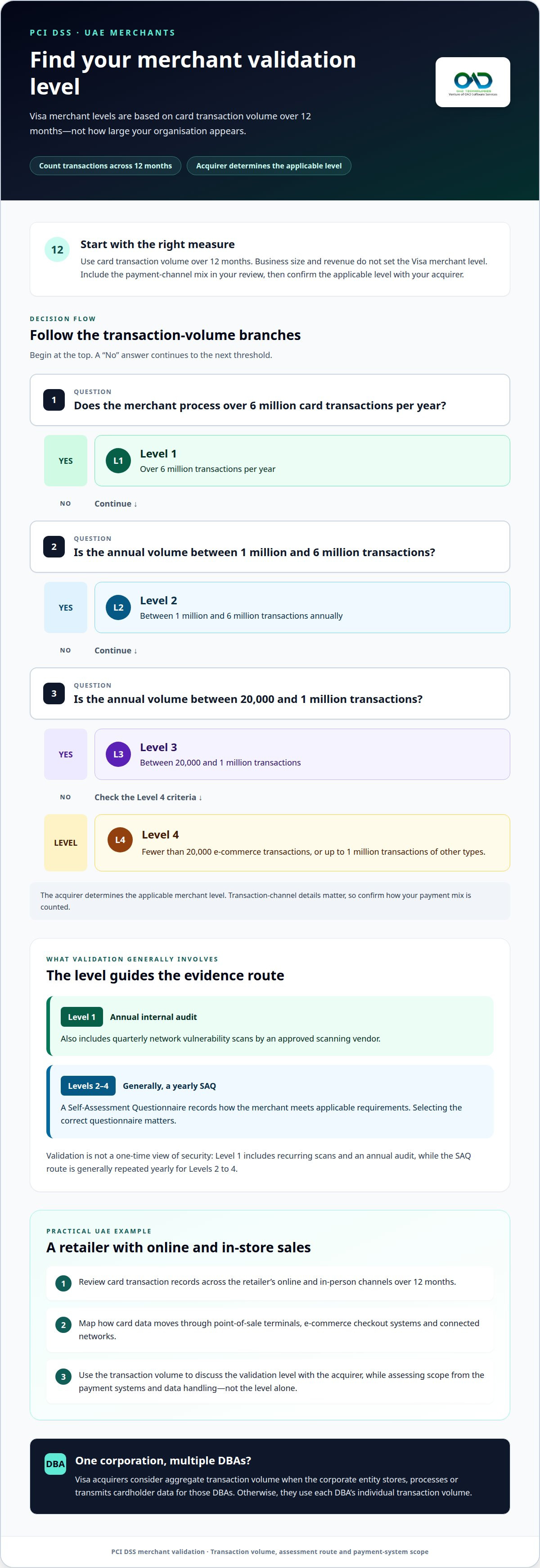
Visa merchant validation uses four levels based on card transaction volume over 12 months. The level helps determine which validation route and information security evidence apply.
Merchant levels and transaction volumes
Merchant levels classify businesses by transaction volume, giving acquirers a basis for setting validation expectations. Visa levels use the merchant’s transactions over 12 months, rather than business size or revenue.
Level 1 covers merchants processing over 6 million transactions per year. Level 2 covers between 1 million and 6 million transactions annually, while Level 3 covers between 20,000 and 1 million transactions. Level 4 applies to fewer than 20,000 e-commerce transactions, or up to 1 million transactions of other types.
These thresholds make payment-channel records important. A UAE business with online and in-person sales should understand its overall transaction mix before planning validation. Acquirers determine the applicable merchant level, so transaction volume and business structure both matter.
Level 1 validation
Level 1 is the highest merchant validation level and applies to businesses processing over 6 million card transactions per year. Its validation route includes an annual Report on Compliance (ROC) and quarterly network vulnerability scans by an Approved Scanning Vendor.
For a UAE enterprise processing high card volumes across several channels, the assessment needs to account for the systems supporting those transactions. Quarterly scans check network vulnerabilities, while the annual assessment examines compliance more broadly. Together, these activities provide recurring evidence rather than a one-time view of security.
Transaction volume across multiple business names can also affect classification. When one corporation has multiple DBAs, Visa acquirers consider aggregate transaction volume if the corporate entity stores, processes or transmits cardholder data for those DBAs. Otherwise, they use each DBA’s individual transaction volume.
Merchant levels and SAQs
For merchants in Levels 2 to 4, validation generally includes a yearly Self-Assessment Questionnaire (SAQ). An SAQ records how the merchant meets applicable requirements, making the correct questionnaire important to an accurate validation.
Transaction level alone does not describe every payment system or control in a business. Merchants must also consider how they accept payments and handle card data when determining assessment scope. Transaction records and a clear picture of payment operations support a more reliable validation process.
For example, a UAE company expanding its online checkout may see its e-commerce volume change over a 12-month period. Tracking that volume helps it plan for the appropriate merchant level and validation route. A focused discussion about merchant validation can help clarify how transaction volume relates to compliance planning.
PCI DSS assessment, remediation, certification, and ongoing monitoring
A PCI DSS assessment compares a payment environment and its security controls with the applicable requirements. UAE businesses can use a Qualified Security Assessor (QSA) for assessment and ongoing validation. Choose an assessor whose approach fits your payment scope and validation route.
Assessment, remediation and certification
An assessment reviews the controls and evidence supporting an organisation’s compliance with the security standard. Its findings help distinguish effective controls from gaps requiring remediation.
Remediation turns identified gaps into assigned actions, such as correcting a configuration weakness or documenting an access process. Teams can then retain evidence of how each issue was addressed. A successful PCI DSS assessment can result in a certificate of compliance for one year.
For a UAE business, an assessment should reflect the payment environment actually in use, including relevant network connections and operational processes. This makes the remediation plan more useful than a generic list of technical fixes.
Ongoing monitoring and vulnerability management
Ongoing monitoring tracks access to network resources and card data, while vulnerability management identifies and addresses weaknesses. Both help businesses maintain controls after an assessment instead of treating validation as a one-off exercise.
Monitor systems regularly, update software, test security processes and provide employee awareness training. Address identified vulnerabilities promptly. These activities help teams spot changes that could affect card payments, such as a new system connection or a change to user permissions.
Payment pages also need attention. Keep an inventory of scripts running on each page, record their business purpose and track changes. Reviewing the inventory helps identify unexpected scripts or changes that could expose payment data. For example, a UAE retailer adding a checkout feature should include its scripts in ongoing security reviews.
Choosing a Qualified Security Assessor
A QSA is a qualified assessor businesses can engage for PCI DSS assessment and ongoing compliance validation. The right fit depends on the organisation’s validation route, payment environment and the evidence the assessment needs to cover.
Before engaging an assessor, define the payment channels, systems and processes included in the assessment. Discuss how the assessor will review controls, record findings and explain remediation needs. A clear scope helps prevent gaps between the systems the business relies on and those covered by the assessment.
Level 1 validation requires an annual on-site audit by a QSA. Other validation routes differ, so align the assessor’s work with the merchant’s applicable requirements. A continuing relationship can also help teams interpret new vulnerabilities, changes to payment systems and evidence needed for the next validation cycle.
PCI DSS scope for payment-card organisations
PCI DSS scope follows the systems and people that store, process or transmit payment-card data. For a UAE organisation, mapping each payment route helps show where controls and responsibilities apply.
Map the payment environment
Start with every way customers can pay: an e-commerce checkout, shop terminal, call-centre transaction or recurring payment. Then trace cardholder data through connected applications, networks, databases and operational processes. A system may be in scope even if it does not store card numbers, when it can affect payment-system security.
For example, a UAE subscription business might accept card payments through a hosted checkout while its billing platform manages renewals. Its scope analysis should include the page, the integration and any systems that influence payment security. A clear data-flow map helps teams distinguish payment functions from unrelated business systems.
Payment gateways, hosted pages and tokenisation
A payment gateway can process transactions for a merchant, but using one does not automatically remove the merchant’s responsibilities. The merchant still needs to understand how its website connects to the gateway and which systems can affect that connection.
A hosted payment page directs customers to a page managed by a service provider. Tokenisation replaces a card number with a token for later reference, so the merchant’s systems need not handle the original number for that purpose. These methods can change the environment under review, but they do not remove scope. The actual data flow and system connections remain central.
Encryption and point-to-point encryption
Encryption makes cardholder data unreadable to parties without the means to decrypt it. Point-to-point encryption (P2PE) protects payment data from capture at a payment device through its secure transfer to a decryption environment.
For a UAE retailer using payment terminals, an important distinction is where encryption begins and where authorised decryption takes place. Teams should understand which devices, networks and processes handle card data, rather than assuming encryption puts every connected system out of scope. Sensitive authentication data, including CVV codes, should not be stored after authorisation.
Costs and processor fees
Payment processing fees and compliance costs are separate considerations. Processor charges depend on the merchant’s acquiring arrangements and transaction terms. Compliance effort depends on its payment channels, systems, assessment needs and remediation work.
A UAE business adding online card payments to existing in-store transactions should account for both the new gateway integration and the controls it introduces. Comparing these operational requirements helps decision-makers plan changes without assuming that a processor or hosted page removes all compliance responsibilities.
The 12 PCI DSS requirements
PCI DSS sets 12 requirements covering technical safeguards, access, monitoring and governance. For UAE organisations, they provide a structure for translating payment security into controls across commerce systems and service-provider relationships.
PCI DSS version 4.0 was published in 2022. Its requirements apply across the payment environment, while the validation route depends on the organisation’s role and merchant level.
- Build and maintain secure network controls: protect the network that supports cardholder data and manage security configurations.
- Apply secure configurations: remove default credentials and settings before deploying systems used for payment operations.
- Protect stored account data: limit retention and safeguard cardholder information that the business needs to keep.
- Protect data in transit: use strong safeguards when transmitting cardholder data over open, public networks.
- Protect systems against malware: maintain protections for systems that store, process or transmit payment data.
- Develop and maintain secure systems: manage vulnerabilities and security throughout software development and system maintenance.
- Restrict access by business need: give users access only to the cardholder data and systems their roles require.
- Identify users and authenticate access: assign individual identities and protect system logins.
- Restrict physical access: control entry to locations and equipment that hold or process cardholder data.
- Log and monitor access: record activity involving systems and cardholder data to support investigation.
- Test security regularly: test systems and processes to identify weaknesses before they lead to a breach.
- Maintain an information security policy: define and communicate responsibilities for protecting cardholder data.
These requirements work together. Access restrictions, for example, limit who can reach sensitive information, while logging helps identify activity requiring investigation. A UAE e-commerce business can assess its checkout, payment systems and staff access as connected parts of one commerce environment.
PCI DSS 4.0.1 specifies a 12-character minimum for strong passwords. Additional PCI DSS v4.0 best practices were mandated by March 31, 2025. Organisations should translate each applicable requirement into an implemented control and retain evidence showing how it operates.
Payment brands and acquirers, rather than the PCI Security Standards Council, enforce compliance. Acquiring banks may require merchants or service providers to submit validation evidence, such as an applicable self-assessment or assessment report. Consequences imposed by card brands for non-compliance may depend on the organisation’s payment arrangements and circumstances.
A Qualified Security Assessor can support an assessment when the validation route calls for one. The assessor reviews evidence and controls against the applicable requirements; the acquiring bank or payment brand sets its own submission expectations.
OAD Technologies: Governance, Risk, and Compliance (GRC)
OAD Technologies helps organisations put the technical controls behind PCI DSS into practice. Vulnerability Assessment and Penetration Testing (VAPT) supports the regular testing the standard expects; SIEM and a 24 X 7 SOC provide the logging and monitoring of access to cardholder data; Data Loss Prevention (DLP) and email security from OAD’s trusted partners Mimecast and Trustifi help keep card data from leaving the business and block payment-fraud phishing; and Zero Trust access controls restrict systems to those with a business need. Managed Detection and Response (MDR) and CrowdStrike endpoint protection guard payment systems against malware, while backup and disaster recovery keep payment operations resilient.
OAD holds ISO 9001, ISO 14001, ISO 45001 and ISO/IEC 27001 certifications, and its SOC is backed by sub-15-minute response times. The right combination of services depends on the organisation’s payment environment and requirements.
For UAE businesses planning PCI DSS compliance, OAD Technologies can help align the compliance work with practical security needs. Contact OAD Technologies to discuss your requirements.
Make payment security part of business change
Payment environments evolve as organisations add channels, integrations and services. Treat PCI DSS compliance in the UAE as an ongoing part of technology and operational decisions, not a task that ends with an assessment. A new checkout flow or supplier connection can change how payment data moves, so align security ownership with the teams responsible for those changes.
OAD Technologies supports this work with Data Loss Prevention (DLP), Vulnerability Assessment and Penetration Testing (VAPT), SIEM/SOC monitoring and Managed Detection and Response (MDR), addressing data protection, vulnerability testing and detection needs. These capabilities can help organisations plan security around their payment environment and business priorities.
Set a clear next step by identifying the payment processes that need attention and the internal teams responsible for them. A considered plan helps keep payment security aligned with business change.
With clear ownership and steady improvement, your payment operations can move forward with greater confidence.
Frequently Asked Questions
Is PCI DSS mandatory in the UAE?
For businesses accepting card payments, PCI DSS is typically a condition of their payment arrangements, rather than a standalone UAE statute. This distinction matters during procurement and contract reviews: payment acceptance terms may set validation expectations separately from UAE laws. Assign an owner to track those contractual commitments alongside applicable regulatory obligations, so teams do not mistake one assessment for proof of compliance with every requirement.
What does PCI compliance mean?
PCI compliance means an organisation can show that its payment environment meets the requirements applicable to its role and assessment route. In practice, teams need to connect control ownership with operational evidence. For example, a change record can show who approved a payment-system configuration change, while an access review records the business reason for retaining a user’s permissions. These records make compliance part of routine operations.
What is PCI?
PCI stands for Payment Card Industry, the ecosystem associated with card-based commerce. The term alone does not identify a specific security obligation. In business documents, distinguish the wider industry from PCI DSS, the specific data security standard discussed here. This helps procurement and technology teams interpret contract language accurately, especially when a supplier refers broadly to “PCI” without naming the standard, assessment type or responsibility involved.
Who needs to be PCI DSS compliant?
Responsibilities depend on an organisation’s role in the payment arrangement and the systems it controls. A merchant, payment processor and service provider may have different obligations, even when supporting the same transaction. For a UAE business using several vendors, a responsibility matrix can clarify who owns each payment function, supplies supporting records and coordinates changes. This is especially useful when a transaction crosses several systems.
What are the latest PCI DSS 4.0.1 requirements and deadlines?
PCI DSS 4.0.1 contains a large number of detailed sub-requirements, so organisations should identify those relevant to their payment environment rather than treating the standard as a single checklist. The applicable validation route and assessment scope shape the work. For deadline management, maintain a register of obligations communicated through the organisation’s payment arrangements, with an accountable owner and evidence of completed actions.
Which UAE regulators require PCI DSS compliance for payment businesses?
The Central Bank of the UAE (CBUAE) is the UAE regulator identified in connection with payment businesses. PCI DSS itself is an industry standard, and payment arrangements can set validation expectations. Regulated organisations should distinguish these expectations from their broader supervisory obligations. This helps compliance teams avoid relying on a PCI assessment alone to show that every applicable UAE regulatory requirement has been addressed.
How does PCI DSS apply to UAE merchants using payment service providers?
A UAE merchant should define responsibilities with its payment service provider in writing. Clarify which party manages each payment function, what evidence the merchant can access, how service changes are communicated and how incident coordination works. For example, before changing a checkout integration, the merchant and provider can document the affected systems and operational contacts. Clear agreements support coordinated oversight without assuming that outsourcing transfers every responsibility.
Disclaimer
Content by OAD Technologies is for general informational purposes only and does not constitute professional or cybersecurity advice. No warranties are made regarding accuracy or completeness; reliance is at your own risk. OAD Technologies shall not be liable for any direct or indirect losses arising from use of this content.