
For UAE decision-makers, choosing a managed SOC means evaluating service coverage, integration and operational impact, not simply adding tools. The priority is to select a service that addresses business risks while keeping ownership, coverage and responsibilities clear.
Before choosing a managed SOC or replacing existing tools, assess how each option supports your organisation’s needs. Does your team need stronger detection and response, clearer visibility across systems or better protection for sensitive information? The right choice depends on the gaps to address and the capabilities your team can operate effectively.
This article explains how to assess security coverage, communicate requirements and make implementation decisions when evaluating a managed SOC in the UAE. It offers a practical way to compare cybersecurity priorities without assuming that a larger stack is automatically better.
Key Takeaways
- Map each security tool and control to a business risk, then identify overlap and coverage gaps before simplifying the stack.
- Use clear diagrams and realistic scenarios to show how security processes work and where people need to act.
- Bring relevant security logs together and automate repeatable tasks so teams can follow incidents more consistently.
- Write policies in plain language, with clear responsibilities and practical steps employees can apply in their roles.
- Explain cyber risks in business terms so technical and non-technical stakeholders can make informed decisions together.
1. Evaluating cybersecurity tools and coverage
Start with a register of every security tool, the systems it protects and the person responsible for its alerts. Map each tool to a business risk, such as account takeover, data exposure or service disruption. This reveals overlapping controls and uncovered assets, and shows where simplifying complex cybersecurity for my team could reduce friction without weakening protection. Record each tool’s purpose before deciding whether to retain, replace or integrate it.
Assess coverage across users, devices, applications, networks, cloud services, and sensitive information. For each area, document the control, owner, evidence produced, and action taken when it detects a problem. Use recognised frameworks such as the NIST Cybersecurity Framework to focus evaluation on risk reduction, not tool count alone.
For example, a UAE logistics business could map endpoint controls to staff laptops, access controls to operational systems, and monitoring to critical network activity. A coverage gap might emerge if alerts reach a shared inbox without an assigned responder. Overlap might appear when separate tools flag the same event but offer no shared context. A cybersecurity review for UAE organisations can help structure this assessment around exposure and business priorities.
Email is a common place where overlap and gaps both appear. Rather than layering several filters, many UAE teams consolidate on a single managed email security platform such as Mimecast or Trustifi, combined with role-relevant phishing awareness training, so suspicious messages are blocked and reported through one clear process.
2. Evaluating managed SOC services in the UAE
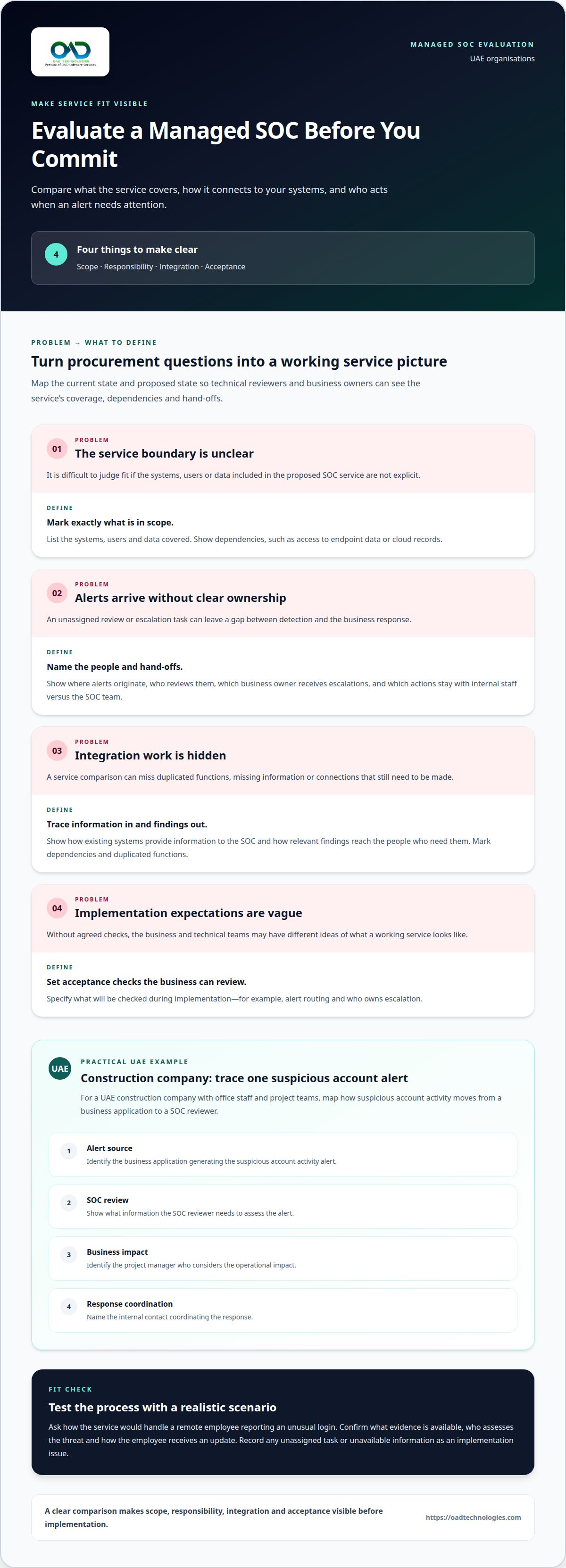
Use visual aids to compare managed SOC services against your UAE organisation’s requirements, not merely to polish a sales presentation. A clear diagram can show which systems a proposed service covers, what information it needs and how responsibility is divided between internal teams and the SOC provider. This helps decision-makers assess fit before selecting a service or changing a process.
For each option, map the current state and the proposed state. Show where alerts originate, who reviews them and which business owner receives escalations. Mark dependencies, such as access to endpoint data or cloud records. A visual comparison makes gaps, duplicated functions and integration work easier to discuss during procurement and implementation planning.
- Scope: Mark the systems, users, and data included in the proposed SOC service.
- Responsibility: Identify which actions stay with internal staff and which are handled by the SOC team.
- Integration: Show how existing systems provide information and receive relevant findings.
- Acceptance: Define what the business will review during implementation, such as alert routing or escalation ownership.
For a UAE construction company with office staff and project teams, a diagram could trace a suspicious account activity alert from the business application to the SOC reviewer. It could identify the information needed for assessment, the project manager who considers operational impact and the internal contact coordinating the response. This gives procurement and technical teams a shared basis for evaluating the service scope without assuming every site needs identical controls.
Use a practical scenario to test whether a proposed SOC service fits day-to-day work. For example, ask how the process would handle a remote employee reporting an unusual login. Clarify what evidence is available, who assesses the threat and how the employee receives an update. If the answer depends on an unassigned task or unavailable information, record that as an implementation issue.
Keep visuals focused and consistent. Use the same symbols for systems, people and decision points across SOC service comparisons. Include a short legend and a written version so stakeholders can review the material in different formats. Avoid technical details that do not affect service scope, risk or operational decisions.
Before choosing a SOC service, share the diagram with both a technical reviewer and a business owner. Ask each to explain how the proposed process would work in a relevant scenario. Their feedback can reveal unclear responsibilities or increasing complexity before implementation begins, helping the organisation make a more informed decision. If your team needs support translating requirements into an implementation discussion, discuss your requirements.
3. Centralising logs and orchestrating workflows
When evaluating a SIEM or MDR service in the UAE, consider how it brings together security records from endpoints, cloud platforms, identity systems and network devices. Centralising relevant logs gives analysts one place to connect events that might otherwise seem unrelated. For example, an unfamiliar sign-in followed by a permission change is easier to investigate when both records are visible together.
Choose data sources that help answer specific security questions, and check that a prospective service can handle them. Include records from critical business systems, user accounts and devices, and define who owns each source. Standardise timestamps and key fields where possible. Consistent details help analysts compare events and distinguish genuine patterns from separate, routine activity.
More data does not automatically mean more insight. When comparing SIEM or MDR services, consider how they handle logs that lack context, arrive late or generate repeated alerts, which can obscure vulnerabilities and consume analyst time. Set a purpose for each data source: which risk it helps detect, who reviews its alerts and what action follows. Remove feeds that add noise without improving investigation or response.
Orchestration connects detection to a controlled sequence of actions. When implementing a SIEM or MDR workflow for a suspicious account sign-in, for example, it might add account and device details to the alert, assign it to a reviewer and record the decision. Automate repeatable information gathering first. Keep consequential actions, such as disabling access, subject to clear approval rules and a named owner.
For a UAE SIEM or MDR implementation, a practical sequence can be:
- Choose a priority case: Begin with one recurring event, such as a malware alert on a company laptop.
- Map the evidence: Identify which logs show the alert, device, user, and related activity.
- Define the response: Specify who reviews the evidence, who acts, and how the outcome is recorded.
- Test the workflow: Use a controlled scenario to find missing data, unclear hand-offs, or unnecessary steps.
- Refine before expanding: Fix the process, then apply the same discipline to another priority case.
For UAE organisations choosing a service, investment should match operational needs. A multi-site business may need consistent event visibility across branches, while a smaller team may prioritise a few critical systems. Findings from Vulnerability Assessment and Penetration Testing can also help teams focus investigation workflows on identified exposure instead of treating every alert equally.
Finally, assess whether the service workflow helps staff act with clarity. Review unresolved alerts, repeated hand-offs and cases without an owner. Discuss these patterns in regular security reviews. Documenting decisions helps teams improve automation without obscuring responsibility or turning every incident into a manual investigation.
SIEM and MDR services can help cybersecurity teams automate repetitive tasks, including log analysis and incident response.
When implementing automation through a service, define its starting condition, required information, permitted actions and point for human review. Record the intended outcome before enabling it, then compare completed cases with that outcome. If a required field is missing or the result is unclear, leave the step with a reviewer rather than allowing it to proceed automatically. Review the procedure when ownership or response guidance changes, and give staff a clear way to pause or escalate a case. This keeps the workflow bounded and lets analysts check whether automation supports the intended response.
4. Choosing cybersecurity compliance support
A useful compliance service turns security requirements into actions employees can follow. When evaluating providers, ask how they will translate broad expectations such as “protect company data” into practical rules for access, storage, sharing and reporting. For example, they should be able to specify which approved channel staff should use to share a confidential file and what to do if they send it to the wrong recipient.
Assess whether the service covers the decisions and work activities relevant to your organisation. For remote working, check how the provider will address access to business systems, information storage and reporting a lost device. For access management, ask how managers will request permissions and how teams will remove them when someone changes roles. Clear ownership makes instructions easier to maintain.
What UAE cybersecurity and data protection laws must businesses follow? Requirements depend on the organisation, its sector and the data it handles. Relevant rules may include the UAE Personal Data Protection Law, alongside sector-specific requirements such as CBUAE requirements for regulated financial institutions or ADHICS for healthcare organisations. Ask prospective providers how their service will address the requirements that apply to your business.
When assessing a provider’s proposed approach, look for clear details on:
- Who: Identify the employee, manager, or response team responsible for each action.
- What: Name the information, device, account, or system covered by the rule.
- How: Give the approved process, such as using managed access rather than sharing a password.
- When: Explain the trigger for action, such as reporting a suspected incident as soon as it is noticed.
- Where: Point to the organisation’s reporting channel or approved storage location.
What should a cybersecurity compliance service cover for employees? It should help staff use approved access methods, protect credentials, handle business data carefully and report suspicious activity promptly. Employees also need to know where to report an incident and whom to contact if a device or account may be exposed.
How should a compliance service address personal devices and public Wi-Fi? Personal devices may lack the organisation’s security settings, updates or oversight, while public Wi-Fi can expose users to unsafe connections. Ask providers how their approach will define whether personal devices are permitted, which safeguards apply and what employees should do if access seems unusual.
For a UAE retailer, a compliance service could help branch staff use approved systems for customer records, avoid saving those records to personal devices and report a misplaced work device through a named internal channel. This makes the rule relevant to daily operations and clarifies responsibility.
When choosing a provider, ask how it will review requirements when business processes, systems or applicable obligations change. Confirm that each document will have an owner, a clear version date and revisions explained in plain language. A short, scenario-based awareness exercise can show whether staff understand a rule before an incident tests it.
5. Evaluating managed SOC services with non-technical stakeholders
When evaluating a managed SOC service in the UAE, translate its technical alerts into the business decisions they require. Instead of reporting “multiple failed authentication attempts”, explain that an account is receiving repeated access attempts and may need review. Then state the decision required, such as whether to restrict access temporarily while the team investigates. Executives can compare service options more confidently when the risks, business impact and response responsibilities are presented together.
The Feynman Technique offers a useful test when assessing a provider’s explanations: describe a concept in everyday language to someone unfamiliar with it. If you hesitate or rely on unexplained acronyms, the explanation may need work. For instance, describe encryption as making a file unreadable without the right key, then explain which business information needs that protection.
Build each managed SOC briefing around a few questions: What happened? Which business process could it affect? What response is needed, and who owns it? A concise incident update might say, “A staff account accessed an unusual file. The team has restricted that account and is checking related activity. The operations lead must confirm whether work can continue through an alternative process.”
- For executives: Connect a risk to service continuity, customer trust, or a decision about managed SOC investment.
- For department managers: Explain which workflow changes and what staff should do differently.
- For employees: Give one clear action, such as reporting a suspicious request through the approved channel.
- For technical teams: Include the relevant system detail, evidence, owner, and next response step.
A UAE property management company evaluating a managed SOC could discuss an access-control concern by showing which shared business process may be affected, rather than leading with log fields or system terminology. A simple diagram can show the path from detection to review, decision and recovery. Infographics and short videos can also explain the service and its processes, provided each visual supports a specific decision instead of adding technical detail.
Use plain language without removing important uncertainty or context. Separate confirmed observations from possible consequences, and label actions that need approval. In a leadership meeting about a managed SOC, a brief risk summary and clear investment rationale may be more useful than a long list of alerts. For staff, a realistic scenario and an opportunity to practise the response can make the procedure easier to apply.
After each briefing, ask a colleague from another team to summarise the proposed service, the problem it addresses and the next step. If their explanation differs from the intended response, revise the wording, diagram or process owner. Regular feedback helps build a shared security culture and gives non-technical stakeholders a meaningful role in managed SOC decisions.
OAD Technologies: Managed Cybersecurity Services
OAD Technologies helps organisations, including healthcare providers, simplify cybersecurity by consolidating protection into a smaller set of managed services aligned with their systems, data and operational priorities. Its 24 X 7 SIEM/SOC delivers sub-15-minute response times, and Managed Detection and Response (MDR) is built on CrowdStrike endpoint protection, with Sangfor EDR, XDR and MDR as an alternative endpoint option.
OAD also delivers Zero Trust access, email security with Mimecast and Trustifi, Data Loss Prevention (DLP), Vulnerability Assessment and Penetration Testing (VAPT), private cloud and HCI, backup and disaster recovery, and managed services. OAD holds ISO 9001, ISO 14001, ISO 45001 and ISO/IEC 27001 certifications. These services suit internal teams seeking clearer visibility, focused assessment or support managing security operations.
Contact OAD Technologies to discuss the cybersecurity needs your team is working to simplify.
Make your next security decision with confidence
Security should support your organisation’s ability to grow and adapt, not leave teams unsure of their responsibilities. If your priority is simplifying complex cybersecurity for my team, focus the next conversation on a specific operational challenge: protecting sensitive information, understanding weaknesses or strengthening incident response.
OAD Technologies can match these needs with relevant services. Data Loss Prevention (DLP) addresses risks involving sensitive information. Vulnerability Assessment and Penetration Testing (VAPT) helps identify security weaknesses, while Managed Detection and Response (MDR) supports threat detection and response. The right starting point depends on the risks and processes your organisation needs to address.
A focused discussion can clarify the business problem, the intended outcome and how security improvements fit into your wider operations. This gives your team a practical basis for moving forward without adding complexity for its own sake.
With a clear priority and relevant expertise, your team can make security easier to manage while keeping protection aligned with the work that matters.
Frequently Asked Questions
What should UAE businesses assess when consolidating cybersecurity services?
Consolidate tools only after confirming each one’s role, dependencies and effect on existing controls. Before retiring a product, document which alerts, records and integrations rely on it, then test the replacement against agreed acceptance criteria. For example, a business could run the proposed setup alongside its current system during a controlled transition, compare detection outcomes and preserve access to records needed for investigations.
How should UAE businesses evaluate cybersecurity services for different teams?
Describe the business situation, its potential consequences and the decision needed, using familiar terms. Instead of “unauthorised privilege escalation”, explain that someone may gain access beyond their role, then name the affected task or information. Tailor the detail: a department head may need to approve a process change, while a staff member needs a clear instruction. Do not present a possible outcome as a confirmed fact.
What should a small UAE business prioritise when buying cybersecurity services?
Identify essential accounts, devices and business records, then assign an owner to each. Apply updates to supported systems, limit access to what each role needs and maintain backups the business can restore. For example, a UAE trading firm can prioritise its finance accounts and order records, document who can access them and specify whom staff should notify if access is lost or unusual activity appears.
Disclaimer
Content by OAD Technologies is for general informational purposes only and does not constitute professional or cybersecurity advice. No warranties are made regarding accuracy or completeness; reliance is at your own risk. OAD Technologies shall not be liable for any direct or indirect losses arising from use of this content.