
Cybersecurity for UAE government services has to protect sensitive information without interrupting the systems people rely on. Government cybersecurity solutions in the UAE combine protection for critical infrastructure, threat monitoring, incident response and continuity planning, with controls aligned to the organisation’s obligations.
For public-sector and regulated teams, government cybersecurity solutions in the UAE must balance secure operations with accessible, dependable digital services. Assess the capabilities a solution should include, how requirements such as the UAE PDPL, NESA / IA Standard and Dubai ISR may shape the approach, and what to consider when selecting a provider.
For example, a UAE government department delivering a public digital service that handles personal information needs an approach that addresses both data protection and service availability. The sections ahead explain how monitoring and response support that goal, how to plan for IT continuity, and how security services can fit the organisation’s environment.
Key Takeaways
- Identify which UAE requirements apply to your organisation, then align security controls with the data and services you need to protect.
- See how national cybersecurity initiatives shape priorities for resilience, secure digital services and critical infrastructure.
- Understand how SOC monitoring supports threat detection and incident response, and what to define before selecting a service.
- Compare cybersecurity capabilities and deployment options against your operational needs, regulatory obligations and continuity priorities.
- Explore how OAD Technologies’ healthcare IT and cybersecurity services, including DLP, VAPT and MDR, can address relevant protection needs.
Cybersecurity services for government and regulated industries
UAE government entities and regulated organisations need controls that protect sensitive information while supporting reliable public services. A sound approach maps applicable requirements to each entity’s systems, data and operational risks, then identifies the cybersecurity services needed to address them.
Information Assurance Regulation Alignment
The UAE Information Assurance Regulation uses a risk-based approach to protecting information assets and supporting systems. TDRA developed it to set requirements across UAE entities. Compliance planning can start by identifying important assets, assessing risks and mapping relevant controls to those risks. Government cybersecurity solutions should show how monitoring, access controls and response procedures support this work. A control register can connect requirements to accountable owners, evidence and review processes.
Capabilities and Deployment Options
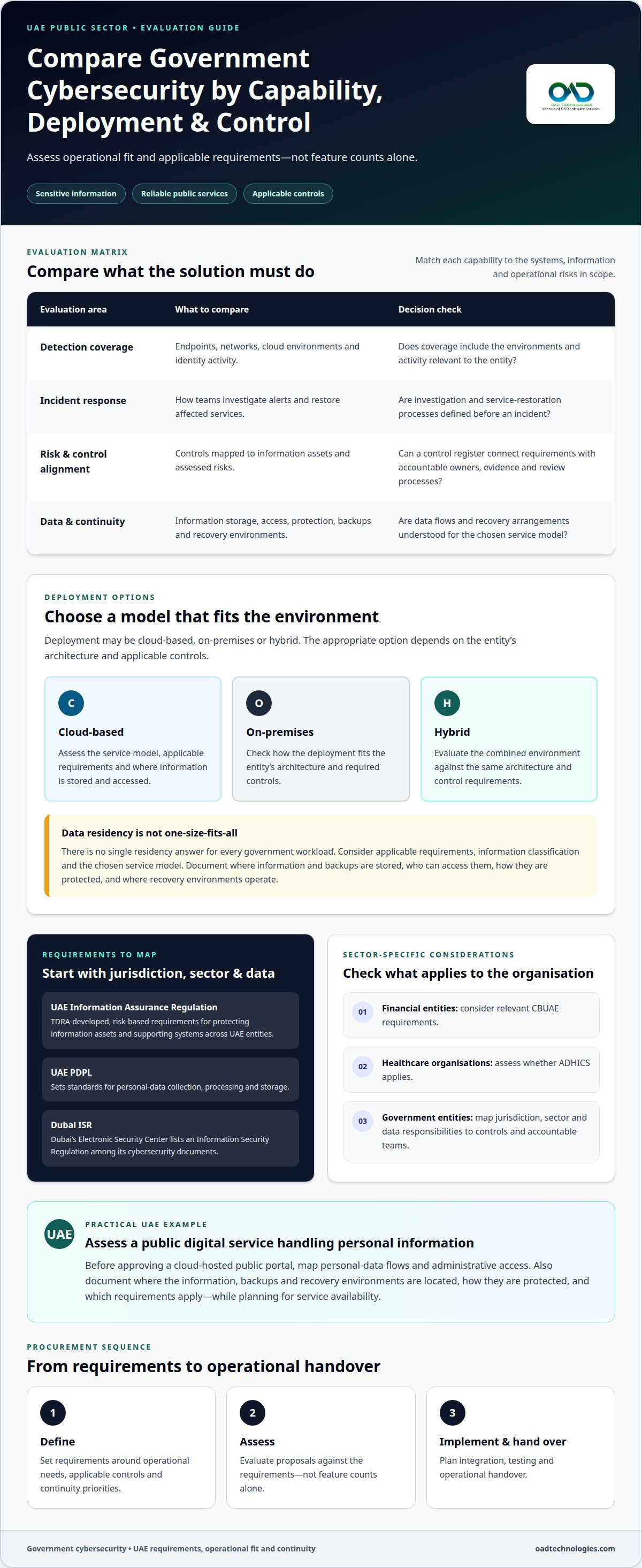
Compare capabilities against operational needs, not feature counts alone. Detection should cover relevant endpoints, networks, cloud environments and identity activity. Incident processes should define how teams investigate alerts and restore affected services. Deployment may be cloud-based, on-premises or hybrid, depending on the entity’s architecture and applicable controls. For procurement, define requirements, assess proposals against them, then plan integration, testing and operational handover.
Cloud Security and Data Residency
Cloud security, data residency and sovereign-data decisions depend on applicable requirements, information classification and the chosen service model. The UAE PDPL sets standards for personal-data collection, processing and storage. There is no single residency answer for every government workload. Document where information is stored, who can access it, how it is protected, and where backups and recovery environments operate. For example, before approving a cloud-hosted public portal, map personal-data flows and administrative access.
Cybersecurity Oversight and National Requirements
National requirements can apply alongside sector-specific obligations. TDRA developed the UAE Information Assurance Regulation, while the UAE PDPL applies to personal-data handling. Financial entities should also consider relevant CBUAE requirements, and healthcare organisations should assess ADHICS applicability. Government entities can identify their jurisdiction, sector and data responsibilities, then map applicable requirements to controls and accountable teams. This government cybersecurity context helps connect regulatory mapping with operational priorities.
Dubai’s Cyber Security Strategy aims to protect data and electronic services from threats and attacks. It includes a domain focused on building a secure cyberspace through controls that protect the confidentiality, credibility, availability and privacy of data. The Dubai Electronic Security Center lists an Information Security Regulation (ISR) among its cybersecurity documents.
UAE organisations handling sensitive data, operating in regulated industries such as banking, healthcare or government, or responding to cyber incidents may consider SOC services. ADGM and DIFC data protection regulations apply to financial free zones. The UAE Information Assurance Regulation, developed by the Telecommunications and Digital Government Regulatory Authority (TDRA), sets requirements for protecting information assets and supporting systems across UAE entities.
Government cybersecurity initiatives and investment
UAE cybersecurity investment forms part of a national agenda for stronger governance, skills and collaboration. For public and private organisations, planning means linking spending to critical services, information risks and operational needs.
The UAE’s National Cyber Security Strategy was launched by the Telecommunications and Digital Government Regulatory Authority (TDRA) in 2019. It is based on five pillars and includes 60 initiatives to mobilise the country’s cybersecurity ecosystem. The UAE Cabinet agreed to establish the UAE Cybersecurity Council in November 2020, reinforcing a national focus on coordinated cyber resilience. Government entities can use these priorities to shape internal plans for secure digital services, risk management and capability building.
International cybersecurity assessments can offer a broad view of national commitments, but they do not determine the security posture of each organisation. These results describe national-level commitments, not the security posture of each organisation. An entity still needs to assess its systems, suppliers and service dependencies. For public bodies overseeing essential services, considering critical infrastructure dependencies can help connect investment planning with operational impact.
The UAE cybersecurity market is projected to grow at a compound annual growth rate of 12.1% by 2028. That forecast signals market expansion, but it does not determine an individual entity’s budget. Investment decisions depend on systems in scope, information sensitivity, existing controls and the operational impact of disruption. Evaluate proposed capabilities against those factors rather than selecting them solely because a market category is growing.
Private-sector investment also supports wider resilience when organisations handle sensitive information or support public services. Banks, healthcare providers, utilities and technology suppliers can all create dependencies for government operations. For example, before investing in a customer platform, a UAE utility could assess data flows, supplier access, monitoring and recovery needs. This links procurement choices to the platform’s risks and dependencies.
A useful investment plan links each capability to an intended outcome and an accountable owner. Security information and event management (SIEM), for example, brings relevant security events together for analysis. Its value depends on suitable data sources, alert handling and operational follow-through. When considering managed security operations, assess how monitoring and response responsibilities fit the operating model, integration needs and governance.
To turn national priorities into a scoped programme, document critical services, existing controls, investment gaps and the outcomes each project supports. Discuss your UAE cybersecurity investment priorities as a next step towards aligning requirements, capabilities and implementation planning.
24 X 7 SOC monitoring and incident response
A Security Operations Centre (SOC) centralises monitoring, detection, analysis and response to security incidents. For a UAE government organisation, continuous coverage allows security events to be assessed beyond standard office hours. It also connects technical alerts to service priorities, helping teams focus on incidents that could disrupt public services or expose sensitive information.
Effective monitoring starts with visibility. Analysts need relevant activity from systems, endpoints, networks and cloud environments, plus context about critical services and authorised users. They can then triage alerts, investigate suspicious patterns and escalate credible incidents through agreed channels. A SOC’s value depends on usable data, clear ownership and response procedures, not simply the number of alerts collected.
Incident response should follow a defined sequence: validate the alert, determine its scope, contain affected systems, preserve evidence and coordinate recovery. This helps teams distinguish a genuine compromise from routine activity and limit disruption. Regular exercises can test whether technical teams, service owners and communications staff understand their responsibilities during an incident.
For qualifying personal-data breaches, Article 9 of the UAE PDPL requires the controller to notify the UAE Data Office once it becomes aware of the breach. The law sets no fixed number of hours for that notification. Government organisations should connect incident handling with their data-protection responsibilities, record relevant decisions, and route qualifying cases to the appropriate internal owners.
A national security strategy and related initiatives can guide resilience goals, but each entity needs operational procedures suited to its services. For example, a government department undergoing digital transformation may depend on a public portal, identity systems and cloud-hosted records. Its incident plan should identify which service owners assess impact, who can approve containment, and how teams restore access while investigating vulnerabilities.
Consider a suspicious login affecting a department’s online permit service. The monitoring team can correlate it with other account and network activity, escalate credible signs of compromise, and work with service owners on containment. Response procedures should preserve evidence for investigation while prioritising continuity for residents and businesses using the service.
Procurement decisions should define what continuous coverage includes: monitored systems, escalation routes, incident ownership, evidence handling and operational reporting. Government teams should also establish how the SOC coordinates with internal IT, privacy and service-continuity leads. Clear service boundaries help prevent gaps between detection and action, particularly when several teams support the same public-facing system.
Measure operational readiness through incident simulations, alert reviews and documented corrective actions. These activities show whether staff can follow the response plan and whether monitoring covers critical systems. As threats evolve, review procedures when services change, new vulnerabilities emerge or incident lessons expose coordination gaps.
Which UAE government entities oversee cybersecurity and set national requirements?
UAE cybersecurity oversight spans national data-protection responsibilities and sector-specific requirements. The useful distinction for an organisation is between the authority responsible for an obligation and the control standard used to address it. Mapping both helps procurement teams define scope, assign accountability and avoid treating different requirements as interchangeable.
The UAE Data Office is relevant to personal-data protection under the UAE PDPL. Government entities handling personal information should identify where it is collected, processed and stored, then assign internal responsibility for related decisions. This does not replace technical security governance. It clarifies how data-protection obligations connect with security, privacy and service owners.
Sector oversight adds another layer. Financial institutions should account for applicable Central Bank of the UAE (CBUAE) requirements, while healthcare organisations should assess whether ADHICS applies. These references serve different sectors and are not a universal checklist for every public entity. The organisation’s activities, information and regulated services determine which sector requirements belong in its compliance register.
A practical mapping exercise can record each requirement, the responsible authority, affected service, internal owner and evidence needed to demonstrate implementation. For example, a UAE public healthcare organisation could map a digital appointment service against its health-sector responsibilities, personal-data processing and service operations. It can then assign controls to the relevant technical or governance owner, rather than leaving accountability with procurement alone.
Procurement teams can use this register to compare proposed capabilities with actual obligations. A supplier proposal should clarify which systems and processes are in scope, which controls the solution supports, and what remains the organisation’s responsibility. Purchasing a security capability does not, by itself, establish compliance with a law or sector requirement.
Oversight mapping should account for organisational boundaries. A government entity may rely on a service provider, shared platform or partner organisation while retaining responsibility for its own decisions and information. Record relevant interfaces, data access and control owners so responsibilities remain visible across the service chain. Revisit the mapping when a service, data flow or organisational role changes.
For leadership, a concise register gives a practical view of regulatory ownership without merging distinct obligations. It can support governance reviews, procurement decisions and internal assurance by showing which requirements apply, who manages them and where evidence resides. This connects UAE oversight expectations with day-to-day cybersecurity responsibilities.
How do UAE government cybersecurity solutions compare by capabilities and deployment options?
UAE government entities can compare solutions by the risks addressed, systems covered and operational model required. A useful assessment separates technical capability from deployment choice, then tests both against service continuity, applicable requirements and existing architecture. This keeps procurement focused on fit rather than feature volume.
Start with capability coverage. Threat detection should account for relevant activity across endpoints, networks, email and cloud services. Vulnerability assessment can identify weaknesses, while security information and event management consolidates events for analysis. Cloud Security Posture Management can help assess cloud configurations. Compare how each capability fits the entity’s systems, who reviews its findings, and how identified issues move into remediation.
Assess cloud, on-premises and hybrid deployment options against operational and data requirements. A cloud model may simplify integration with cloud workloads; an on-premises design may suit systems with specific infrastructure constraints. A hybrid arrangement can connect both environments, but requires clear responsibility for data flows, access and monitoring. For each option, map where information is processed, which teams administer the environment, and how continuity arrangements work.
Use a consistent evaluation sequence for each proposal:
- Define scope: list critical services, systems, information types and dependencies.
- Map requirements: connect the UAE Information Assurance Regulation, PDPL or applicable requirements to proposed controls.
- Test capability: use a relevant scenario, such as suspicious activity affecting a public-facing service, to assess detection, escalation and recovery responsibilities.
- Assess integration: record required data sources, existing tools, access boundaries and operational owners.
- Plan implementation: set out configuration, testing, handover, support ownership and performance review.
For example, a UAE government entity moving a resident-facing service to a hybrid environment can trace a user request through cloud and on-premises components when comparing proposals. The assessment should show which controls protect each connection, how alerts reach the responsible team, and how service owners coordinate a response. Information classification and applicable requirements can guide the evaluation.
Deployment quality also depends on operational fit. A technically capable solution may create friction if it generates alerts without clear ownership or depends on data the entity cannot provide. Ask providers to explain the proposed workflow, dependencies and implementation stages in the context of the entity’s services. Compare responsibilities and evidence, not just product descriptions.
A decision record should explain why the selected capabilities and deployment model suit the entity’s requirements. It should also capture trade-offs, dependencies and review triggers, such as a major service change. This gives procurement, technical teams and service owners a shared basis for implementation and future assessment.
OAD Technologies: Healthcare IT and Cybersecurity
OAD Technologies provides Healthcare Technology Solutions and cybersecurity services relevant to UAE government entities responsible for health services and sensitive information. Vulnerability Assessment & Penetration Testing (VAPT) can assess systems, while Data Loss Prevention (DLP) addresses risks around sensitive data. Managed Detection & Response (MDR) supports threat detection and incident handling.
These services can help connect security priorities with healthcare systems’ operational needs. For example, when reviewing a digital service, a public healthcare organisation can consider how assessment, data protection and response capabilities fit its environment and compliance responsibilities.
Contact OAD Technologies to discuss your healthcare IT and cybersecurity requirements.
Turn security priorities into an actionable programme
Give cybersecurity decisions a clear operational owner. Bring service leaders, IT teams, risk specialists and procurement together to define priority outcomes, how progress will be assessed, and how changes to public services affect security requirements. This makes government cybersecurity solutions in the UAE part of service planning, not a separate technical exercise.
Start with a defined scope, such as a public-facing service or sensitive-information workflow. Document its dependencies, decision-makers and operational constraints, then use those details to shape an implementation plan. A staged approach helps teams learn from each deployment and adapt controls as organisational needs evolve.
OAD Technologies can discuss how cybersecurity requirements connect with your organisation’s services and operating environment. A focused conversation can help establish a practical starting point for the next stage of planning.
With clear ownership and a defined scope, your organisation can build resilience into its digital services and move forward with confidence.
Frequently Asked Questions
What government cybersecurity solutions are available in the UAE?
UAE government entities can use layered solutions for data protection, vulnerability assessment, threat detection, incident response and cloud security. The right combination depends on the systems and information involved. For example, an agency protecting a public-facing service might assess vulnerabilities, monitor endpoint activity and apply controls to sensitive records. Government cybersecurity solutions in the UAE should fit the entity’s technical environment and operational responsibilities, rather than rely on a standard package.
What cybersecurity regulations and standards apply to UAE government agencies?
Applicable requirements depend on the entity’s jurisdiction, sector and data. Relevant measures may include the UAE Information Assurance Regulation, the UAE PDPL, and, for Dubai entities, DESC’s Information Security Regulation and Cloud Service Provider Security Standard. Healthcare or financial organisations may also need to consider sector-specific requirements such as ADHICS or CBUAE rules. For a new government service, map its data and systems to applicable requirements before setting procurement criteria.
Which cybersecurity providers serve UAE government organisations, and what solutions do they offer?
OAD Technologies provides cybersecurity services relevant to UAE organisations, including Data Loss Prevention (DLP), Vulnerability Assessment & Penetration Testing (VAPT), and Managed Detection & Response (MDR). These address different needs: protecting sensitive information, assessing technical weaknesses, and supporting threat detection and response. A government organisation can define the scope around its systems, information and operational responsibilities, then consider which capabilities align with that scope and its compliance work.
What cybersecurity risks and threat trends affect UAE government agencies?
Cyberattacks targeting the UAE rose by 20% in 2023, with critical sectors including finance and energy among the targets. Government agencies also need to manage risks of sensitive-data exposure, disruption to public services, and threats affecting critical infrastructure and service dependencies.
Disclaimer
Content by OAD Technologies is for general informational purposes only and does not constitute professional or cybersecurity advice. No warranties are made regarding accuracy or completeness; reliance is at your own risk. OAD Technologies shall not be liable for any direct or indirect losses arising from use of this content.