Could Zero Trust replace a traditional VPN? It can change how remote access is granted, limiting users to the applications and data they’re authorised to use, but it doesn’t automatically make every VPN unnecessary. For zero trust in UAE government entities, the practical aim is to verify access continuously rather than rely on a trusted network boundary.
This shift matters when UAE government teams need to protect sensitive services while supporting staff, devices and workloads across varied environments. A stronger approach begins by identifying the systems and data that need protection, then applying identity controls and access decisions suited to their risk.
This guide explains how to assess government networks, manage identity and access, and verify users and devices continuously. It also covers how multi-factor authentication and network segmentation can limit exposure if an account or device is compromised. The steps connect these controls into a practical implementation path, taking UAE government requirements and operating conditions into account.
Key Takeaways
- Map sensitive systems, data flows and access risks to identify where a Zero Trust rollout should begin.
- Use identity controls to grant users and third parties only the access their roles require.
- Build ongoing checks around user identity, device condition and connection context, not just network location.
- Apply MFA and network segmentation to strengthen access and help contain the impact of a compromised account or device.
- Use assessment, DLP, VAPT and MDR capabilities to address gaps as Zero Trust controls are implemented and refined.
Identity and access management
Treat identity, not network location, as the anchor for access decisions. For UAE government entities, the UAE Information Assurance (IA) Standards and Dubai’s Information Security Regulation include access control and monitoring requirements aligned with Zero Trust.
-
Establish identity-based access
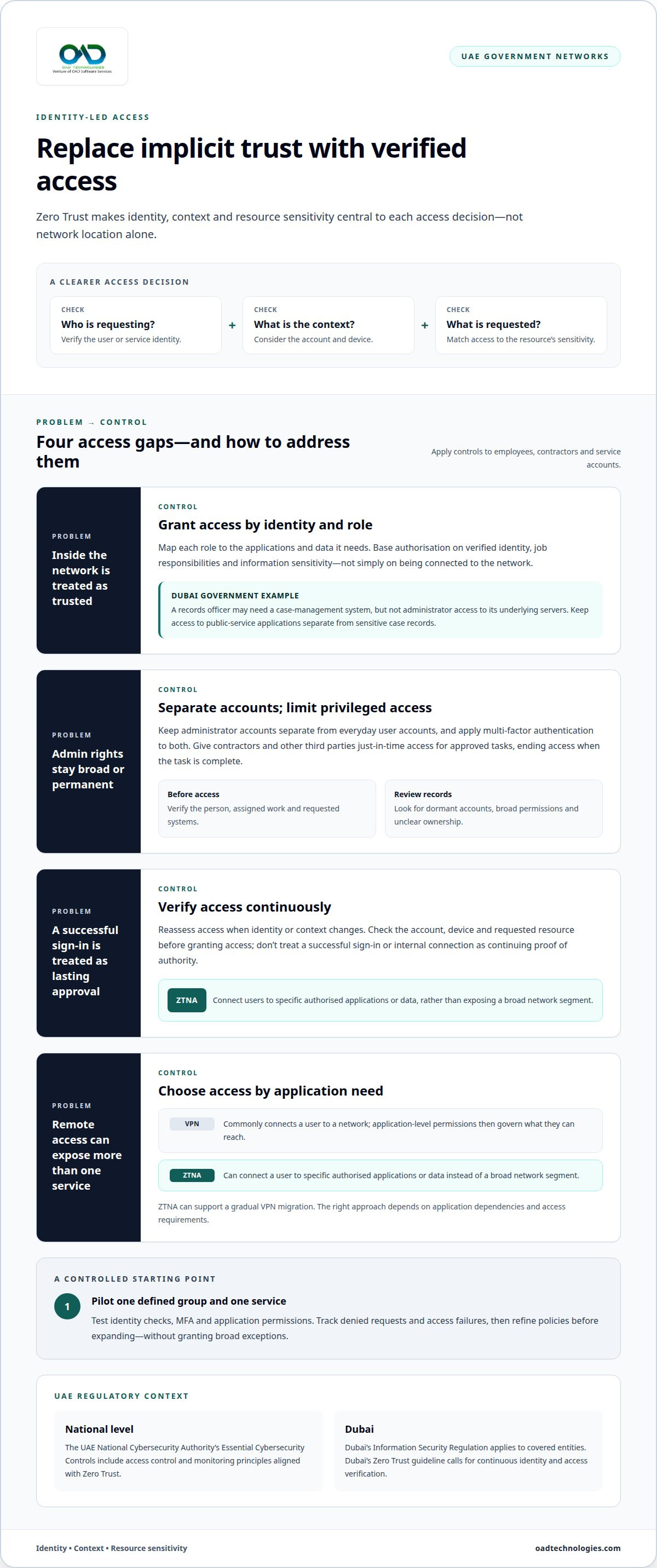
Map each role to the government applications and data it needs. Grant access based on verified identity, job responsibilities and information sensitivity. For example, a records officer may need a case-management system, but not administrator access to its underlying servers.
Use an identity and access management process to authenticate users and authorise each request. Include employees, contractors and service accounts in the assessment. Look for shared accounts, unused permissions and roles that combine incompatible duties. A connection inside the network perimeter is not, by itself, proof of identity or authority.
For a Dubai government department, separate access to public-service applications from access to sensitive case records. This gives each identity a defined purpose and makes excessive permissions easier to spot. Record who approves each role and which resources it can reach.
-
Manage privileged identities
Separate administrator accounts from everyday user accounts, then apply multi-factor authentication to both. MFA should cover every user account, including privileged accounts. This means a stolen password alone is not enough to gain access, while routine work stays separate from high-impact administrative activity.
Give contractors and other third parties just-in-time access for approved tasks. Set access to start when needed and end when the task is complete. Before granting access, verify the person’s identity, assigned work and requested systems. Avoid permanent privileges for temporary support, maintenance or project work.
Review privileged identity records for dormant accounts, broad permissions and unclear ownership. A government database administrator, for example, may need temporary access to restore a service, but not continuous access to unrelated systems. Keep approval and activity records together so administrators can trace who authorised access and what it covered.
-
Verify access continuously
Reassess access as identity and context change, rather than relying on the initial sign-in. Check the account, device and requested resource before granting access. Dubai’s Zero Trust guideline calls for continuous identity and access verification, making it a core operating practice for government networks.
Use Zero Trust Network Access to connect users to specific authorised applications or data, rather than exposing a broad network segment. Traditional VPN access commonly connects users to a network, with application-level permissions then governing what they can reach. ZTNA can support a gradual VPN migration, but the right approach depends on application dependencies and access requirements.
Begin with a defined group, such as remote staff accessing one service. Test identity checks, MFA and application permissions before expanding. Track denied requests and access failures, then use these signals to refine policies without granting broad exceptions.
What is the Zero Trust security model?
Base each access decision on identity, context and resource sensitivity, not network location. At federal level, the UAE IA Standards set relevant controls, while Dubai’s Information Security Regulation (ISR) applies to covered entities.
-
Define Zero Trust principles
Apply the “Never trust, Always verify” principle to each user, device and connection. The UAE National Cybersecurity Strategy emphasises Zero Trust principles, while NESA and Dubai ISR set relevant requirements for covered entities. Zero Trust is not a uniform mandate for every federal and emirate-level entity; obligations depend on the requirements that apply.
For a Dubai government department, define access policies around the sensitivity of each digital service. Check that a user’s role and device context support the requested access. Avoid treating a successful sign-in or an internal network connection as continuing approval.
-
Address remote-work and human-factor risks
Apply the same identity and device checks to remote staff as to office-based staff. A remote employee accessing a government case system should use an approved device and receive access only to that service. Location alone should neither permit nor deny access; assess the user, device and requested resource together.
Include mistakes, privilege misuse and social engineering in the cybersecurity risk assessment. For example, a staff member who receives a convincing sign-in request could expose credentials. Use MFA and access policies to reduce reliance on passwords, and make it straightforward to report suspicious requests.
- Use the ISR Officer Certification Programme to build practical information-security capability across government sectors. The programme equips individuals with skills to implement information security regulations. Give trained officers clear roles in policy reviews, risk assessments and incident coordination, then connect their findings to the entity’s security posture.
For cloud and remote access, Zero Trust controls who can reach workloads and data. It does not determine where cloud data is stored. Treat data residency as a separate hosting and data-location requirement, and assess it alongside access policies before moving government workloads.
- Link monitoring to a written incident response plan. Define how the security team escalates suspicious sign-ins, unusual privilege use and access from non-compliant devices. For example, if a government email account accesses a case system at an unexpected time, investigate the activity rather than trusting it automatically.
Use monitoring results to update policies and response procedures. A Zero Trust implementation assessment can help map access controls, cloud workloads and operational risks into a phased plan.
Continuous verification of users, devices, workloads, and data
Make each access decision reflect current identity, device condition, workload activity and data sensitivity. In Dubai, continuous traffic monitoring and sensitivity-based data classification support this approach.
- Use checks that reassess users and devices during active sessions. A government employee’s approved laptop can become risky after unusual activity or a change in device compliance. Re-evaluate access when context changes instead of relying only on the initial sign-in. For example, a session accessing a public service should not automatically gain access to a sensitive records workload.
Apply equivalent checks to workloads, including cloud services and application connections. Review service accounts and API activity because automated processes can access data without a person signing in. Audit permissions and behaviour together. If a service account suddenly requests unrelated records, flag it for investigation rather than treating its familiar identity as sufficient proof.
- Classify information by sensitivity before setting monitoring priorities. A Dubai department handling public enquiries can distinguish routine service data from sensitive case records. Use those classifications to define which users, workloads and devices may interact with each data group. This gives monitoring teams a clear basis for assessing unusual access and supports controls aligned with business need.
Monitor network traffic across cloud and on-premises environments. Combine traffic signals with network segmentation to see which zones communicate and investigate unexpected connections. Protect cloud data in transit and at rest. Include application programming interfaces in regular reviews, as an exposed or misused API can create access paths outside ordinary user sessions.
- Correlate security events through a SIEM and behavioural analytics. A sign-in from an unusual context may seem low risk on its own. Combined with unexpected file access and a new device, it may indicate a developing threat. Link identity, endpoint and network events so analysts can assess the sequence, affected workload and data sensitivity together.
Set monitoring rules around critical systems and established operating patterns. For example, a government payment workload may normally exchange data with specific services. An unexpected connection or unusual volume should trigger an alert for review. Update detection rules as workloads change: stale baselines can obscure genuine threats or generate avoidable alerts.
- Connect threat analytics to a defined response process. When endpoint detection identifies suspicious activity, teams can investigate and isolate a compromised device. Record the alert, decision and action, then review whether the event affected related identities, workloads or data. This creates a traceable path from detection to containment and recovery.
Use dashboards to track risky identities, MFA posture, privileged access, device compliance, vulnerabilities and active incidents. Dubai’s Zero Trust dashboard uses existing cybersecurity signals as live evidence of compliance with its Information Security Regulation. These indicators can help an entity move from periodic snapshots towards continuous visibility and more timely policy adjustments.
Zero Trust assessment tool and implementation guideline for Dubai government networks
Assess the network, systems, data and access paths before choosing controls. For Dubai government entities, align the assessment with the applicable Information Security Regulation requirements and operational priorities.
- Inventory users, devices, workloads, data stores and connections across the network. Record which services support critical public functions, where sensitive information flows, and which legacy systems cannot support modern controls. For example, map a Dubai department’s public-service portal to its databases, administrator accounts and third-party connections.
Rate each access path by its potential impact if compromised. Identify unsupported operating systems, shared accounts, flat network zones and remote connections that bypass current controls. This baseline gives the zero trust uae government architecture a practical starting point and helps teams prioritise identity and access improvements.
- Choose a bounded use case, such as remote access to one government application or privileged access to a sensitive database. Apply identity checks, device requirements and least-privilege permissions to that service first. Test how the controls interact with legacy authentication, application dependencies and approved business processes.
Use the pilot to identify policy conflicts before expanding. A legacy records application, for instance, may rely on a fixed service account or older network connection. Document the dependency and design a controlled transition rather than disabling access abruptly. Dubai’s Zero Trust guideline includes controls such as MFA, segmentation and continuous traffic monitoring.
- Expand in phases, using assessment findings to determine the sequence. Foundational phases, such as identity controls and network segmentation, usually come first; reaching maturity across all Zero Trust pillars is a multi-year effort that depends on organisational complexity.
Track implementation through measurable indicators, such as MFA coverage, privileged access reviews, device compliance and unresolved vulnerabilities. Dubai’s Zero Trust dashboard, which draws on existing security signals, illustrates how operational evidence can support ongoing visibility.
- Estimate implementation costs based on network size, complexity, existing controls and legacy dependencies. A department with fragmented identity systems may need more integration work than one with centralised access management. Include technology, migration, testing, staff capability and ongoing operations in the assessment, then phase investment around risk reduction and service continuity.
Review the plan after each deployment stage. Confirm that segmentation does not interrupt essential services, that remote staff retain approved access, and that alerts reach the response team. A focused OAD Technologies Zero Trust architecture assessment can help translate these dependencies into a phased control design.
Multi-factor authentication and network segmentation
Combine stronger identity checks with network zones that restrict unnecessary access. UAE enterprises can use both controls to protect government infrastructure and applications.
-
Deploy multi-factor authentication
Require multi-factor authentication before users access sensitive services. Apply it to privileged and ordinary accounts, including remote access. Choose authentication methods that suit the service’s risk and users’ operating needs. For example, an administrator accessing a government records system should face an additional identity check beyond a password.
Connect MFA decisions to continuous verification. Reassess access if identity or device context changes during a session. Review exceptions and failed sign-ins, then adjust policies where they create avoidable exposure. Avoid broad bypasses for legacy applications: document dependencies and plan a controlled transition to stronger authentication.
-
Segment the network
Divide infrastructure into isolated zones according to business needs, data sensitivity and application relationships. Separate public-facing services from internal administration and sensitive records. If one zone is compromised, well-designed segmentation can limit lateral movement into other systems.
Map required connections before applying restrictions. A Dubai government service might need its public portal to reach a specific application and database, but not every internal network. Permit necessary flows and block unrelated paths. Test policies against service dependencies to avoid disrupting public operations.
- Extend segmentation into microsegmentation where broad zones still permit excessive access. Create smaller boundaries around workloads or applications, using factors such as user role, location and business function. For instance, restrict a finance application to approved staff and its required services, rather than allowing every device in the same network zone to connect.
Use network traffic and access logs to identify unexpected connections. Compare observed flows with documented application requirements, then refine rules in stages. This makes policy changes easier to assess and helps teams identify systems that still depend on broad permissions.
- Coordinate MFA and segmentation as parts of one security architecture. An authenticated user should still reach only the applications their role requires. A device that passes an identity check should not gain unrestricted network access. Review identity policies, segment rules and service dependencies together after significant infrastructure or application changes.
Track operational measures such as MFA coverage, exceptions, blocked connections and policy-related service interruptions. Use these signals to prioritise improvements and assess whether controls work as intended. For UAE government entities, align the design with applicable requirements, including Dubai’s Information Security Regulation where relevant.
OAD Technologies: Zero Trust Architecture
OAD Technologies helps government entities translate Zero Trust priorities into a tailored Zero Trust Architecture. This is useful when assessment findings need to become coordinated controls across identity, devices, applications and network access.
For example, a UAE government entity could pair architecture design with Vulnerability Assessment and Penetration Testing (VAPT) to identify security gaps. Data Loss Prevention (DLP) and email security from Mimecast and Trustifi protect sensitive information, OAD’s 24 X 7 SIEM/SOC provides the continuous monitoring Zero Trust depends on with sub-15-minute response times, and Managed Detection and Response (MDR) built on CrowdStrike, with Sangfor EDR, XDR and MDR as an alternative, checks device health and contains threats. OAD holds ISO 9001, ISO 14001, ISO 45001 and ISO/IEC 27001 certifications. The right combination depends on the entity’s systems, risks and implementation priorities.
A defined assessment and phased plan can connect technical changes with operational needs. Contact OAD Technologies to discuss Zero Trust requirements for your environment.
Make Zero Trust an operating capability
For UAE government entities, Zero Trust should be part of routine technology decisions, not a standalone security project. Build security requirements into new services, system changes and supplier access. This keeps access policies aligned as teams, applications and operating needs evolve.
Good governance gives Zero Trust for UAE government operations a clear foundation. Set a regular schedule for reviewing policy exceptions, service dependencies and changing risks. Give teams a clear route to raise issues when controls affect public services. Their feedback can guide refinements while keeping essential work moving.
OAD Technologies can help shape an approach around your organisation’s priorities and environment. A focused discussion can connect your requirements with the constraints your teams need to manage.
With clear ownership and ongoing improvement, your organisation can build a more adaptable security posture over time.
Frequently Asked Questions
Can Zero Trust replace traditional VPN?
Zero Trust can replace some VPN use cases, but it is not a direct, universal substitute. Zero Trust Network Access can provide application-specific access without exposing a broad network connection. A government entity should first map VPN-dependent applications, users and service connections. For example, remote staff accessing one case-management application may move to application-level access, while systems with complex dependencies may need a staged transition.
Does Zero Trust work with legacy applications?
Yes, Zero Trust can accommodate legacy applications through phased controls and careful integration. Begin by documenting how each application authenticates users, connects to databases and depends on service accounts. A legacy records system, for example, might retain its existing authentication while network access becomes more restricted. Use compensating controls where modern identity checks are not technically compatible, then reassess as the application changes.
What is Zero Trust and why is it important for UAE organisations?
Zero Trust is an approach in which access decisions rely on identity and context, rather than assumed trust based on network location. It helps UAE organisations manage access across office, remote and cloud environments. For example, a government team can restrict a contractor’s access to a specific service and task. The approach also improves visibility into who or what can reach sensitive resources.
What does zero trust mean for UAE government entities?
For UAE government entities, Zero Trust means applying access controls according to the person, device, resource and context involved. Controls should reflect each entity’s responsibilities, systems and applicable security requirements. For example, a public-service portal and a sensitive case database may need distinct access policies and monitoring. Zero Trust is an operating approach, not a single product or one-size-fits-all deployment.
What are the UAE government’s zero trust cybersecurity policies and standards?
Relevant references include the UAE IA Standards (formerly NESA) and Dubai’s Information Security Regulation (ISR). The UAE National Cybersecurity Strategy also emphasises Zero Trust principles. Which requirements apply depends on the entity and its remit; these references are not one identical mandate for every federal and emirate-level organisation. Map controls to the authority and regulation relevant to your organisation.
What zero trust architecture should a UAE government entity implement?
Choose an architecture that fits the entity’s applications, data sensitivity, identity systems and hosting environment. Core design elements may include identity and access controls, MFA, network segmentation, device checks and security monitoring. For example, an entity could separate public-facing services from internal administration and sensitive records. Design controls around required service connections so security restrictions do not obstruct essential government operations.
What are the steps to implement zero trust in a UAE government organisation?
Start by assessing systems, data flows, identities, devices and existing access paths. Select a defined use case, such as remote access to a single service, then test identity checks and access policies. Address dependencies before expanding. Measure progress through indicators such as MFA coverage, device compliance and policy exceptions. Include operational teams in reviews so implementation decisions account for service continuity and support needs.
What are the costs and timelines for zero trust implementation in the UAE?
Costs vary with network size and complexity, existing security controls, integration needs and legacy dependencies. Foundational phases, including identity controls and network segmentation, typically come first, while full maturity across Zero Trust pillars is a multi-year programme. Treat any timeline as a planning estimate, not fixed delivery dates: phased scope, application dependencies and operational capacity affect the programme timeline.
Disclaimer
Content by OAD Technologies is for general informational purposes only and does not constitute professional or cybersecurity advice. No warranties are made regarding accuracy or completeness; reliance is at your own risk. OAD Technologies shall not be liable for any direct or indirect losses arising from use of this content.