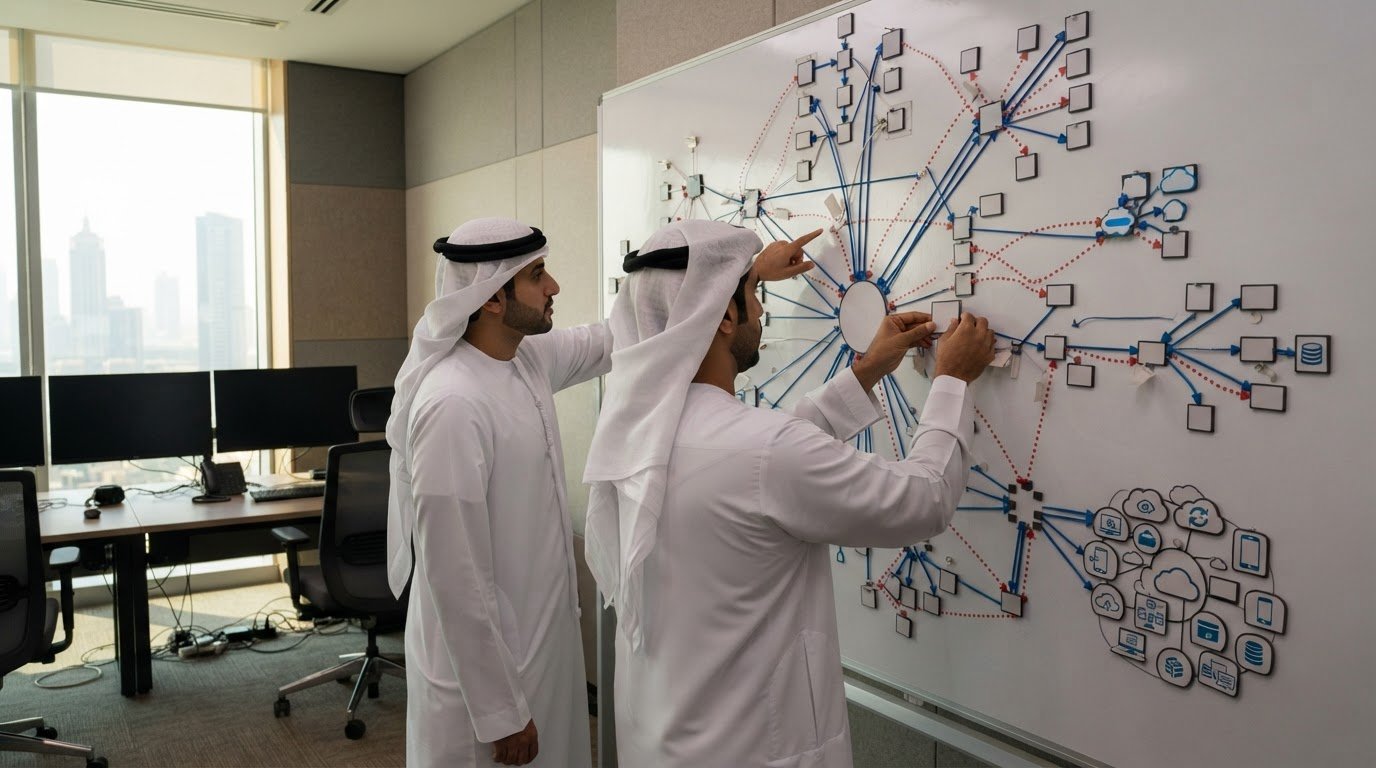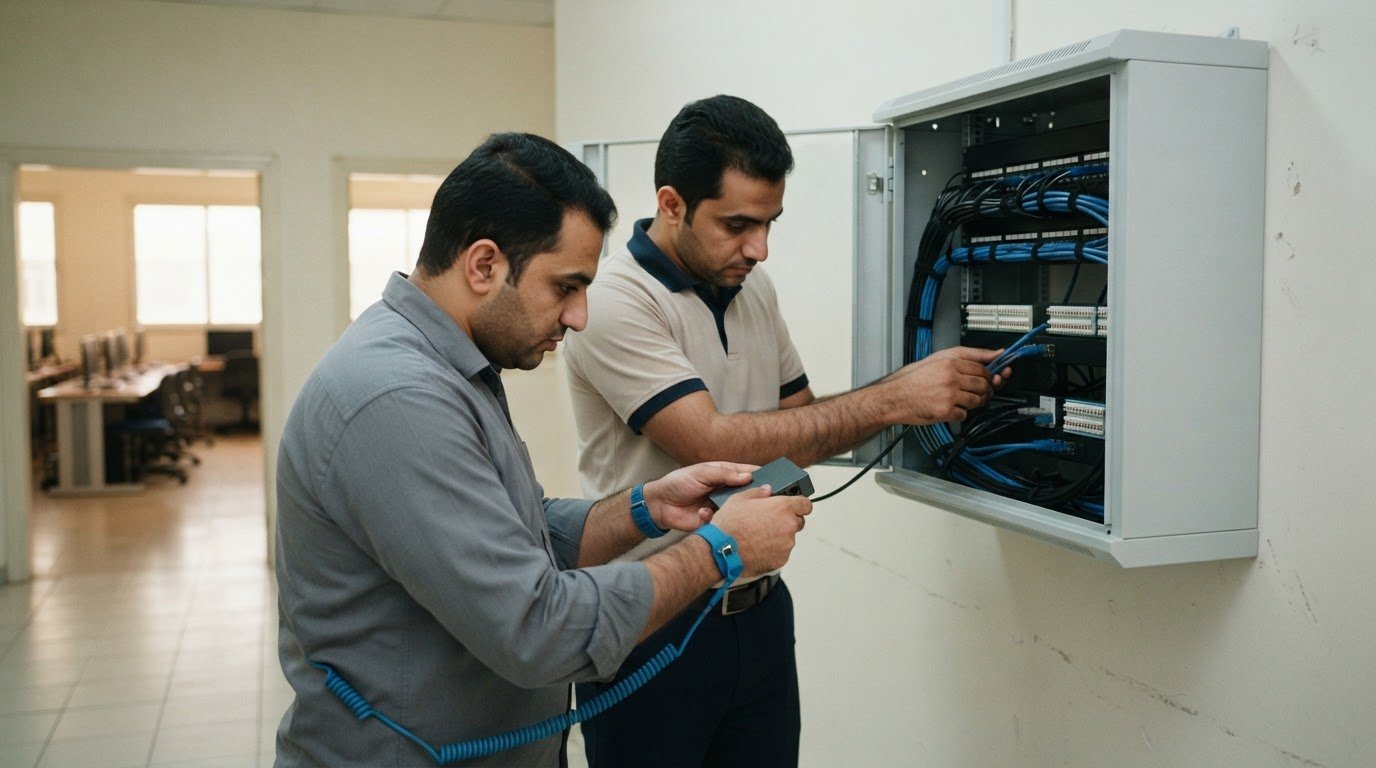
For a school, an unmanaged device can expose weaknesses across learning systems and personal data. Choosing VAPT in the UAE can help institutions assess risks across student and staff devices, school systems and incident response.
Schools and universities need to protect learning and administrative systems. The buying decision is how to assess vulnerabilities across changing devices and users, prioritise remediation and avoid disrupting education.
This article explains what to consider when selecting a security assessment, how its findings can help institutions prioritise risk, and how monitoring and response can support incident handling. It also considers data protection obligations for student and parent records. Federal Decree-Law 45 of 2021, the UAE Personal Data Protection Law, applies to personal data including those records, according to UAE Legislation.
When evaluating VAPT, institutions can consider unmanaged devices, incident planning and reporting requirements relevant to their setting, including those set by KHDA or ADEK. OAD's VAPT service can support this assessment. A practical UAE school example shows how these measures can strengthen protection while keeping learning operations in view.
Key takeaways
- When evaluating cybersecurity services for UAE schools, check how they cover unmanaged student and staff devices accessing school systems and data.
- Assess providers’ incident response responsibilities and coordination, including how their service supports continuity of teaching and administration.
- Use cybersecurity assessment findings to compare providers, identify institutional risks and prioritise remediation.
- For UAE schools handling student and parent records, check how a provider’s service supports compliance with the UAE Personal Data Protection Law and relevant regulator reporting requirements.
- When implementing a service, confirm that access management, logging and incident response controls fit your institution’s systems and risk profile.
Evaluating security monitoring for school devices
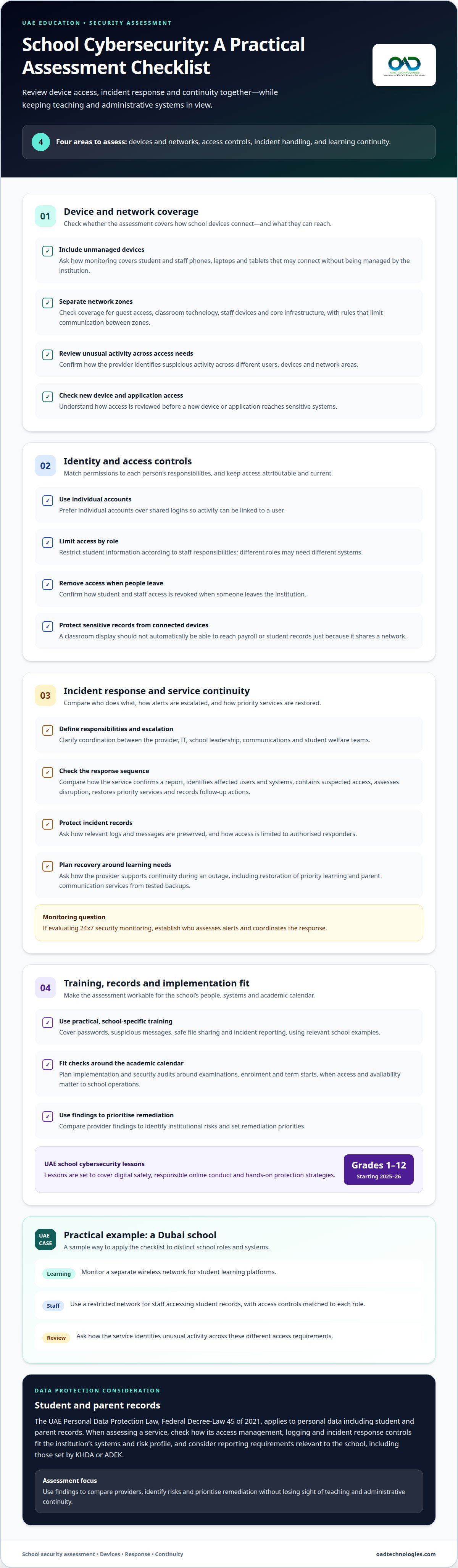
When evaluating a security monitoring service, schools should check how it covers student and staff phones, laptops and tablets that may connect without being managed by the institution. A provider should be able to monitor network activity while helping the school separate personal devices from administrative systems and restrict access by user and device. This gives students access to approved learning resources without granting every device access to sensitive records.
For example, a school in Dubai could ask a managed security provider to monitor a separate wireless network for student learning platforms and a restricted network for staff accessing student records. Access controls should match each role: a teacher may need class materials, while a finance employee needs different systems. During procurement, schools can confirm how the service will identify unusual activity across these distinct access requirements.
Campus network segmentation should also form part of the service assessment. Schools can ask how monitoring will cover guest access, classroom technology, staff devices and core infrastructure in distinct network zones, and how rules will limit communication between them. A connected classroom display, for instance, should not automatically reach payroll or student records simply because it uses the same network.
When comparing service proposals, schools can check whether the provider can support processes to:
- Require individual accounts instead of shared logins, so activity can be linked to a user.
- Limit access to student information according to staff responsibilities.
- Review new device and application access before it reaches sensitive systems.
- Revoke access when a student or staff member leaves the institution.
Cybersecurity training should give staff and students practical guidance on passwords, suspicious messages, safe file sharing and reporting a possible incident. Classroom cybersecurity lessons can cover digital safety, responsible online conduct and hands-on protection strategies appropriate to each age group. When selecting a monitoring service, schools should also check how staff courses can use school-specific examples, such as a message requesting a parent’s payment details or an unexpected file shared with a class.
Federal Decree Law No. 34 of 2021 on Combatting Rumours and Cybercrimes took effect in the UAE on 2 January 2022, according to UAE Legislation. Schools can reinforce responsible online conduct through age-appropriate lessons and clear reporting routes. For more advanced students, computer and network security subjects can introduce access control, secure configurations and the role of responsible testing.
Incident readiness also depends on timely visibility. A school evaluating 24x7 security monitoring can ask how the provider identifies unusual logins or activity across its networks, and define who assesses alerts and coordinates response. A documented incident process should cover escalation, containment, evidence preservation and restoring affected services. Academic-calendar planning helps schedule service implementation and security audits around examinations, enrolment and term starts, when system access and availability are especially important.
Reviewing device access before a new term can reveal outdated accounts, unmanaged applications and network rules that no longer fit. A documented plan should connect these checks with staff training and incident response. Schools can explore cybersecurity services and controls when evaluating protection and monitoring options.
Evaluating incident response and continuity services for UAE schools
When comparing incident-response or MDR services, a school should check whether the proposed scope covers detection, containment, recovery and learning continuity. Confirm who coordinates IT, school leadership, communications and student welfare teams, and who can isolate a device, suspend an account, contact service owners and approve a return to normal operations. Clear responsibilities help reduce delays when an incident affects teaching or administrative systems.
Compare each provider’s reporting and escalation process. Staff should know how to report a suspicious login, unexpected file encryption or suspected hacking, even if they are unsure whether an incident is confirmed. Check whether the service records the time, affected accounts, systems involved and actions taken, and how it preserves relevant logs and messages while limiting access to authorised responders.
Use these points to compare the proposed response scope:
- Confirm the report and identify affected users, devices and applications.
- Contain the suspected access, for example by disabling a compromised account or isolating an affected device.
- Assess which learning, communication or administrative activities are disrupted.
- Restore priority services from tested backups, then validate access and system integrity.
- Document decisions, notify the appropriate leaders and record follow-up actions.
Ask providers how their service supports continuity during an outage. A school could prioritise its learning platform and parent communications while temporarily suspending a compromised administrative application. Compare how each proposal identifies approved alternatives and decision-makers, and explains how to confirm services have been restored. Ask how recovery exercises are conducted and whether they fit the school’s operations.
For a qualifying personal data breach, UAE PDPL Article 9 requires the controller to notify the UAE Data Office once aware. The law sets no fixed number of hours for that notification. When evaluating a service, check how technical investigation connects with the people responsible for assessing affected records and coordinating required communications.
Schools comparing cybersecurity providers in the UAE can assess how each incident-response or MDR service handles detection, escalation, evidence, recovery and continuity. Ask for a clear explanation of responsibilities, reporting outputs, integration with existing systems, testing and pricing. A certification may support an evaluation, but it doesn’t replace evidence that the proposed process fits the school’s systems and academic operations.
National requirements and institution-specific obligations should inform the plan, alongside the school’s own risk assessment. A provider’s response model should name the escalation leader, explain how alerts reach school decision-makers and show how incidents involving cloud applications or campus infrastructure are handled. Schools can discuss incident response and continuity requirements when comparing service scope, implementation needs and operational fit.
Cybersecurity assessments and risk management
Cyber threats can expose records, interrupt learning or compromise education systems. Include phishing, stolen credentials and malicious files in an assessment, alongside weaknesses in cloud services and campus infrastructure. Cybersecurity for schools in the UAE should reflect each institution’s systems, users and educational activities.
Selecting and scoping VAPT
When choosing VAPT for a school, define the systems to test, such as a learning platform, admissions application, cloud services or campus infrastructure. Confirm how the provider will account for user access, data flows and existing controls, and whether the scope includes configuration reviews, vulnerability assessment and penetration testing. Findings should connect each weakness to affected services rather than list technical issues without operational context.
Evaluate providers by reviewing their proposed scope, testing approach and sample reporting. The report should identify tested systems, explain findings clearly and distinguish urgent exposure from lower-priority improvements. VAPT can test whether a weakness is exploitable, while a broader assessment can examine governance and control coverage. OAD Technologies provides Vulnerability Assessment and Penetration Testing (VAPT) for technical testing as part of a school’s review.
Risk management
Risk management turns assessment findings into decisions. Record each risk alongside the affected asset, possible operational consequences, existing safeguards, accountable owner and planned treatment. For example, a weakness in an admissions application may have different consequences from an outdated device in a low-sensitivity classroom. This context helps leadership prioritise remediation rather than treating every finding equally.
Governance keeps those decisions visible. School leaders, IT staff and data owners can review the risk register, approve treatment priorities and track unresolved items. Assign each action to a responsible role and define its completion condition, such as restricting access or validating a configuration change. Reassess after major system or supplier changes, or a significant incident. Effective cybersecurity for schools in the UAE links technical findings to accountable decisions.
Threats, standards and controls
Phishing can trick staff into revealing credentials, while malicious attachments can disrupt files or applications. Weak access controls can expose student information, and cloud misconfigurations may leave data or services accessible to unintended users. Assess these risks against the school’s systems, user groups and educational activities rather than relying on a generic threat list. Because phishing is a common route into school accounts, an email security service such as OAD's Mimecast and Trustifi offering can filter malicious messages and attachments before they reach staff and students.
The UAE Information Assurance Standards are the national control set referenced for educational institutions. Access control, logging and incident response are among the areas to examine. An assessment can map existing safeguards to these areas, identify ownership gaps and record evidence of operation. Education regulators also set requirements for licensed institutions concerning student information handling, safeguarding and incident notification.
For example, a school reviewing a cloud-based admissions system can map access, review system logs and test whether response procedures cover suspected account misuse. The application owner, IT team and leadership can assign responsibility for each action. This makes cybersecurity for schools in the UAE specific to the institution’s risks and operational needs.
How UAE schools can assess PDPL-focused security services
UAE schools evaluating security services should consider how providers support compliance with Federal Decree-Law 45 of 2021, the UAE Personal Data Protection Law, which applies to personal data including student and parent records. When comparing services, assess how they can help protect records across enrolment forms, learning platforms and parent communication systems.
When evaluating a service, ask how it can help map where personal data enters, moves and is stored. An admissions form, for example, may pass from the school website to an enrolment system and then to authorised staff. A useful assessment should identify each system’s purpose, users and the information it handles, helping reveal unnecessary access and potential exposure points.
Also assess how a service supports practical security controls. These may include assigning access according to job responsibilities, removing accounts when roles change and reviewing permissions for systems holding student information. A teacher may need class records, while a facilities employee may not. Clear access boundaries reduce exposure if an account is misused.
When comparing providers, consider whether their service can help the school:
- Identify student and parent records across admissions, learning and communications systems.
- Document which roles can access each category of information.
- Review how records move between school systems and external applications.
- Restrict access when staff responsibilities change or accounts are no longer needed.
- Keep an incident process that connects technical investigation with assessment of affected records.
For a practical UAE example, a school evaluating a security service for its online admissions platform can ask whether the review traces a parent’s contact details from submission through staff access and storage. The school can assess whether each access point supports admissions work, whether permissions match staff roles, and how the relevant records would be identified during an incident.
When selecting a service, clarify how it supports ownership across school leadership, IT teams and staff responsible for admissions or student services. These groups can define who maintains system access, manages records and coordinates an incident review. A documented responsibility map helps technical teams work with people who understand the context of the records.
Article 9 of the UAE Personal Data Protection Law requires a controller to notify the UAE Data Office once aware of a qualifying breach. The law sets no fixed number of hours for that notification. When evaluating a service, schools should check how it supports an incident process involving people who can assess whether student or parent information is involved and coordinate the required response.
Ask how the service supports reviews when the school introduces an application, changes admissions processes or moves records between systems. Such changes can alter who has access and where information is handled. Regular governance reviews help keep protections aligned with school processes and the UAE Personal Data Protection Law.
How can UAE schools choose cybersecurity services aligned with national standards?
The UAE Information Assurance Standards provide a national control set that educational institutions can use when evaluating cybersecurity services. Schools can assess whether a managed security provider can support reviews of access control, logging and incident response, and relate those services to school systems, data and operational needs.
When comparing providers, ask how their service covers specific school systems. For access control, confirm how they assess roles and permissions in admissions, learning and finance applications. For logging, ask which systems they can monitor and who reviews relevant activity. For incident response, check how staff can escalate suspected events and how the provider coordinates investigations with school teams.
A useful service assessment connects promised capabilities with evidence. Ask providers to show how they verify that system permissions reflect the school’s access policy, how logging supports investigations and how incident procedures identify decision-makers, communication routes and service priorities. These checks help school leaders understand how a service will operate in practice, not simply what its proposal says.
Service scope should reflect how the institution uses its infrastructure. A school can ask providers how they will help separate administrative systems from guest access, limit staff account privileges and review access when responsibilities change. For cloud applications, assess whether the service includes configuration and user-permission reviews alongside network controls. The aim is to reduce unnecessary access while supporting teaching and administration.
Schools can compare providers using a prioritised evaluation register:
- Record each control area and the systems or data the service will protect.
- Assign an accountable school role for overseeing the provider and reviewing the service.
- Request evidence of coverage, such as access records, configuration reviews or response procedures.
- Rank service gaps by their potential effect on student information and school operations.
- Agree how remediation will be tracked and controls revisited after significant system changes.
For example, a UAE school reviewing a provider for a new learning application can ask how the service will check staff permissions, confirm that relevant activity is logged and route suspected account misuse to its incident response team. The application owner, IT team and school leadership can agree who handles each action with the provider. This connects the purchased service with daily responsibilities instead of leaving ownership unclear.
Education regulators set requirements for licensed institutions concerning student information handling, safeguarding and incident notification. Ask providers how their service can support the school’s mapping of applicable regulator expectations alongside the UAE Information Assurance Standards, and what technical evidence they can provide. Requirements depend on the institution and its licensing context, so governance should connect compliance oversight with service evidence.
Repeatable service reviews help keep coverage aligned as school systems evolve. Agree how access, logging and response arrangements will be reassessed when applications change, services are introduced or operational responsibilities shift. This gives leadership a practical view of service coverage and remediation progress, supporting a consistent security posture across education systems.
Choosing cybersecurity services for UAE education institutions
UAE education institutions evaluating Vulnerability Assessment and Penetration Testing (VAPT), Data Loss Prevention (DLP) or Managed Detection and Response (MDR) should compare provider experience, service scope and implementation requirements. Buyers can assess how VAPT findings will be prioritised, which sensitive information DLP will protect and how MDR will support detection and incident investigation.
Before implementation, institutions can map these services to their systems, data risks and operational requirements, then agree responsibilities and reporting with the provider. For example, a UAE school group could assess its student information systems with VAPT, define DLP controls for sensitive records and evaluate MDR coverage for security alerts. OAD Technologies provides these services to help institutions address their cybersecurity priorities.
Contact OAD Technologies to discuss service options for your institution.
Choose the right cybersecurity service for your school
Start by identifying the security gap that matters most. If you need to assess a vulnerable application, compare VAPT scopes and deliverables. For sensitive records, evaluate DLP coverage across the systems your school uses. If faster incident detection and response is the priority, assess MDR options, including service coverage and fit with your existing environment.
OAD Technologies provides Vulnerability Assessment and Penetration Testing (VAPT), Data Loss Prevention (DLP) and Managed Detection and Response (MDR). When comparing options in the UAE, define your requirements, review how each service will work with your current systems, and request a scope that reflects your institution’s operational needs.
For example, a UAE school planning a new student portal could scope VAPT to assess the application before launch, then use the findings to prioritise remediation. Discuss implementation, responsibilities and ongoing support before selecting a service.
Choose the service that addresses your highest-priority risk and fits your school’s environment, budget and capacity to implement it.
Frequently asked questions
What should a UAE school include when scoping a cybersecurity assessment?
When evaluating a cybersecurity assessment, identify the digital learning, administrative and data systems in scope, such as email, admissions, online learning and parent portals. Ask providers how they will assess access controls and the protection of submitted information, and what deliverables they will provide. For example, a school planning a new parent portal can include it in the assessment scope and use the findings to prioritise controls.
Who should be involved in choosing a cybersecurity service for a UAE education institution?
Schools, universities and education groups should involve IT teams, school leaders, data owners, teachers and administrative staff when evaluating a cybersecurity service. These stakeholders can help define which systems and records need protection and how an incident could affect operations. A university handling research data can also identify contractual security requirements related to funding or international partnerships before agreeing the service scope.
Which UAE requirements should a school consider when buying a cybersecurity service?
When scoping a service, consider how it will support the institution’s obligations under Federal Decree-Law 45 of 2021, the UAE Personal Data Protection Law, which applies to personal data, including student and parent records. The UAE Information Assurance Standards are also referenced as a national control set for educational institutions. Federal Decree Law No. 34 of 2021 addresses combatting rumours and cybercrimes. Schools should also consider requirements set by the education regulators that license them.
How should schools in Abu Dhabi and Dubai scope cybersecurity services?
When comparing services, ask providers to account for the institution’s licensing and operational context. In Dubai, a school should consider the requirements relevant to its KHDA licensing and operations; in Abu Dhabi, it should consider those applicable to its ADEK licensing. Confirm that the proposed controls and reporting process reflect the institution’s own regulatory context, systems and responsibilities rather than assuming identical obligations across both emirates.
What should a school ask a provider about incident response and data breaches?
When evaluating incident response support, ask how the provider will work with responsible school leaders and technical teams to contain affected accounts or systems, preserve relevant evidence and assess whether student, parent or staff information may be involved. Clarify how response actions and decisions will be documented. For a qualifying personal data breach, UAE PDPL Article 9 requires the controller to notify the UAE Data Office once aware; it sets no fixed number of hours.
How can a UAE school prioritise and implement cybersecurity improvements?
Ask providers to help identify essential systems, such as learning platforms, admissions tools and finance applications, and assign an owner to each. Review access, configurations, available security logs and incident procedures, then record weaknesses and their operational impact. Prioritise remediation according to the systems and information at risk. Agree how improvements will be tracked and reviewed after significant technology or process changes.
Disclaimer
Content by OAD Technologies is for general informational purposes only and does not constitute professional or cybersecurity advice. No warranties are made regarding accuracy or completeness; reliance is at your own risk. OAD Technologies shall not be liable for any direct or indirect losses arising from use of this content.