In the Sophos State of Ransomware in Manufacturing and Production 2024 report, 65% of manufacturers said they had been hit by ransomware. Cybersecurity for manufacturing in the UAE matters because an attack can move beyond office systems, disrupting production networks, operational technology and the data that keeps a factory running.
That risk is harder to manage when production equipment must remain available, legacy controllers are difficult to patch, and IT systems connect to operational technology. A compromised account, vendor connection or corporate device can create a route to systems that were not designed for today’s threats.
This article explains why manufacturers attract attacks and how firms in the UAE can reduce exposure without treating production like an ordinary office network. It covers practical ways to segment IT and OT, control remote access, protect intellectual property and prepare for ransomware, while balancing security, safety and operational continuity.
Key takeaways
- Use passive monitoring to build visibility into industrial control networks without disrupting sensitive equipment or production.
- Contain legacy machines that cannot be patched, restrict unnecessary connections, and plan for their eventual replacement.
- Give equipment vendors named, limited access through a controlled route, then expire and log that access when maintenance ends.
- Set incident escalation procedures that bring operations and security teams together before a response could stop a production line.
- Protect design files and operational data with access controls and data loss prevention, while accounting for UAE personal data requirements.
Industrial control system and operational technology security
In the UAE, look for cybersecurity providers with industrial control system and operational technology expertise. Their work should address production networks, safety, availability, incident response and regulatory alignment, not just office IT. For manufacturing operations in the UAE, this means understanding how a security action could affect equipment and output.
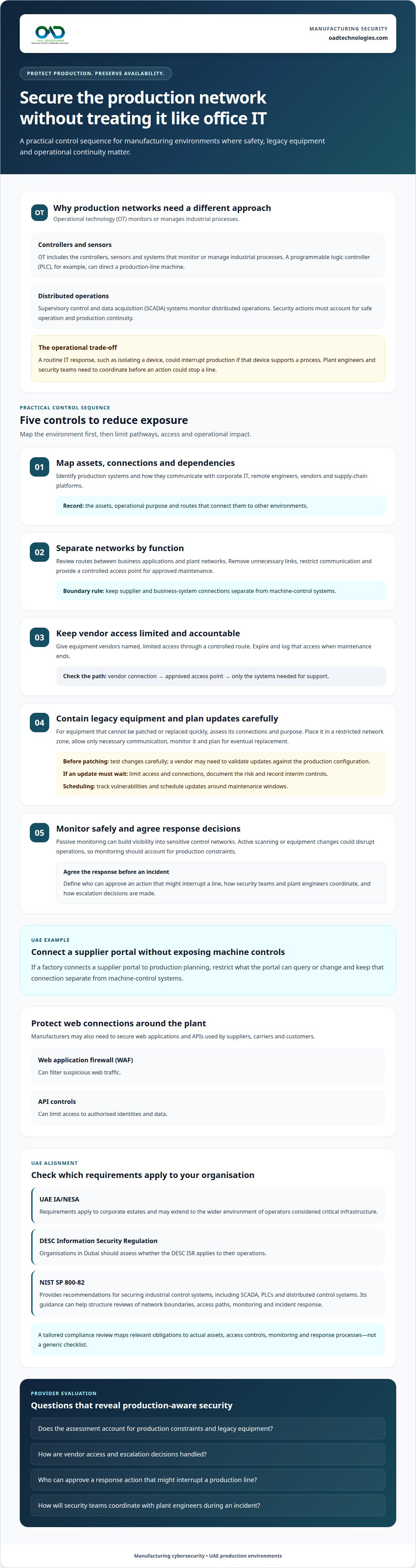
Operational technology (OT) includes the controllers, sensors and systems that monitor or manage industrial processes. A programmable logic controller (PLC), for example, can direct a production-line machine. Supervisory control and data acquisition (SCADA) systems monitor distributed operations. Unlike standard business networks, OT systems require security measures that account for safe operation and production continuity.
According to the National Institute of Standards and Technology, Special Publication 800-82 provides recommendations for securing industrial control systems, including SCADA, PLCs and distributed control systems. Its guidance gives security teams a reference for assessing OT risks. They can use it to structure reviews of network boundaries, access paths, monitoring and incident response without assuming that controls designed for office computers fit factory equipment.
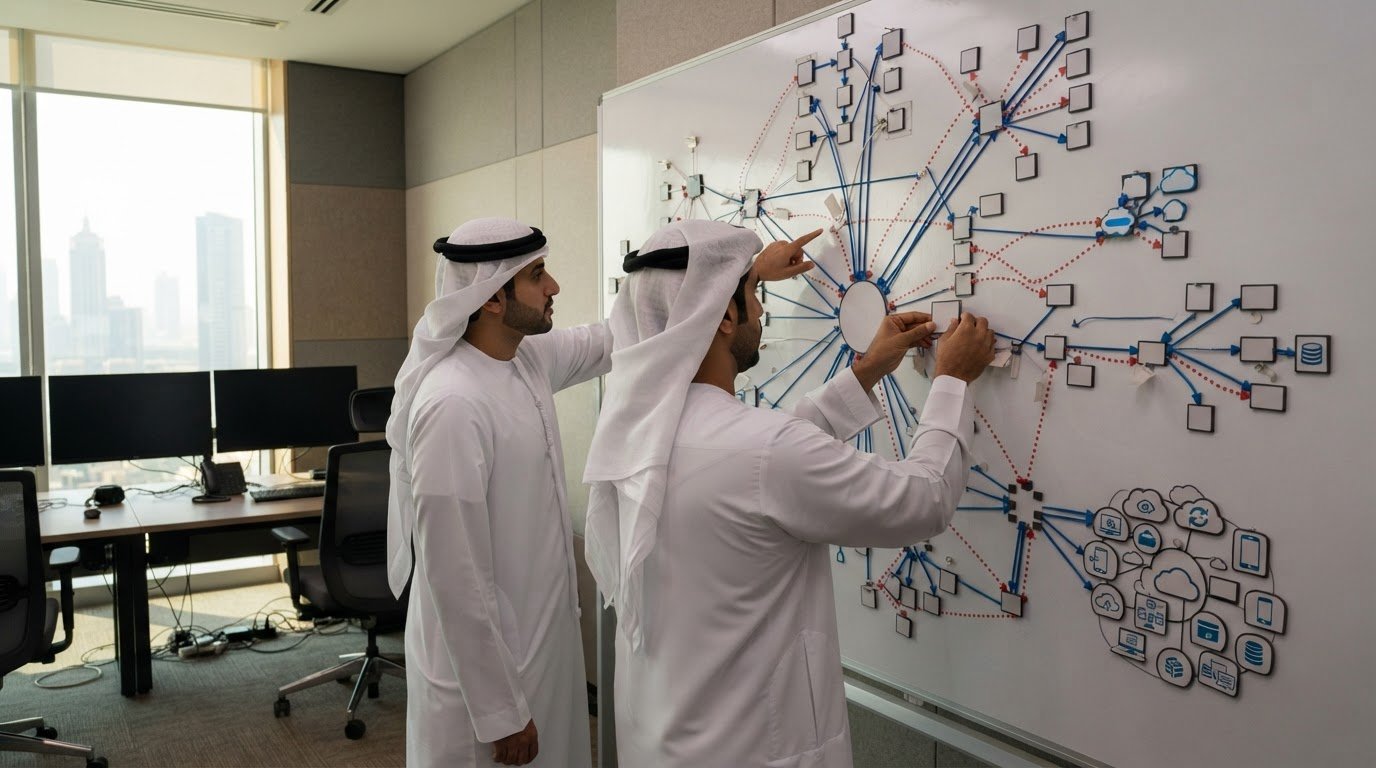
Start by identifying systems, connections and operational dependencies. Map which production assets communicate with corporate IT, remote engineers, vendors and supply-chain platforms. Then separate networks by function, restrict unnecessary communication and provide a controlled access point for approved maintenance. Passive monitoring is often preferable on sensitive control networks, where active scanning or equipment changes could disrupt operations.
Regulatory alignment depends on the organisation’s role. Applicable entities should assess the current UAE Information Assurance Regulation and any critical-infrastructure or sector direction; Dubai entities should separately assess DESC ISR applicability. Map confirmed obligations to actual IT and OT assets, access controls, monitoring and response processes rather than using “NESA” as a generic label.
Manufacturers should also secure web applications and APIs used by suppliers, carriers and customers. A web application firewall (WAF) can filter suspicious web traffic, while API controls can limit access to authorised identities and data. For example, a factory connecting a supplier portal to production planning should restrict what the portal can query or change. Keep that connection separate from machine-control systems.
When choosing a provider, ask how its assessment accounts for production constraints, legacy equipment, vendor access and escalation decisions. A useful response plan defines who can approve an action that might interrupt a line. It also records how security teams coordinate with plant engineers during an incident, protecting national infrastructure and business continuity without treating every alert as permission to stop production.
Why are cyber attacks prevalent in the manufacturing sector?
Manufacturers attract attacks because production relies on connected systems, while older equipment can be difficult to secure without disrupting operations. Cybersecurity for manufacturing in the UAE calls for an understanding of both industrial technology and the production decisions that shape incident response.
Legacy and unsupported systems
Legacy equipment may remain in service after its operating system or software stops receiving security updates. A factory may also depend on a machine that cannot be replaced quickly because production processes rely on its configuration. Assess each asset’s connections, purpose and vendor support, then prioritise isolation and monitoring where upgrades could interrupt production.
Unsupported equipment is not automatically unusable, but it does require compensating controls and a replacement plan. For example, a manufacturer can place an older machine in a restricted network zone, allow only necessary communication and monitor traffic for unexpected connections. Segmentation limits the routes an attacker could use to move from that machine to other systems.
Unpatched operational technology
OT patches require careful testing because a change can affect machine behaviour or process stability. A vendor may need to validate updates against a production configuration before deployment. Establish an asset inventory, track known vulnerabilities and schedule updates around maintenance windows. Where patching must wait, limit access and connections, then document the risk and interim controls.
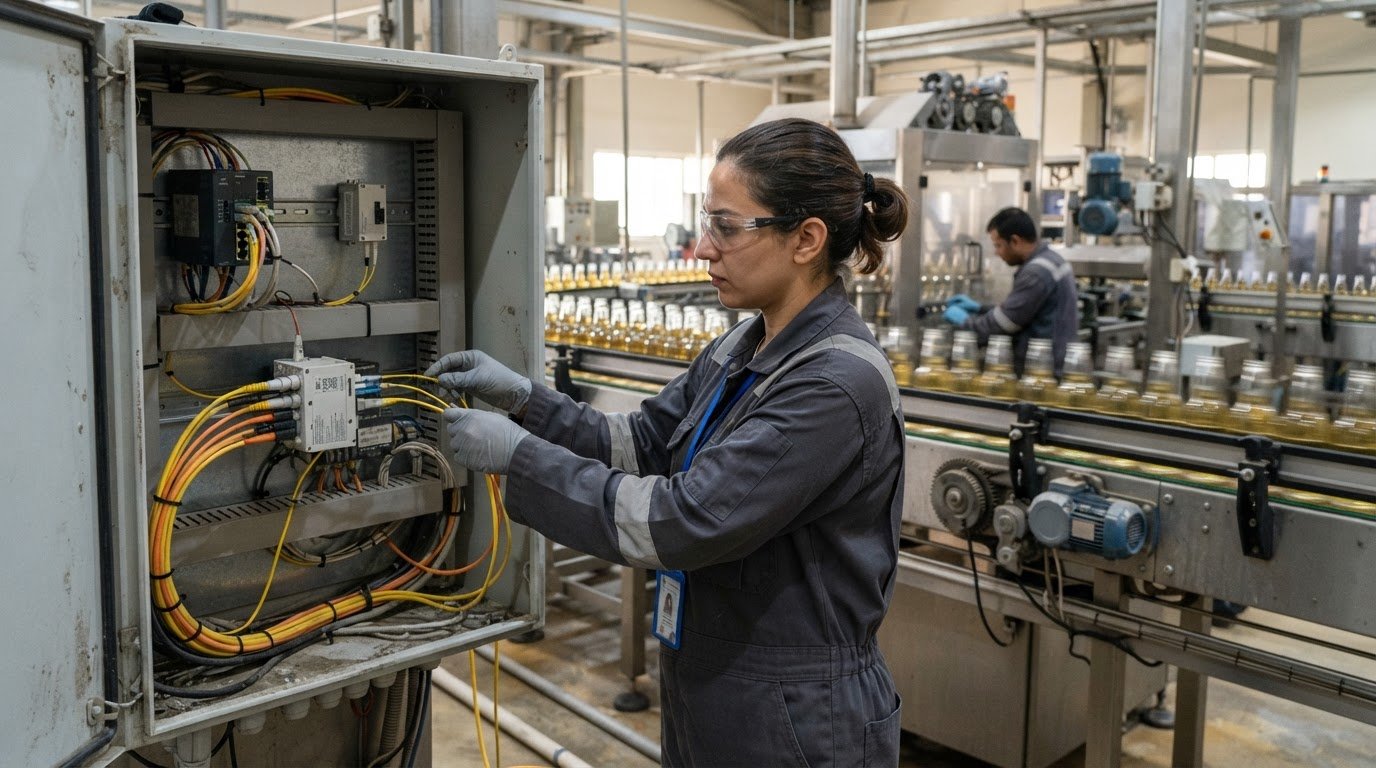
Integrating IT and OT can create new paths for an attack. A compromised office device, shared account or vendor connection may expose production systems. Review each route between business applications and plant networks, remove unnecessary links and use a controlled access point for approved support. Continuous monitoring can help teams spot unusual traffic without disruptive equipment changes.
IT and OT system differences
IT teams often prioritise confidentiality and rapid patching; OT teams must also protect safety and availability. A routine IT response, such as isolating a device, could interrupt production if that device supports a process. Staff training should therefore cover OT-specific risks, vendor access, escalation and incident coordination. Relevant learning and certification paths depend on each person’s role and the systems they support.
Distributed denial-of-service (DDoS) attacks target the availability of online services by overwhelming them with traffic. Protect exposed supplier portals, customer interfaces and APIs with suitable traffic filtering and capacity controls, while keeping those services separated from machine-control networks. A logistics platform used by a UAE factory, for instance, should not provide a direct route into production controllers.
Manufacturing staff can build practical skills through role-based sessions on phishing, account security, incident reporting and the safe handling of removable media. Engineers need additional training on remote maintenance and change approval; security teams need to understand production dependencies. Exercises should use realistic scenarios, such as unexpected behaviour from a vendor account, so teams know who assesses the threat and who authorises a response.
For a useful assessment, map legacy assets, IT-to-OT connections, internet-facing services and vendor access together. This reveals where segmentation, DDoS controls, monitoring or planned replacement can reduce exposure without treating every production system as an office endpoint.
How should manufacturers secure their production network?
Cybersecurity for manufacturing in the UAE should focus on systems that generate meaningful security signals. Managed Detection and Response (MDR) can support the investigation of those signals, while Vulnerability Assessment and Penetration Testing (VAPT) can identify weaknesses for planned remediation.
Continuous monitoring and SOC services
Before selecting a monitoring service, define which environments and data sources matter. These may include corporate endpoints, identity systems, network devices and production-network traffic. A useful service scope explains how analysts correlate those signals, distinguish routine activity from anomalies and report findings in terms operations and security leaders can act on.
Ask how the monitoring process manages alert quality. Too many low-value notifications can make important events harder to spot. Alert tuning should account for the manufacturer’s asset inventory, approved software and known production activity. Reports should identify the affected system, observed behaviour and recommended next action, rather than provide an unexplained alert count.
Managed Detection and Response (MDR) can suit manufacturers that need support investigating and responding to detected threats. Define the service boundaries: which systems are in scope, what evidence analysts can access, and which response actions are authorised. For manufacturing across the UAE, clear boundaries help distinguish monitoring responsibilities from actions that require operational approval.
A service review should also address how monitoring adapts when production changes. A new machine, engineering application or supplier integration can alter normal network behaviour. An agreed process for updating asset and activity context helps analysts assess later alerts more accurately, without treating every new connection as a confirmed threat.
Incident response and business continuity
Use vulnerability assessment findings to prioritise remediation based on operational impact, exploitability and available mitigations. A report should distinguish weaknesses affecting production from findings on supporting corporate systems. It should also identify dependencies, so teams can schedule remediation around engineering constraints rather than apply the same treatment to every asset.
Penetration testing can assess whether selected security controls withstand realistic attack paths, but the scope must reflect the production environment. Define the systems in scope, testing windows and prohibited actions before testing begins. For sensitive control equipment, assessment methods should avoid changes that could affect process behaviour.
Business continuity planning also needs evidence that recovery arrangements work. Test whether protected configurations and essential operational records can be restored, then validate restored settings with engineering staff before reconnecting systems. This tests a different aspect of resilience than detection: whether the organisation can recover usable information and return affected processes to operation.
Review assessment findings alongside monitoring trends. If repeated alerts point to the same asset or access route, include that evidence in the next vulnerability review. This creates a practical cycle of detection, prioritisation and remediation, with security improvements paced to the manufacturer’s operating requirements.
Protecting manufacturing intellectual property and operational data
Manufacturers need to protect design files, process knowledge and production records across connected IT and OT environments. Classifying information by sensitivity helps teams safeguard valuable assets without obstructing legitimate operations.
Manufacturing intellectual property protection
Product designs, machine settings, formulations and production methods can reveal how a factory operates. Identify where these files are stored, who can access them, and how employees or suppliers share them. Apply role-based permissions, strong authentication and encryption to sensitive repositories. Review access when responsibilities change, and log activity involving downloads or transfers.
For example, a manufacturer sharing a design package with a subcontractor can grant access to only the files needed for that project. Set an expiry for the access, restrict onward sharing where systems allow, and retain records of file activity. Data Loss Prevention (DLP) controls can help identify or restrict transfers that conflict with the organisation’s handling rules.
Operational data protection
Operational data includes production schedules, equipment status, quality records and maintenance information. Map how data moves between plant devices, corporate applications and external partners. Restrict access by role and business need, protect backups from unauthorised changes, and establish retention rules. These steps help reduce exposure while allowing authorised teams to use information for operations.
Separate personal information from industrial records. According to the UAE legislation portal, the UAE Personal Data Protection Law is Federal Decree-Law 45 of 2021. The law concerns personal data, so manufacturers should identify personal information in areas such as employee records or customer systems and manage it distinctly from machine telemetry and production data.
Article 9 requires a controller to notify the UAE Data Office once it becomes aware of a qualifying breach. The law sets no fixed number of hours for that notification. A response process should therefore define how teams identify a potential breach, assess whether personal data is involved, preserve relevant records and escalate the matter to the controller’s responsible personnel.
AI-driven protection and IT/OT convergence
As IT and OT systems become more connected, monitoring can combine signals from user accounts, endpoints and network traffic. AI-driven analytics may help surface unusual patterns, such as a device communicating with an unfamiliar system or access outside normal maintenance activity. Treat alerts as leads for investigation, not automatic proof of compromise.
Set clear boundaries for any AI analysis. Limit access to the data used for monitoring, protect models and logs, and assign a human owner to assess alerts before operational changes occur. For instance, review an unusual command from a production-support account against approved maintenance activity before blocking access or interrupting a process.
How does ransomware reach a production line?
Ransomware can reach production through corporate networks, vendor connections, removable media or shared systems, even when factory equipment has no direct internet connection. If it affects production, consequences can include stopped lines, delayed orders and lost revenue.
Ransomware crossing from corporate IT
A common route starts with a compromised corporate account or device, then follows permitted connections towards production systems. Shared credentials, broad network access and unreviewed vendor connections can make that movement easier. Map each route between office networks, engineering systems and controllers, then restrict communication to what each process needs.
Internet access is not the only entry point. An infected USB device or a supplier’s remote connection can introduce ransomware into a production environment. For example, engineers might use removable media to transfer a file to an isolated machine. Controls for approved devices, file scanning and documented transfer procedures can reduce exposure.
In May 2017, the WannaCry outbreak forced Renault and Nissan to halt production at several plants, as reported by Automotive News Europe. It shows how malware affecting connected business systems can also disrupt manufacturing activity. The operational impact depends on which systems become unavailable, how production processes rely on them, and whether teams can safely continue work.
Production network segmentation
Segmentation divides networks into controlled zones, limiting how far ransomware can travel after entering one area. Separate corporate IT, production management and machine-control environments, then allow only the connections they require. A compromised office laptop should not have unrestricted access to a production controller simply because both networks support the same factory.
A practical design might separate office systems from production scheduling and machine-control networks. Connections between zones can pass through monitored points, with rules limited to approved systems and services. Review these rules whenever a new line, supplier platform or maintenance connection is introduced.
Backups are also important for recovery. Protect production configuration files and essential operational records from the same accounts and systems that ransomware could compromise. Test restoration procedures with plant engineers, since restoring a machine configuration without operational validation could cause further disruption.
Security design should combine network controls, endpoint protection and detection across connected IT and OT environments. Select endpoint platforms through supported-configuration, integration, operational and safety testing rather than a default vendor ranking. Define who investigates each alert and who approves containment if isolation could stop production.
Measure readiness through a scenario exercise. For example, simulate ransomware on a corporate workstation and trace its possible routes towards production. Record which connections must be blocked, which operations need to continue, and how teams will communicate during recovery. Repeat the exercise after major network changes or new supplier integrations.
OAD Technologies: Logistics IT and Cybersecurity
OAD Technologies supports UAE manufacturers and logistics firms through enterprise-grade Managed Technology Services delivered on a Fully Managed, Defined Scope basis. The agreed design can combine segmentation, endpoint protection, SIEM/SOC, MDR, email security, DLP, VAPT, private cloud, HCI and recovery controls according to the environment. Coverage, response targets, containment authority and vendor dependencies are documented rather than assumed.
These services may be relevant when a factory connects IT and OT, reviews vendor access or strengthens controls around intellectual property. The right starting point depends on the exposure to address: VAPT assesses security weaknesses, MDR supports ongoing detection and response, and DLP focuses on sensitive information.
To discuss cybersecurity priorities for your manufacturing environment, speak to the OAD Technologies team.
Build security around production priorities
The next step is to turn cybersecurity for manufacturing in the UAE into a defined programme, aligned with your production environment and business priorities. Start by deciding which operational risks need attention first, who owns each decision, and how security changes fit maintenance and continuity plans.
OAD Technologies can support this work with Vulnerability Assessment and Penetration Testing (VAPT) to identify weaknesses, Managed Detection and Response (MDR) for threat detection and response, and Data Loss Prevention (DLP) to help protect sensitive information. These capabilities can form part of a tailored approach rather than a one-size-fits-all deployment.
Bring operational and security teams into the planning discussion early. Their shared understanding of production dependencies can help set practical priorities and a clear implementation path.
A considered plan can strengthen resilience while keeping production requirements at the centre of every decision.
Frequently asked questions
Do I need both IT and OT security?
Yes, if your factory uses both business technology and systems that control or monitor production. IT security protects corporate services, accounts and business data; OT security must also account for equipment behaviour and safe operations. Coordinate the teams around shared risks, such as an employee account used for both office access and engineering support. This joined-up view helps prevent gaps between corporate policies and plant-floor realities.
Do I need OT security if my factory is not connected to the internet?
Yes. An offline production network can still encounter threats through removable media, maintenance laptops, supplier equipment or temporary vendor connections. For example, a technician might transfer a configuration file from a connected device to an isolated machine. Define how files and devices enter the production environment, who approves transfers and how teams inspect them. Isolation reduces exposure, but it does not remove every route into a factory.
How does industrial cybersecurity handle legacy equipment?
Start by recording each machine’s purpose, owner, software, dependencies and support status. This information helps distinguish a low-impact asset from equipment that could affect production or safety. For a machine that cannot be replaced immediately, document the risk, restrict its access and assign an owner to review its status. A replacement plan should account for process validation, maintenance opportunities and connected-equipment dependencies.
What does IEC 62443 mean for us in practice?
IEC 62443 is an international standard for industrial automation and control system security. For a manufacturer, it can provide a reference point when discussing security expectations across plant operations, engineering and suppliers. Use it to structure conversations about system boundaries, responsibilities and risk priorities. It is not a substitute for understanding your own production processes or determining which UAE regulatory requirements apply to your organisation.
When should a manufacturer consider managed security?
Consider managed security when internal staff cannot consistently review alerts, investigate suspicious activity or coordinate response across IT and plant operations. It may also help when a business is adding production sites, connecting supplier systems or preparing for operational changes. Before defining the scope, identify which environments need monitoring, who owns incident decisions, and how external support will work with engineering and business continuity processes.
What are the main cybersecurity threats facing manufacturing companies in the UAE?
Manufacturers in the UAE should account for ransomware, phishing and other social engineering, compromised accounts, supplier-related threats and attacks against exposed business applications. Risks can extend from corporate systems to production where networks or access are connected. A practical review considers how each threat could reach the organisation, which assets it could affect, and whether existing response processes protect both data and operational continuity.
Disclaimer
Content by OAD Technologies is for general informational purposes only and does not constitute professional or cybersecurity advice. No warranties are made regarding accuracy or completeness; reliance is at your own risk. OAD Technologies shall not be liable for any direct or indirect losses arising from use of this content.