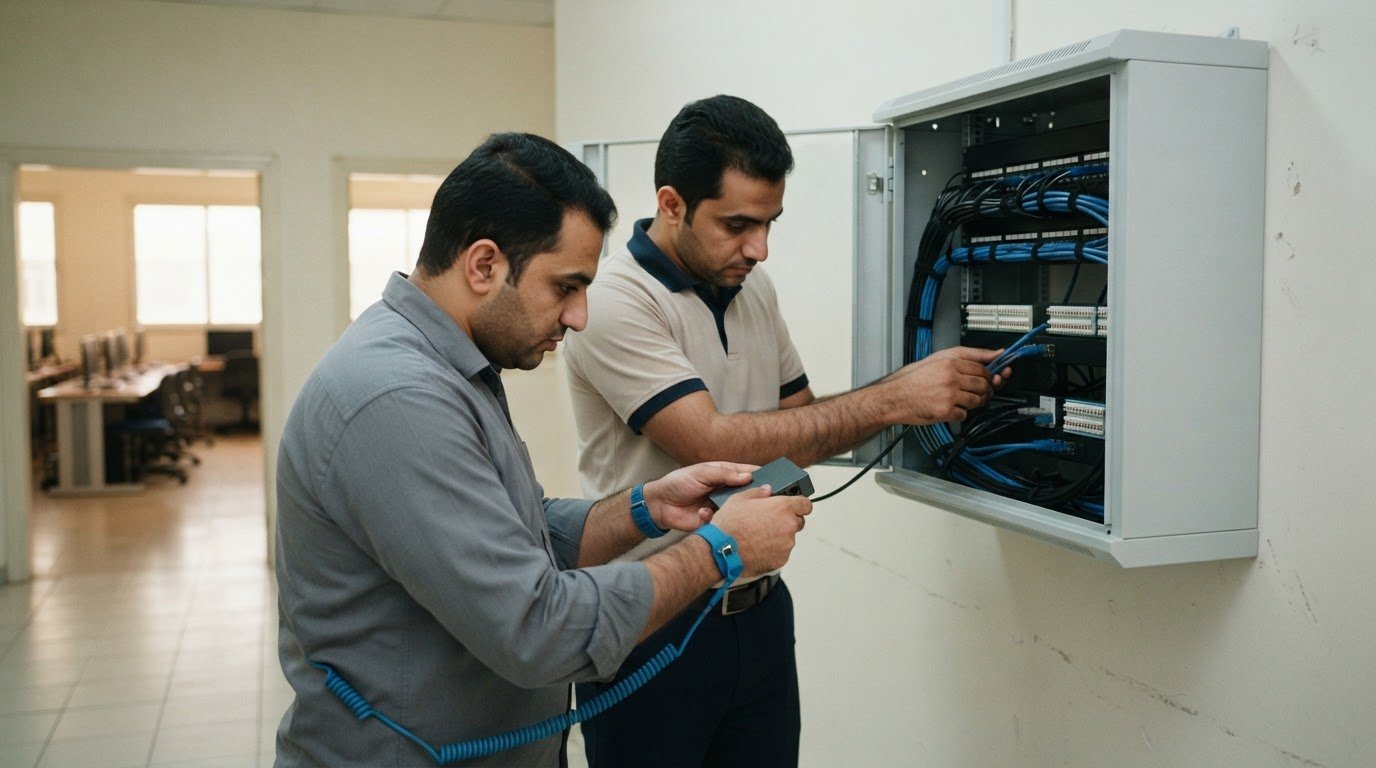
For UAE organisations, the first decision is whether the UAE Information Assurance Regulation applies to the entity, its critical services or its sector. Applicability should be confirmed from the organisation’s legal status, regulatory obligations and any critical-infrastructure designation rather than assumed from a legacy “NESA-compliant” label.
The scope can be less obvious for private businesses and their suppliers. A practical assessment considers the organisation’s designation, sector obligations and access to sensitive systems, then connects these factors to the controls and evidence required.
This article explains how to assess applicability, prioritise UAE IA controls and prepare evidence that shows controls operate in practice. It also distinguishes the current regulation from legacy NESA terminology and connects information-assurance work with other UAE obligations.
Key Takeaways
- Start by determining whether your organisation is a government or semi-government entity, designated critical infrastructure, or operates in a regulated critical sector.
- Build implementation timelines around identified control gaps, remediation work and evidence readiness, while treating assurance as ongoing rather than a one-off exercise.
- Prioritise controls using risk assessment and the applicable UAE IA requirements, then map overlapping controls to related obligations where appropriate.
- Prepare evidence that shows controls operate in practice, including records of internal reviews, incident response exercises and supplier security measures.
- Align information security obligations with relevant UAE requirements, including the UAE Personal Data Protection Law, Federal Decree-Law No. 45 of 2021.
What are the NESA Security Control Implementation timelines?
UAE IA compliance means applying the relevant requirements of the UAE Information Assurance Regulation to the entity’s information systems, critical services and supporting functions. The work includes governance, risk assessment, control implementation and evidence-based assurance, with ongoing review as systems and risks change.
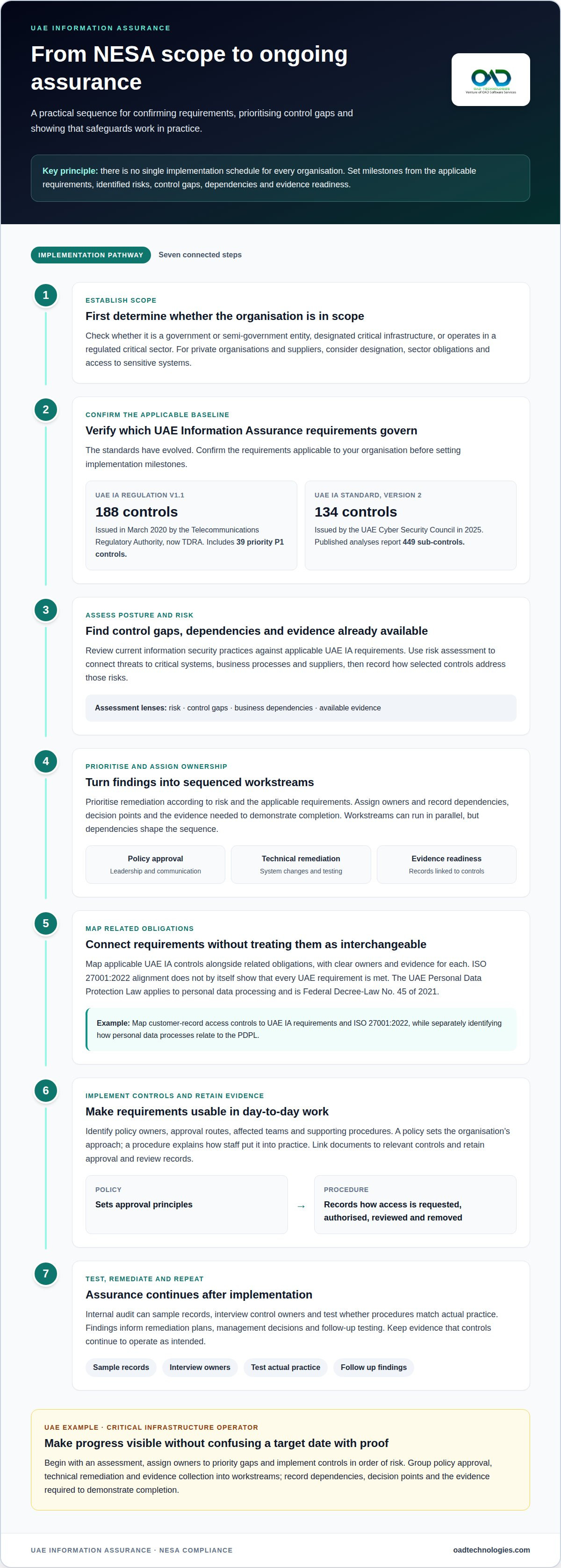
No single implementation schedule suits every organisation. Start by assessing the current information security posture, then set remediation priorities based on risk, control gaps, business dependencies and available evidence. A policy gap may require leadership approval and staff communication; a technical weakness may call for system changes and testing. These workstreams can progress in parallel, but dependencies shape the overall sequence.
UAE Information Assurance has evolved through distinct versions. The UAE IA Regulation v1.1 was issued in March 2020 by the Telecommunications Regulatory Authority, now known as TDRA. It contains 188 controls, including 39 priority P1 controls. The UAE Cyber Security Council issued version 2 of the UAE IA Standard in 2025. Published analyses report 134 controls and 449 sub-controls in that version. Confirm which applicable requirements govern the organisation before setting implementation milestones.
Information security policies translate requirements into decisions and responsibilities. Identify policy owners, approval routes, affected teams and supporting procedures. A policy should explain the organisation’s approach; a procedure should show how staff put it into practice. For example, an access-control policy can set approval principles, while the related procedure records how access is requested, authorised, reviewed and removed. Link each document to the relevant control and retain approval and review records.
A UAE critical infrastructure operator could begin with an assessment, assign owners to priority gaps and implement controls in order of risk. Its plan might group policy approval, technical remediation and evidence collection into separate workstreams. Record dependencies, decision points and the evidence needed to demonstrate completion. This makes progress visible without treating a target date as proof that a control works.
Internal audit provides a separate assurance step. Auditors can sample records, interview control owners and test whether documented procedures match actual practice. For example, they can compare an access procedure with approval records and system permissions. Findings then inform remediation plans, management decisions and follow-up testing. The electronic security context of NESA also shows why written policies alone are insufficient: implementation and continuing evidence matter across information systems and related signals.
Relationship to other UAE cybersecurity and data protection requirements
UAE cybersecurity obligations can overlap, but each addresses a different layer of risk. Map applicable requirements together, then assign clear owners and evidence to each obligation.
Differences from ISO 27001 and UAE PDPL
The UAE Information Assurance Regulation is the national control reference used for applicable information-assurance obligations. ISO/IEC 27001:2022 is an international management-system standard; mapping controls can support implementation, but certification or alignment does not by itself prove that every applicable UAE IA requirement is met.
For example, a UAE organisation handling customer records can map access controls to UAE IA requirements and ISO 27001:2022, while separately identifying how its personal data processes relate to the PDPL. This avoids treating one assessment or certification as automatic evidence of compliance with every obligation.
NESA Compliance Assessment Roles
An organisation’s cybersecurity, risk and compliance teams can begin by reviewing its posture against applicable UAE Information Assurance requirements and documenting gaps. An external cybersecurity assessor can provide an independent review. Define the scope, examine control design and operation, record evidence and assign remediation owners. The organisation remains responsible for decisions, implementation and oversight.
The UAE National Cyber Risk Management Framework provides a basis for assessing risk and prioritising controls. Teams can use it to connect threats to critical systems, business processes and suppliers, then document how selected controls reduce identified risks. This helps management distinguish urgent weaknesses from improvements that can be scheduled later.
The National Electronic Security Authority, commonly known as NESA, is a historical authority name that remains common in procurement and compliance discussions. Current documents should identify the applicable UAE Information Assurance Regulation and the responsible regulator or competent authority rather than treating “NESA” as a current certification.
The UAE National Cybersecurity Strategy 2025–2031 provides national direction, while the UAE Information Assurance Regulation supplies detailed control requirements for applicable entities. Governance records and assessment scopes should cite the current instrument and any sector-specific obligations.
Consider a UAE infrastructure operator that processes personal data and relies on suppliers for system access. It can map UAE IA controls, ISO 27001:2022 alignment and PDPL-related processes separately, then test how supplier access is governed. To coordinate an assessment across these obligations, discuss your compliance requirements.
Security control priorities and implementation
Prioritise controls by connecting each requirement to risk, affected systems and accountable owners. The UAE IA Standard version 2 retains four priority levels, P1 to P4, giving organisations a way to sequence implementation rather than treating every gap equally.
Published analyses report that version 2 contains 15 control families: six management and nine technical. This structure links governance decisions with operational safeguards. Management controls address how responsibilities, policies and oversight are organised; technical controls concern protections applied to systems and information. Map each applicable control to an owner, implementation task, evidence source and review method.
Use the organisation’s risk assessment to decide what needs attention first. Consider information sensitivity, system importance, threat exposure and the consequences of control failure. Document the reason for each priority and its dependencies. A control may rely on an approved policy, a system configuration or supplier action, so the implementation sequence should reflect those dependencies.
- P1: Identify applicable priority requirements and address gaps linked to high-impact risks.
- P2: Schedule controls that strengthen safeguards around important systems and processes.
- P3: Plan remaining improvements against identified risks and operational dependencies.
- P4: Track lower-priority work, ownership and review dates within the control plan.
The UAE IA Standard version 2 uses P1 to P4 priority levels. Assigning a level alone does not prove a control is implemented. Record the risk rationale, responsible owner, planned action and evidence that will demonstrate operation. If an assessment identifies a vulnerability in a critical service, for example, the remediation plan should connect the finding to the affected asset, corrective action and subsequent testing.
Mapping UAE IA controls to ISO 27001:2022 Annex A can reduce duplicated work. Create a cross-reference showing which ISO controls support each UAE IA requirement, where coverage is partial, and which UAE-specific actions remain. Treat the mapping as an aid, not as proof that one standard automatically satisfies the other. Keep separate evidence references where a shared control serves different obligations.
Use a controlled cycle for technical implementation: define the required outcome, configure the safeguard, test its operation, record evidence and assign follow-up. For a vulnerability, this could mean documenting the affected system, remediation decision and retest result. Penetration testing can help expose weaknesses within an agreed scope, while an agency or internal team tracks findings through to closure. Management review then connects technical results to risk decisions.
Review the control plan whenever system changes, new vulnerabilities or assessment findings alter the risk picture. This keeps priorities aligned with the organisation’s current environment, rather than a static spreadsheet of requirements.
NESA audit support and evidence preparation
For UAE entities, audit readiness depends on evidence linking policies, technical safeguards and daily operations. Progress reviews help uncover gaps before an assessment tests how controls work.
Audit Evidence Requests
NESA audits assess how controls operate, not simply whether policies have been written. Prepare an evidence register linking each applicable requirement to its owner, supporting records and review date. Typical evidence includes approved policies, access records, risk assessments, configuration records, incident logs and supplier agreements. An auditor may sample records or interview control owners to test whether documented procedures match actual practice.
Internal audits help government, semi-government and critical infrastructure entities identify weaknesses before a formal assessment. Review policy approval and implementation records, then test whether technical controls operate consistently. For example, an internal auditor can trace a reported security incident through its response record, escalation decisions and follow-up actions. Exercise incident response plans, document the outcomes and track corrective actions to closure. Vendor contracts should also clearly set out cybersecurity obligations when suppliers access sensitive systems.
NESA Audit Duration
There is no universal duration for a UAE IA assessment or remediation programme. Timing depends on scope, evidence readiness, access to control owners, technical findings and whether remediation and retesting are required. Agree the assessment phases, dependencies and acceptance criteria in writing before work begins.
Use progress reviews to keep the audit on track. Assign an owner to each evidence request, record its status and flag dependencies such as system access or management approval. Review open findings with risk management and technical teams, distinguishing evidence still being gathered from controls awaiting remediation. This gives leadership a clear view of outstanding decisions without confusing document collection with control effectiveness.
Audit pricing depends on the case and is provided after a quote request. Scope, the systems and entities under review, evidence readiness and the effort required to assess remediation all affect the work involved. A focused review of defined controls differs from an assessment spanning multiple systems, teams or suppliers. Agreeing the scope and expected evidence early helps clarify the assessment effort.
For a practical UAE example, a critical infrastructure operator can maintain one evidence register across its information systems. The register can record each control, its responsible owner, the latest test, related supplier evidence and unresolved findings. Internal audit can sample these records and test selected controls, while management reviews remediation progress. This supports a traceable audit trail and helps direct attention to weaknesses affecting essential services.
Organisations and suppliers expected to comply
Applicability is determined by the current regulation, the entity’s status, its critical services and sector-specific direction. Government, regulated and critical-infrastructure organisations should confirm scope with the competent authority; private suppliers should not assume that a customer requirement automatically changes their own legal designation.
Using a cloud service does not, by itself, determine whether a provider must comply. An in-scope organisation should assess cloud systems supporting critical services, the information they process and the provider’s access to sensitive environments. It should also identify responsibilities between customer and provider, and document security obligations in supplier contracts.
For suppliers, the key question is whether their systems or personnel can access an in-scope entity’s sensitive systems. UAE organisations should assess vendors with such access, define cybersecurity obligations in contracts and retain evidence of oversight. A supplier may need to support its customer’s controls and evidence requests, even when the customer remains accountable for its own compliance.
For example, a UAE government organisation using a cloud service for a critical business process can map the service, data flows and supplier access. It can then assign owners for access reviews, incident coordination and supplier evidence. If a cloud service supports critical infrastructure, include its dependencies in risk assessment and continuity planning instead of treating the provider as outside the security boundary.
Failure to meet applicable NESA requirements can expose UAE organisations to regulatory scrutiny, remediation mandates and increased oversight by sector regulators. It can also contribute to delays in government projects and approvals. The impact depends on the organisation’s obligations, the nature of any gaps and the regulator’s response. These risks make documented remediation and management oversight important.
To determine scope, organisations can take a practical sequence:
- Identify whether the entity is governmental, semi-governmental, designated critical infrastructure, or operates in a regulated critical sector.
- Map systems that handle critical information or support essential services, including cloud environments and external connections.
- Record which suppliers can access sensitive systems, then link relevant contract terms to security responsibilities.
- Assign owners to unresolved risks and track remediation evidence for management review.
This assessment helps organisations distinguish direct obligations from supplier-related exposure. A tailored scope also helps focus resources on critical information, digital infrastructure and the threats most relevant to services and operations.
OAD Technologies: Governance, Risk, and Compliance (GRC)
OAD Technologies supports UAE IA readiness through enterprise-grade Managed Technology Services delivered on a Fully Managed, Defined Scope basis. The agreed scope can include control mapping, gap assessment, risk ownership, remediation planning and evidence preparation; legal applicability and regulatory acceptance remain with the organisation and competent authority.
Where technical findings need attention, Vulnerability Assessment and Penetration Testing (VAPT) can help identify weaknesses, while Data Loss Prevention (DLP) addresses risks involving sensitive information. Managed Detection and Response (MDR) supports the detection and handling of security threats. The appropriate combination depends on the organisation’s risks and implementation needs.
To discuss how OAD Technologies can support your compliance work, contact OAD Technologies.
Make compliance part of everyday governance
Treat NESA compliance in the UAE as an ongoing management practice, not a project that ends when an assessment closes. Assign accountable owners, schedule reviews around material system changes and give leadership clear visibility of open risks and decisions. This keeps security priorities connected to operational change.
A useful next step is to turn assessment findings into a practical improvement plan. Set out the decision required, the responsible role, the evidence that will show progress and how follow-up will be reviewed. Keep the plan proportionate to the organisation’s services and risk profile, and update it as dependencies or threats change. Consistent governance helps technical teams and executives share a clear view of progress.
OAD Technologies can discuss how its Governance, Risk, and Compliance support fits your organisation’s NESA requirements and readiness priorities.
Clear ownership and ongoing review help your organisation build a more resilient compliance practice.
Frequently Asked Questions
Who must be NESA compliant?
Applicability depends on the organisation’s formal status and the requirements relevant to its activities. Start with the legal entity, not only its parent group or technology environment. For a group with several UAE entities, record each entity’s role, sector and applicable direction separately. This provides a clearer basis for deciding which operations are in scope and where accountability sits.
How long would it take to do a NESA audit?
Audit fieldwork and the wider readiness programme are different activities. Fieldwork includes reviewing records, interviewing control owners and testing selected safeguards; readiness also involves preparation and any corrective work. Keep these workstreams distinct when planning, and identify when evidence, system access and relevant staff will be available. This gives project leads a more useful schedule than treating the audit as a single calendar event.
What does NESA stand for?
NESA stands for National Electronic Security Authority, a historical authority name that remains widely used. In current documents, state whether the term is legacy shorthand and cite the applicable UAE Information Assurance Regulation or sector requirement to avoid ambiguity.
Which UAE organisations must comply with NESA Information Assurance Standards?
Establish applicability for each legal entity and relevant operation rather than assuming a group-wide determination automatically covers every business unit. Record the basis for the decision, the responsible decision-maker and any related sector direction. If a business operates across different activities, separate the systems and processes under review from those outside the defined scope, and document the rationale for that boundary.
What are the latest UAE NESA Information Assurance Standards and control requirements?
Use the applicable UAE IA Standard version as the reference for control requirements. Do not rely on an older control mapping without reviewing it against that version. For each control, define how it applies to the organisation’s environment, what evidence demonstrates operation, and who approves exceptions or remediation decisions. This makes a version update a controlled review of applicability, not merely a document replacement.
What is the difference between NESA and UAE IA Regulation compliance?
“NESA compliance” is commonly used as shorthand in UAE cybersecurity discussions, while UAE IA Regulation compliance refers to alignment with the relevant information assurance requirements. In an assessment scope or procurement document, name the applicable instrument and version instead of relying on shorthand alone. This helps stakeholders understand what is being assessed and avoids ambiguity in reporting or remediation ownership.
What steps are required to achieve NESA compliance in the UAE?
Set governance before technical work begins: confirm the executive sponsor, approve decision rights and establish how unresolved risks will be accepted or escalated. Then define management review points for remediation decisions and scope changes. For example, a control owner who cannot meet an agreed requirement should document the issue, its business impact and the decision required, rather than leave the gap without accountable oversight.
How long does a NESA compliance assessment or certification take?
An assessment timeline varies with the scope and the work required to address findings. An assessment and a certification are not the same outcome: the UAE IA Regulation v1.1 and UAE Cyber Security Council published material do not describe an official NESA certificate. Organisations can instead define readiness through documented assessment results, management decisions, evidence of corrective work and a process for continued review.
Disclaimer
Content by OAD Technologies is for general informational purposes only and does not constitute professional or cybersecurity advice. No warranties are made regarding accuracy or completeness; reliance is at your own risk. OAD Technologies shall not be liable for any direct or indirect losses arising from use of this content.