For UAE companies, the dark web matters because traditional search engines don’t index it, while stolen data can be shared in forums and marketplaces. Dark web monitoring in the UAE scans these spaces for exposed company information, such as employee credentials, domains or sensitive client data. It can help security teams spot potential exposure and decide what to investigate, but it doesn’t remove stolen information or prevent its use.
It’s reasonable to ask what the dark web is before deciding whether monitoring belongs in your security programme. This article explains how monitoring works, what risks exposed organisational information can create, and how to assess service scope and pricing in the UAE. You’ll also see how monitoring fits alongside measures such as access controls and incident response, and which practical factors shape the right approach for your organisation.
Key takeaways
- Understand how threat intelligence turns exposed information into signals your security team can investigate and prioritise.
- Learn how UAE data protection requirements relate to incident handling when a potential exposure involves personal data.
- See why monitoring works best alongside access controls, endpoint security and a clear incident response process.
- Assess how compromised credentials and other exposed information could affect employees, customers and business operations.
- Identify the service scope and operational factors that shape monitoring costs, then consider how security assessments and detection capabilities can support your response.
Threat intelligence
Threat intelligence helps UAE organisations prioritise external signals that could affect business systems. Dark web monitoring searches selected sources for exposed organisational information and turns relevant matches into alerts for assessment.
Monitored data and assets
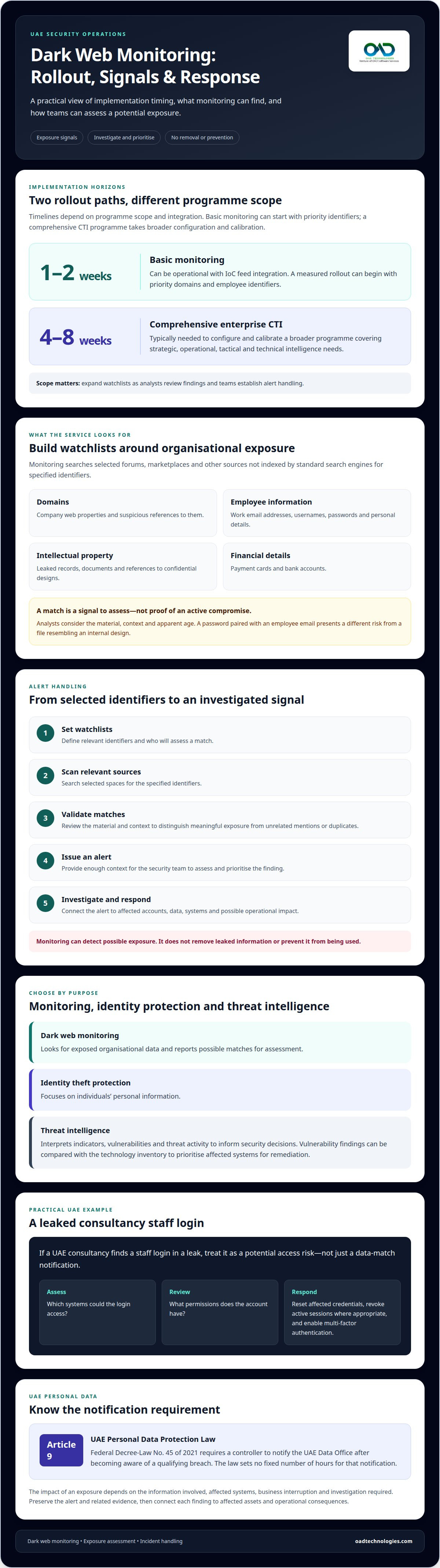
Coverage can include domains, employee information, intellectual property, payment cards and bank accounts. A useful watchlist reflects the organisation’s exposure: an online retailer may prioritise customer-facing domains and payment details, while an engineering firm may focus on employee credentials and confidential designs. Teams should define which identifiers matter and who will assess a match. Domain monitoring can surface suspicious references to company web properties.
Leaked data and intellectual property detection
Monitoring searches relevant sources for leaked records, documents and references to intellectual property. An employee email address appearing alongside a password presents a different risk from a file that resembles an internal design. Analysts assess the material, context and apparent age before escalating an alert. This helps distinguish a meaningful indication of exposure from an unrelated mention or duplicate listing.
Monitoring service comparisons
How do dark web monitoring services compare with identity theft protection and threat intelligence? Dark web monitoring looks for exposed organisational data, while identity theft protection focuses on individuals’ personal information. Threat intelligence has a broader role: it interprets indicators, vulnerabilities and threat activity to inform security decisions. When evaluating a service, consider whether alerts include enough context to support an investigation, rather than simply reporting a match.
Dark web monitoring workflow
What is dark web monitoring, and how does it work? It searches selected sources that standard search engines do not index, including forums and marketplaces, for specified identifiers. The process involves setting watchlists, scanning relevant sources, validating matches, issuing alerts and supporting investigation. Monitoring can detect possible exposure, but it cannot remove leaked information or stop it being used.
Threat intelligence can also include vulnerability intelligence, such as information about actively exploited CVEs. Security teams compare relevant findings with their technology inventory, then prioritise affected systems for remediation. A CVE identifier refers to a specific vulnerability; the affected software and evidence of exploitation help determine its relevance. This adds an external threat perspective to vulnerability assessment without treating every published issue as equally urgent.
Implementation timelines depend on programme scope and integration. Basic monitoring with indicator-of-compromise (IoC) feed integration is usually quicker to start than a comprehensive enterprise cyber threat intelligence (CTI) programme, which needs more configuration and calibration. That broader programme can address strategic, operational, tactical and technical intelligence needs. A measured rollout can begin with priority domains and employee identifiers, then expand watchlists as analysts review findings and teams establish alert handling.
Where can I get help with monitoring the dark web?
UAE organisations can combine exposure monitoring with incident assessment and coordinated response. Effective support turns a possible data leak into clear actions for affected accounts and systems.
UAE enterprise leaks and exposed credentials
Enterprise leaks may expose customer records, internal documents or staff credentials through compromised accounts and third-party services. A UAE business should assess what appeared, which systems the information could access, and whether it remains usable. For example, if a consultancy finds a staff login in a leak, it should treat it as a potential access risk and investigate the account and its permissions.
Employee data exposure
Employee exposure may include work email addresses, usernames, passwords and personal details. If an employee reused a password on a breached external service, attackers may try it against company systems. Organisations should reset affected credentials, revoke active sessions where appropriate and enable multi-factor authentication. Individuals can use reputable identity-monitoring services to check personal details and should promptly change any reused passwords.
The UAE Personal Data Protection Law is Federal Decree-Law No. 45 of 2021, according to the UAE Legislation portal. Article 9 requires a controller to notify the UAE Data Office after becoming aware of a qualifying breach. The law sets no fixed number of hours for that notification. Article 26 leaves penalties to Cabinet decision, so organisations should avoid relying on unsourced fine figures when assessing exposure.
The impact of a breach varies according to the sensitive information exposed, systems affected, business interruption and investigation required. Early detection may help teams act before an exposed credential is used, but the outcome depends on the incident and response. A useful assessment connects each alert to affected assets and operational consequences instead of treating every match as equally urgent.
After a confirmed exposure, preserve the alert and related evidence, then identify affected accounts and data. Reset compromised credentials, disable accounts that no longer need access, and isolate affected systems when investigation indicates risk. If personal data may be involved, assess the incident against Article 9 and document decisions. A UAE retailer, for example, could coordinate its security and privacy teams to investigate a leaked staff login and assess possible customer-data access.
Continuous surveillance and stakeholder protection
Dark web monitoring services can watch selected sources continuously and alert teams when corporate identifiers appear. For UAE organisations, the value depends on connecting each alert to a clear investigation and response process.
The Central Bank of the UAE has issued brand protection and digital impersonation requirements for licensed financial institutions (reference CBUAE/FCMCP/2025/3057), according to Crowe. For those institutions, monitoring supports awareness of potential misuse of corporate names, logos and digital addresses. It can reveal impersonation signals in places such as dark web forums, marketplaces and other online sources. An alert still needs review before a team treats it as a genuine threat.
Corporate brand protection involves more than searching for a company name. Teams can monitor lookalike domains, copied brand assets and references that could mislead customers or employees. For example, a UAE bank could investigate a suspicious domain using its name and assess whether it imitates a customer login page. A monitoring service should make alerts understandable, preserve useful context and help route findings to security, communications or legal stakeholders.
Continuous monitoring does not mean every signal requires the same response. Security teams can classify alerts by the asset involved, the apparent audience and the potential impact. A mention of a public company address may simply need recording; exposed credentials or a convincing impersonation attempt may require urgent investigation. Monitoring should also distinguish newly observed activity from repeated references, helping teams focus on changes rather than duplicate noise.
Endpoint protection provides a separate but complementary layer. Dark-web alerts may identify credentials or information that could help an attacker target an employee’s device. EDR can support investigation of suspicious endpoint activity, but platform selection should follow workload, integration, licensing and operating-model assessment rather than a default vendor ranking.
For effective response, assign clear owners before an alert arrives. A UAE organisation can define a route from detection to validation, containment and stakeholder communication:
- Security: assess the source and connect the alert with account or endpoint activity.
- Identity teams: reset affected credentials and review access where exposure is credible.
- Communications: prepare accurate stakeholder updates if impersonation could mislead customers.
For example, a UAE financial institution could send a suspected fake domain to its security team for validation, then coordinate customer messaging after assessing the evidence. Monitoring can inform this process, but it cannot remove information from the dark web or prevent stolen data from being used. Pair it with access controls, endpoint protection and an incident response plan.
Risks of exposed organisational information
Exposed information can give attackers a practical route into company systems, and stolen credentials remain one of the most common ways in. A password found in a dark web leak may be reused against corporate email, cloud services or remote access. Cybersecurity teams should treat each exposed login as a lead to investigate, not proof of successful access.
Credential reuse increases that risk. If one external account is compromised, attackers may test the same credentials elsewhere. A response should identify the affected account, reset its password, revoke active sessions where appropriate, and review sign-in activity for suspicious access. These steps reduce the chance that a stolen login remains useful.
Executive exposure monitoring focuses on information connected to senior leaders, such as work email addresses, account credentials and impersonation references. A leaked executive login could put privileged systems at risk, while a fake profile could mislead staff or business contacts. Include relevant executive identifiers in monitoring and route credible findings to security teams for validation. Access reviews can then establish whether exposed credentials are linked to sensitive permissions.
A useful cyber exposure report turns raw alerts into a prioritised view. It should identify the exposed asset, type of information, source and available context, and distinguish confirmed matches from items that need investigation. For example, if an employee email appears in a leaked dataset, the report should clarify whether a password is also present. This distinction helps security teams choose proportionate actions instead of treating every mention as an active breach.
The deep web and dark web are not indexed by traditional search engines in the same way as public websites. Exposure may therefore remain invisible in an ordinary web search. Monitoring findings can be compared with internal security records to identify potential links. A SIEM can help correlate an exposed account with suspicious sign-in activity, giving investigators more context than an external alert alone.
For a UAE organisation, a practical review starts by grouping findings by affected employees, systems and data types. Security teams can prioritise privileged accounts, confirm whether credentials remain active and document containment actions. If exposed information involves personal data, assess the incident against applicable UAE requirements. This process turns an exposure report into decisions about access, investigation and stakeholder impact.
Dark web monitoring service pricing
Dark web monitoring service pricing in the UAE depends on scope, coverage and the response included; there is no single standard rate. Key factors include monitored assets, source coverage, alert validation, reporting and integration requirements.
What are the limitations and risks of dark web monitoring services? They cannot remove leaked information from forums or marketplaces, or stop stolen data from being used. Coverage also depends on the sources searched, so monitoring should complement endpoint security, access controls and incident response.
To assess a proposal, distinguish monitoring breadth from response depth. A focused service might track specified company domains and employee accounts. A broader programme may include sensitive data indicators, intellectual property, payment information and additional online sources. Each asset type added to the watchlist affects the work needed to assess matches.
Source coverage matters because relevant information can appear across dark web forums, marketplaces, document-sharing platforms and public leaks. Assess how the service covers these sources and whether alerts include enough context for investigation. A result showing a company email address is different from one containing an active password or confidential file. Clear evidence helps security teams prioritise potential cyber threats.
Human validation is another factor to consider. Automated matching can flag an old reference, duplicate record or unrelated name. Analyst review helps classify findings, assess whether information is current and distinguish a potential route of exploitation from background noise. The level of validation affects both report usefulness and the workload for internal teams.
Integration can also affect the scope. If alerts need to enter a SIEM or connect with identity and endpoint workflows, teams must define data formats, ownership and escalation routes. For example, a UAE retailer could prioritise corporate accounts and customer-facing websites, then route credible credential alerts to its identity team. That focused scope differs from an enterprise programme covering subsidiaries and intellectual property.
Compare proposals by the operational questions they answer: which identifiers are monitored, how often sources are searched, how alerts are validated, and what reporting supports incident decisions? Clarify whether the service provides mitigation recommendations or only notifications. These details show whether the scope reflects your organisation’s risk priorities.
A practical UAE evaluation starts with a defined asset inventory and clear business priorities. A company handling sensitive customer accounts may prioritise credential exposure, while a design business may focus on leaked intellectual property. Set review ownership and escalation steps before monitoring begins, so a relevant alert leads to an investigation rather than an unassigned report.
OAD Technologies
OAD Technologies helps UAE organisations connect potential exposure with practical security assessment and response. When a dark web alert raises questions about vulnerable systems, cybersecurity services such as Vulnerability Assessment and Penetration Testing (VAPT) can assess weaknesses, while Managed Detection and Response (MDR) and Security Information and Event Management (SIEM) support investigation of related activity. Data Loss Prevention (DLP) can also help address risks involving sensitive organisational data.
Because leaked credentials are often used in phishing and impersonation, OAD can connect dark-web findings with appropriate email, identity, endpoint and SOC controls through enterprise-grade Managed Technology Services delivered on a Fully Managed, Defined Scope basis. Product choice, monitoring coverage, response targets and containment authority depend on the verified vendor route and written service design.
This support is relevant when your team needs to understand whether an exposure is connected to system vulnerabilities, suspicious activity or data-handling risks. The next step is to discuss your organisation’s priorities and how related capabilities could fit its existing security operations.
Turn exposure signals into stronger decisions
Next, decide how dark web monitoring in the UAE will fit your organisation’s security operations. Assign clear ownership for reviewing alerts, set escalation routes and connect external exposure findings with internal investigations. This turns monitoring into a repeatable decision process rather than a stream of disconnected notifications.
OAD Technologies provides related services through Data Loss Prevention (DLP), Vulnerability Assessment and Penetration Testing (VAPT), and Managed Detection and Response (MDR). DLP addresses sensitive data risks, VAPT assesses weaknesses, and MDR supports detection and response. Together, these capabilities can help organisations build a coherent approach around their own systems and priorities.
Choose a next step based on the exposure questions your team needs to resolve. A focused discussion can connect those questions with relevant security capabilities and operational context.
With clear ownership and considered action, your organisation can strengthen its preparedness for emerging threats.
Frequently asked questions
What is the dark web?
The dark web is a part of the internet that standard search engines don’t index, and people access it using specialised software such as Tor or I2P. It differs from the deep web, which includes ordinary private content such as password-protected accounts and internal company portals. For a UAE business, the distinction matters because exposed records may appear in places that routine searches of public websites won’t cover.
How does the dark web endanger your business identity?
Exposed information can help someone impersonate a company, employee or executive. For example, a leaked staff email paired with a corporate logo could make a fraudulent message appear credible to a supplier. A lookalike domain may also confuse customers about which website is genuine. Monitoring can surface these warning signs for review, but it cannot remove material or prevent anyone from using exposed information.
Which dark web monitoring services are available in the UAE?
Options range from monitoring selected identifiers to broader threat-intelligence programmes that assess exposure and provide security context. Scope may include company domains, staff accounts, brand references or sensitive files. OAD Technologies can help organisations define how verified findings enter existing incident, identity and email-security processes.
What data can dark web monitoring detect, such as passwords, emails, or UAE Emirates ID numbers?
Monitoring may identify exposed email addresses, usernames, passwords, company documents, payment details and other personal information when matching data appears in covered sources. An Emirates ID number may be detected if it appears in accessible material and is included in the monitoring scope. A match needs context: a name or email address alone does not prove account access or identity misuse. Avoid sharing identity documents with untrusted checking sites.
What should a UAE resident do if their credentials or personal data are found on the dark web?
Change any exposed password promptly, especially if it was reused, and enable multi-factor authentication on important accounts. Sign out active sessions where the service allows it, then review recent account activity for unfamiliar access. If the exposure includes payment details, contact the relevant financial institution through its official channel. Keep the alert as evidence and report suspected identity misuse to the relevant organisation or UAE authority.
How can UAE businesses choose a dark web monitoring provider?
Set evaluation criteria for covered sources, identifiers, alert context, validation, reporting and escalation. A useful report helps teams distinguish an exposed corporate account from an unrelated mention and supports a clear investigation decision. Consider how findings fit existing incident processes and who owns follow-up. OAD Technologies offers VAPT, MDR and SIEM among its cybersecurity services, supporting related assessment, detection and monitoring requirements.
Disclaimer
Content by OAD Technologies is for general informational purposes only and does not constitute professional or cybersecurity advice. No warranties are made regarding accuracy or completeness; reliance is at your own risk. OAD Technologies shall not be liable for any direct or indirect losses arising from use of this content.