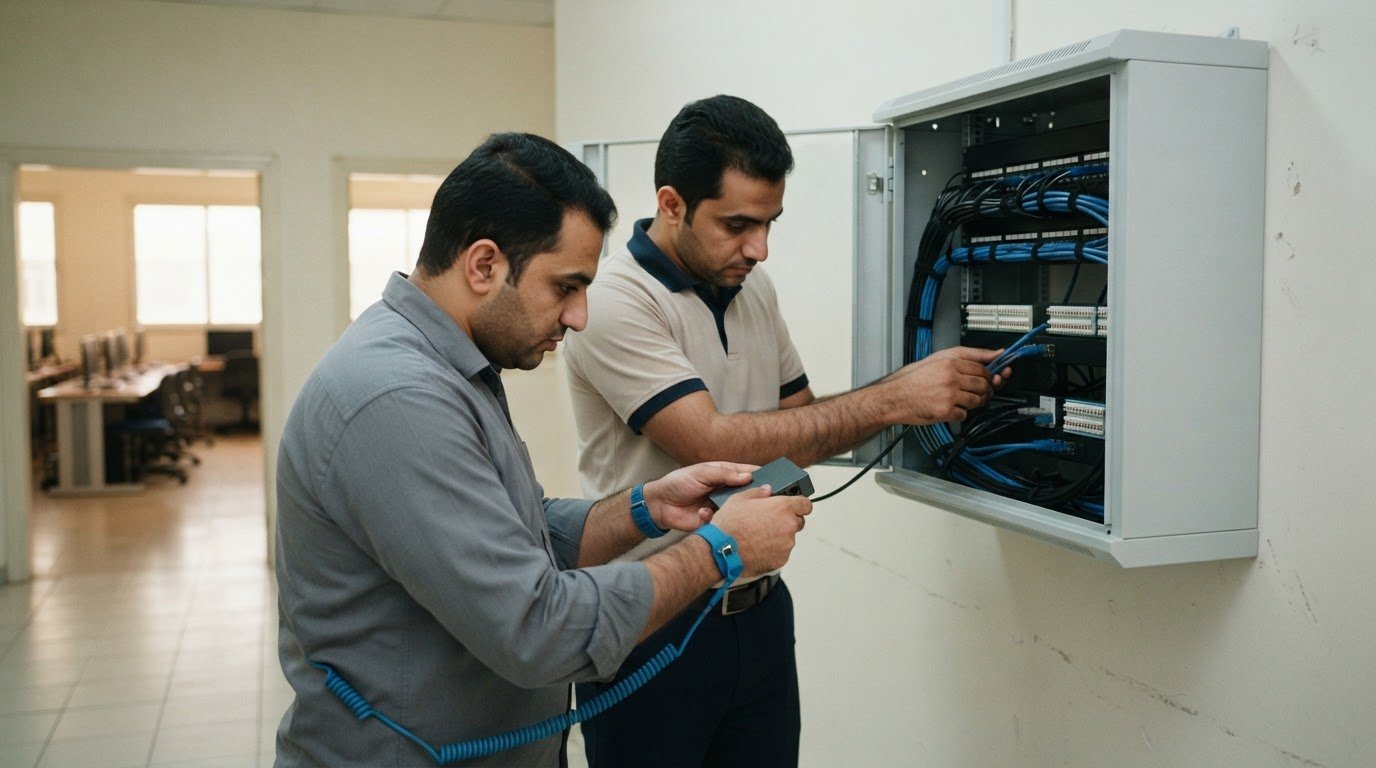
Choosing incident response services involves more than selecting a generic checklist. A useful incident response plan should clarify who leads the response, how incidents are assessed, what actions teams take, and how they communicate and recover.
For UAE and GCC organisations, the right approach should reflect business operations, systems, data and applicable regulatory requirements. Evaluating these needs before an alert disrupts operations can help decision-makers assess whether their incident response arrangements are suitable.
This guide examines what to consider when evaluating and implementing incident response services, including preparation, identification, containment, eradication, recovery and lessons learned. For example, a UAE healthcare organisation could assess how a suspected account compromise might affect access to clinical systems and sensitive information, then clarify who assesses the incident, preserves evidence and coordinates communications. This provides a practical starting point grounded in operational realities.
Key Takeaways
- When assessing incident response support in the UAE/GCC, check how the provider will account for your systems, sensitive data, responsibilities and applicable obligations.
- Ask how severity criteria will help teams prioritise incidents by operational impact and coordinate an appropriate response.
- Confirm who will communicate internally and externally, approve messages, and assess how regulatory considerations affect notifications.
- Evaluate how the service covers each response stage, from preparation and detection through recovery and lessons learned, including coordinated actions and documented evidence.
- Assess whether the provider can evaluate likely threats to your critical assets and business processes and identify where preventive controls or specialist cybersecurity support could strengthen response readiness.
What is an incident response plan template?
A cybersecurity incident response plan template gives you a structure for documenting decisions, roles, communications and recovery actions. For UAE and GCC organisations evaluating incident response support, use it to assess how a provider’s services fit your systems, sensitive data and applicable requirements.
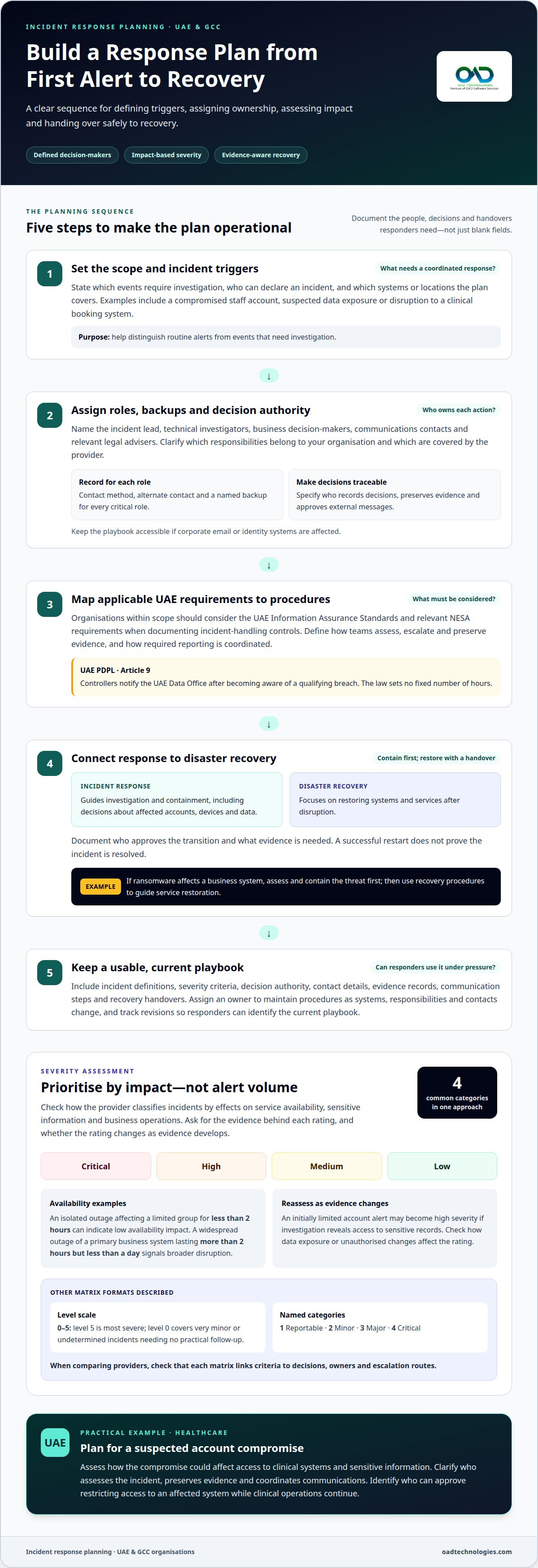
- Define the plan’s scope and incident triggers. State which events require coordinated response, who can declare an incident, and which systems or locations the plan covers. Include examples such as a compromised staff account, suspected data exposure or disruption to a clinical booking system. Clear triggers help your team and any external provider distinguish routine alerts from events needing investigation.
-
Assign team roles and backups
Assign an incident lead, technical investigators, business decision-makers, communications contacts and relevant legal advisers. When evaluating incident response support, clarify which responsibilities sit with your organisation and which are covered by the provider. Record each person’s contact method and alternate, and name a backup for every critical role. For a healthcare provider, identify who can approve restricting access to an affected system while clinical operations continue.
Keep contacts and responsibilities in an accessible playbook. Ensure responders can reach it if corporate email or identity systems are affected. Specify who records decisions, preserves evidence and approves external messages.
- Map applicable UAE requirements to accountable roles and procedures. Organisations within scope should consider the UAE Information Assurance Standards and relevant NESA requirements when documenting incident handling controls. Define how teams assess incidents, escalate them, preserve evidence and coordinate required reporting. Under UAE PDPL Article 9, controllers notify the UAE Data Office after becoming aware of a qualifying breach; the law sets no fixed number of hours.
-
Distinguish response plans from disaster recovery plans
The response plan guides investigation and containment, including decisions about affected accounts, devices and data. A disaster recovery plan focuses on restoring systems and services after disruption. When assessing a provider, clarify how its response support connects with your recovery procedures, so teams know when recovery can begin without losing evidence or reintroducing a threat.
Document the handover between containment and restoration. If ransomware affects a business system, for example, your internal team and response provider assess the incident and contain the threat, then recovery procedures guide service restoration. A successful restart does not prove that the incident is resolved. Specify who approves the transition and what evidence is needed.
- Build the template around usable procedures, not blank fields. Include incident definitions, severity criteria, decision authority, contact details, evidence records, communication steps and recovery handovers. When comparing incident response support in the UAE, assess how a provider will work with these procedures and your organisation’s operational needs. In the UAE, cybersecurity planning should reflect applicable requirements and operational needs.
Update the document as systems, responsibilities and contacts change. Assign an owner to maintain the procedures and track revisions, so responders can identify the current playbook during an incident.
Evaluating incident severity capabilities
When assessing an incident response service, ask how it connects each security incident with its likely impact on operations. A four-level classification offers a practical starting point for comparing how providers prioritise response.
-
Assess incident severity classification
Ask how incidents are classified by their effect on service availability, sensitive information and business operations. A provider may use four categories: critical, high, medium and low. Check whether it defines evidence for each. A suspected ransomware event disrupting a core UAE business system may be more severe than an isolated alert. Classification should not be based on alert volume alone.
Check whether the provider records the reason for each classification and revises it as evidence changes. An initially limited account alert, for example, may become high severity if an investigation reveals access to sensitive records. This ties escalation to observed impact, not assumptions.
- Ask for category examples covering availability, confidentiality, and integrity. An isolated outage affecting a limited group for less than 2 hours can indicate low availability impact. A widespread outage of a primary business system lasting more than 2 hours but less than a day signals broader disruption. Check how data exposure or unauthorised changes alter the rating.
-
Compare incident severity matrices
Assess whether a provider’s matrix connects severity criteria to decisions, owners, and escalation routes. One template uses levels from 0 to 5, with level 5 most severe and level 0 for very minor or undetermined incidents needing no practical follow-up. Another approach uses Reportable (1), Minor (2), Major (3), and Critical (4). Ask the provider to explain its model and define it clearly.
For each category, check who leads, which teams are notified and what action begins. If labels from different scales are used, ask how they are mapped. A matrix helps teams apply the same framework during alerts and tabletop exercises.
- Check that each severity level reflects business consequences, not just technical indicators. A successful denial-of-service attack with significant operational impact fits the Critical (4) example in one classification. Some adverse business impact aligns with Minor (2), while wider operational, financial, or reputational consequences indicate Major (3). Ask for the observable conditions behind each decision.
- Evaluate whether escalation rules account for uncertainty and changing impact. When evidence is incomplete, the provider should assign a provisional category and specify who can change it. For a UAE retailer, suspicious activity affecting payment services may take priority over an alert involving one employee device. Decisions should reflect service dependencies and affected users.
- Ask how the provider tests its matrix in exercises and refines confusing criteria. A ransomware scenario can show whether technical responders and business leads reach the same severity decision. Check whether the provider records where labels, handovers, or escalation steps cause delays, then revises the definitions. For help shaping incident priorities around your operations, discuss severity planning.
Choosing incident response services and communications in the UAE
When evaluating incident response services in the UAE, check how the provider supports response decisions and communications with staff, customers, suppliers and regulators.
- Confirm who communicates with each audience and who approves messages, both within your organisation and with the incident response provider. Name an incident lead for internal updates, an authorised spokesperson for external statements and a legal contact for regulatory considerations. In a UAE logistics company, for example, the operations lead might brief staff about affected systems while the spokesperson handles customer enquiries. Agree on an alternate for each role.
-
Evaluate the provider’s communications support
Ask whether the provider can help prepare separate message templates for employees, customers, suppliers and relevant authorities. Messages should state what is known, which services or information may be affected, what recipients should do and when they can expect another update. They should avoid speculating about the cause or scope, mark details still under investigation and go to a designated approver.
Check that the provider can coordinate through channels that remain available if email or collaboration systems are compromised. Agree how decisions, timestamps and recipients will be recorded in an incident log, helping teams distinguish confirmed facts from investigative findings during containment and eradication.
-
Check support for UAE incident reporting obligations
When comparing incident response services, ask how the provider will help map applicable UAE reporting obligations to owners, triggers and submission procedures. Under UAE PDPL Article 9, a controller must notify the UAE Data Office after becoming aware of a qualifying breach. The law sets no fixed number of hours. Confirm how the provider will help record when the controller became aware and assess whether the breach qualifies.
Identify any sector-specific or contractual reporting requirements that may apply. Their scope depends on the organisation and the incident, so do not assume one deadline applies to every UAE business. Agree who will determine which requirements apply and document the decision.
- Ask how the provider will support a notification decision record for each incident. Capture the detection time, affected systems, information involved, potential consequences and escalation decisions. Assign one person to maintain the record as evidence develops. This provides a traceable basis for internal reviews and any applicable reporting.
- Agree how communications will be coordinated with response actions. Before announcing that systems are restored, confirm that technical responders have authorised recovery and assessed containment. For example, a UAE organisation investigating a suspected account compromise should avoid telling users to resume access until the response lead approves that step.
- Check how the provider will help prepare for questions from employees, customers and the media. Give employees a clear way to report new evidence, and direct external enquiries to the authorised spokesperson. Update approved messages as facts change, while retaining earlier versions, recipients and approvals in the incident log.
Preparation, identification, containment, eradication, recovery, and lessons learned
Run each response stage in sequence, while recording decisions and changes. Assign an owner to each handover so employees know who acts next.
-
Prepare contacts and incident documentation
Maintain an offline contact list for response leads, technical teams, executives and relevant advisers. Include alternates and a secure way to reach them if corporate email fails. Store incident logs where responders can access them without relying on affected systems.
Prepare a record for detection times, observations, decisions, evidence and actions. If a UAE clinic suspects an account compromise, for example, employees should report unusual access through the designated channel. The assigned recorder documents each report without altering original evidence.
-
Identify and contain incidents
Compare alerts with expected activity, then record the affected accounts, devices, services and data. Identification may take hours as responders connect separate signals. Document what supports the incident assessment, distinguishing confirmed facts from working hypotheses.
Contain the threat while limiting unnecessary disruption. Depending on the evidence, responders may disconnect an affected system or disable a compromised account. Containment time varies with the incident’s scope. Record the reason for each action and any business service it interrupts.
-
Eradicate, recover and learn
Address the cause only after responders understand the incident’s scope. Eradication can take considerably longer than containment. Deal with the identified entry point and affected components before restoring services. In a ransomware incident, preserve relevant evidence and investigate whether access remains before recovery begins.
Restore systems through approved recovery procedures, then monitor for renewed suspicious activity. Define a monitoring period for signs of re-compromise in the plan, with a longer period for ransomware incidents.
- Define preparation activities in the plan and practise them. Review and update the incident response plan at least once each year or after a significant incident. Conduct tabletop exercises at least annually, giving employees the opportunity to practise roles, escalation and handovers with realistic scenarios.
Use exercises to uncover gaps in contact access, evidence handling or recovery decisions. Record each finding, assign an owner and track the resulting change. A full incident response simulation annually or technical drills semi-annually can test different parts of the process.
- Set evidence-handling procedures before an incident occurs. Document actions during detection and analysis, preserve relevant evidence, and keep any applicable system backup secure as part of the chain of custody. Restrict access to incident records in line with organisational procedures.
After containment, compare the incident timeline with system logs and employee reports. This may reveal missed alerts, unclear handovers or recovery steps that need revision. Focus the review on improving procedures and controls, not assigning blame.
- Schedule the post-incident review meeting promptly after closure, while details are fresh. Assess damage, containment decisions and recovery outcomes, then record lessons learned and policy changes. Set a target date for completing the incident report.
Retain incident documentation according to the applicable retention policy and regulatory requirements. Use the final report to assign follow-up actions, owners and evidence of completion. This closes the response cycle and gives organisations a documented basis for improving future preparation.
Assessing incident response needs and likely cyber threats
When evaluating incident response services in the UAE or GCC, assess threats in relation to the systems, information and services your organisation depends on. Common gaps include relying on a generic service scope, overlooking supplier access and failing to update risk assumptions as systems evolve.
- List critical assets and their business purpose, including customer records, payment services, staff accounts, cloud workloads and operational systems. For each asset, identify its owner, users and dependencies. A UAE retailer, for example, can map online ordering to payment processing, inventory and customer data to see which disruptions an incident response provider may need to address together.
- Identify plausible threats for each asset and describe how they could occur. Consider phishing that exposes credentials, ransomware affecting shared files, unauthorised account use, cloud misconfiguration and supplier compromise. Treat these as scenarios to discuss with prospective incident response providers, not predictions. For each, record the access route and the systems or information potentially affected.
- Assess likelihood using evidence available to your organisation. Review security alerts, incident records, access patterns, known weaknesses and infrastructure changes. A new cloud workload may create different exposure from a long-established internal system. When comparing service proposals, do not rank threats by alert volume alone: a low-frequency scenario could still disrupt a critical business process.
- Estimate impact on service availability, data confidentiality and integrity, and business operations. Consider what would happen if a payment platform became unavailable, customer records were exposed or a supplier account was misused. Identify affected teams, customer services and recovery dependencies. Record the reasoning behind each assessment so decision-makers can judge whether a proposed response service is suited to the scenarios that need greater preparation.
- Rank risks by combining likelihood and impact, then assign an owner and treatment. Link each priority to an action, such as monitoring, access restrictions, testing or a documented escalation route. When evaluating incident response services, consider how they fit these priorities alongside Vulnerability Assessment and Penetration Testing to assess technical weaknesses. Keep the assessment focused on business consequences rather than treating every technical finding as equally significant.
- Turn priority risks into specific response scenarios to discuss with prospective providers. For a UAE retailer, a suspected compromise of an online ordering account could require checking access logs, assessing customer-data exposure and coordinating service decisions. Define what evidence would increase the scenario’s severity, and check whether the proposed service covers these needs. Do not assume one control can prevent every attack or address every operational dependency.
- Update the assessment when systems, suppliers, business processes or threat evidence change, and review whether the incident response service still fits. Revisit assumptions after a significant incident or exercise, and record what changed and why. Common gaps include outdated asset lists, untested supplier scenarios and risk ratings without supporting evidence. Assign an owner to track changes and incorporate relevant findings into incident procedures and service reviews.
OAD Technologies: Healthcare IT and Cybersecurity
OAD Technologies supports organisations, including healthcare providers, with the capabilities an incident response plan depends on. Its 24 X 7 SIEM/SOC detects and triages incidents with sub-15-minute response times, and Managed Detection and Response (MDR) built on CrowdStrike (with Sangfor EDR, XDR and MDR as an alternative) contains threats on endpoints. Backup and disaster recovery support clean restoration after ransomware, while Vulnerability Assessment and Penetration Testing (VAPT), Zero Trust access, email security and Data Loss Prevention (DLP) reduce the likelihood and impact of incidents. OAD holds ISO 9001, ISO 14001, ISO 45001 and ISO/IEC 27001 certifications.
Consider these capabilities when reviewing how your organisation protects data, assesses technical exposure or handles detected threats. The right priorities depend on your systems, information and operational requirements.
Contact OAD Technologies to discuss your cybersecurity requirements.
Make incident readiness part of operational planning
Treat a cybersecurity incident response plan template as a working guide, not a document to leave untouched. Its value comes from clear ownership, informed decisions and procedures suited to how your organisation operates. As technology and business priorities evolve, incident readiness can inform broader decisions about resilience, accountability and security investment.
OAD Technologies helps organisations connect cybersecurity planning with practical capabilities, including Data Loss Prevention (DLP), Vulnerability Assessment and Penetration Testing (VAPT), and Managed Detection and Response (MDR). These services address needs ranging from assessing weaknesses to protecting sensitive information and responding to detected threats.
A useful next step is to identify where your response capability needs closer alignment with business priorities. A focused discussion can clarify your requirements and the work needed to address them.
With clear priorities and appropriate support, your organisation can build readiness that keeps pace with its changing digital environment.
Frequently Asked Questions
How can UAE organisations evaluate incident response services?
Compare providers on how they investigate incidents, coordinate with your internal teams and support decisions about containment and recovery. Ask what evidence they provide to justify recommended actions and how they document unresolved risks at handover. For example, a UAE organisation could ask how a provider would coordinate with the service owner before restricting access to a shared platform. Check that the proposed service fits your systems, responsibilities and applicable UAE requirements.
How should UAE/GCC organisations assess incident response service coverage?
Assess coverage against business impact, affected information and the evidence available to responders. Ask how the provider handles a suspicious sign-in to a dormant account compared with confirmed access to an account controlling business-critical systems. Clarify how incident priorities are recorded, what evidence could change a rating and who can adjust it. This helps decision-makers assess whether the service can support consistent triage when technical signals are incomplete or several teams report related activity.
What roles should an incident response provider and internal team cover?
Establish who will investigate systems, make business decisions and manage communications. Identify relevant system owners too, as they may know about dependencies that technical responders cannot see. For example, an organisation using an external payroll platform should identify who manages that supplier relationship and coordinates relevant information. Define each role’s decision-making authority so responders know when to act and when approval is needed.
What should UAE organisations confirm about incident response communications?
Confirm that the service includes approved message formats for different audiences and a way to share updates if normal channels become unavailable. Ask how messages distinguish confirmed information from details still under investigation. If an exposure is suspected, employees need a way to report related observations without broadly circulating personal or sensitive data. Establish who approves each message and how the provider records which audience received it, helping teams maintain a consistent account as facts develop.
How can organisations assess incident response readiness before engaging a provider?
Review the plan at least once each year or after a significant incident, and conduct tabletop exercises at least annually. Revisit relevant sections when the organisation changes a critical system, supplier or responsibility. Use each exercise to test a specific decision, such as who can authorise restricting access to a service. Record each gap, assign an owner and incorporate the resulting change into the next plan revision.
What should UAE/GCC buyers look for in an incident response plan template?
A free downloadable template can provide a starting structure, but buyers should check whether its roles and procedures can be adapted to their organisation’s systems, responsibilities and applicable requirements.
Disclaimer
Content by OAD Technologies is for general informational purposes only and does not constitute professional or cybersecurity advice. No warranties are made regarding accuracy or completeness; reliance is at your own risk. OAD Technologies shall not be liable for any direct or indirect losses arising from use of this content.