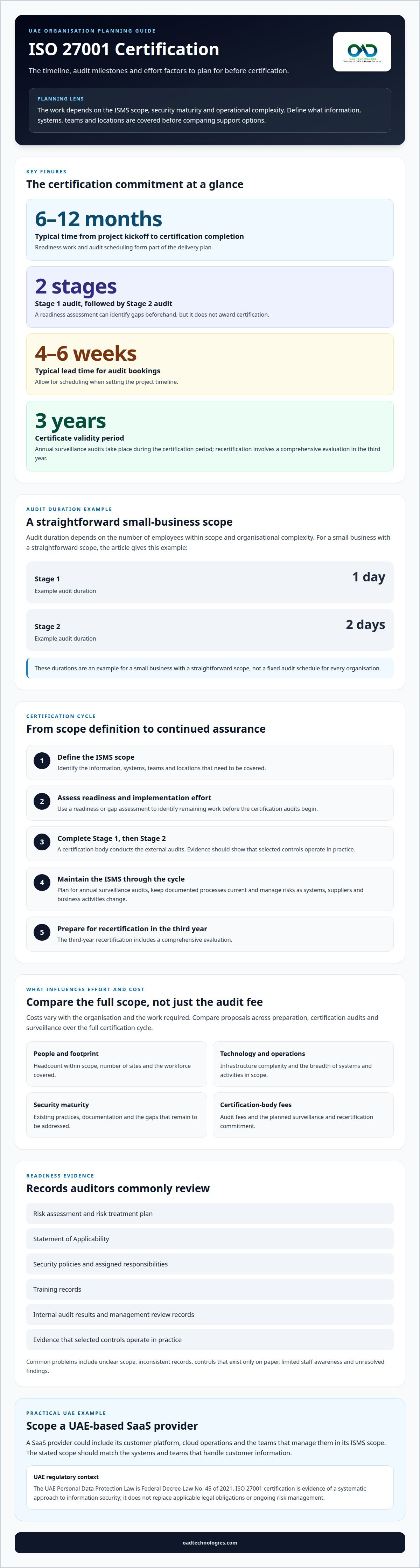
For UAE organisations evaluating ISO 27001 certification, the decision involves more than the audit: it requires assessing scope, implementation effort and support options. Certification typically takes 6-12 months from kickoff and includes a Stage 1 audit followed by a Stage 2 audit. Once certified, an organisation undergoes annual surveillance audits, and the certificate is valid for three years.
The effort depends on what the organisation includes in its Information Security Management System (ISMS), the maturity of its security practices and the complexity of its operations. For example, a UAE-based SaaS provider might scope its customer platform, cloud operations and the teams that manage them. When comparing certification support options, consider how each provider can help define a practical ISMS scope, plan implementation and account for the factors that influence cost. This helps you plan work around your business rather than treat certification as a paperwork exercise.
Key Takeaways
- Compare certification options against the information, systems, teams and locations the organisation needs covered.
- Use a gap assessment to estimate the work and cost required before certification audits begin.
- Evaluate certification value against customer assurance, risk management and relevant UAE obligations.
- Budget for scope, workforce, sites, security maturity and the ongoing effort to maintain certification.
- Plan the commercial commitment around the organisation’s operations, technology and changing risk.
The ISO 27001 certification process
For UAE organisations considering ISO 27001 certification, the main decisions include defining the ISMS scope, assessing implementation effort and selecting a certification body.
Assessing ISMS scope and delivery
Buyers can assess whether the proposed ISMS scope covers the relevant information, teams and systems, and how risk assessment, control selection and implementation will be managed. A readiness assessment can help identify gaps before a certification body conducts a Stage 1 audit, followed by a Stage 2 audit. Certification typically takes 6-12 months from project kickoff to completion.
A readiness assessment identifies remaining work but does not award certification. Certification generally follows an external audit by a certification body.
Audit duration and certification costs
Audit duration depends on the number of employees within the ISMS scope, alongside organisational complexity. A small business with a straightforward scope may need one day for Stage 1 and two days for Stage 2. Certification bodies usually need several weeks’ notice to book audits, so buyers should account for scheduling when planning delivery.
Costs vary according to headcount, scope, number of sites, infrastructure complexity, security maturity, existing documentation and certification-body fees. When comparing proposals, consider preparation, certification audits and surveillance throughout the three-year certification cycle, rather than treating the initial audit as the full commitment.
Surveillance audits and certificate validity
A successful certification audit results in a certificate valid for three years. Annual surveillance audits take place during the certification period, with surveillance audits typically scheduled in Years 1 and 2. Buyers should include these reviews in delivery plans and assess how the organisation will maintain its ISMS and operate documented processes and controls.
In the third year, recertification involves a comprehensive evaluation. Ongoing risk management between audits helps keep evidence current as systems, suppliers and business activities change.
Required documents and audit evidence
When evaluating readiness, buyers can ask how evidence will link the ISMS scope, risk decisions and daily practices. Auditors commonly review the risk assessment, risk treatment plan, Statement of Applicability, security policies, assigned responsibilities, training records, internal audit results and management review records. They also examine evidence that selected controls operate in practice.
Common audit problems include an unclear scope, inconsistent records, controls that exist only on paper, limited staff awareness and unresolved findings. For example, a UAE service provider should check that its stated scope matches the systems and teams handling customer information. Buyers can also clarify how training will help implementers maintain processes, auditors assess evidence objectively and staff follow relevant controls.
Benefits of ISO 27001 certification for UAE organisations
ISO/IEC 27001:2022 gives organisations a structured way to manage information security risks. Its business value depends on how effectively the ISMS supports customer confidence, operational decisions and market requirements.
Business benefits in the UAE
Certification gives customers and business partners independent evidence that an organisation manages information security systematically. It can also support supplier assessments, where buyers request documented security practices before sharing information or awarding work. A certificate communicates that an established process is in place; it does not remove the need to manage risks or meet applicable obligations.
For UAE organisations, a useful first step is to connect security controls with business priorities. For example, a government supplier can map responsibilities, risk decisions and evidence to the services included in its ISMS. An internal audit can then identify process gaps before they disrupt operations or undermine confidence during customer reviews.
ISO/IEC 27001:2022 also supports a consistent approach across teams. Defined ownership helps people understand how information security fits their roles, while management reviews provide a way to assess whether controls remain suitable as the organisation changes.
Return on certification investment
Assess returns through business outcomes, not the certificate alone. Consider whether documented processes make customer security reviews easier, reduce repeated evidence gathering or help meet supplier requirements. These operational gains can matter to sales and delivery teams, although certification itself does not guarantee new contracts or revenue.
To make the investment measurable, establish a baseline before implementation. Track internal audit findings, time spent preparing customer responses, recurring control gaps and the actions needed to address them. Compare these measures as the ISMS matures, and include ongoing maintenance in the assessment.
Clearer ownership of risks can also contribute to the return. When leaders review security risks alongside business changes, they can prioritise controls according to potential impact. For example, a UAE organisation expanding into cloud services can assess access, supplier dependencies and information handling before integrating the new service.
Organisations that benefit
ISO 27001 can suit organisations in any industry or of any size when they need to protect sensitive information. Finance, healthcare, logistics and government suppliers may find certification relevant because customers, partners or procurement processes place importance on demonstrable information security.
The 2022 edition groups 93 Annex A controls across four themes. Organisations select controls based on their risk assessment and document their decisions, rather than treating every control as an identical operational requirement. This helps tailor implementation to the business while preserving a clear basis for audit and management review.
Certification can be especially useful where several teams handle information or customer assurance requests recur. Discuss your information security priorities to identify how certification goals can align with business needs.
What is an information security management system?
An Information Security Management System (ISMS) connects policies, people, processes and controls to manage information security risks. For UAE organisations evaluating security services or certification, it can help structure evidence against relevant obligations, but certification alone does not establish regulatory compliance. The UAE Government identifies the UAE Personal Data Protection Law as Federal Decree-Law No. 45 of 2021.
The ISO 27001 management standard
ISO/IEC 27001 sets requirements for establishing, implementing, maintaining and continually improving an ISMS. Its clauses 4 through 10 address the organisation’s context, leadership, planning, support, operations, performance evaluation and improvement. UAE buyers can use these requirements to assess whether a proposed ISMS service supports an ongoing business process, rather than a collection of disconnected technical measures.
The standard provides a management system for protecting the confidentiality, integrity and availability of information. It does not prescribe the same security tools for every organisation. When evaluating an ISMS implementation, leaders define the system’s boundaries, assess relevant risks and check that the proposed controls suit the organisation’s operations, information and obligations.
For UAE organisations, this distinction matters when customers, partners or regulators expect evidence of consistent security practices. Buyers should assess how an ISMS provider will connect business context, risk assessment, controls and performance reviews. Certification evaluates the system within its defined scope, not every activity outside it, so scope should be considered when comparing proposals.
ISMS requirements and implementation
When evaluating implementation proposals, UAE organisations can check how leadership responsibilities and required resources will be defined. The work should identify relevant interested parties, business processes and information assets, then set security objectives, assess risks, select a treatment approach and record the controls chosen to address those risks.
Documentation supports consistent execution and gives buyers a way to assess how the proposed system will operate. Policies explain expectations, while procedures and records show how teams put them into practice. For example, an access-control process should identify approval responsibilities and retain evidence of decisions. Staff awareness matters too: employees need to understand the security practices relevant to their roles, not just receive a policy document.
Implementation continues after controls are introduced. Buyers should establish how internal audits will assess whether processes meet the organisation’s requirements, and how management reviews will consider performance, findings and necessary changes. Corrective actions address identified problems and help prevent recurrence. This cycle keeps the security management system responsive to changes in technology, suppliers and business operations.
Information security and cyber risk management
Risk management helps UAE organisations decide which information security issues need attention and why. A risk assessment identifies assets, threats, vulnerabilities and possible business impacts. When assessing an ISMS provider or plan, organisations can check how risks will be evaluated against their criteria, assigned owners and treated, whether reduced, accepted, avoided or shared.
Controls should follow these decisions. For example, a UAE retailer could assess risks to customer and payment information across its online operations and stores. The resulting treatment plan might set requirements for access, supplier oversight, incident handling and staff responsibilities. Buyers can evaluate whether the proposed controls reflect the assessed risks and the ISMS scope.
Partners also form part of the risk picture when they handle information or support critical processes. An implementation should define security expectations, assess relevant supplier risks and review whether agreed controls remain effective. Regular monitoring, incident analysis and management review feed new information into risk decisions, keeping the ISMS aligned with business changes.
What is included in a typical ISMS scope and statement of applicability?
The scope sets the boundaries for the ISMS, while the Statement of Applicability records how selected controls address its risks. For UAE and GCC organisations, these documents help buyers assess whether an implementation partner can align the ISMS with the services, locations and regulatory requirements relevant to their operations.
Defining the ISMS scope
When evaluating an ISMS provider, check how they identify the services, business activities, locations, teams and technology to include. Ask how they handle interfaces with systems or suppliers outside those boundaries. These details help establish which policies and processes apply and whether the proposed certification boundary fits your organisation’s needs.
Scope decisions should reflect business operations and information flows, not simply an organisational chart. For example, a UAE logistics company comparing ISMS implementation proposals might check whether each includes shipment-management systems, staff handling customer records and processes connecting warehouse operations with delivery teams. If an essential supplier supports a scoped service, ask how the provider will address that dependency, even if the supplier is outside the boundary.
Ask providers to document the rationale for boundaries and exclusions. Omitting a business-critical system from the scope can leave security risks unmanaged or create a gap between the certificate and customer expectations. During implementation, mapping sensitive information from collection through access, storage, sharing and disposal can help buyers assess how operational activities connect with information protection.
Check whether the proposed service includes reviewing the scope when services, locations, suppliers or technology change. For instance, adding a customer portal may affect teams, information flows and controls already covered by the ISMS. A controlled review helps establish whether the documented boundary still reflects actual operations.
The Statement of Applicability
The Statement of Applicability links risk decisions to the controls selected for the ISMS. When comparing providers, check that it records which controls apply, which do not, the reasons for those decisions and each control’s implementation status. This gives management and auditors a structured view of how assessed risks translate into security measures.
Ask how the provider will connect each applicable control’s stated purpose with operational evidence. For example, a supplier-related control should align with the organisation’s supplier processes and relevant records. If a control is excluded, expect a clear rationale tied to the ISMS context and risk assessment. Broad labels or unexplained exclusions make it harder to show that decisions were deliberate.
Assess whether the service treats the document as a working record, not a one-off certification form. Clarify how control owners, implementation actions and status updates will be managed when processes change. Internal audit findings, incidents and management reviews can reveal where a control needs adjustment or stronger evidence.
When selecting an implementation service, ask how it supports continual improvement: reviewing a finding, identifying its cause, assigning corrective action and assessing whether the change worked. If a UAE organisation introduces a new service, it can revisit relevant risks, policies and control choices. This helps keep the ISMS aligned with actual operations throughout the certification process.
Certification costs and factors affecting the price
Budget for more than the certification audit. Scope, readiness, implementation effort and recurring audit activity all shape the total investment for UAE organisations.
Pricing factors
The certification body’s audit effort depends partly on the number of employees and sites within the ISMS scope. A business covering several locations, complex infrastructure or varied services may require broader evidence review than a single-site organisation. Security maturity matters too: established processes and usable documentation may reduce preparation work, while significant gaps require additional implementation effort.
Build a budget around the full certification cycle, not a single invoice. Include internal staff time, any external implementation support, the certification audit and later surveillance audits. Other cost drivers include scope boundaries, number of sites, industry requirements, existing documentation, and the complexity of technology and operations.
For example, a UAE manufacturer with a scope covering production systems, corporate offices and multiple sites may need more audit planning than one with a narrow, office-based scope. The budget should reflect the locations, systems and processes included, as well as the work required to maintain evidence and controls.
- Scope and headcount: More people, services or sites can increase audit effort.
- Readiness: Existing risk management and documentation affect preparation needs.
- Technical complexity: Diverse infrastructure and supplier dependencies add assessment work.
- Audit cycle: Include certification and ongoing surveillance activity in the plan.
The price depends on the case and is provided after a quote request. A detailed scope and cost breakdown help decision-makers understand which activities drive the investment and where internal capacity can support implementation.
Timelines and cost planning
Project duration influences the budget because staff time, implementation support and certification-body scheduling extend beyond the audit days. Smaller organisations with a narrow scope and external support can often move faster, while larger or multi-site organisations should expect a longer programme.
Plan the work in stages: define the scope, assess gaps, implement controls, prepare documentation, conduct internal reviews and schedule the certification audit. Delays in assigning owners or resolving control gaps can extend the project and increase internal effort. Coordinating these decisions early helps align budget approvals with delivery milestones.
Calculate the investment across the three-year certification cycle, including surveillance and recertification planning. In a UAE procurement setting, a supplier preparing for customer assurance reviews can align its certification timeline with contract planning. This lets leaders assess the resources required without assuming certification will automatically secure regulatory approval or commercial work.
For a realistic budget, distinguish one-off preparation from recurring audit and ISMS maintenance work. Compare projected effort across departments, locations and suppliers, then assign accountable owners. This gives finance and security teams a shared basis for monitoring implementation costs and keeping planned certification activity on schedule.
OAD Technologies
OAD Technologies is itself certified to ISO/IEC 27001, alongside ISO 9001, ISO 14001 and ISO 45001, so it understands what auditors expect to see. It helps UAE organisations implement the technical controls an ISMS relies on when risk assessment identifies needs such as testing systems, strengthening monitoring or protecting sensitive data. Its Vulnerability Assessment and Penetration Testing (VAPT), 24 X 7 SIEM/SOC with sub-15-minute response times, Managed Detection and Response (MDR) built on CrowdStrike, Zero Trust access, email security, Data Loss Prevention (DLP), and backup and disaster recovery offerings address distinct Annex A control areas. These capabilities can inform control implementation and ongoing risk management, but certification itself depends on the organisation’s ISMS and an independent certification audit. For example, a UAE business preparing for an audit might use VAPT findings to identify technical weaknesses requiring remediation, then track actions within its own risk treatment process. To discuss security priorities relevant to your certification plans, contact OAD Technologies.
Turn certification plans into business action
For organisations pursuing ISO 27001 certification in the UAE, treat the next step as a business decision, not just a security project. Assign an executive sponsor, identify the teams affected and agree what evidence will show that the programme supports operational priorities. Clear ownership helps keep decisions moving across technical and business functions.
Map planned changes to services, suppliers, data flows and customer commitments. This gives security and operations leaders a shared basis for sequencing work and addressing competing priorities. Revisit the plan as the organisation evolves so that certification objectives remain connected to how it operates.
A focused discussion about scope, current risks and internal capacity can help shape a practical way forward. The right priorities depend on how your organisation handles information and where it plans to grow. A considered plan gives your team a clear starting point and room to build lasting security practices.
Take the next step with a plan grounded in your organisation’s needs and ambitions.
Frequently Asked Questions
How do ISO 27001 audits work?
ISO 27001 audits assess whether the organisation’s ISMS meets the standard and operates as documented. Auditors review records, interview relevant staff and sample processes or controls within the agreed scope. The initial certification audit has Stage 1 and Stage 2, followed by surveillance during the certificate cycle. For example, an auditor may compare an access policy with approval records and staff practices to assess consistency.
What does ISO 27001 implementation involve?
Implementation turns information security objectives into assigned responsibilities, risk decisions and working processes. Teams identify relevant information and operations, assess risks, select controls, and establish supporting policies and records. They also need to communicate role-specific practices to staff and review whether controls work as intended. For instance, a new supplier may prompt an organisation to assess dependencies and update its supplier oversight process.
What are the benefits of ISO 27001 and why is it so important?
ISO 27001 can give customers and business partners a clearer basis for assessing an organisation’s information security practices. It also gives leaders a consistent way to assign ownership and make risk decisions across teams. The value is practical when security requirements arise during procurement or supplier reviews. Certification supports assurance, but it does not guarantee contracts, eliminate cyber risks or replace other applicable obligations.
What is ISO 27001 certification and what does it cover?
ISO 27001 certification is an independent assessment of an organisation’s Information Security Management System against the standard’s requirements. It applies to the defined ISMS scope, rather than automatically covering every service, site or activity. For organisations pursuing ISO 27001 certification in the UAE, the scope should reflect actual operations and information flows. A certificate is evidence of assessment, not proof that no security incidents can occur.
What are the ISO 27001 certification requirements for UAE organisations?
Organisations need an ISMS that meets ISO 27001 requirements, including defined scope, risk assessment, selected controls, documented processes and ongoing evaluation. The certification audit assesses that system against the standard. UAE organisations should also identify relevant legal, contractual and sector-specific obligations separately. For example, ISO certification does not replace the Dubai Information Security Regulation where that regulation applies to an organisation’s activities.
Which ISO 27001 certification bodies are accredited in the UAE?
Look for a certification body accredited by the Emirates International Accreditation Centre (EIAC) or another member of the International Accreditation Forum’s multilateral recognition arrangement. Accreditation supports broader recognition of the certificate. The certification body conducting the audit should be independent of any firm that designed the organisation’s ISMS. Before contracting, establish that the body’s accreditation covers management system certification and the relevant audit scope.
How much does ISO 27001 certification cost in the UAE?
There is no single cost for every UAE organisation. The budget depends on the ISMS scope, headcount, number of sites, technical complexity, existing documentation, implementation effort and certification-body audit activity. Include surveillance and later recertification planning, not just the initial audit. A focused single-site scope and a multi-site operation have different resource needs. Any project-specific service quotation depends on the case and follows a quote request.
How long does ISO 27001 certification take in the UAE?
Certification typically takes 6-12 months from project kickoff to completion. The schedule depends on the scope, existing security maturity, staff availability, control implementation and audit-body scheduling. A UAE organisation with established processes may have different preparation needs from one building its ISMS across multiple sites. Allow time for evidence to demonstrate that processes operate in practice, rather than planning only around the external audit dates.
Disclaimer
Content by OAD Technologies is for general informational purposes only and does not constitute professional or cybersecurity advice. No warranties are made regarding accuracy or completeness; reliance is at your own risk. OAD Technologies shall not be liable for any direct or indirect losses arising from use of this content.