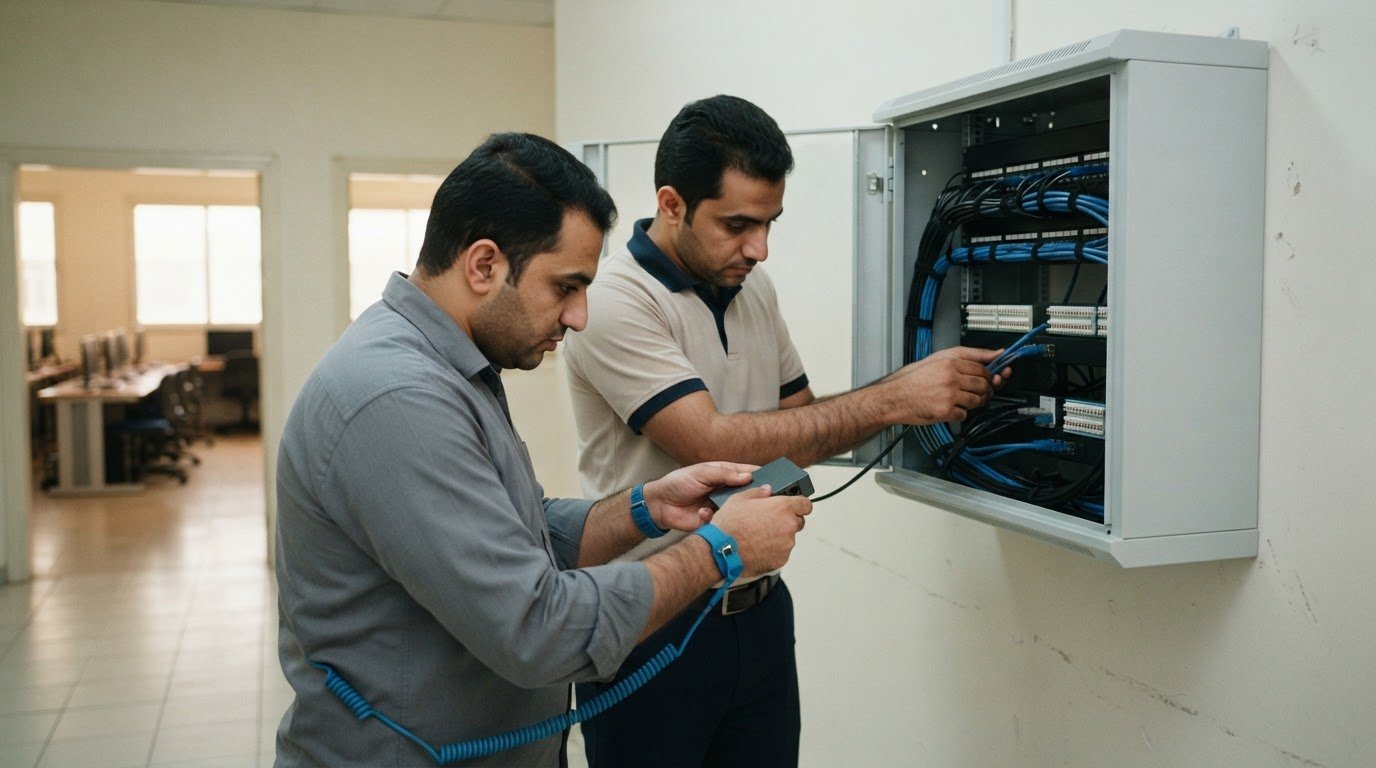
An automated vulnerability scan can quickly identify known weaknesses, but it may not answer the crucial question: could an attacker exploit them? Manual penetration testing investigates how weaknesses might be combined to reach systems or data. These methods serve different purposes, so treating them as interchangeable can leave gaps in security planning and budgeting.
Vulnerability assessment and penetration testing (VAPT) combines these approaches to help organisations identify and assess security risks. VAPT cost in the UAE depends on the systems in scope, infrastructure complexity, depth of manual testing and provider expertise. The price for an engagement depends on its scope and requirements. This guide explains how those factors shape a quote, what an assessment may cover, and how automated scanning compares with hands-on testing, so you can determine what suits your organisation.
Key Takeaways
- Map the applications, networks and cloud assets in scope to understand what drives assessment effort and cost.
- Distinguish automated vulnerability scans from manual penetration testing: they identify risks in different ways and provide different levels of insight.
- Compare provider proposals by testing scope, expertise and deliverables, not just by the way fees are presented.
- Check what a VAPT package covers, including validation, reporting and any retesting, so you can judge its value.
- Use a practical UAE scenario, such as assessing a business application alongside its connected infrastructure, to clarify what your organisation needs tested.
How infrastructure size and complexity affect cost
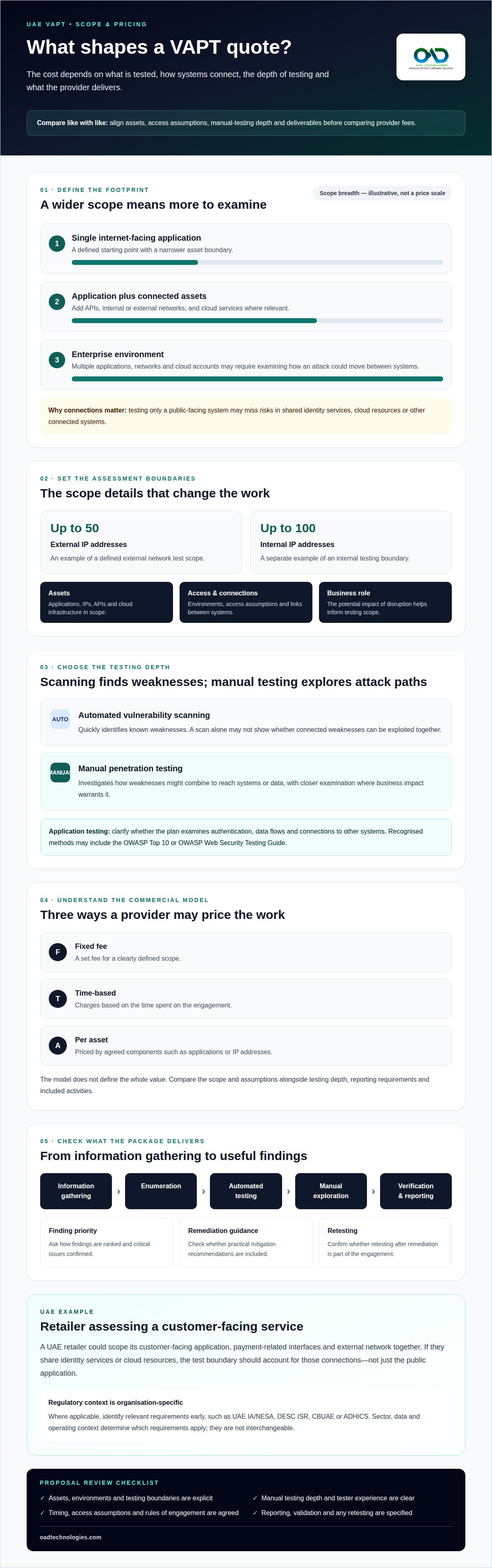
The effort involved in a UAE security assessment depends on what must be tested, how systems connect and how deeply each area needs examination. A single internet-facing application has a different scope from an enterprise environment spanning applications, internal networks, cloud accounts and APIs. More assets mean more potential entry points, while interconnected systems require testers to examine how an attack could move between them.
Asset counts help define the starting scope. For example, an external network test covering up to 50 IP addresses differs from internal testing across as many as 100 IPs. Adding an application or API expands the work further: testers assess its authentication, data flows, and connections to other systems. A cloud environment can also require configuration review alongside testing of accessible services. Each additional component changes the questions the assessment must answer.
Complexity matters as much as size. A payment application connected to customer records may need closer examination than a standalone informational site. Manual testing can investigate whether separate weaknesses combine into a path to sensitive data, something automated checks alone may not establish. Where exploitation could affect important operations, the assessment scope should reflect the system’s business role and the potential impact of disruption.
For example, a retailer operating across the UAE might include its customer-facing application, payment-related interfaces and external network in one assessment. If these assets share identity services or cloud resources, testing only the public application could miss risks in those connections. A clear asset inventory and agreed boundaries help direct effort towards the retailer’s highest-risk data and services.
Compliance considerations can also shape scope. UAE organisations may need to align assessment planning with relevant requirements or controls, such as UAE IA/NESA, DESC ISR, CBUAE, ADHICS, PCI DSS, or ISO 27001. These names do not mean every organisation has the same obligations; sector, data, and operating context determine which apply. Identifying relevant requirements early helps define which systems, evidence, and test methods belong in scope.
To make cost estimates comparable, define the assets, environments, access assumptions, and depth of manual testing. Include internal and external networks, applications, APIs, and cloud infrastructure only where they support the assessment objective. A clearly bounded scope helps prevent gaps and keeps attention on material attack paths. The Vulnerability Assessment and Penetration Testing service covers this kind of security assessment.
How much does VAPT cost in Dubai and the UAE in 2026?
For UAE organisations, a useful proposal sets out the assessment scope, testing approach and team expertise. Compare providers by how clearly they connect these elements to your cybersecurity and regulatory needs.
Provider selection and questions
Choosing a provider means assessing whether its team can test your systems competently and present findings in a useful form. A vulnerability scan alone may not show how an attacker could exploit connected weaknesses. Before considering commercial terms, review the proposed methodology, relevant experience, tester roles and sample report structure.
Ask who performs manual testing, how the provider confirms critical findings, and whether the final report prioritises remediation. For application testing, ask whether the scope uses recognised methods such as the OWASP Top 10 or the OWASP Web Security Testing Guide. Also clarify how testing boundaries, timing, and rules of engagement are agreed, especially where production systems support essential operations.
A provider’s experience should match the environment being assessed. A government supplier handling sensitive systems may need a different scope from a retailer testing a customer-facing application. Ask how the assessment maps to relevant requirements, such as UAE IA/NESA, DESC ISR, CBUAE or ADHICS, where applicable. These frameworks are not interchangeable: the organisation’s sector and obligations determine which criteria are relevant.
Pricing models and package contents
Pricing models explain how a provider calculates the work, while package contents describe what the assessment delivers. Reviewing both helps you determine whether a proposal covers the testing your organisation needs, rather than just a scan or asset list.
A provider may set a fixed fee for a defined scope, charge by time spent, or price by asset, such as applications, IP addresses or other agreed components. The price depends on the assets, access, testing depth and reporting requirements. Compare proposals only after aligning their scope and assumptions.
An assessment may combine information gathering, enumeration, automated testing, manual exploration, verification and reporting. Some engagements also include privilege-escalation testing or retesting after remediation. Ask which activities are included, how findings are ranked and whether the report provides practical mitigation recommendations. A clearly stated scope makes omissions easier to identify.
For a UAE business handling payment data, for example, clarify whether testing covers the application, related interfaces, and relevant network exposure. If regulatory alignment matters, ask how the provider connects its test plan and evidence to the applicable requirements. To discuss an assessment scope for your environment, contact OAD Technologies.
How provider expertise affects VAPT costs
Provider expertise affects how well a team can distinguish a detectable weakness from a credible attack path. Automated tools can flag known issues, but experienced testers interpret results in the context of network structure, application behaviour and business operations. Their analysis can reveal whether separate weaknesses combine into a meaningful risk. Proposals should explain how automated testing and human judgement work together.
Experience with the relevant technology matters. A tester assessing a cloud-hosted application needs to understand its access controls, interfaces and deployment structure. Network testing calls for knowledge of how devices and services interact, not just a list of scan results. Ask how the team will validate critical findings, document evidence and explain practical remediation. These details show how expertise contributes to the assessment.
Credentials can demonstrate professional development, but a certificate alone does not show that a team can assess your specific environment. Review the proposed testers’ relevant assessment experience, methods and reporting approach. Ask whether the team will explain findings to both technical staff and business decision-makers. A useful report links each weakness to its potential impact and provides clear remediation guidance.
Methodology also affects the depth of vapt services. For example, a report aligned with the OWASP Web Security Testing Guide describes a different application-testing approach from a broad automated scan. ISO 27001 does not specifically make penetration testing mandatory, but it requires organisations to manage technical vulnerabilities. A provider should explain how its testing evidence supports your organisation’s chosen controls, without implying that one assessment guarantees compliance.
You can manage effort without weakening the assessment. Start by defining the business objective and prioritising systems that hold vital data. Then provide a clear asset inventory, set testing boundaries and arrange appropriate access. This preparation reduces time spent resolving scope questions. Automation can make vulnerability identification more efficient, while manual validation remains important for understanding exploitability and context.
A UAE organisation could apply this approach by prioritising a customer-facing application connected to internal network services. The assessment can focus on those critical paths rather than treating every system as equally important. If the environment changes substantially, update the scope to include new assets and connections. This keeps testing aligned with the current environment and the organisation’s principal risks.
Evaluate proposals by comparing planned testing activities, expertise and deliverables against the same scope. A scan may suit routine visibility, while a complex environment may need deeper manual analysis. Ask how the provider handles false positives, evidence and remediation priorities. The aim is not to minimise testing indiscriminately, but to direct specialist effort towards weaknesses with clear business consequences.
Do UAE VAPT providers charge fixed fees, hourly rates, or per asset?
UAE VAPT proposals may base charges on a defined scope, staff time or the assets tested. Each model allocates effort differently, so the billing format alone does not show what the assessment covers. For example, testing one web application is easier to scope as a defined project than an open-ended review of changing infrastructure. Match the charging method to the work and deliverables.
A fixed-fee model sets a price for an agreed scope. The proposal should identify the included applications, networks, testing methods, reporting and any retest. For example, a retailer commissioning an assessment of one customer portal can use a fixed scope to clarify the planned work. Adding an API or internal network later may require a change to the scope and charge.
Hourly or day-based billing ties the charge to the time spent by the testing team. It can suit exploratory work when the effort depends on findings or access conditions. Before work begins, clarify which tasks are billable, how progress is reported and how scope changes are handled. For example, agree whether time spent resolving unavailable test accounts counts towards the engagement.
Per-asset pricing links the charge to a countable unit, such as an application, API, IP address or cloud environment. It can help structure a proposal when assets are clearly inventoried. However, applications may differ in architecture, user roles and integrations. Confirm how the provider defines an asset and accounts for complexity, shared components and duplicate environments.
Some proposals combine pricing models. A provider might set a fixed scope for a web application, then price additional manual testing by effort or charge for newly added assets. This hybrid approach can accommodate a defined core assessment alongside changing requirements. Ask for each component to be itemised, with its assumptions, inclusions and conditions for change clearly described.
Compare proposals against the same scope, not just by billing label. Check whether each includes automated scanning, manual validation, reporting and remediation guidance. Then confirm the assets, access assumptions, testing boundaries and exclusions. A proposal that includes an API within an application may differ from one that treats it separately, even if both describe similar testing.
Before approving a UAE engagement, document the agreed scope and how changes affect billing. For an organisation assessing a patient-facing application, specify whether connected interfaces and cloud components are included. This prevents different interpretations of the project. A clear commercial structure links the provider’s effort to the systems tested and evidence delivered, helping decision-makers compare assessments on consistent terms.
What is included in a standard VAPT package in the UAE?
A VAPT package combines automated vulnerability assessment with human-led penetration testing. Together, these activities identify known weaknesses and examine whether they can be exploited. Exact deliverables depend on the agreed scope, such as an application, external network or cloud environment. A useful package describes the testing activities, reporting outputs and any follow-up work, rather than relying on the VAPT label alone.
An engagement often begins with information gathering and enumeration. Testers identify in-scope systems, exposed services and relevant application features before running automated checks. Enumeration builds a clearer picture of the environment and helps the team focus on plausible attack paths. For a web application, this may involve examining login functions, user roles and exposed interfaces within the agreed boundaries.
Automated testing can identify known vulnerabilities and configuration issues across the defined assets. Human testers then explore and verify findings, reducing reliance on scan output alone. They examine whether a weakness is reproducible and what access it could enable. For web applications, methodologies may include the OWASP Top 10, OWASP ASVS, or the OWASP Web Security Testing Guide, depending on the assessment objective.
Manual testing adds context that automated tools cannot provide on their own. A tester may examine whether weaknesses in authentication and access control combine to expose restricted information. The assessment can also include privilege-escalation testing when it fits the authorised scope. Agree testing boundaries, timing and rules in advance to protect the availability of live services.
The report turns technical results into remediation priorities. It should describe findings, supporting evidence, severity, affected assets and practical mitigation recommendations. High-risk vulnerabilities need clear prioritisation, while lower-risk observations should include enough context to support informed planning. For a UAE organisation working towards a regulatory or industry requirement, the scope and reporting evidence should reflect its relevant controls.
Retesting may be a separate or defined follow-up activity. It assesses whether remediation has addressed reported weaknesses, rather than simply repeating the original scan without context. Clarify which findings can be retested, what evidence the provider will return and whether the retest is included. These details make the package’s post-assessment value easier to understand.
For example, a business operating across the UAE could assess an online application by defining tests for its login, user permissions and connected API. The package should make clear which components were tested, how findings were validated and what remediation actions the report recommends. Review these deliverables alongside the scope to distinguish a scan-only service from an engagement combining automated checks and manual analysis.
OAD Technologies: Vulnerability Assessment and Penetration Testing (VAPT)
OAD Technologies provides Vulnerability Assessment and Penetration Testing (VAPT) for organisations seeking a clearer view of weaknesses across their digital environment. Consider this service when you need an assessment tailored to specific applications, networks or infrastructure, rather than a scan that leaves important questions unanswered. A defined scope helps connect testing depth and reporting to your operational priorities.
For example, a UAE business preparing to assess a customer-facing application can identify its most important systems and interfaces, then align the assessment with its security and compliance priorities. OAD Technologies also provides Data Loss Prevention (DLP), Managed Detection and Response (MDR) built on CrowdStrike, and a 24 X 7 SIEM/SOC with sub-15-minute response times, so findings can be monitored and remediated after testing. OAD holds ISO 9001, ISO 14001, ISO 45001 and ISO/IEC 27001 certifications.
Contact OAD Technologies to discuss your VAPT requirements.
Make security testing part of ongoing planning
Planning VAPT costs in the UAE helps connect assessment decisions with business priorities. When planning new systems or changes to existing services, include security considerations early in project discussions. This gives decision-makers a clearer basis for aligning assessment scope with operational plans.
Use assessment findings to inform discussions between technology, security and business teams. A shared understanding of priorities helps translate technical observations into decisions about ownership, remediation planning and future investment.
If you’re planning an assessment around your organisation’s environment and priorities, discuss your requirements with OAD Technologies.
Thoughtful planning helps your team set clear priorities and make informed security decisions.
Frequently Asked Questions
What is VAPT?
Vulnerability Assessment and Penetration Testing combines vulnerability identification with controlled attempts to exploit weaknesses. The assessment identifies potential security issues; penetration testing examines whether they could give an attacker access or cause an impact. For example, a scan might flag weak access controls, while a tester investigates whether they expose restricted functions. Together, the findings help an organisation understand its exposure and prioritise remediation.
What is the typical cost of a VAPT in the UAE?
VAPT cost depends on your organisation’s requirements and is provided in a quote. Scope, infrastructure complexity, testing depth and reporting needs influence the estimate. A focused review of one application differs from an assessment spanning networks, cloud services and APIs. For a useful comparison, align each proposal to the same assets and deliverables instead of relying on a broad market average.
How much does network penetration testing cost in the UAE?
The cost depends on the network’s size and complexity, and on whether testing covers external exposure, internal systems or both. An external perimeter test examines accessible services, while internal testing may assess how an attacker could move between network resources. The quote reflects the scope and testing requirements. Clearly identify the network segments and assets to be assessed when defining the engagement.
What factors affect VAPT pricing in the UAE, such as scope and complexity?
Pricing reflects the number and type of assets, their interconnections, testing depth and required expertise. A single application with straightforward access differs from a hybrid environment linking cloud services, APIs and internal systems. Regulatory or industry evidence requirements can also shape reporting. For example, an organisation handling payment data may need a scope that addresses the relevant payment environment, not just its public website.
Are there UAE regulations or industry requirements that mandate VAPT?
Some UAE requirements call for security testing for particular sectors or entities. UAE IA/NESA requirements include periodic testing for government and critical-infrastructure entities. The CBUAE framework calls for penetration testing and vulnerability assessments for financial institutions. Dubai’s DESC ISR Version 3 mandates testing of external-facing services for in-scope government, semi-government, and supplier organisations. Applicability depends on an organisation’s status and regulatory context.
How long does a VAPT take in the UAE, and can duration affect its cost?
Most VAPT assessments take 1 to 3 weeks, while larger, multi-part engagements can take 3 to 6 weeks. Duration depends on the assets, access arrangements, and depth of testing. A longer engagement can require more specialist effort, which may affect its quote. For example, testing interconnected applications, networks, and cloud components requires broader coordination than assessing one isolated system.
What should businesses check before choosing a VAPT provider in the UAE?
Check that the proposed scope names the systems, testing methods, boundaries, and reporting deliverables. Ask who performs manual testing, how critical findings are validated, and whether the report gives practical remediation guidance. Confirm the team understands requirements relevant to your sector, such as CBUAE or ADHICS where applicable. A provider should also agree testing windows and rules of engagement, particularly when production systems support essential services.
Disclaimer
Content by OAD Technologies is for general informational purposes only and does not constitute professional or cybersecurity advice. No warranties are made regarding accuracy or completeness; reliance is at your own risk. OAD Technologies shall not be liable for any direct or indirect losses arising from use of this content.