More security tools don’t automatically mean someone is ready to investigate an alert. MDR services in the UAE combine continuous monitoring, threat detection, investigation and response, often providing coverage around the clock without requiring a business to build a full in-house security operations centre. Their cost depends on the environment, endpoints, integrations and coverage requirements.
It is reasonable to ask whether managed detection and response adds value when your organisation already has endpoint or network security tools. The difference lies in the analysis and response behind the alerts: signals need to be interpreted in context, investigated and connected to a clear response.
This guide explains what MDR can cover, which threat signals and security tools may be included, and the practical factors that shape pricing without relying on generic price ranges. It also covers onboarding, response authority and UAE data-processing arrangements, helping you assess whether MDR fits your team and operating environment.
Key takeaways
- Assess MDR cost through the size and complexity of your environment, the endpoints and integrations in scope, and the coverage your team needs.
- Understand how analyst investigation and agreed response authority distinguish managed detection and response from security tools that generate alerts for your own team to handle.
- Look beyond endpoint alerts: user behaviour, network activity, email, identity and cloud signals can help reveal suspicious patterns.
- Use onboarding to map data sources and uncover visibility gaps, then tune detections as the monitoring team learns your environment.
- Include telemetry processing location, retention and any processing outside the UAE in your service and compliance assessment.
How much does managed detection and response cost?
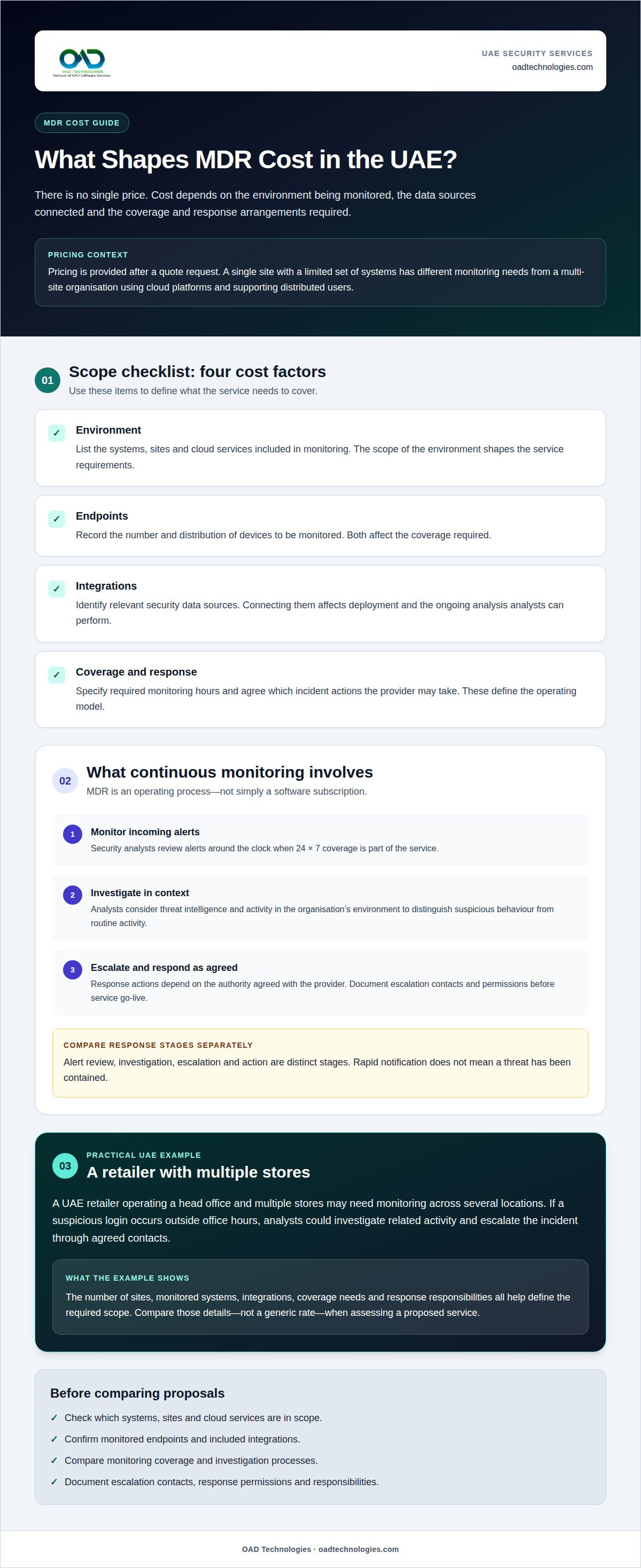
There is no single price for managed detection and response in the UAE. Pricing depends on the environment, endpoint count, integrations and required coverage, and is provided after a quote request. A business with one site and a limited set of systems has different monitoring needs from a multi-site organisation using cloud platforms and supporting distributed users.
Continuous monitoring is a central part of the service. Security analysts review incoming alerts around the clock, using security tools, threat intelligence and knowledge of the organisation’s environment. Threat intelligence helps put suspicious indicators into context, while investigation helps distinguish activity that needs a response from routine system behaviour. The continuous monitoring and response capability should therefore be understood as an operating process, not simply a software subscription.
Coverage can run 24 X 7. That matters when an incident develops outside office hours: an alert left for the next working day may give an attacker more time to act. Analysts monitor, investigate and help the organisation respond to genuine incidents. The exact response actions depend on the authority agreed with the provider, so escalation contacts and response permissions should be documented before service go-live.
Threat intelligence is useful when analysts consider it alongside signals from the monitored environment. A suspicious connection, for example, needs investigation in context: which system generated it, whether related activity appeared elsewhere, and whether it fits normal business use. This helps security teams prioritise incidents instead of treating every alert as equally urgent. Continuous monitoring can also make changes in activity visible as they happen, rather than only during a later review.
- Environment: The systems, sites and cloud services included in monitoring shape the scope.
- Endpoints: The number and distribution of monitored devices affect coverage requirements.
- Integrations: Connecting relevant security data sources influences deployment and ongoing analysis.
- Coverage and response: Required monitoring hours and agreed incident actions define the operating model.
For example, a UAE retailer operating a head office and multiple stores may need monitoring across several locations. A suspicious login outside office hours could prompt analysts to investigate related activity and escalate the incident through agreed contacts. This illustrates why MDR monitoring and response costs depend on scope and operational requirements, not a generic rate. Compare the proposed coverage, included integrations and response responsibilities against the environment the business needs protected.
Managed Detection and Response (MDR) definition
MDR combines security platforms with analysts who monitor, investigate and respond to potential threats. Services often centre on endpoint or extended detection tools, while data sources and response actions depend on the agreed scope.
MDR provider responsibilities
A managed security provider monitors connected security data, reviews alerts and investigates suspicious activity. Responsibilities should distinguish analysis and recommendations from actions the provider can take directly. Before the service goes live, agree escalation contacts and response authority in writing. For example, the agreement can specify who approves isolating a device or disabling an account during an incident.
When comparing MDR providers for a UAE environment, assess monitoring scope, integrations, investigation processes, escalation arrangements and support models rather than relying on provider names alone.
Incident response and forensic analysis
When an alert suggests a possible incident, analysts examine available evidence to establish what happened and which systems may be affected. They can help coordinate response actions within the authority agreed in advance. After an incident, forensic analysis can help explain how a breach occurred and identify measures that may reduce the chance of recurrence. The depth of this work depends on available telemetry and the incident’s scope.
A useful service description distinguishes alert investigation, containment assistance and post-incident analysis. It should also explain how findings are handed to the organisation’s internal security and technology teams.
Response times and latency
Compare response stages separately: alert review, investigation, escalation and action. They are distinct, and rapid notification does not mean a threat has been contained. Ask how each stage is measured and how urgent alerts reach your designated contacts. This makes service commitments easier to assess against business impact and internal decision-making.
Delays can also occur between a security event, its transmission to monitoring platforms and an analyst’s review. Integration quality and complete data sources affect how quickly activity becomes visible. Ask providers to explain their response process and what happens when an alert needs your approval. No single response-time figure describes every incident or action.
For UAE buyers, compare providers against the same practical criteria: which platforms and data sources they cover, how analysts investigate alerts, what response actions they may take, and how they support incident follow-up. These details show whether the service complements existing security teams or addresses a gap in detection and response capacity.
Endpoint, email, identity and cloud threat signals
Key risks include incomplete telemetry, false positives and response actions that exceed agreed authority. UAE businesses across finance, healthcare, retail and other sectors can use MDR; monitoring scope should reflect their systems, data and applicable sector controls.
Threat signals become more meaningful when analysts connect activity across endpoints, email, user identities, network traffic and cloud services. Together, these sources can reveal suspicious behaviour that a single alert might not show.
Threat analysis and false-positive review
An endpoint alert may indicate unusual software activity, while an identity signal may show an unexpected login pattern. Analysts examine these events in context, including related network traffic and user behaviour, to determine whether they suggest a genuine threat or routine work. This helps direct attention towards incidents that merit investigation.
Detection tuning matters. During weeks two and three of onboarding, providers should adjust detections to reduce false positives and focus on relevant threats. A low alert count alone does not prove effective security: it may reflect limited visibility or overly aggressive suppression. Review changes alongside alert quality and the data sources being monitored.
Threat hunting and advanced analytics
Threat hunting examines activity for patterns that may not trigger a standard alert. Analysts can use advanced analytics and machine learning to identify anomalies in user behaviour and network traffic. These methods support investigation, but do not replace context about the organisation’s systems, operations and security controls.
For example, unusual access to a cloud account alongside unexpected endpoint activity may warrant closer review. Analysts can investigate whether the events are connected and whether further response is needed. Threat intelligence can add context to suspicious indicators, while hunting looks across available activity for related signals.
Email signals can include unusual message activity or suspicious links, while identity monitoring can surface anomalous access behaviour. Cloud security data adds context about hosted environments. OAD’s Mimecast and Trustifi email security can feed these email signals into MDR monitoring. The value depends on which sources are connected and whether their records give analysts enough detail to investigate a sequence of events.
For a UAE financial services firm, a suspicious account login followed by unusual access to a cloud application could trigger investigation across identity and cloud records. The organisation’s sector controls and data-handling needs should inform what telemetry is collected, who can access it and how incident decisions are escalated. Those choices also shape visibility: a source outside the monitoring scope cannot contribute its signals.
AI-assisted analytics can help identify patterns across large volumes of activity, but an anomaly prompts investigation; it is not proof of an attack. Human review remains important for distinguishing unusual business activity from cyber threats. A sound operating process records why an alert was escalated, dismissed or tuned, so detection changes do not silently hide relevant behaviour.
Security tool integrations and coverage validation
Useful monitoring depends on the security data sources connected and the assets they represent. During the first week of onboarding, providers should map the environment, connect security sources and identify visibility gaps.
The initial map should link each source to the systems it covers. For example, an endpoint agent may report device activity, while identity records add context about account use. A SIEM can bring security events together for analysis. The aim is not to collect every available record, but to create a relevant view of the environment and its risks.
Coverage validation checks whether that view reflects the actual environment. Missing EDR agents on company laptops or domain controllers can leave gaps attackers may exploit. For endpoint coverage, OAD recommends CrowdStrike Falcon EDR as the primary agent, with Sangfor EDR/XDR as an alternative. Compare monitored assets with the organisation’s current inventory, record systems without telemetry and agree how to address them. Keep the map current as devices, locations and cloud services change.
Integrating existing technologies can reduce fragmented visibility, but connections must produce usable data. Consider endpoint, email, network and cloud sources, alongside identity records and threat intelligence. The practical test is whether analysts can trace related activity across these sources. For example, an endpoint alert becomes more informative when analysts can view associated account or network events.
The right operating model also depends on internal capacity. A 50-user firm with no security staff may gain more from external monitoring and investigation than a 1,000-user firm with its own security operations team. Headcount alone does not decide fit: consider who reviews alerts, investigates incidents and coordinates response when internal specialists are unavailable.
Tailoring means aligning integrations and detection priorities with actual business operations. A UAE logistics company, for example, could map endpoint and cloud systems used by its office and operational teams, then identify which assets lack monitoring. This UAE example illustrates why a standard technology bundle may not match every organisation. Customisation should clarify what is covered, where visibility remains limited and how the security team handles those gaps.
Coverage validation should produce clear operational outputs, not just a connection count. A useful review records:
- Which systems and assets send security data.
- Where endpoint or identity visibility is incomplete.
- Which integrations need adjustment or follow-up.
- How changes to the environment will be reflected in monitoring.
These checks help decision-makers connect team capacity, existing tools and monitoring scope. They also make it easier to assess whether the technologies support a tailored security approach as the organisation changes.
UAE-based MDR data processing and storage
For UAE organisations, data location is a service-design and governance decision. Before onboarding, establish where security telemetry is stored and processed, how long it is retained, and whether any processing takes place outside the United Arab Emirates.
The UAE Personal Data Protection Law may be relevant when monitoring involves personal data. Under Article 9, a controller must notify the UAE Data Office once aware of a qualifying breach; the law sets no fixed number of hours. Sector-specific requirements may also matter: financial institutions should consider applicable CBUAE requirements, while healthcare organisations should assess ADHICS and relevant Dubai entities should consider DESC ISR.
Data residency is not determined by server location alone. MDR telemetry may pass through collection, analysis, storage and support workflows, so each stage matters. Clarify which records leave the organisation, where analysts access them, which subcontracted processing locations are involved, and how retention and deletion work. These details help security and privacy teams assess operational and regulatory implications together.
A practical review maps the data lifecycle before the service begins. Identify the telemetry collected, its purpose, processing and storage locations, retention periods, access roles and deletion process. Document any processing outside the UAE and the controls governing it. This gives procurement, security and privacy teams a shared basis for evaluating the arrangement.
Implementation involves scoping the service, agreeing on data handling, connecting telemetry sources and validating that monitoring works. Initial visibility may develop during implementation, while tuning continues as analysts learn about the environment.
During procurement, request clear answers on these data-handling points:
- Location: Where telemetry is stored and processed, including any locations outside the UAE.
- Retention: How long each relevant telemetry category is retained and how deletion is handled.
- Access: Which provider roles can access the data and for what operational purpose.
- Incident handling: How data is used during investigation and incident response.
For organisations handling sensitive data, these decisions should inform the service scope before telemetry begins to flow. A documented data lifecycle can help align monitoring with internal policies and applicable UAE requirements, without assuming every organisation follows the same regulatory regime.
OAD Technologies
OAD Technologies helps UAE organisations assess how managed detection and response fits their security environment, team capacity and data-handling needs. Its MDR, SIEM, DLP and VAPT services can address connected needs, from monitoring security events to assessing vulnerabilities and protecting sensitive information.
Turn to OAD Technologies when you need to define monitoring scope, integrate security tools or clarify how incident response should work alongside internal teams. The right design depends on your systems, priorities and operating requirements, not a standard package.
Discuss your MDR requirements and the security outcomes your organisation needs with OAD Technologies.
Make MDR part of your next security decision
As your organisation adopts new platforms, expands cloud use or changes how teams work, its monitoring needs will change too. Treat MDR as an ongoing operating decision, with regular attention to whether the service still fits your environment and security priorities. That perspective helps UAE decision-makers build a service scope around business realities rather than a static checklist.
For organisations assessing MDR services in the UAE, OAD Technologies offers Managed Detection & Response (MDR) alongside Data Loss Prevention (DLP) and Vulnerability Assessment and Penetration Testing (VAPT). These services address related security needs, from monitoring and response to protecting sensitive information and assessing weaknesses. The right starting point depends on the challenges your organisation needs to address.
Discuss your priorities and operating context with OAD Technologies to explore a suitable next step.
A clearer path forward starts by matching security decisions to the way your organisation operates.
Frequently asked questions
What is MDR and do I really need it for my business?
MDR can help if your business needs security expertise beyond the capacity of its existing IT team. Consider whether someone internally can assess suspicious activity, decide on next steps and coordinate action outside normal operations. If those responsibilities are already covered, a different level of support may be appropriate. Base the decision on your team’s capabilities and risk priorities, not simply the number of security tools installed.
Does MDR replace a SIEM?
Usually, no. A SIEM may remain important for event visibility, reporting or existing security processes, while MDR provides an operational capability. For example, removing a SIEM that internal teams rely on for audits or investigations could disrupt established work. Assess the role your SIEM already plays before deciding whether to retain it, extend its use or change how it fits alongside managed security.
How long does MDR onboarding take?
Initial visibility may develop during implementation, while useful detection refinement takes longer as the provider learns normal activity. Timing depends on access to relevant systems, internal approvals and the availability of technical contacts. Set practical expectations about what will be operational at each stage. A clear onboarding plan should identify unresolved dependencies and explain how they affect developing coverage.
MDR vs internal SOC: which is right for my company?
An internal SOC may suit an organisation that needs direct control over security operations and can sustain the required specialist roles. MDR may suit a business that needs external analyst capacity without building a full in-house function. Some organisations combine both: internal staff retain ownership of business decisions while external specialists add investigation capacity. Compare the model with your hiring plans, existing expertise and desired level of operational control.
What does detection tuning look like in weeks 2-3?
Use this stage to establish how detection changes are governed. The provider should document each proposed adjustment, its reason and expected effect, then explain how the result will be assessed. Business and technology owners can help distinguish legitimate activity from unacceptable risk. A change record also helps internal teams understand why a detection behaves differently, without relying on informal handovers.
What should happen in week 1 with a new MDR provider?
Alongside technical onboarding, agree the operating rules for collaboration. Confirm business contacts, decision-makers, escalation routes and who can authorise disruptive actions. Record these arrangements before the service goes live, so analysts know how to proceed during a time-sensitive incident. Internal teams should also identify relevant change windows and business-critical processes, helping prevent a security action from unintentionally interrupting essential operations.
Disclaimer
Content by OAD Technologies is for general informational purposes only and does not constitute professional or cybersecurity advice. No warranties are made regarding accuracy or completeness; reliance is at your own risk. OAD Technologies shall not be liable for any direct or indirect losses arising from use of this content.