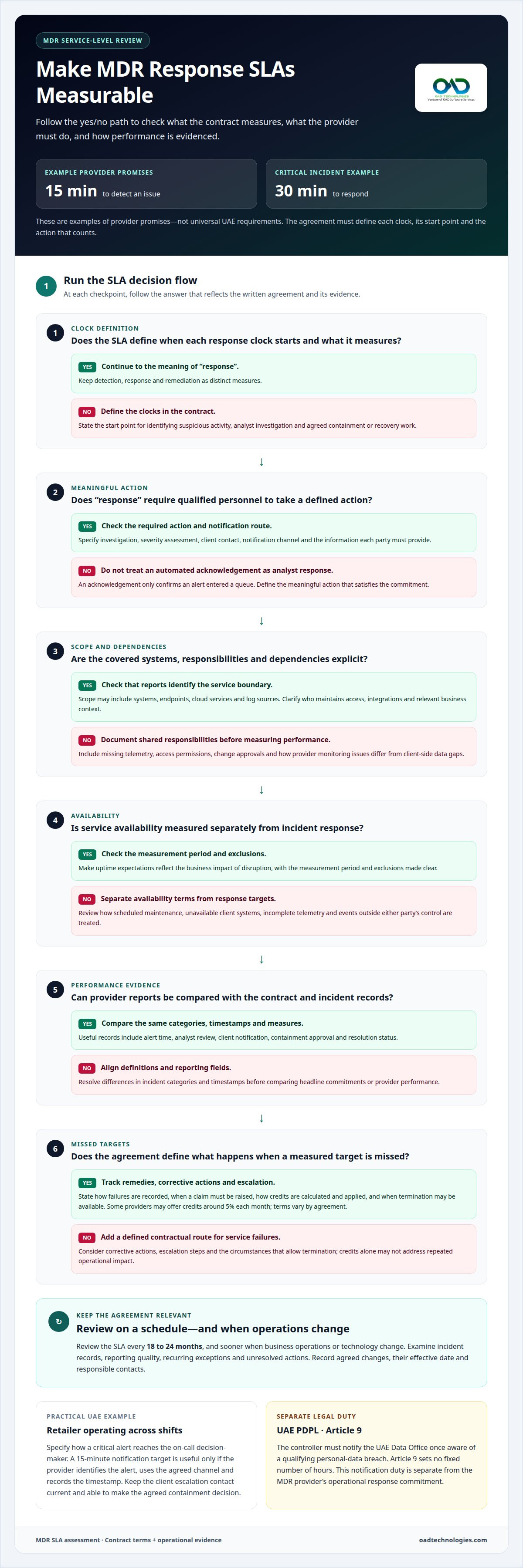
Some MDR providers promise to detect an issue within 15 minutes and respond to a critical incident within 30 minutes, but these are not universal UAE requirements. An MDR provider SLA should define what each clock measures, when it starts, and what action counts as a response, then state service availability separately.
A fast response figure can look reassuring on paper, but mean little if an automated acknowledgement counts as meeting the commitment. For UAE enterprises, an MDR provider SLA should define measurable service levels, reporting responsibilities and what happens when targets are missed.
This article explains how to assess response-time and availability terms against operational needs, review performance evidence and identify service gaps. It also covers when to revisit the agreement as your systems, operations and risk priorities change.
Key takeaways
- Define when the response clock starts and what counts as a meaningful action, not just an automated acknowledgement.
- Compare provider reports with the contract using consistent incident categories, timestamps and service measures.
- Use performance reviews to identify recurring gaps and agree how missed service levels will be addressed.
- Revisit the agreement when business operations, technology or risk priorities change, so its scope stays relevant.
- Set uptime expectations around the business impact of disruption, and make sure the measurement period and exclusions are clear.
Contractual commitments versus vendor-reported response times
UAE enterprises should treat an MDR response target as a contract term, not a regulatory deadline. The UAE PDPL’s Article 9 requires a controller to notify the UAE Data Office once aware of a qualifying personal-data breach; it sets no fixed number of hours. That notification duty is separate from the provider’s operational response commitment. A well-defined agreement makes that distinction clear.
Start by naming the parties and their responsibilities. Identify the organisation receiving the service, the provider, and the people responsible for incident communications and reporting. Define the systems, endpoints, cloud services and log sources in scope. A commitment cannot be measured fairly if the parties disagree about which telemetry is integrated or who maintains the connection.
Separate detection, response and remediation. Detection measures when the provider identifies suspicious activity. Response should define when qualified personnel investigate, assess severity and contact the client. Remediation describes agreed containment or recovery actions, including who approves changes to production systems. Some providers promise detection within 15 minutes or a critical-incident response within 30 minutes, but an MDR provider SLA must define each clock’s start point.
Define what “response” means. An automated acknowledgement confirms that an alert entered a queue, not that an analyst reviewed it or contained an incident. Specify the required action, severity categories, notification channel and information each party must provide. State whether the commitment applies outside working hours and name escalation contacts for critical incidents.
System integration creates shared responsibilities. The provider may analyse available telemetry, while your organisation maintains access, approves integrations and supplies relevant asset or business context. If an endpoint agent stops reporting, the SLA should distinguish provider monitoring failures from missing client-side data. Document dependencies such as access permissions and change approvals, so reports explain delays rather than obscure them.
Also decide whether incident handling is autonomous or guided. Autonomous actions may include agreed containment steps; guided response may require your approval before a device is isolated or an account disabled. Document pre-approved actions, who can authorise others and how decisions are recorded. For example, you might pre-authorise isolating a compromised test endpoint while reserving production systems for approval.
For a UAE example, a national retailer with staff across different shifts should specify how a critical alert reaches its on-call decision-maker. A 15-minute notification target is useful only if the provider identifies the alert, uses the agreed channel and records the timestamp. The client’s escalation contact must also be current and able to make the agreed containment decision.
Finally, connect the contract to operational evidence. Define report fields for alert time, analyst review, client notification, containment approval and resolution status. These records let both parties compare the contractual measure with the incident timeline. Clear MDR service scope and shared system responsibilities make response commitments measurable rather than promotional.
Provider performance reviews and SLA optimisation
Regular reviews turn an SLA into an operational management tool and reveal when its measures no longer reflect business priorities.
Reviewing and revising SLAs
An SLA review checks whether its service measures, responsibilities and remedies still fit the organisation’s needs. Schedule a review every 18 to 24 months, and sooner when operations or technology change.
Use each review to examine incident records, reporting quality, recurring exceptions and unresolved actions. Agree changes in writing, including their effective date and responsible contacts. The agreement should also state the customer’s cancellation rights, so persistent service problems have a defined contractual route.
Legal review and liability terms
Before approval, have the agreement reviewed for scope, exclusions, liability limits and termination clauses. A headline service commitment may be narrowed by exceptions elsewhere in the contract.
Examine how the terms treat scheduled maintenance, unavailable client systems, incomplete telemetry and events outside either party’s control. Check which types of loss are subject to liability limits and whether exclusions remove key duties. A UAE organisation should align these clauses with its own legal and regulatory obligations, rather than assume one template suits every sector.
Missed targets and remedies
Remedies define what the provider must deliver after a measured service failure. Service credits are a common remedy, but the agreement must state the applicable calculation and conditions.
Specify how missed targets are recorded, when the client must raise a claim and how credits are applied. A sliding scale can link the remedy to the severity or duration of a failure. Credits alone may not address repeated operational impact, so also document corrective actions, escalation steps and the circumstances that allow termination.
Comparing and monitoring providers
Compare proposals using the same service scope, measurement rules, exclusions and remedies. Resolve differences in definitions before comparing headline commitments. Otherwise, one provider may count an automated acknowledgement while another measures analyst action.
After signing, review provider reports against incident records and agreed measures. Track missed targets, recurring exclusions, corrective actions and credit decisions in each review. For a UAE business with operations across multiple shifts, include the relevant business owners in reviews so changes to operating needs inform revisions. If contract measures need to align more closely with security operations, discuss your service requirements.
Revising SLAs after business or technology changes
A service agreement should evolve as your organisation changes its operations, systems or risk priorities. Regular revisions keep scope, escalation routes and expected outcomes aligned with the environment being protected.
Review the agreement when the business adds or stops a service, changes working patterns, hires new teams or adopts new technology. For example, a UAE retailer moving customer platforms to cloud infrastructure should reassess which systems generate security telemetry and who escalates alerts. The change may affect service scope, integrations, responsibilities and response expectations.
Outcome-based terms focus on results the parties can observe, rather than activity alone. Define outcomes such as timely alert assessment, clear incident records and agreed escalation to business owners. Link each measure to its data source and reporting method. This gives the client a clearer basis for assessing delivery without treating the provider’s internal process as the outcome.
Cloud-provider terms need particular attention because a service may depend on infrastructure, identity and applications supplied by different vendors. Record who manages each component, what evidence is available and how incidents move between teams. A UAE organisation using cloud-hosted customer services, for instance, can map the provider’s monitoring role against its own cloud administration and application responsibilities.
Privacy clauses should address access to personal data, confidentiality, permitted use, retention and secure deletion. Under Article 9 of the UAE PDPL, a controller must notify the UAE Data Office once aware of a qualifying breach; the law sets no fixed number of hours. The agreement can define how the vendor promptly alerts the controller and supplies incident details, while preserving the controller’s legal responsibilities.
When several vendors support one service, a joint SLA or aligned agreements can reduce gaps during hand-offs. Name the lead escalation contact, define how vendors share incident status and establish a common record of actions and timestamps. For example, a cloud host, application provider and security team should each know when to escalate a suspected compromise.
Revisions also protect the business value of the agreement. Clear service scope, measurable outcomes, reporting duties and escalation paths help both parties identify responsibility and resolve disputes. Where a new cloud environment changes monitoring needs, integrated security information and event management can support consistent event visibility across connected systems.
Pricing varies because scope, monitored assets, integrations, coverage, analyst involvement and response duties differ by provider and service tier. Compare quotes against these components and the contract’s measurable deliverables, not the headline price alone.
Availability and uptime targets
An uptime commitment measures whether a service is available for use; it does not, by itself, prove effective incident handling. MDR services typically offer 24 X 7 coverage, and providers usually state a separate uptime target for their platform. Treat these as separate metrics: one describes coverage, the other describes service availability.
Define exactly which components the availability percentage covers. It might apply to the monitoring platform, alert intake, customer portal or a combination. If the portal is unavailable but incident notifications still work, the contract should explain whether that counts as downtime. This distinction connects technical availability to operational impact.
The measurement structure matters as much as the target. Specify the measurement period, how availability is calculated, which monitoring evidence is used, and how planned maintenance is treated. A 99.5% target during a defined 8 a.m. to 6 p.m. time slot means something different from a commitment covering every hour. Identify the relevant time zone and reporting method in the agreement.
Consider the arithmetic before accepting a percentage. An SLA example sets 99.5% uptime over 30 days; that equates to 3.6 hours of downtime during that period. The business should decide whether that interruption is tolerable for its monitoring and escalation processes. A percentage without a stated period can obscure how much disruption the commitment allows.
Set targets according to business impact, not an isolated benchmark. A UAE organisation supporting overnight customer transactions may value continuous alert intake differently from a business with limited after-hours operations. Map critical systems and operating periods to the components that must remain available, then define reporting and escalation if they become unavailable.
For a UAE-based online retailer, an outage during late-night trading could leave security alerts unseen even while daytime reporting remains accessible. Its SLA should distinguish platform availability from analyst coverage and explain how alerts are handled during a platform interruption. The retailer may prioritise resilient alert delivery over dashboard access.
Some telecom SLAs cite 99.999% network availability, equivalent to about five and a quarter minutes of downtime per year. That figure is a network availability example, not a universal MDR target. Compare like with like: confirm the service measured, period covered, exclusions, and remedy for a missed commitment.
Connect availability metrics to incident records and provider reports. Track outages, their duration, affected components and whether alert handling continued. This evidence makes service reviews more useful and helps determine whether the agreed target still fits the organisation’s operating model.
Comparing SLA promises with actual performance
A signed service level is only useful if reported results can be matched to operational evidence. Microsoft and Omdia’s State of the SOC: Unify Now or Pay Later report estimates that 46% of alerts prove to be false positives, while 42% go uninvestigated. These figures show why a dashboard’s headline response metric cannot describe the full quality of incident handling.
Use a consistent comparison period and the incident definitions in the contract. For each case, compare the provider’s report with alert timestamps, severity, analyst activity, client notification and final outcome. This helps distinguish an investigation from an automated acknowledgement and shows whether a missed service level reflects delayed action, incomplete records or different incident classifications.
Build an evidence record for sampled incidents. Include alert creation time, analyst review, severity assessment, client notification, recommended action and final outcome. For example, note whether an alert was closed as benign or escalated for investigation. The MDR provider SLA should specify which records support each metric, so both parties assess performance against the same evidence.
Compare like with like. Separate critical incidents from routine alerts, and distinguish cases requiring client approval from those the provider could handle independently. A monthly report that combines these cases may show a strong average while concealing slower handling of a high-impact event. Review individual timelines alongside aggregate metrics to see where performance varies.
Reporting should support operational and executive decisions. Weekly operational updates can surface open investigations, recurring data gaps and outstanding actions. Monthly executive summaries can show trends, service-level attainment and unresolved risks. Assign an owner and due date to each corrective action, then record progress and remaining blockers in the next report.
During the first 30 days of service, use performance evidence to build familiarity with the environment, tune detections and reduce alert noise. Keep this tuning period distinct from steady-state assessment. Otherwise, early configuration work and ongoing service performance may be blended, obscuring both progress and persistent issues. An MDR provider SLA can also define how this initial period appears in reports.
For a UAE organisation operating across several sites, compare incidents by location and system type. Check whether endpoint coverage, alert routing and escalation records are equally complete. Treat missing telemetry as a data-quality issue, not evidence of strong detection. This helps security teams distinguish service delivery gaps from limitations in the available data.
At each review, document the evidence, agreed interpretation and follow-up actions. A consistent record gives procurement, security and business owners a shared basis for discussing performance and refining service measures.
OAD Technologies
OAD Technologies helps UAE organisations align security operations with measurable service expectations through enterprise-grade Managed Technology Services delivered on a Fully Managed, Defined Scope basis. MDR, SIEM and SOC coverage, response targets, escalation channels, containment authority, evidence and platform dependencies are agreed for the specific environment; no universal sub-15-minute response or preferred endpoint platform is promised.
For example, an organisation expanding its cloud operations may need to reassess which events feed monitoring and how service reports reflect the changes. OAD Technologies can help align these requirements with relevant security services, including Data Loss Prevention (DLP) or Vulnerability Assessment and Penetration Testing (VAPT) where they address the organisation’s needs.
Contact OAD Technologies to discuss your MDR service-level requirements.
Build service commitments that grow with your business
Security operations change as systems, teams and priorities evolve. Treat an MDR provider’s SLA as a living business agreement: connect its measures to the outcomes your organisation needs and make review part of operational planning. A clear evidence trail helps decision-makers identify where scope or accountability needs adjustment.
OAD Technologies provides MDR alongside Data Loss Prevention (DLP) and Vulnerability Assessment and Penetration Testing (VAPT). These services address different needs, from managing detection and response to reducing data-loss exposure and assessing vulnerabilities. The right fit depends on the risks and operational requirements your organisation needs to address.
Use your next agreement review to align service expectations with your current environment and business priorities. A well-defined commitment gives your teams a clearer basis for collaboration and future improvement.
Take the next step with confidence, and shape service commitments around the business you’re building.
Frequently asked questions
How can I verify service levels?
Verify a service level by comparing the agreement’s definitions with evidence from actual incidents. Select cases across severity levels and check whether provider records support the reported outcomes. For example, a procurement team can compare an incident summary with internal ticket records and escalation notes. Record classification differences and agree how future reports will resolve them. This makes performance discussions more objective and actionable.
What are key components of an SLA?
A useful SLA identifies the parties, service scope, responsibilities, performance measures, reporting process and remedies for missed commitments. It should also cover change control, data handling, escalation ownership and termination conditions. For example, a UAE organisation can define how a newly acquired subsidiary enters the service scope, preventing assumptions from becoming a dispute when the organisation changes.
What should I consider when selecting metrics for my SLA?
Choose metrics that reflect business risk and can be measured consistently from available records. Consider whether each measure captures an outcome the business values, rather than activity that may not reduce risk. For example, an organisation handling sensitive customer information might track whether incidents involving that information reach the correct internal owner. Avoid relying on a single average, which can conceal differences between business-critical and routine cases.
What should I look for when choosing an MDR provider?
Assess whether the provider can support your environment, explain its responsibilities and produce evidence that meets your reporting needs. Map proposed coverage against your endpoint, cloud and identity systems. Ask how integration gaps, conflicting incident classifications and required client decisions are handled. Clear explanations of these dependencies help security and procurement teams judge whether the service fits their operating model.
How do MDR SLAs address reporting and compliance?
An SLA can define reporting content, access controls, retention responsibilities and how the provider escalates suspected incidents. Under Article 9 of the UAE PDPL, a controller must notify the UAE Data Office after becoming aware of a qualifying personal-data breach; the law sets no fixed number of hours. The agreement should support information-sharing, while recognising that the controller’s legal obligations remain its responsibility.
How is service availability defined and guaranteed?
Availability terms should identify covered service components and explain how interruptions are measured. They can also state how planned maintenance, upstream dependencies and client-side outages affect calculations. Treat the percentage as a contractual commitment with defined measurement rules, not a promise that every component will always work. For example, specify whether an unavailable reporting portal counts as an outage if incident notifications continue through another agreed channel.
How do I compare MDR providers?
Give each provider the same description of your environment, operating needs and reporting requirements. Compare proposals against consistent definitions for coverage, incident handling, evidence, exclusions and remedies. Ask each provider to explain how a sample scenario would be recorded and communicated, such as suspicious access to a finance system. This reveals differences in assumptions and service boundaries that headline commitments alone may not show.
If I opt for outcome-based pricing with an IT outsourcer, do I still need SLAs?
Yes. Outcome-based pricing still requires clear definitions of how outcomes are measured, which party controls each dependency and what happens when delivery falls short. An SLA can link payment conditions to verifiable evidence while documenting responsibilities and escalation routes. For example, if a result depends on timely access from your internal team, the agreement should explain how that dependency is recorded and managed.
Disclaimer
Content by OAD Technologies is for general informational purposes only and does not constitute professional or cybersecurity advice. No warranties are made regarding accuracy or completeness; reliance is at your own risk. OAD Technologies shall not be liable for any direct or indirect losses arising from use of this content.