Security controls matter, but customers also need to understand how their information is protected. When evaluating cybersecurity services, UAE organisations should consider how safeguards, clear explanations, responsible data handling and incident communication work together. Protection customers cannot see or understand may not give them confidence in how their data is managed.
Customers reasonably expect organisations to take security seriously, especially when they share personal or payment information online. A UAE retailer, for example, can support confidence in its customer portal by explaining what information it collects, who can access it and how it responds to security incidents. When choosing and implementing security services, clear communication makes practices easier to understand without overstating what they can prevent.
This article explores how UAE organisations can assess transparency, access controls, incident communication, regulatory alignment and risk management when selecting cybersecurity services. It also considers how the UAE’s data protection context shapes these decisions, and how practical security measures can support customer confidence and business resilience.
Key Takeaways
- Use encryption, access controls and data masking to reduce unnecessary exposure of customer information.
- Explain in clear language what customer data you collect, how you use it and how you protect it.
- Prepare incident-response processes and communicate promptly and transparently when a security event affects customers.
- Align security and risk management with the UAE privacy and sector requirements relevant to your organisation.
- Use regular risk assessments to identify weaknesses and prioritise improvements that support customer confidence.
Encryption, access control and data masking
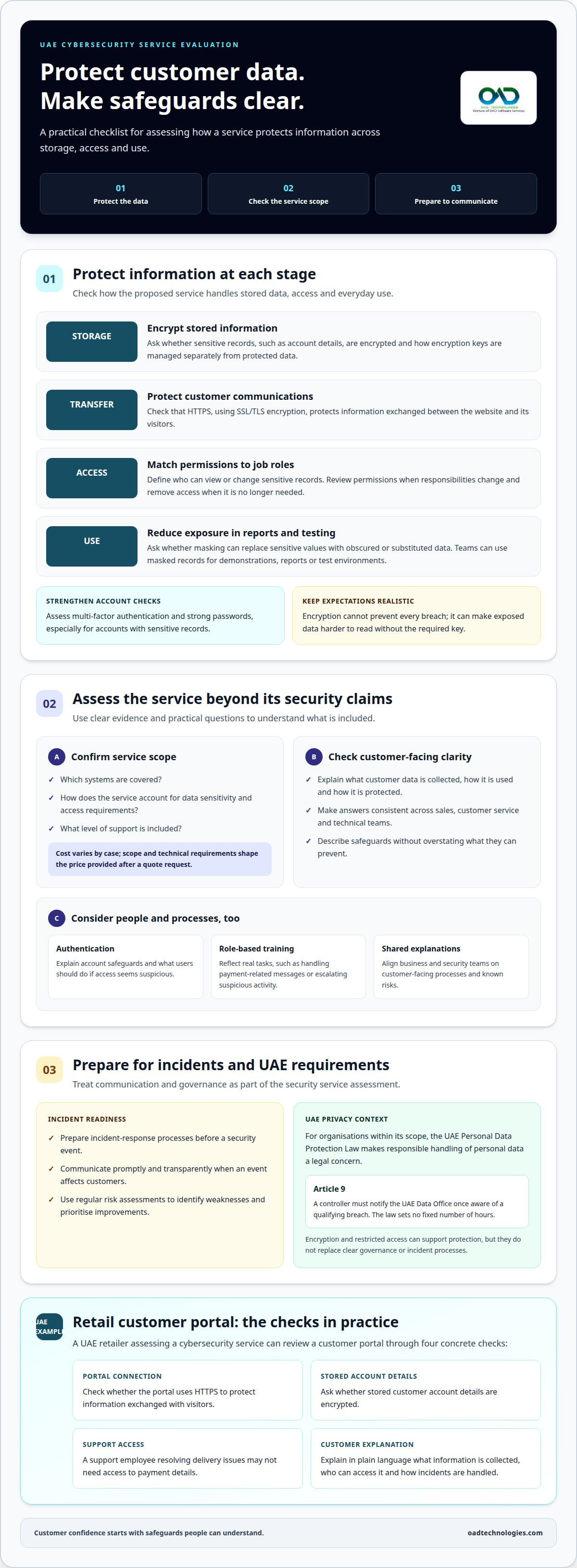
When evaluating cybersecurity services in the UAE, businesses should check how a provider will protect customer information across storage, access and use. Encryption makes data unreadable without the appropriate key. Access controls limit who can view or change it. Masking replaces sensitive values with obscured or substituted data, reducing exposure in reports, demonstrations and test environments. Ask how proposed services address these needs and fit existing business processes.
Discuss protection for both stored information and communications between customers and online services. HTTPS, which uses SSL/TLS encryption, helps protect information exchanged between a website and its visitors. For example, a UAE retailer assessing a cybersecurity service can check whether its customer portal uses HTTPS and whether stored account details are encrypted. Encryption cannot prevent every breach, but it can make exposed data harder to read without the required key.
When comparing service scope, ask how access rules will reflect job responsibilities, rather than convenience. Define which roles can access sensitive records, what each role can do and how long access remains active. A support employee resolving delivery issues, for example, may not need access to payment details. Multi-factor authentication and strong passwords add safeguards to accounts. Confirm how permissions are reviewed when responsibilities change and access is removed when no longer needed.
Assess whether the proposed service can support data masking for teams that need to use information without exposing customers’ original details. A development team testing a booking system, for instance, can work with masked records rather than real customer profiles. Keep original data available only to authorised roles, and manage encryption keys separately from the protected data. These requirements can help buyers judge whether a service reduces unnecessary exposure while allowing business processes to continue.
For small and medium-sized businesses in the UAE, cybersecurity costs depend on factors such as the systems covered, data sensitivity, access requirements and level of support. The cost varies by case; scope and technical requirements shape the price provided after a quote request.
Include data protection compliance in the evaluation. For organisations within its scope, the UAE Personal Data Protection Law makes responsible handling of personal data a legal concern. Encryption and restricted access can support protection, but they do not replace clear governance or incident processes.
A UAE clinic considering a cybersecurity service can assess how role-based access would separate reception tasks from access to clinical records, and how masking could protect patient details in training data. A layered cybersecurity programme can help connect these controls to privacy, operational needs and the organisation’s risk profile. Customer confidence grows when protective measures are applied consistently and explained in plain language.
How UAE/GCC buyers can assess security measures and customer trust
When evaluating a security service or supplier, UAE buyers need more than a security claim: they need clear information about how customer data is handled. Accessible policies, practical explanations and consistent governance make security measures easier to assess.
Business and security team collaboration
When implementing a security service, security specialists and business teams should agree on how customer-facing processes protect information. Sales, customer service and technical teams should give consistent explanations of data handling and known risks. For a UAE retailer evaluating a service, that could mean preparing a shared response to questions about account security and payment data. Coordination helps prevent conflicting answers and makes security commitments more credible.
Authentication and multifactor security
When comparing services, buyers can assess how authentication checks a person’s identity before granting access, and whether multifactor security requires proof beyond a password. A business can apply stronger authentication to administrator accounts and customer portals containing sensitive records. Clear explanations should tell users which safeguards protect their accounts and what to do if access seems suspicious. These measures help reduce unauthorised access without asking customers to interpret technical settings.
Employee training and security culture
When selecting or implementing a security service, buyers should consider how it supports employees in protecting customer information and acting on threats. Role-based training can show finance staff how to handle payment-related messages, while support teams practise escalating suspicious account activity. Managers should reinforce these actions with clear reporting routes and regular discussion. Training works best when it reflects real tasks rather than relying on a generic presentation.
Customer evaluation of cybersecurity
Customers assess a company’s cybersecurity through the evidence it shares: understandable privacy information, access safeguards, payment protections and a defined incident response. UAE buyers may also consider whether answers are consistent across sales, support and published policies. A clear explanation of data collection and use gives customers a practical basis for evaluating risk. Avoid broad claims; describe specific measures and their purpose.
For payment security, explain how checkout information is handled and which party processes it. PCI DSS is a standard associated with protecting payment card data; customers benefit when businesses describe relevant controls in plain language. Fraud prevention can also include monitoring unusual IP and device patterns. For example, a UAE online shop evaluating a security service could ask how it reviews suspicious checkout activity without expecting a promise that every fraudulent attempt will be stopped.
Maintaining transparency during implementation takes ongoing governance: keep security information current, coordinate updates across teams and make customer-facing explanations easy to find. To discuss how security measures can be communicated clearly, contact OAD Technologies.
Keep security documentation organised, clearly explained and accessible to buyers and customers. Give customers visibility into security measures so they can better understand how their data is managed.
Incident response and transparent communication
When evaluating incident response support in the UAE, organisations should consider how a provider will help limit disruption and support clear communication during a security incident. Customers need accurate updates, not speculation or silence.
Assessing customer communications
When choosing incident response support, consider how the service will help explain what personal data a business processes, why it uses it and how customers can raise concerns. Clear privacy notices and support guidance help customers understand the organisation’s practices. For example, a UAE property management company can explain how it uses residents’ contact details for building updates. Consistent answers from service and technical teams also help protect its reputation.
Planning incident communications
When implementing incident response support, agree how affected customers will receive timely, factual updates about a security event and its known impact. An incident response plan should assign responsibility for decision-making, technical investigation and customer communication. It should also guide teams in distinguishing confirmed facts from developing findings. Preparation helps prevent contradictory messages while the response team investigates and contains the incident.
Evaluating data protection transparency
When assessing incident response arrangements, consider how they support clear descriptions of safeguards and data-handling practices. Explain why data is collected, who can access it and how customers can raise a privacy concern. A UAE booking platform, for instance, could distinguish information needed to confirm a reservation from optional marketing preferences. This detail helps customers make informed choices and understand the business’s approach.
During an incident, the response service should help teams communicate what happened, which services or information may be affected and what actions are under way. Separate confirmed details from points still under investigation, then provide updates when material information changes. Avoid unsupported claims about the cause or assurances that no further risk exists. Clear explanations help customers make informed decisions, while vague or conflicting messages can deepen concern.
For personal data, the UAE Personal Data Protection Law provides a relevant transparency requirement. Its first data protection principle requires personal data processing to be transparent, and data subjects have a right to be informed about what happens with their personal data. Article 9 requires a controller to notify the UAE Data Office once aware of a qualifying breach; it sets no fixed number of hours. When selecting incident response support, check that communication plans account for these requirements.
Before engaging a provider, rehearse the response with its proposed service arrangements. A tabletop exercise can test how technical teams, leadership and customer-facing staff share information and approve updates. For a UAE online service, teams could practise responding to a suspected account compromise, from initial assessment to customer notification. Managed Detection and Response can support incident investigation and coordinated action, while clear communication remains essential to customer confidence.
UAE regulatory compliance and risk management
Customers assess compliance through evidence, consistent controls and clear accountability. ISO 27001 and SOC 2 are named security certifications; PCI DSS is a standard for payment data protection. UAE organisations should also identify applicable requirements, including CBUAE cybersecurity requirements for relevant financial organisations and ADHICS for relevant Abu Dhabi healthcare organisations.
UAE/GCC risk assessment and continuous monitoring
Risk assessment identifies important assets, likely threats and weaknesses, while continuous monitoring tracks changes that could alter exposure. Together, they help organisations prioritise controls as systems and business needs grow. A UAE retailer adding online payments, for example, should consider customer records, checkout processes and supplier access when reviewing its risks.
Risk management also needs an owner, a response plan and regular updates. Document each risk, its potential business impact, existing safeguards and the action required. Monitoring can then help detect changes, such as new access paths or unusual account activity. This evidence gives leadership a clearer basis for decisions and supports transparent discussions with customers.
UAE regulatory audits and risk mitigation
A cybersecurity audit examines whether controls are designed and operating as intended. It can reveal gaps between written policies and actual practice, helping teams assign remediation work. A thorough cybersecurity audit should take place at least once a year. Organisations can also reassess after significant changes, such as introducing a customer platform or changing how sensitive information is handled, and consider applicable UAE sector requirements.
Mitigation turns audit findings into accountable work. Rank issues by their impact on customer data and essential operations, then assign an owner and track progress. A UAE healthcare provider, for example, could prioritise weaknesses affecting access to patient information and assess them against ADHICS where applicable. Governance, risk and compliance processes can connect these findings with policies, responsibilities and evidence.
Cybersecurity certifications and UAE customer trust
Certifications can give buyers a structured way to assess an organisation’s security practices, but they don’t replace clear explanations or effective controls. ISO 27001 and SOC 2 can provide evidence for security reviews, while PCI DSS relates to protecting payment card data. Explain what a credential covers and how it relates to the customer’s information and services.
Requirements depend on the organisation, sector and data involved. A UAE business should map relevant obligations, including the UAE Personal Data Protection Law, to its data handling and governance practices. Financial or healthcare organisations may also need to consider CBUAE cybersecurity requirements or ADHICS, respectively, where applicable. A documented compliance assessment helps distinguish applicable obligations from controls adopted to manage other risks.
Leadership should connect risk decisions to the organisation’s purpose through clear cyber risk mission and vision statements. These statements guide investment and help teams explain to customers why particular safeguards matter. Insider risk also deserves attention: defined access, reporting routes and fair policies can help organisations identify concerns earlier while supporting employee trust. Compliance is more credible when people understand their responsibilities and can raise issues clearly.
Cybersecurity and customer trust
For UAE and GCC businesses evaluating cybersecurity services, customer trust is one factor to weigh alongside coverage, operational responsibilities and implementation requirements. Customers value protection for sensitive information, clear explanations and credible responses when an attack occurs. The practices that matter most are those customers can understand and see reflected in a company’s actions.
Customer priorities in cybersecurity practices
Customer priorities are the safeguards and behaviours that reduce risk to their information and make a company’s commitments credible. In a McKinsey consumer survey, 87% of respondents said they would not do business with a company if they had concerns about its security practices. For UAE and GCC decision-makers comparing security providers, this makes it important to assess how a service supports evidence of data protection, access governance and customer incident updates.
For a UAE online retailer evaluating a managed security service, this could mean confirming how the provider supports monitoring of customer accounts and what happens if suspicious activity appears. Customers should be able to find relevant security details without decoding technical language. A concise security page, aligned with privacy notices and support guidance, can help people understand the measures behind the service. Keep claims specific, current and consistent across customer touchpoints.
Cybersecurity as a basis for customer trust
Cybersecurity supports customer trust when an organisation’s safeguards and communication match its stated commitments. It cannot remove every risk, but consistent actions show customers that protecting their information is part of how the business operates. For UAE and GCC buyers, evaluating how a provider’s service supports these commitments can inform decisions about handling sensitive records or payments.
Trust also depends on what happens between incidents. When assessing a service, clarify ownership of security decisions, how relevant systems are monitored and how customers can raise concerns. For example, a UAE booking platform selecting a monitoring service can check how it will support account alerts and reports of activity customers do not recognise. This connects technical safeguards with a responsive customer experience.
Cybersecurity can also shape business decisions beyond the security team. UAE and GCC leaders evaluating security services can consider how providers support visible practices, such as reviewing access to sensitive information, tracking remediation and communicating relevant changes. This turns governance into actions customers and employees can recognise.
Customer confidence is tested when a company changes systems, adds a supplier or introduces a digital service. Before choosing an implementation approach, explain what changes mean for data handling, review risks before launch and align communication with actual controls. For instance, a UAE retailer adding a delivery partner can clarify what customer details the partner receives and why. Customers then have a clearer basis for deciding whether to continue sharing information.
Building customer trust through cybersecurity also requires linking each customer-facing promise to an operational measure and an accountable owner. When evaluating a security service, check how it supports promises such as monitoring for suspicious activity, with a defined process for reviewing alerts and responding. If a business promises transparency, its notices and support answers should describe the same practices. This alignment helps cybersecurity support lasting customer relationships.
OAD Technologies: Zero Trust Architecture
OAD Technologies helps organisations align security controls with how people, devices and systems access business data. Its Zero Trust Architecture can support organisations reviewing access across connected environments, particularly as services and teams evolve.
OAD Technologies also protects customer-facing communications with email security from its trusted partners Mimecast and Trustifi, guarding against phishing and impersonation that target customers and staff. Its 24 X 7 SIEM/SOC, with sub-15-minute response times, and Managed Detection and Response (MDR) built on CrowdStrike help detect and contain incidents quickly. Vulnerability Assessment and Penetration Testing (VAPT) assesses weaknesses, Data Loss Prevention (DLP) reduces sensitive information exposure, and backup and disaster recovery keep customer services available. OAD holds ISO 9001, ISO 14001, ISO 45001 and ISO/IEC 27001 certifications.
Explore Zero Trust Architecture as one way to strengthen access decisions and support a more consistent security posture.
Contact OAD Technologies to discuss your organisation’s cybersecurity needs.
Turn customer confidence into a lasting advantage
Customer confidence grows when security decisions keep pace with business change. Treat trust as an ongoing operational priority: review how new services, suppliers and data uses affect your security approach, then make relevant commitments clear to customers.
A durable approach to building customer trust through cybersecurity connects technical decisions with the experience customers receive. OAD Technologies supports this work through Data Loss Prevention (DLP), Vulnerability Assessment and Penetration Testing (VAPT), and Managed Detection and Response (MDR). These services can help address data exposure, assess weaknesses and respond to security threats.
The right next step depends on your organisation’s risks, systems and customer commitments. A focused discussion can help identify which security priorities need attention first.
Keep building trust through deliberate action, clear accountability and security decisions that support your organisation’s future.
Frequently Asked Questions
What should UAE businesses assess when selecting cybersecurity services to protect digital trust?
Assess how a service supports confidence in your digital services, data practices and online interactions. Customers consider privacy, security, integrity and whether an organisation acts responsibly, not just whether a website works. For example, a UAE customer using an online booking service needs confidence that it will handle account details appropriately and provide reliable information throughout the transaction.
How can businesses assess whether cybersecurity services will support customer trust?
Consider whether the service can help reduce the chance that customer information or digital services will be misused or disrupted. It should also give your organisation a basis for making clear commitments and following through consistently. For example, a company launching a customer app can assess its security before release, assign responsibility for reported weaknesses and explain how customers can flag suspicious activity. These practices make trust part of the service experience.
What should businesses ask cybersecurity providers about communicating security measures?
Ask how to describe specific measures, their purpose and their limits in plain language. Avoid absolute claims such as “completely secure”; instead, explain what a control is designed to do and how customers can report concerns. For instance, a UAE delivery platform might explain how it protects account access and handles security reports without promising to prevent every attack. Keep website statements, privacy notices and support responses aligned.
Which customer-trust risks should UAE/GCC buyers prioritise when selecting cybersecurity services?
Consider stolen credentials, phishing, exposed databases, weak supplier access and delayed or confusing incident responses. A compromised employee account, for example, could expose customer records even if the main platform remains available. Unclear data practices can also erode confidence without a technical breach. Organisations can reduce these risks by reviewing access, supplier connections and customer-facing processes as their services change.
Disclaimer
Content by OAD Technologies is for general informational purposes only and does not constitute professional or cybersecurity advice. No warranties are made regarding accuracy or completeness; reliance is at your own risk. OAD Technologies shall not be liable for any direct or indirect losses arising from use of this content.