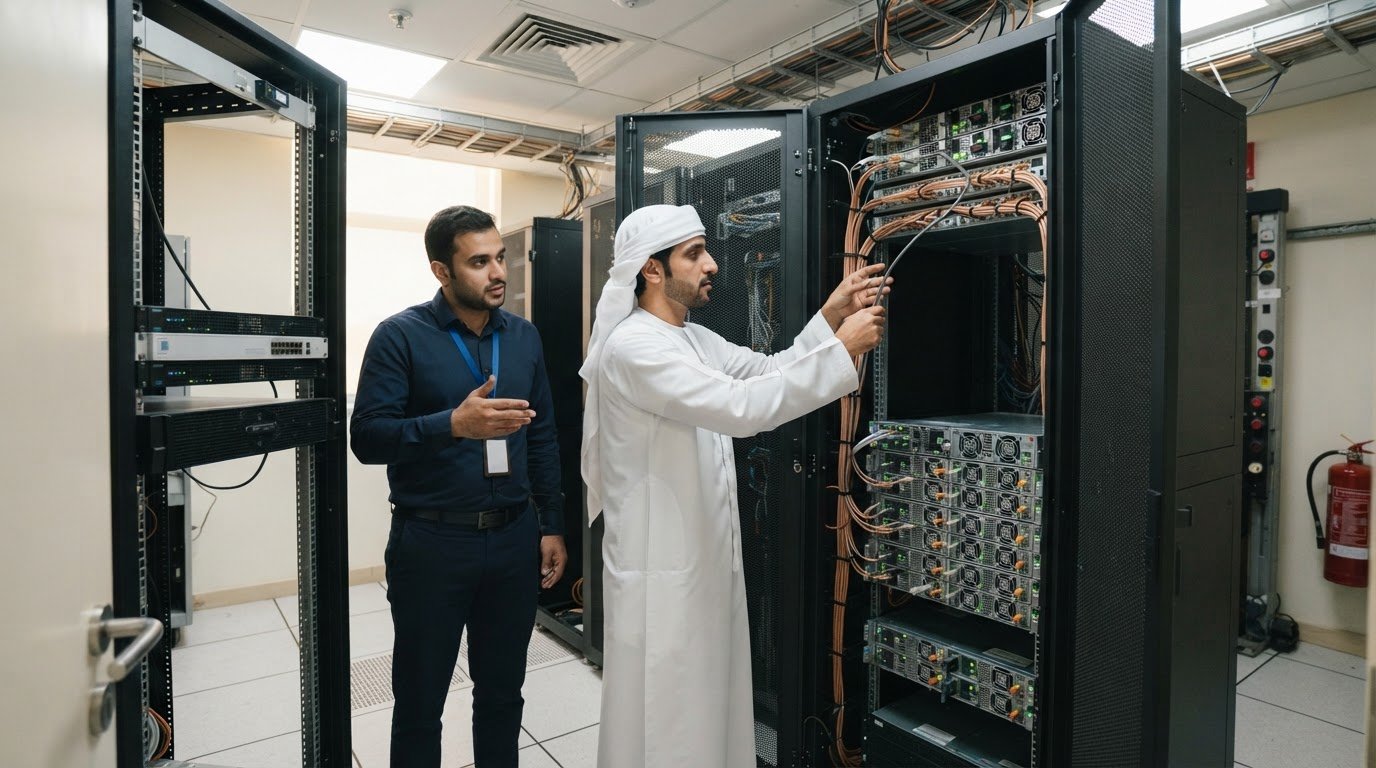
A breach should not have a clear path from one compromised device to an entire enterprise. When evaluating a network segmentation service, UAE organisations should assess how the provider will divide the network into zones and control traffic between them. The right scope and access rules can help contain incidents while supporting each zone’s purpose and sensitivity.
For example, a UAE organisation may need to separate a public-facing application from staff systems and sensitive business data. Buyers should consider whether proposed boundaries fit their environment and how implementation could affect legitimate work. Clear requirements can help compare service scope, fit and cost.
This article covers practical considerations for choosing a segmentation service, including grouping assets by sensitivity, reviewing network flows and applying least-privilege firewall rules. It also explains how traditional segmentation differs from micro-segmentation, helping you assess which approach may suit your organisation and discuss implementation with a provider such as OAD.
Key Takeaways
- When evaluating segmentation services, check how the proposed zones separate public-facing services, application processing and sensitive data.
- Assess how firewall rules will enforce least privilege, allowing only required traffic between specific systems and documenting each rule’s reason.
- Compare broader network zones for major boundaries with micro-segmentation for finer-grained controls around individual workloads or devices.
- Before choosing a provider, review its proposed rollout: mapping assets, dependencies and traffic, then reviewing policy changes before enforcement.
- For a UAE organisation, ask how the service would separate a public-facing service from staff systems and sensitive business data to help contain a compromise and protect critical information.
1. Assessing network segmentation for UAE operations
When assessing network segmentation for a UAE or GCC organisation, start by identifying which systems need separate controls and what business risks those boundaries should address. Routers, switches, VLANs and firewalls can separate traffic and restrict unauthorised connections. Define the required scope before comparing technical options, so the design fits the organisation’s systems and security needs rather than relying on a single perimeter.
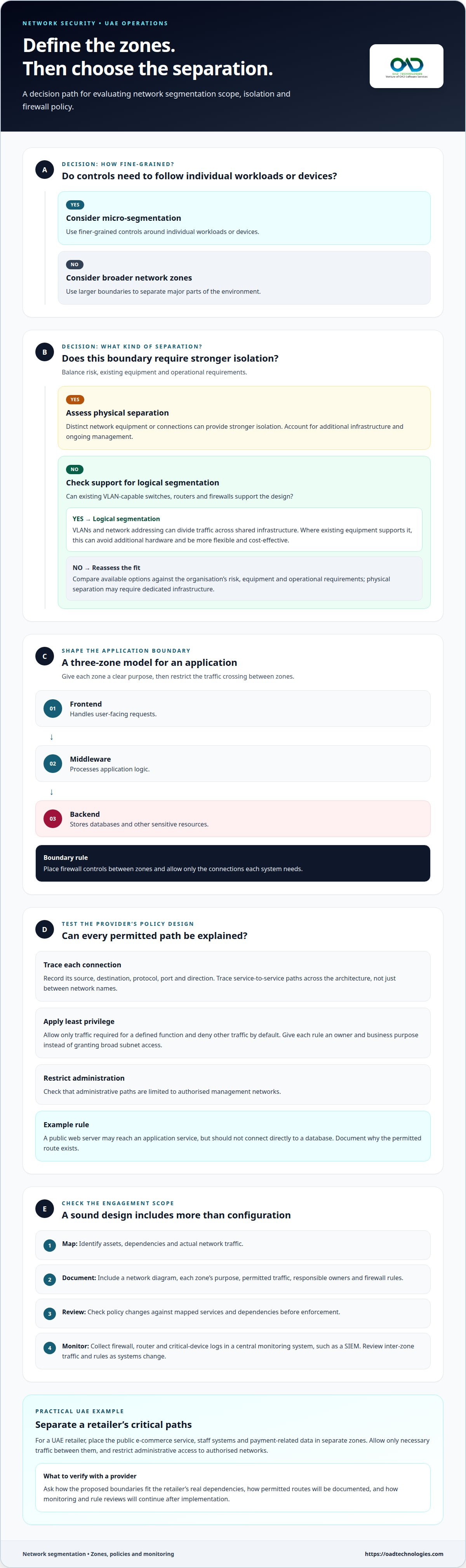
For an application, assess whether three security zones are appropriate: frontend, middleware and backend. The frontend handles user-facing requests, while middleware processes application logic. The backend stores databases and other sensitive resources. OWASP guidance recommends at least these three components for developed information systems. A firewall between zones can limit each connection to the systems and services it needs.
When comparing technical fit, consider logical segmentation using VLANs and network addressing across shared infrastructure, or physical segmentation using distinct network equipment or connections. Logical segmentation can avoid additional hardware, making it more flexible and cost-effective than physical separation. Physical separation can provide stronger isolation but requires additional infrastructure. The right choice depends on risk, existing equipment and operational requirements.
Assess whether existing VLAN-capable switches, routers, firewalls and network access controls can support the proposed design. Logical segmentation may cost less to deploy when existing equipment supports it. Physical separation can cost more because it may require dedicated hardware and ongoing management. Actual costs depend on equipment, licences, network complexity and support needs, so include these factors when comparing service scope and proposals.
Ask how the design will be documented in a network security policy. It should include a network diagram, each zone’s purpose, permitted traffic, responsible owners and firewall rules. For example, record why a public web server can reach an application service but cannot connect directly to a database. Clear documentation supports audits, troubleshooting and consistent rule changes.
Include monitoring in the proposed scope, not just the initial configuration. Collect firewall, router and critical-device logs in a central monitoring system, such as a Security Information and Event Management (SIEM) platform. Reviewing traffic between zones helps teams spot unexpected connections, investigate suspicious activity and identify rules that no longer match business needs.
For a UAE retailer, a public e-commerce service, staff systems and payment-related data can sit in separate zones. Allow only necessary traffic between them, and restrict administrative access to authorised networks. This can help contain suspicious activity and focus controls on sensitive data. When evaluating providers, consider how a network infrastructure security design can support growth without granting every new system broad access.
Segmentation can improve traffic flow, focus monitoring and reduce the systems exposed to a threat. It can also support security standards by helping organisations isolate sensitive environments and show how access is controlled. These benefits depend on accurate diagrams, regular rule reviews and boundaries that reflect real operational dependencies. Evaluate these ongoing requirements alongside technical fit and implementation costs.
2. Evaluating firewall policy services for interservice communication
When evaluating a segmentation or firewall-policy service, UAE and GCC organisations should check how the provider maps services, dependencies and required traffic into enforceable boundaries. Ask whether the assessment records each connection’s source, destination, protocol, port and direction. For example, a web application may need to reach an application service, while direct access to its database remains blocked. This makes each permitted route traceable to a business purpose.
A useful service should assess whether policies apply least privilege: allowing only connections needed for a defined function and denying other traffic by default. Check whether each rule has an owner and purpose rather than granting broad access between entire subnets. The review should also assess whether administrative paths are restricted to authorised management networks, limiting unnecessary routes that could enable unauthorised access or movement between systems.
Ask how the provider validates firewall boundaries against the actual architecture. A detailed diagram can help locate each firewall, identify services that communicate across boundaries and spot paths that could bypass controls. The assessment should trace a request from an external service through application components to a data store, showing every permitted transition, not just network names. Confirm how the diagram will be kept aligned with deployed services as systems change.
The National Institute of Standards and Technology lists NIST SP 800-41 Rev. 1, Guidelines on Firewalls and Firewall Policy as a reference for network segmentation and firewall policy. NIST SP 800-215, Guide to a Secure Enterprise Network Landscape, is also a reference for enterprise network design. UAE and GCC buyers can use these documents to inform service requirements, while ensuring proposed rules reflect their organisation’s services and operating architecture.
When comparing providers, check how they manage firewall and access control list (ACL) changes. The service should record the business need, affected systems, approver and review date for each rule. Ask whether proposed changes are compared with observed traffic and assessed for likely effects before implementation. Confirm how logs are reviewed afterwards for blocked legitimate connections or unexpected access, and how obsolete rules and permissions that no longer match service requirements are identified.
Review the service’s approach to combining documentation with traffic visibility. It should be able to forward logs from firewalls, routers, VPNs and critical devices to a central monitoring platform, so teams can connect specific rules to observed flows, investigate anomalies and identify overlapping permissions. Automated policy workflows can help make reviews consistent, but changes affecting critical services should have clear human approval.
When assessing a provider, ask how it coordinates access control, threat detection and mitigation across network controls to reduce conflicting decisions. Each enforcement point and rule owner should remain visible. A practical UAE example is to have a provider review one interservice path, compare its diagram with active rules, then document and test corrections. Discuss a firewall policy review when rule ownership or network boundaries need structured attention.
3. Network segmentation versus micro-segmentation
For UAE and GCC organisations assessing segmentation services, the first choice is how much control different systems need. Traditional network segmentation creates broad boundaries around groups of systems, departments or environments. VLANs and subnets organise network traffic and addressing, while firewalls filter traffic crossing defined boundaries. Micro-segmentation applies finer-grained access controls to individual workloads, applications or devices, including those on the same network segment.
The distinction affects how attacks can spread, and helps buyers assess where finer controls may be needed. A compromised device in a broad segment may reach other systems if internal traffic is unrestricted. Micro-segmentation creates smaller, isolated zones, or microperimeters, around specific assets and their required connections. If an application server is compromised, policies can restrict its lateral movement to explicitly permitted services.
Microperimeters follow workloads rather than relying only on fixed network locations. For example, a policy can allow a payment application to communicate with its designated database while blocking unrelated servers. As workloads move between data centres or cloud environments, controls can follow the application’s identity. When selecting a service, decision-makers can assess whether this approach complements existing network architecture rather than requiring every VLAN or firewall to be replaced.
Automation helps keep fine-grained policies aligned with changing systems. A deployment pipeline can apply approved access rules when a workload is created and remove them when it is retired. Automation can also help apply consistent controls across cloud and on-premises environments. Buyers should consider the asset labels and review processes needed to manage this: an incorrect label can reproduce an unsafe rule at scale.
Identity-based micro-segmentation uses attributes such as workload role, application identity or device status to inform access decisions. A policy might permit only an approved application service to reach a database, regardless of the server’s location. User identity can add another control layer, but it does not replace restrictions between machine-to-machine services. When comparing services, assess how identity and network context work together.
To compare approaches, consider how a service would segment users, devices, applications and data by sensitivity. Assets can be grouped by function and risk: guest devices kept separate from employee endpoints, and management interfaces isolated from ordinary user traffic. Applications and their data stores can sit in distinct policy groups, with only required service flows permitted. High-sensitivity data systems can be labelled so their controls remain distinct as infrastructure changes.
An organisation in the UAE could place visitor Wi-Fi in an internet-only microsegment, preventing access to corporate applications and internal services. A contractor’s managed device could receive narrowly scoped access to a required application rather than broad network access. Buyers can use these examples to assess whether a provider’s service can apply identity and device context beyond department-level boundaries.
Choose the level of detail according to operational risk and the team’s ability to manage policies. Broad segmentation establishes major boundaries; micro-segmentation provides precise controls where lateral movement would create greater exposure. When selecting a service, consider whether its controls can prioritise critical applications, sensitive data and high-risk connections first, since fine-grained rules everywhere can add complexity.
4. Choosing a UAE segmentation engagement
For UAE organisations considering a segmentation engagement, define the business scope before comparing providers. Identify the sites, cloud environments and critical services involved, then set the outcomes the project must support. This gives decision-makers a basis for assessing provider fit, operational impact and alignment with existing security investment.
When evaluating proposals, check how providers will review the current environment, business processes and security priorities. The scope should account for applications, devices, operating systems, cloud services and dependencies across business units. Ask how the provider will distinguish controls that can use existing infrastructure from those that may require new investment.
Compare how each proposal translates business priorities into design requirements. It should address which services need to communicate, which environments require separation and how access will be managed. For an organisation operating across multiple UAE sites, ask how the engagement will account for local connectivity, shared applications and differences in operational needs. These factors affect both the proposed sequence and the level of disruption.
Confirm that the provider can scope requirements across cloud, hybrid and IoT environments. Ask how proposed policies will reflect cloud workload functions and limit IoT access to required platforms. The proposal should also address remote access, including identity, device authorisation and permitted destinations, so buyers can assess whether the design matches day-to-day operations.
Review the proposed governance and service responsibilities before procurement. Clarify who approves policy changes, owns application dependencies and records exceptions. Ask how Zero Trust principles will guide access decisions without disrupting business workflows. Clear responsibilities help buyers compare the operational support included in each engagement.
Assess the rollout plan for business continuity. Look for sequencing by environment or application, review points before changes proceed, and coordination with affected service owners. The provider should explain how it will assess observed traffic, simulate selected policy changes and agree deployment windows. These details help buyers judge whether operational dependencies will be identified before controls are enforced broadly.
Agree acceptance criteria as part of the engagement scope. These might cover whether authorised services remain accessible, unapproved paths are restricted and monitoring can identify relevant events. Clear criteria give stakeholders a shared basis for reviewing outcomes and assessing the provider’s delivery.
Include ongoing maintenance in the procurement decision. Confirm who will review changes, handle exceptions and keep diagrams and policies aligned as applications and infrastructure evolve. For UAE decision-makers, this operational plan is part of the engagement scope, not an afterthought. It helps ensure the segmentation investment remains workable as the organisation changes.
5. Evaluating network segmentation for protected data
For UAE organisations evaluating network segmentation, the goal is to protect priority assets, not create zones for appearance alone. Start with an inventory of information, applications and devices. Label each asset by sensitivity, business purpose and the impact of exposure or unavailability. This helps administrators apply stricter controls where compromise could cause the greatest harm and gives implementation providers a clear basis for designing controls.
Group assets with similar protection needs, then separate systems that perform different functions. Keep endpoint, server, database, IoT or OT, and management networks distinct. For example, an employee laptop should not have unrestricted access to a database containing confidential records. When comparing implementation support, assess how providers will map these boundaries to business needs and document permitted connections.
Production environments also need separation from corporate networks. A phishing incident affecting office software should not provide a direct route to production systems. OT devices may have different operational requirements from IT services, so define their necessary connections carefully. Permit only traffic needed for control, maintenance or data exchange, and monitor those paths.
A hospital in the UAE offers a practical example. Patient-record systems, staff devices, guest Wi-Fi and connected medical equipment have different purposes and exposure risks. Separating these environments can limit unnecessary access between them. Healthcare buyers should assess whether proposed designs and implementation support address applicable requirements, including ADHICS. A guest device should reach the internet, not internal clinical applications; a medical device should communicate only with the services needed for its operation.
Segmentation also supports data protection by reducing where sensitive information can be accessed. Identify where information is stored, processed and transmitted, then apply access controls around those paths. A payment system, for instance, can sit in a restricted zone with only the required application connections. Fewer permitted routes make access easier to review and unexpected traffic easier to investigate. Buyers should confirm that implementation support covers these data flows and provides clear records for review.
Boundaries alone do not protect information copied through an authorised channel. Combine network controls with appropriate access management, endpoint protection and data safeguards. Monitor movement between zones and review logs for unusual access patterns. Centralised monitoring can help correlate firewall and device events, giving security teams useful context when investigating suspicious activity. When selecting support, ask how monitoring, handover and ongoing policy reviews will be addressed.
Keep the design useful as the organisation changes. When teams add software, devices or data flows, update asset labels and access policies as part of the change. Review whether each connection still serves a business need, and remove access that is no longer necessary. The goal is a clear map of protected assets, permitted paths and accountable owners, not maximum separation at any cost.
OAD Technologies: Network Security Solutions
OAD Technologies provides Network Security Solutions tailored to organisations’ infrastructure and security priorities. Consider this support when network zones need clearer controls, access paths require review or sensitive information needs stronger protection.
OAD designs segmentation as part of a Zero Trust architecture, so access between zones is granted per user, device and workload rather than by network location. For data moving across segmented environments, Data Loss Prevention (DLP) can help address risks involving sensitive information. Vulnerability Assessment and Penetration Testing (VAPT) can assess weaknesses in network controls, while OAD’s 24 X 7 SIEM/SOC, with sub-15-minute response times, and Managed Detection and Response (MDR) built on CrowdStrike monitor traffic crossing zone boundaries. OAD holds ISO 9001, ISO 14001, ISO 45001 and ISO/IEC 27001 certifications. These capabilities can complement segmentation by connecting access design with assessment and threat handling.
To discuss how segmentation priorities fit your environment, contact OAD Technologies.
Keep segmentation aligned with change
When evaluating ongoing segmentation support, assess how the provider will review access, ownership and monitoring as applications, devices and business processes change. Ask how significant changes will be assessed against operational needs, so security decisions stay relevant as infrastructure develops.
For UAE and GCC organisations, compare how providers support clear ownership and collaboration between IT, security and application teams. A documented decision process can help keep changes consistent while accounting for business needs. Consider whether the proposed support can clarify why connections exist and who should review them.
Where data protection, security testing or threat response needs to align with network boundaries, OAD Technologies provides Data Loss Prevention (DLP), Vulnerability Assessment and Penetration Testing (VAPT), and Managed Detection and Response (MDR). These capabilities can support an assessment of exposure and protection around sensitive environments.
Choose support that fits your environment and can adapt as it grows.
Frequently Asked Questions
What is network segmentation?
Network segmentation defines separate security boundaries within an organisation’s connected environment. Its value depends on whether those boundaries match the risks and responsibilities the organisation needs to manage. A useful design records which team owns each segment, the business function it supports and the information it protects. That context makes boundaries meaningful for governance, not just visible in a network diagram.
How does network segmentation work in practice?
Segmentation works by applying access decisions to communications that cross defined boundaries. Controls may sit in network infrastructure, cloud configurations or workload policies, depending on how an application is deployed. Change is an important consideration: moving a service or adding a dependency can alter which paths need protection. Treating these changes as security-impacting helps prevent a valid connection from becoming an unnoticed exposure.
How should UAE/GCC organisations evaluate network segmentation services?
When comparing providers, assess whether their proposed scope covers the organisation’s sites, cloud environments and critical workloads. Ask how they will document design decisions, test required business transactions and show that unapproved paths are rejected. Confirm who will own exceptions and how they will be reviewed. These criteria help procurement, IT and security teams compare proposals and judge whether the service can meet operational and governance needs.
Which security standards and regulations address network segmentation, including PCI DSS and UAE requirements?
PCI DSS recognises segmentation as a way to isolate cardholder data and help define assessment scope; it does not establish one universal network design for every organisation. UAE requirements depend on the organisation’s sector, systems and applicable controls. The UAE PDPL, CBUAE requirements, DESC ISR, ADHICS and UAE IA/NESA may be relevant in different contexts. Do not assume any named regime creates the same segmentation obligation for every entity.
How can organisations test and monitor network segmentation effectiveness?
Test both permitted and prohibited paths, including less obvious routes such as cloud peering, secondary interfaces and IPv6 where used. Confirm that monitoring records the relevant source, destination and enforcement decision, so investigators can distinguish a blocked attempt from an allowed flow. Repeat these checks after material routing or cloud configuration changes. A controlled VAPT assessment can provide additional evidence about whether boundaries behave as intended.
What should buyers compare when selecting network segmentation services?
Compare providers on their experience with environments similar to yours, the clarity of their proposed scope and the evidence they provide to support acceptance. Ask how they handle existing network dependencies, service availability and exceptions, and how responsibilities are divided between the provider and your team. Review the proposed testing and monitoring approach, including how changes will be assessed. This helps buyers weigh operational fit and ongoing effort alongside the initial service proposal.
Disclaimer
Content by OAD Technologies is for general informational purposes only and does not constitute professional or cybersecurity advice. No warranties are made regarding accuracy or completeness; reliance is at your own risk. OAD Technologies shall not be liable for any direct or indirect losses arising from use of this content.