
A vulnerability report is useful to the board when it explains what could be disrupted, what the exposure means for the business and what action is under way. Knowing how to explain security vulnerabilities to the board means translating technical severity into consequences for critical services, revenue, customers and compliance, not simply presenting a list of findings. Technical detail still matters, but it needs clear business context.
Boards also need to understand how compliance status relates to risk. A control gap may indicate a governance issue, while compliant status alone does not show whether a critical system remains exposed. This article explains how to connect vulnerabilities to business impact, report risk alongside compliance, and describe ownership, remediation progress and remaining exposure. It also covers likely questions from directors, helping security leaders present a concise, evidence-led account that supports informed decisions in the UAE.
Key Takeaways
- When evaluating VAPT services in the UAE, check that findings identify affected business services, critical assets and potential revenue impact.
- Ask providers to report compliance status alongside risk and remediation progress; compliance alone does not show whether important systems remain exposed.
- For major vulnerabilities, confirm the service makes exposure, response ownership, actions taken and remaining risk clear to decision-makers.
- Check that findings address the UAE regulatory and governance requirements relevant to your organisation, and show how remediation supports them.
- Before implementation, agree how the provider will explain business impact, response decisions, recovery readiness and any support or resources needed next.
Evaluating vulnerabilities and cyber threats in business terms
For UAE organisations evaluating vulnerability assessment and penetration testing (VAPT), board members need to know which business service a weakness could affect and what disruption may follow. Assess providers on their ability to explain exposure through operational consequences, not technical terminology alone.
Translating technical weaknesses into business risk
A vulnerability becomes a business risk when an attacker could exploit a weakness in a system that supports an important service. When choosing a VAPT service, assess whether its reporting helps directors understand priorities, ownership and resource needs without requiring them to interpret technical detail.
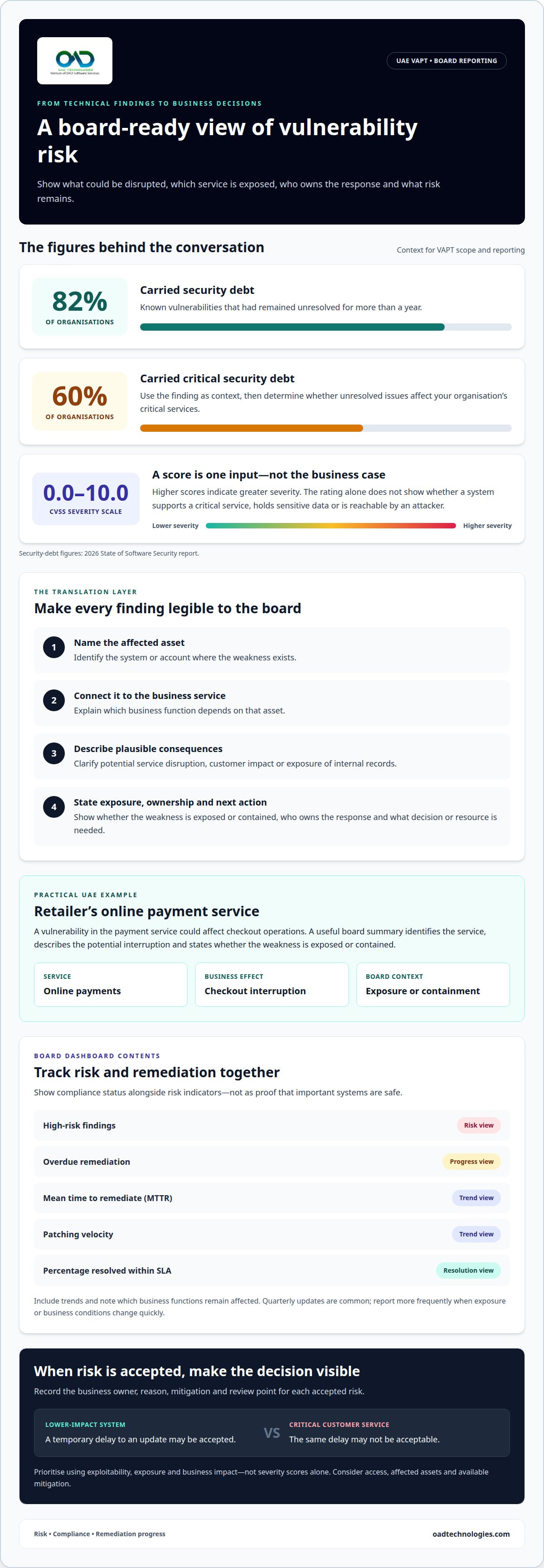
Ask providers to build findings around the affected asset, the service it supports and the plausible consequence. For example, a flaw in an online booking system could interrupt customer transactions, while a weakness in a staff account could expose internal records. A useful report names the system and business function, then describes the potential effect.
Use the Common Vulnerability Scoring System (CVSS) as one input, not the full business case. Its severity ratings run from 0.0 to 10.0, with higher scores indicating greater severity. A score doesn’t show whether the affected system supports a critical service, holds sensitive data or can be reached by an attacker. When assessing VAPT proposals, check that providers explain these conditions alongside the rating.
In a UAE example, a vulnerability in a retailer’s online payment service could affect checkout operations. A board summary should identify the service, describe the potential interruption, and state whether the weakness is exposed or contained. When comparing VAPT providers, look for findings that connect technical exposure to business continuity, rather than simply listing technical issues.
Business impacts of breaches and unresolved vulnerabilities
A breach is a security incident that compromises systems or information. An unresolved vulnerability is an unremediated weakness that may create an attack path. For UAE buyers selecting VAPT, reporting on both can help show how weaknesses may disrupt services, affect customer confidence and consume response resources.
Criticality depends on context. A severe flaw in an isolated test environment may present less immediate business risk than a lower-scored weakness in a system supporting customer transactions. Ask providers to explain differences in access, exposure, affected assets and available mitigation. This gives directors a clearer basis for weighing remediation against operational constraints.
Many organisations carry security debt: known vulnerabilities that remain unresolved for long periods. When evaluating VAPT scope and reporting, establish how long your own findings have stayed open and whether they affect critical services.
For a decision-ready summary, require the report to name the affected service, describe the plausible impact and identify the action or decision needed. This helps the board discuss business priorities and risk ownership effectively.
What should a board-level VAPT report include?
A useful board report on a Vulnerability Assessment and Penetration Testing (VAPT) service brings risk, compliance status and remediation progress into one decision-ready view. Quarterly updates are common, with more frequent reporting when exposure or business conditions change quickly. For UAE and GCC buyers, agree reporting needs before selecting a provider.
Risk appetite and acceptable cyber risk
Cyber risk appetite is the level and type of exposure an organisation is prepared to accept while pursuing its objectives. Agreeing on it helps directors distinguish a managed exception from a risk that requires immediate action, and helps define the scope and priorities of a VAPT engagement.
For example, a UAE organisation might accept a temporary delay to a low-impact system update, but not the same delay for a critical customer service. Record the business owner, reason, mitigation and review point for each accepted risk. Use these decisions to guide VAPT scoping and give the board a basis for revisiting priorities when conditions change.
VAPT risk summaries and dashboards
A VAPT dashboard groups findings by business service, severity, owner and remediation status. It gives directors an overview of whether testing and remediation are reducing exposure without turning the meeting into a technical activity log.
Show compliance status alongside risk indicators rather than treating compliance as proof that systems are safe. A board summary can cover high-risk findings, overdue remediation, mean time to remediate (MTTR), patching velocity and the percentage resolved within SLA. Include trends and note which business functions remain affected. Consistent quarterly reporting helps the board compare progress between meetings and assess whether the VAPT service is meeting its objectives.
VAPT finding prioritisation and remediation decisions
Prioritisation ranks VAPT findings by exploitability, exposure and business impact, not severity scores alone. This helps executives direct patches and mitigation towards the systems most likely to disrupt important services, and assess whether the provider’s recommendations fit operational needs.
For each critical or high-risk finding, report whether attackers can reach the affected system, what service it supports, and what mitigation is available. Boards should oversee remediation timelines and documented risk acceptance, including the accountable owner and review point. Fixing a critical vulnerability within 24 hours can serve as an example remediation target, not a universal deadline. Where a patch would disrupt operations, explain the interim controls and the decision needed.
VAPT investment costs and risk
To compare VAPT costs with cybersecurity investment, weigh the proposed spend against potential business impact and available mitigation. This lets the board assess the service’s scope and value without relying on a speculative loss estimate.
Present the affected service, exposure, remediation options and operational trade-offs together. For example, compare the effort required to apply patches with the consequences of leaving an internet-facing customer service exposed. Explain how each option changes residual risk, then identify the investment decision or accepted exposure required. This makes the case for VAPT spending clearer than presenting a security cost without business context.
For organisations evaluating VAPT reporting and remediation priorities, discuss your cybersecurity requirements with OAD Technologies.
Explaining major vulnerabilities and response actions
For a zero-day vulnerability or active exploitation, brief the board on affected systems, exposure, containment, remediation ownership and the next update. Separate confirmed incidents from potential exposure so directors can distinguish what has happened from what could happen.
Use a scenario to make the response concrete: a flaw in an internet-facing service may let an attacker reach systems before a patch is available. Explain which business functions rely on that service, what evidence indicates exploitation and which controls reduce access or limit impact. Directors need the decision and its implications, not a stream of technical alerts.
Log4Shell provides a clear example of why major vulnerabilities demand coordinated attention. The vulnerability was highly publicised in late 2021 and affected a very wide range of products that relied on the Apache Log4j library. A board briefing on a comparable event should state how the organisation identifies affected assets, checks exposure, applies patches or mitigations, and tracks systems still awaiting action.
Make response ownership explicit. One person should lead the response to a critical vulnerability and any resulting major cyber security incident. That owner coordinates technical teams, business functions and suppliers, then reports decisions, blockers and remaining exposure. Clear accountability helps teams work towards shared priorities and gives directors a point of contact.
Critical-vulnerability work can continue for many weeks or months, particularly when remediation depends on suppliers or complex systems. Keep the board informed about progress, unresolved dependencies and interim controls. Trusted cyber security advice can guide patching or mitigation as soon as possible, while system owners confirm that changes don’t disrupt essential operations.
Detection and monitoring help establish whether a vulnerability has led to an attack. Explain which signals teams are watching, which systems are covered and how an alert informs an incident decision. For example, unexpected access to a vulnerable service may prompt investigation, containment and evidence preservation. Distinguish an attempted attack from a confirmed compromise.
Boards should also understand what happens after containment. Regularly test business continuity and incident response plans to assess whether teams can respond and recover. A UAE organisation operating a customer-facing service, for example, can use an exercise to examine who approves service isolation, how customers are supported, and which suppliers must assist.
Close each update with the next response milestone, the accountable owner and any board decision required. If a patch is unavailable, explain the mitigation in place and the conditions that would trigger escalation. This makes incident reporting part of ongoing response governance, rather than a retrospective account of technical activity.
Evaluating VAPT findings against governance and regulatory requirements
When evaluating a vulnerability assessment and penetration testing (VAPT) service, consider whether its findings can be linked to controls, accountable owners and governance decisions. In the UAE, distinguish technical exposure from a regulatory reporting obligation.
Map findings to applicable requirements
For each finding, record the affected system, relevant control, evidence, remediation owner and funding route. This helps directors assess the value of remediation beyond technical severity. For example, a weakness affecting a financial service may need to be mapped to applicable CBUAE requirements; a healthcare organisation can assess relevant ADHICS controls. Organisations can also consider UAE IA/NESA requirements or DESC ISR where applicable to their operations.
Use the organisation’s actual regulatory scope when setting VAPT requirements, rather than treating every standard as universally applicable. The board summary should identify the applicable regime, the affected control and whether the finding creates a gap, weakens evidence or needs further assessment.
Connect compliance status to exposure
Compliance status and vulnerability risk answer different questions. A control may be documented and operating while a newly identified weakness still creates exposure in a particular system. When reviewing VAPT results, report both: the applicable requirement and control status, followed by the affected asset, business impact, remediation action and remaining risk.
Certification or alignment evidence should also be presented with its scope. ISO 27001 is an information security management standard; it does not replace organisation-specific analysis of affected systems. A board can review the relevant scope, identified exceptions and how VAPT findings feed into corrective actions. A compliance risk management approach can help connect findings with governance obligations and remediation decisions.
Disclosure and reporting in the UAE
Vulnerability disclosure and breach notification are separate processes. Organisations can provide a named technical contact and consider a vulnerability disclosure programme and security.txt file, giving researchers acting in good faith a route to report weaknesses.
For personal data, Article 9 of the UAE PDPL requires a controller to notify the UAE Data Office once aware of a qualifying breach; the law sets no fixed number of hours. A VAPT finding alone is not the same as a qualifying breach, so board reporting should distinguish suspected exposure, confirmed compromise and notification decisions.
Directors should understand who owns each decision, what evidence supports it and which requirements apply. A useful governance record links each finding to the affected system, relevant control, response owner and basis for any regulatory reporting decision. This helps the board track VAPT remediation without confusing certification, compliance status and operational security.
Selecting vulnerability assessment and penetration testing services in the UAE
When evaluating vulnerability assessment and penetration testing (VAPT) services, UAE organisations should compare the provider’s scope, reporting and remediation support. Identify the business services and systems to assess, and agree how findings will help decision-makers understand exposure and prioritise action.
Ask providers how they will assess high-risk exposure and communicate findings during an engagement. Agree the reporting schedule and how the provider will show what has changed, such as newly identified issues, completed remediation or a shift in residual risk.
Compare service scope and reporting
Before selecting a provider, confirm that its proposed scope covers the relevant assets and business impact, and that reports identify findings, response owners and recommended next actions. Ask how the provider will distinguish confirmed observations from issues that require further investigation. For UAE organisations, consider whether the assessment needs to align with applicable requirements, such as UAE IA or NESA.
Compare how providers measure remediation progress. Mean time to remediate, patching velocity, vulnerabilities resolved within SLA and changes in high-risk findings can reveal progress and bottlenecks. Ask how each measure will be explained in business terms. For example, slower patching on a customer-facing service may require an operational decision, not just a technical explanation.
Assess provider and supply-chain exposure
When evaluating a VAPT provider, ask how it assesses its own security controls, handles vulnerability reports and communicates relevant incidents. Ask whether independent third parties assess its security controls and practices. Establish whether the provider retains or uses organisational data after the service ends, and how that arrangement affects exposure.
For cloud software in scope, include data residency when the organisation must keep information within a specific region. For example, an organisation assessing a board portal can ask where its board papers are stored and who can access them. Review recovery time objectives (RTOs) and recovery point objectives (RPOs) when assessing backup and disaster recovery. These answers help decision-makers understand supplier dependencies, not just vulnerabilities in one application.
Plan implementation and remediation
Before engaging a provider, agree which service and systems will be assessed, how findings will be reported and what resources or approval are required for remediation. If a vendor must provide a patch, clarify the dependency, interim controls and escalation route. For a potential data breach, distinguish a vulnerability finding from evidence of actual access or compromise.
A practical UAE example is a company assessing a cloud software flaw that could affect access to internal board documents. The VAPT scope can identify affected accounts, the vendor’s response, relevant access restrictions and the next decision point. Decision-makers can then assess the business exposure and supplier response together.
Consistent reporting helps organisations compare risk and remediation progress between assessments. Vulnerability assessment and penetration testing can provide structured findings to support these decisions.
OAD Technologies
For UAE organisations considering Vulnerability Assessment and Penetration Testing (VAPT), the buying decision starts with defining which systems, data and business services to assess. Clear scope helps connect vulnerability findings with business risk, remediation priorities and the evidence needed for board discussions.
When evaluating a VAPT engagement, consider whether its findings will help you understand exposure, track remediation progress and inform incident readiness. Managed Detection and Response (MDR) built on CrowdStrike, OAD’s 24 X 7 SIEM/SOC with sub-15-minute response times, Zero Trust access and Data Loss Prevention (DLP) may also be relevant where detection, response or sensitive information risks are in scope. OAD holds ISO 9001, ISO 14001, ISO 45001 and ISO/IEC 27001 certifications.
To discuss the right scope and capabilities for your UAE organisation, contact OAD Technologies.
Evaluate managed SOC and MDR for UAE operations
Use your next reporting cycle to assess whether a managed SOC or MDR service could support ongoing vulnerability governance. Compare how providers handle updates between scheduled meetings, clarify who owns decisions and confirm how your team will see whether accepted risks remain appropriate.
When evaluating providers, ask how their service accounts for your systems, supplier exposure and the operational trade-offs behind remediation. For example, a UAE-based organisation can assess whether a provider’s monitoring and reporting give leaders the information they need to review security priorities as systems and threats change.
OAD Technologies can support organisations seeking clearer technical assessments and stronger detection and response capabilities. A discussion can focus on your organisation’s systems, governance needs and the information leaders need to make sound decisions.
Compare service scope, reporting and ownership to decide whether managed detection and response can turn security insight into sustained, informed action.
Frequently asked questions
What should a UAE organisation expect in a VAPT compliance report?
Look for compliance status alongside the specific exposure each control does and does not address. For each relevant control, the report should identify its owner, supporting evidence, any exception and the affected system. In a UAE report, distinguish an internal control gap from a confirmed personal data breach. This helps decision-makers see whether the findings call for remediation, a governance review or consideration of a separate reporting obligation.
What should a VAPT provider assess, and how should findings be explained?
A VAPT provider assesses weaknesses in software, configuration or access that an attacker may use to compromise a system. Testing can include sending crafted input to an exposed application or assessing the risk of compromised credentials against an account with excessive permissions. For example, an unpatched business application might provide an entry point to the data it handles. Ask providers to explain whether that path is usable in context, including exposure and surrounding controls.
Which metrics should buyers use to evaluate VAPT remediation?
Use metrics that show both progress and coverage. Alongside remediation speed, ask how many assessed assets have an identified owner, how many findings have passed retesting and which exceptions remain open. Define each measure consistently across reporting periods. A rising closure count, for example, is less meaningful if the number of assessed systems has also changed or fixes have not been validated.
What should UAE decision-makers ask a VAPT provider before engagement?
Ask which business services will be assessed, what evidence will support findings and what decisions or resources may be needed. Clarify who owns the response, whether suppliers are involved and what conditions would trigger escalation. If a vendor controls the required software update, for example, ask how the assessment will account for exposure while that dependency remains unresolved.
How should VAPT findings be presented to the board?
Ask the provider to explain each priority finding through its business service, plausible consequence and current management decision. A useful explanation could use a short scenario: a weakness affects a payroll application, access is restricted and the team is validating a fix. The report should separate confirmed facts from assumptions, then state what directors need to approve or monitor.
Which VAPT metrics should be included in board reporting?
Choose a compact set of measures that reflects exposure, control performance and response capability. Useful measures can include affected critical services, unresolved risk exceptions, findings awaiting validation and incidents linked to known weaknesses. Ask for the scope and trend for each. A figure without its asset coverage or definition can mislead, especially when systems or reporting methods change.
How should buyers compare VAPT severity ratings with business impact?
Assess severity alongside system exposure, business dependency and plausible disruption. To discuss financial impact without presenting an unsupported estimate, identify cost categories: service interruption, investigation, recovery effort and potential contractual consequences. For a UAE online service, explain which customer operations could pause and what recovery depends on. Keep scenario estimates separate from recorded losses, and state the assumptions behind each.
What should a VAPT report template include for board review?
A practical template can use one row per priority finding, with these fields: vulnerability or identifier; affected service and owner; severity and exposure; business consequence; applicable control or requirement; response status; target or accepted-risk decision; evidence of validation; and next board decision. Add a short executive note on changes since the last report. Keep technical evidence in an appendix for directors who need more detail.
Disclaimer
Content by OAD Technologies is for general informational purposes only and does not constitute professional or cybersecurity advice. No warranties are made regarding accuracy or completeness; reliance is at your own risk. OAD Technologies shall not be liable for any direct or indirect losses arising from use of this content.